Home Blog Page 154

Springfield Prodigy: Best Affordable 2011? [Hands-On Review]

0

THE PRODIGY IS NO LONGER JUST A ’90S EDM BAND, AND 2011S JUST GOT MORE AFFORDABLE

It’s somewhat ironic that the eight years since STI’s patent expired on their hi-cap 2011 design have been the company’s most profitable, due in no small part to their rebranding as Staccato and making a serious play for the LE market by marketing raceguns to cops.

That business success has attracted others to the field, the latest being Springfield Armory, which aims to bring their manufacturing and marketing horsepower to the platform.

As one of the U.S.’s biggest 1911 vendors, Springfield’s decision to add a widebody option to the stable was an obvious one, but getting 2011s to run reliably seems for whatever reason to be more difficult than their single-stack brethren; this problem is exacerbated in calibers that don’t start with a .4.

We got hands-on with a couple of their preproduction models to see if they can pull it off.

LIFTING THE HOOD

Coming to market in early fall with two base models, a Government and Commander version, Springfield is giving the consumer just enough choices to make things interesting while hinting at what’s to come. Both guns ship with two magazines, a 17-round flush-fit, and an extended 20-rounder that complies with the USPSA 140mm limit, and both are ready for optics right out of the box.

You can have any color you want, so long as it’s polished DLC. Grip texture is aggressive enough to provide stiction, but won’t wear out your skin or shirt, should you choose to carry it.

To appeal to the maximum number of users, a system of optics mounting plates will accommodate most MRDS footprints, while preserving iron sights as a backup. Our test guns shipped with a Trijicon RMR on the 5-inch barreled version and one of Springfield’s Hex Dragonfly red dots on the 4.25.

This shares a mounting pattern with Burris and Vortex, so fans of those sights are already taken care of, and we’re told a Leupold-pattern plate will be available shortly.

Both mounting plates are beveled to blend the MRDS body into the slide rather than leave an unsightly overhang, and old-school users are taken care of with fixed front and rear, suppressor-height iron sights, and the front sporting a green fiber optic.

BUIS height appears to have been chosen so that even with red dots with a thick LED housing, such as the RMR, there’s just enough rear sight notch visible over the red dot to be useful without resorting to stratospherically tall irons.

The arse-end of the slide below your chosen sighting device is resolutely old-school and conforms to the Series 70 pattern, with thankfully no trace of a firing pin safety to mess up the classic 1911 trigger pull.

A standard extractor is fitted and correctly tensioned, while the firing pin stop is radiused appropriately for 9mm loads. On both guns, the ejection port is lowered and beveled — no voodoo here, just well-established 1911 gunsmithing.

Government size Prodigy

Forward cocking serrations mimic ones at the slide’s rear, and the usual ball cuts are almost completely absent, save for a vestigial notch that lines up with the almost full-length dust cover. This adds a noticeable amount of mass to the muzzle, which may or may not be your cup of Earl Grey, but there’s no denying the Prodigy’s slide-to-frame fit, which is as tight as many custom guns.

Both slide and frame rails are very well machined, with a silky-smooth action.

1911 purists will turn up their noses at the full-length, two-piece guide rod that’s retained by a reverse recoil spring plug, but they probably didn’t make it this far into the gun anyway, having been turned off by the lack of a “cause they don’t make a 46” caliber and polymer grip.

Their loss. Should anyone want to return to Browning’s original recoil spring design, there’s a slot in the slide to accept a barrel bushing, though this is probably to reduce the number of slide SKUs on hand, rather than an indication of future design intent.

Commander-sized Prodigy features a scaled-down frame with one Pic rail slot, so full-sized WMLs won’t fit. Note ridge at bottom of grip for future extended magwell.

The Prodigy’s barrel is massive, stainless, conventionally rifled with a 16 twist, and Nowlin ramped. One of the first tests we do on 1911s before hitting the range is check barrel to slide lockup, as without hand-fitting, it’s tough to ensure proper engagement between the barrel lug’s camming surface and the slide stop.

Some factories cheat by relying on the barrel link to push the barrel into battery, which works for a few hundred rounds but will eventually shoot loose, leading to sloppy lockup and vertical stringing on target. After hand-cycling the slide a few dozen times, we field stripped the pistols and found even wear on the slide stop across its mating surface, indicating that the barrel feet were making contact where they should.

Turning attention to the frame, controls are what you’d expect of a single-action handgun designed to span both competition and defensive roles. Ambi thumb safeties have zero play between the left and right levers, snicking into engagement with a positive click.

While the magazine release is slightly extended over a stock 1911, you’ll still have to rotate the gun in your hand to reach it, unless you wear a glove bigger than XXL, as the grip is slightly fatter than Browning’s original. That said, it’s nowhere near unmanageable, unless you think a G17 is unwieldy — the grip circumference is identical.

Using the same two-piece construction as an STI/Staccato/SVI means different grip modules can be added to the frame, should you get bored with the standard polymer lower. We have no idea if a steel 2011 grip will bolt straight up, as there’s considerable variation between existing frames in the marketplace, which may require the end user or their ’smith to be handy with a file. But if it does, SVI, Limcat, Cheely, Phoenix Trinity etc. will be happy to add about 7 ounces to the overall weight, while subtracting 600 bucks from your bank balance.

That said, it’ll probably be a while before you’ll want to swap anything, as all the usual modifications we typically do to a stock frame after it leaves the factory are already included — there’s a double undercut on the trigger guard, a soft-but-grippy stipple job and a perfectly executed, functional beavertail safety. Hinting at future accessories, there’s a rail at the grip’s lower edge, which is no doubt designed to secure a magwell in conjunction with the mainspring housing pin.

Compared to an older STI frame we had on hand, the Prodigy’s is approximately 2mm thicker through the dust cover area, adding non-reciprocating mass and burying the slide release, which is inlet into a machined pocket. This makes it slightly harder to engage for administrative handling but doesn’t affect the shooter’s ability to hit on a

reload with either the master or non-dominant thumb. In case you were wondering, the Commander-sized upper fits on the 5-inch frame, despite its 3/8-inch shorter recoil stroke, leaving room for a compensator should someone be so inclined. And we’d be surprised if a factory carry comp version weren’t high up on the agenda.

ROUNDS DOWNRANGE

Bottom line up front — yeah, they can shoot.

Once we made a slight adjustment to the red dot and dialed its brightness all the way down, standing unsupported at 50 yards, the Commander version turned in a 2.25-inch, five-shot group with 130PF reloads consisting of Montana Gold 121-grain JHPs over WSF powder.

We’ve shot pistol-caliber carbines that struggle to get that kind of accuracy, so for a 4.25-inch barreled handgun to achieve it in the first 20 rounds of a range session is an indication of its potential. In the next 300 rounds, we replicated that performance numerous times.

The 5-inch Prodigy didn’t quite achieve the same accuracy as its little brother with the ammo we had available, but it’s one of the softest-shooting handguns we’ve ever encountered, aided no doubt by the amount of heft in the hand.

With a little time to tune ammo to the gun, we’re pretty sure it would turn in similar groups, but deadlines limit the amount of tinkering we’re able to do.

We’d be interested to see what a steel grip frame does to further damp out recoil, because adding a SureFire X300U keeps the front end down during rapid fire.

Slide velocity is noticeably slower than the Commander version — you can feel the pistol pick up a round from the magazine if you concentrate hard — but we couldn’t outrun it no matter how hard we tried during Bill drills.

Are these handguns we’d take right out of the box and stick in a holster for daily carry? Hell no, but then we’d hesitate to do that with a Glock or SIG as well. The difference is that we’d expect the striker-fired guns to run 100 percent during a brief familiarization and break-in period, while the 1911-pattern pistols might stutter. And so it was.

We had two failures to feed in the short gun, both with hollow points, and both on the penultimate round from a magazine. These occurred during the first range session, after which it ran without a glitch, but we’d want to shoot a case of ammo through both Prodigy models before pronouncing them fit for duty — it’s just the nature of tight-fitting 1911s.

If you want the awesome trigger, shoot-the-balls-off-a-gnat accuracy, and overall shootabilty, then you’ll have to put in the time to gain confidence in the system.

Double-stack 1911s aren’t beginners’ guns. For anyone starting out, we continue to recommend a good striker-fired, polymer-framed service pistol of whatever flavor you like best. But when you’re ready for an upgrade, Springfield have made the cost of entry to the 2011 world much more affordable, and once you’ve shot them, you probably won’t want to shoot anything else.

SPECS

Springfield Armory Prodigy

  • Caliber: 9mm Para
  • Capacity: 17; 20 rounds
  • Barrel Length: 5; 4.25 inches
  • Overall Length: 8.5; 7.8 inches
  • Weight: 37; 33.3 ounces
  • MSRP: $1,499 without optic; $1,699 with Hex Dragonfly

What You Need to Know About Whitetail Home Ranges

0

I walked into the fertilizer company’s office just in time to hear the radio crackle, “Bernie, are you there yet?”

I was showing up for work just after daylight that mid-November morning in 1989, and my boss was already asking for me on the radio. But when I answered, the call took on a whole new meaning.

“I’m by the slough on the southeast end of Paul Johnson’s home place. GET DOWN HERE NOW!”

Jerry was also my bowhunting buddy, and I knew what the call meant. It’s illegal to share hunting information over the radio, but I could tell by the urgency in his voice that this call wasn’t exactly work-related.

Jerry often showed up for work late at that time of year because he spent a couple hours each morning glassing the surrounding farmland for bucks that had pushed does out into the open fields. This morning, he needed help — and I was happy to oblige.

Ten minutes later I skidded to a stop next to his vehicle on the gravel road. With our windows down, he excitedly related what had prompted his radio call.

A “huge,” “giant,” “monster,” “unbelievable” buck had seen Jerry’s truck top the hill and had dived into tall cattails and willows, disappearing into the 1-acre slough. The buck was still in there, and Jerry was going in after him. My boss would give me a few minutes to work around and choose an escape route to cover in case anything went wrong with his stalk.

Taking note of the wind direction and assuming the buck would try to sneak out with the wind in his nose, 10 minutes later I was covering a deer trail on the opposite side of the small patch of cover. Jerry began creeping in. Arrow nocked, release on the string, I was ready. I still hadn’t seen the buck, but Jerry and I had hunted a lot of these northern Iowa bucks in similar situations, and I could tell by his wide-eye description of the deer that this wasn’t just another 150.

Moments later, I heard Jerry yell. I stood up just in time to see the buck escape the far side of the cover and run across the field. I got a good, long look at him as he ran through the CRP field and over the crest of a hill. And what I saw defied description.

To this day, the sight of that buck is etched in my memory. In 45 years of bowhunting, I’ve never seen anything else like him. His rack was twice as wide as his butt. It reached for the sky, and my first thought was that he had a rocking chair on his head. Stickers and kickers and drop tines: this buck had it all.

Despite spending the remainder of that day and many hours over the following weeks and even years trying to locate the buck, we never saw him again. We never heard of him being killed. We never even heard of anyone else around there having seen him.

So, to our knowledge he was never killed. When we’d look at replicas of world- and state-record bucks, including the giant 282-inch Raveling buck at the Iowa Deer Classic, Jerry and I would just shake our heads and sigh.

Where did that giant we saw come from? Where did he go? How does a world-class buck just appear out of nowhere — and then disappear just as mysteriously?

An Old Theory Revisited

In 1993, Tom Miranda and I teamed up to write a book called Corn Fed Giants. In it, we offered a lot of information for the farmland whitetail hunter. Among the topics I wrote about in the book is a phenomenon I’ve not seen in print anywhere else.

I wrote of my belief that once an outsized, genetically superior buck gets big and strong enough to beat up every other buck he contacts, he just goes wherever he wants during the rut. He breeds does as he pleases, traveling far and wide if need be in that quest. He might follow long-running travel corridors for miles and miles. Then, when the rut is over, he might return to his original range — or, he might settle down right where he is, in the best available habitat.

When I announced that theory over 20 years ago, researchers’ ability to track wild bucks’ movements wasn’t what it is today. Now, with GPS collars, a lot more has been learned about travel patterns and home ranges. Even so, I don’t believe there’s been any research to back up my theory.

In fact, most research has shown bucks tend to reduce their home ranges they mature, particularly after passing peak breeding age. But I’m not totally ready to give up on trying to explain the issue of bucks that appear and disappear like ghosts.

One thing we’ve learned is that bucks are individuals with their own “personalities.” And to my knowledge, no one has put a tracking collar on a wild, world-class buck in Midwest farmland habitat. I’ve seen too many situations in which a huge buck just showed up on a camera, never seen before and then never shot or even seen again. Nor is either of his shed antlers found. It’s as if he simply appeared out of thin air . . . and then vanished in the same fashion.

What does this mean to the hunter who wants to know more about the home ranges and travel patterns of mature whitetails? And furthermore, is there information out there to help us improve our odds of bringing such deer home with us?

Defining Home Range

Every deer hunter has heard the term “home range.” It’s usually associated with a number of acres or square miles. The numbers vary greatly by terrain, habitat quality, food availability and time of year.

Home ranges of whitetail bucks in excellent habitat with plenty of food available can be quite small. GPS studies in prime areas of Louisiana, Pennsylvania and Maryland have shown home ranges averaging from 269 to 559 acres; not even as much as a square mile (640 acres).

Often a square mile is used as a baseline for a buck’s home range in good habitat, though there are clearly many places in which that figure is way off. A GPS tracking study in Texas showed an average home range of 2,271 acres. Availability of food and proximity to cover make all the difference.

In many parts of the West, in fact, whitetails routinely make treks of 2-3 miles between preferred bedding areas in timbered hills to feed on alfalfa in the lowlands. The deer make that long-distance hike each way daily. It’s hard to put a number of acres on a home range when deer are taking such long strolls.

Putting a number of acres or square miles on a home range is deceiving, because it almost implies the area is something of a circle or square. In reality, a home range might be a section of winding river bottom two miles long by 300 yards wide. It might include a couple areas where the deer move upstream on a small tributary, which further makes putting a number on it difficult. The shape of a deer’s home range is dictated by habitat, not by acres.

It can be a mistake to get caught up in home ranges when targeting a particular deer. Trail cameras can help you get a feel for where the buck is spending the majority of his time and when he’s there, but trying to determine the boundaries of his preferred area can be futile.

Bucks will go wherever they need to go to get food and water daily, and they’ll certainly roam during the rut. Home ranges are very fluid and dynamic.

Core Areas

While an overall home range might be pretty nebulous, a core area isn’t. The Quality Deer Management Association defines a core area as “The portion of a buck’s home range where he spends 50 percent of his time.” Core areas are all about security and comfort. While a buck might range widely to find food and water, he’ll often come back to the same small area in which he feels secure.

These core areas can change due to weather and food availability. If a food source completely runs out, and there’s suitable bedding cover near a new food source, the buck might pack up and move.

Bucks also tend to bed in the thickest, nastiest cover during bad weather, though they tend to select areas with some visibility during pleasant weather. A buck might use three or four core areas during the course of any given year.

On average, mature bucks tend to have smaller core areas than younger bucks. The 2 1/2-year-olds travel widely, having ranges much larger than even 3 1/2-year-olds.

Many bucks 5 1/2 or older have tiny core areas in which they’ve learned they can feel secure. These deer are big enough to take over the best of the best bits of security cover from other bucks if they so desire.

Excursions

The ability to track bucks’ exact whereabouts with GPS technology has opened a whole new world of information about their habits. One of the things learned through these studies is that bucks, especially mature bucks, take off on what biologists have termed “excursions” a few times per year. The GPS collars have shown these to be anywhere from one to four miles from the core area.

These trips often last around three days. It’s no stretch, considering the individuality of bucks, to suggest some are far longer. The “stranger” that just showed up on your camera might be on just such an excursion.

While the rut is one time in which bucks make excursions, it isn’t the only one. Spring also is “vacation time” for many bucks. In a GPS study done in Pennsylvania by the University of Georgia’s Andy Olson, all 19 collared bucks went on spring excursions.

It’s not fully known what triggers such forays, but some likely are the result of nutritional needs as antlers are beginning to grow. This also is the time when many bucks approaching their first birthdays are traveling around, looking for adult home ranges of their own.

Fall excursions might be related to rutting behavior or even hunting pressure. The collared bucks in these studies were quick to go entirely nocturnal when they felt hunting pressure or other human intrusion. Pressure even can cause bucks to leave their home ranges altogether for long periods of time.

Secondary Ranges

Following buck movements by GPS makes it clear most bucks have a backup plan: a secondary home range they’ll move to as needed. This is evidenced by the fact they tend to go directly to new areas and spend a lot of time there, indicating prior knowledge of those places.

I have no way of proving this, but I theorize these secondary ranges are often bucks’ natal areas. A buck spends the first year of life in his mother’s home range, learning it intimately. It stands to reason that if an adult buck is making a beeline to an area he knows well, it’s possibly one he learned as a fawn.

I suppose the only real way to prove or disprove my theory would be to put a GPS collar on a wild buck fawn and track him over several years. To my knowledge, this hasn’t yet been done.

In Conclusion

Keep in mind that only a relatively small number of wild bucks have been collared and tracked for lengthy periods. This leaves us with very general tendencies and few specifics.

Again, bucks are individuals; they often have remarkably different habits and personalities. Add to that the fact no truly giant wild bucks have been collared. They might behave quite differently from run-of-the-mill bucks.

I’ve resigned myself to never knowing where that giant non-typical Jerry and I saw in 1989 came from or went. I’m sure he wasn’t shot by legal means, or we’d have heard. He probably just died an “old man,” as many smart bucks do. But GPS tracking studies continue to offer new insights into whitetail movements and ranges.

Maybe one day a world-class nomad like him will be collared and we’ll all get a look into the secretive lives of such giants. No doubt it would be revealing.

Walleye Jigs For Epic Walleye Fishing

0

Walleye fishing is a popular and enjoyable activity for anglers across the world. One of the most effective techniques for catching walleye is using jigs.

Walleye jigs are specially designed lures that mimic the natural movements of prey fish, which walleye typically feed on. They are available in various shapes, sizes, and colors, and each has its unique features that make it effective in certain fishing conditions.

Whether you are a seasoned angler or a beginner, understanding the different types of jigs, how to choose the right one, and how to use them can significantly increase your chances of a successful catch.

In this article, we will cover everything you need to know about walleye jigs, including the different types, factors to consider when choosing them, tips for using them, and the best ones to use in different water conditions.

Types of Walleye Jigs

Walleye jigs come in various shapes, sizes, and styles, and each has its unique characteristics that make it effective in certain fishing conditions. Here are some of the most popular types of walleye jigs:

Roundhead Walleye Jigs

Roundhead jigs are the most common type of walleye jig. They have a round head and a single hook and are available in various sizes and weights. They are versatile and can be used in a wide range of fishing conditions.

Standup Walleye Jigs

Standup jigs have a flat-bottomed head and a vertical line tie that causes them to stand upright on the bottom. They are effective in rocky areas and can also be used in weeds.

Weedless Walleye Jigs

Weedless jigs are designed to be fished in weedy areas without getting caught up in the vegetation. They have a hook that is recessed in the jig’s body, making it difficult for weeds to snag it.

Swimbait Walleye Jigs

Swimbait jigs are similar to roundhead jigs but have a longer shank and a wider gap hook. They are used with soft plastic swimbaits and are effective when fishing in deeper water.

Bucktail Walleye Jigs

Bucktail jigs are made with a hair or feather skirt and are effective in clear water. They mimic the movements of baitfish and are best used with a slow retrieve.

Factors to Consider When Choosing a Walleye Jig

Choosing the right walleye jig is essential for a successful fishing trip. Here are some factors to consider when selecting a walleye jig:

  1. Water Depth The depth of the water you’re fishing in is an important consideration when choosing a jig. Roundhead jigs are effective in shallow water, while standup jigs work best in deeper water. Swimbait jigs and blade baits are ideal for fishing in depths of 20 feet or more.
  2. Water Clarity The clarity of the water also plays a crucial role in jig selection. In clear water, use jigs with natural colors and avoid using ones with bright colors that might spook the fish. In murky water, use jigs with bright colors that stand out and attract the fish.
  3. Time of Day and Season The time of day and season can also affect the effectiveness of the jig. During early mornings and late afternoons, use jigs with brighter colors to increase visibility. In the winter, when the water is colder, use smaller jigs with slower retrieves.
  4. Structure of the Lake The structure of the lake, such as rocks, weeds, and drop-offs, can influence jig selection. Use weedless jigs when fishing in weedy areas to avoid getting snagged, and use standup jigs when fishing in rocky areas to prevent snagging.

Consider these factors when selecting a walleye jig, and you’ll be well on your way to hooking into some big ones.

Tips for Using Walleye Jigs

Using walleye jigs can be a highly effective way to catch fish, but it’s important to use them correctly. Here are some tips for using walleye jigs:

  1. Cast and Retrieve Technique One of the most common ways to use a jig is with the cast and retrieve technique. Cast the jig out and let it sink to the bottom, then retrieve it with short, quick jerks to make the jig bounce off the bottom. Vary the speed and depth of your retrieve until you find what works best.
  2. Jigging Technique Jigging is a popular technique for catching walleye with jigs. Let the jig sink to the bottom and then use a sharp upward motion of the rod tip to lift the jig off the bottom, then let it sink back down. Repeat this motion, varying the speed and intensity of the jigging until you get a bite.
  3. Drift Technique Drifting is an excellent technique for covering a large area of water quickly. Simply drift with the wind or current, casting the jig out periodically and allowing it to sink to the bottom.
  4. Vertical Jigging Technique Vertical jigging is an effective technique for fishing in deep water. Position your boat over the desired spot and drop the jig straight down, letting it fall to the bottom. Then, use an upward motion of the rod tip to lift the jig off the bottom and repeat the motion until you get a bite.

By using these techniques, you’ll be able to catch walleye with jigs more effectively. Don’t be afraid to experiment with different techniques until you find what works best for you.

Best Walleye Jigs to Use

Selecting the right jig can make all the difference in your walleye fishing success. Here are some recommendations for the best walleye jigs to use:

  1. Northland Fishing Tackle Fire-Ball Jig: The Fire-Ball Jig is a versatile and effective jig that is designed to imitate the movements of baitfish. It has a short-shank hook that allows you to thread on a live minnow or soft plastic bait. It’s available in various colors and sizes and is ideal for fishing in shallow to mid-depth water.
  2. Rapala Jigging Rap: The Jigging Rap is a popular jigging lure that features a balanced design and a center treble hook. It mimics the movement of a dying baitfish and is effective in both shallow and deep water. It’s available in various sizes and colors.
  3. VMC Neon Moon Eye Jig: The Neon Moon Eye Jig is a versatile jig that features a unique 3D holographic eye and a super sharp hook. It’s available in various sizes and colors and is ideal for fishing in clear water.
  4. B-Fish-N Tackle H2O Precision Jigs: The H2O Precision Jig is a high-quality jig that features a custom-designed head and a super sharp hook. It’s ideal for fishing in weeds and can be used with live bait or soft plastics. It’s available in various sizes and colors.
  5. Keitech Tungsten Super Round Jig Head: The Super Round Jig Head is a weedless jig that features a tungsten head and a screw-lock bait keeper. It’s available in various sizes and is ideal for fishing in weedy areas.

These are just a few of the best walleye jigs to use. When selecting a jig, consider the water conditions and factors outlined in section III, and choose a jig that best fits your needs. Remember to experiment with different jigs and techniques until you find what works best for you.

Conclusion

Fishing for walleye with jigs can be a thriling and rewarding experience, but it takes knowledge and skill to be successful. By understanding the different types of walleye jigs, the factors to consider when choosing them, and the tips for using them effectively, you’ll significantly increase your chances of catching more fish.

Remember to select a jig that best fits your needs based on the water conditions and factors outlined in this article. Finally, don’t be afraid to experiment with different jigs and techniques until you find what works best for you. With the right knowledge, skills, and equipment, you’ll be well on your way to reeling in the big ones and enjoying epic fishing adventures.

For 25 years Green Bay Trophy Fishing has guided and provided helpful information to anglers in and around Door County. We are some of the most experienced fishing guides in Green Bay and pride ourselves on being experts on everything related to fishing in the area.

If you are interested in booking a walleye fishing charter, you can view our rates or contact us here.

Where to Find Pheasants

0
Where to Find Pheasants
Pheasants flushed from cover outside corn can often be taken by hunters standing just inside the edge of the cornfield.

If a rooster pheasant were one of Batman’s archenemies, he’d be the Joker. The common denominator of both bird and Bad Guy? Neither of them plays fair, especially Mister Ringneck.

So how do you pin down such a slippery character? Well, for starters, you find out where he lives. Where he spends his time. And why he’s there. Next, you research his weaknesses — those habits than make him less than perfectly elusive. And finally, you develop tactics to exploit those weaknesses, using his shortcomings to your advantage.

Pheasants flushed from cover outside corn can often be taken by hunters standing just inside the edge of the cornfield.

It’s October, so let’s look closely at two of the ringneck’s preferred early season haunts — corn and cattails — and how best to attack this pair of perennial favorites.

CORN

In many areas where corn is planted as a large-scale crop, 95 percent or more of it will still be standing come the first week of October. And standing corn offers, at best, terrible hunting conditions.

Why? First, modern agricultural practices ensure little to no row-to-row cover in today’s 21st Century cornfields. No foxtail. No goldenrod. No reed canary grass. Just dirt sidewalks devoid of any weeds. Yields are maximized, but that doesn’t do much for pheasants and pheasant hunters.

Roosters do love standing corn, mainly for the overhead protection it provides; but again, overhead protection does little for the human predator. Second, standing corn is almost impossible for one or two hunters to work effectively. It’s noisy, and because it’s “clean” of weedy plants it allows pheasants to see us long before we see them.

Meanwhile, it can be difficult for hunting dogs and hunters to keep track of each other in standing corn. And finally, and with little exception, few farmers are going to grant permission to six guys asking to bulldoze through his corn. It’s simple economics there.

That’s the bad news about pheasants, October, and standing corn. The good news is corn is still an asset to the pheasant hunter; however, his approach to the crop needs to focus not on the crop itself, but whatever might be around it — that is, the more “huntable” cover immediately adjacent to it.

Even the largest cornfield has an edge, and as simple as it sounds, that’s where you want to focus your efforts. This will be a bit more challenging than merely walking through knee-high brome grass with standing corn off your left shoulder, and tagging a three-bird limit of roosters. Successfully hunting the edges along standing corn requires some strategy. And that means both tactics designed for you and, if you have one, your bird dog.

Gunning roosters along standing corn involves first understanding two variables — where, and when. Typically, pheasants won’t roost or spend the night in modern cornfields for the simple fact there’s no cover there. They will roost in adjoining cover, and will typically, as morning progresses, migrate toward the edge between corn and cover. Here, they have everything they need — the corn’s nearby overhead cover, bare dirt with grit, the ability to see predators, access to seeds and insects, and some 360-degree protection in the adjacent heavy grass.

What this means to the pheasant hunter is a return to the concept of strategy. If you hunt with a dog — ours were Labrador retrievers, both pointing and non-pointers — absolute control and obedience is paramount now. Pheasants are notoriously skittish; a dog that doesn’t stay extremely close, one that doesn’t obey non-verbal direction (i.e., low-volume whistle commands), won’t necessarily flush birds wild, but will send birds scurrying into the protection of the standing corn, where they will be almost impossible to roust.

The key here is to let the dogs hunt — let them to do their job — but keep them close and always under control.

Second, be quiet. Stealth certainly does play a role in successfully hunting standing corn. Quiet means no shouted commands to the dog. No yelling “Over here! Over here! Seeing anything!!??” back and forth to your hunting partner or partners.

No slamming car doors, shotgun actions, or thinking you can silently slip down to the end of the field between cornrows three and four. Pheasants, like the majority of wild game birds, can hear extremely well. And once they hear you, it’s off to the races — and they run faster than you can.

Finally, keep your numbers small and have a plan. Unless you’re in a group of 15 guns or more — which, granted, can at times be effective, albeit quite the logistical undertaking — a pair of hunters is plenty to work corn edges.

As for a plan, we’ll assume two guns here. Typically, rousted roosters will try to fly toward cover that is heavier than where they were originally flushed. Knowing this, one gun walks quietly at the edge of the standing corn; the second, and the one with the well-mannered and close-working dog, exacts a slow zigzag pattern parallel to and perhaps 30 to 50 yards off the shoulder of the first.

Ideally, birds that don’t go straight away from the man/dog team will make a beeline for the standing corn, and that’s where the silent solo gun waits. One-man pushes can also be tried. Ideally, the man/dog duo works into the wind toward a corner of the standing corn where an earlier quietly positioned hunter stands.

Pheasant Hunting Spoils

One last trick to try while hunting standing corn. Everywhere Daylight Savings Time takes effect in late October, dusk comes earlier in the day. And approaching dark means time for birds to come out of the corn where they’ve spent the day and head for overnight cover.

As close to the end of legal shooting time as possible watch for cockbirds that fly out of the corn, and mark their landing accurately. A quick but quiet approach just might put you into position for a flush and shot.

CATTAILS

Cattails are another phenomenal pheasant cover; however, like standing corn, they’re not without their challenges. One of the most significant is the water commonly associated with cattails. Pheasants don’t like to be wet. And second, cattails are tough enough to hunt when dry; add the water element, and cattails become almost impossible to work efficiently.

That said, pheasants love cattails for the protection they provide, so to ignore the cover is to ignore a good number of birds.

But how to hunt this impenetrable mass of vegetation? You could wait until the water freezes. This makes the cover much more accessible to both hunter and hunted; however, this is in many places a late-season tactic.

In the early season cattails still present a couple of different strategic options. Hunting the edges, as one does with standing corn, is one; the other is to search out those sections of marsh that are still dry following summer’s heat. As mentioned, pheasants dearly love these thick hideouts, and will pull out all the stops when it comes to self-preservation — running and burrowing into the mats, either before or after taking flight.

Cattails lend themselves perfectly to big, strong dogs. Our Labs liked nothing more than rooting roosters out of right-of-way stands of cattails. Still, such dogs need to be controlled and close-working — qualities which are often not a problem, thanks to the twisted web of broad-leafed marsh vegetation.

October, November, or January. Standing corn or cattail marsh. The calendar or the cover mean little to ringneck pheasants, who practice the art of evasion 365 days each year, and who will use either type of cover to full advantage. A quiet, stealthy, and well-thought plan of attack, however, can swing the odds a bit more in the hunter’s favor once opening day rolls ’round.

30 Carbine vs 223: A Carbine Bullet Battle

0

30 Carbine vs 223 ammo comparison

The 30 Carbine and 223 Remington are two centerfire rifle rounds that both served the U.S. military in major overseas conflicts. Although the 30 Carbine and 223 Rem represent cartridges from two different eras, both have seen varying levels of success in the civilian market.

The 30 Carbine was introduced during WWII and served through the Korean War while the 223 Remington was introduced in Vietnam and remains the primary frontline cartridge for all branches of the American military to this day.

Although the 223 Remington fires a lighter bullet than the 30 Carbine, the 223 is superior to the 30 in all ballistic categories and is a perfect example of the advancements in rifle cartridge technology during the 20th Century.

In this article, we will evaluate the 30 Carbine vs.223 to help you understand the differences between the two and give you a clearer understanding of which cartridge is best for your shooting and big game hunting needs.

What is the difference between the 30 Carbine and the 223?

The difference between 30 Carbine vs 223 Remington is that the 30 Carbine round fires a heavier 30-caliber bullet while the 223 Rem fires a lighter 0.224” diameter bullet. Furthermore, the 223 is a more powerful modern bottle-necked cartridge while the 30 Carbine is less powerful and utilizes an older slightly tapered straight-wall cartridge design.

A Note on Nomenclature

Please note that within this article we will refer to the 223 Remington (223 Rem) and the 5.56x45mm NATO round interchangeably. There are differences between the two and you can read about them in this article: .223 vs 5.56

In short, a 223 Rem can safely be fired from a rifle or handgun chambered in 5.56, however the opposite is not true.

Cartridge Specs

When evaluating centerfire cartridges, it’s a good idea to analyze the cartridge specs to gain more knowledge of each.

30 Carbine vs 223 dimension chart

Prior to America’s entrance into WWII, the U.S. Army wanted to provide support and mortar crews with a cartridge that was “more than a handgun but less than a rifle”. For these crews, carrying the heavier M1 Garand was inconvenient but they wanted more range and stopping power than the Thompson submachine gun or M1911 handgun chambered in 45 ACP could offer.

The resulting rifle was the M1 Carbine, which is essentially a scaled-down version of the M1 Garand and converted to use 15 or 30 round magazines. The 30 Carbine round was developed by necking down the 32 Winchester Self-Loading cartridge to fire a 0.308” diameter, 110 grain full metal jacket (FMJ) bullet.

The project was deemed a success and the M1 Carbine firing the 30 Carbine round was released in 1942 and served all branches of the U.S. military during WWII through the Korean War.

In contrast, development of the 223 Remington began in 1957 and the final design was submitted by Remington Arms to the Sporting Arms and Ammunition Manufacturers’ Institute (SAAMI) in 1962.

The development of the 223 Remington cartridge was a joint operation organized by the U.S. Continental Army Command between Fairchild Industries, Remington Arms, and Eugene Stoner of Armalite, using the 222 Remington as a parent cartridge.

The 223 Remington was chambered in the military’s new M16 assault rifle and later M4 Carbine and remains one of the most popular civilian cartridges chambered in the AR-15 semi-automatic sporting rifle.

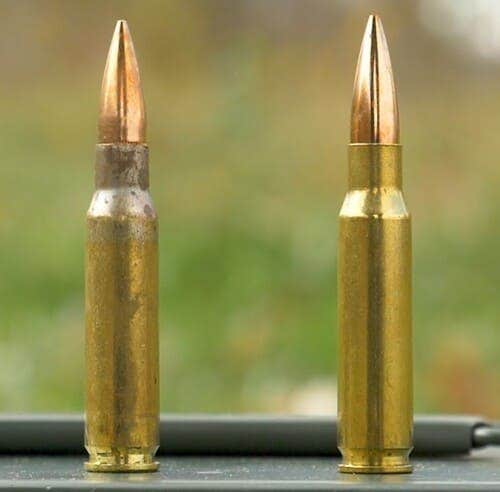
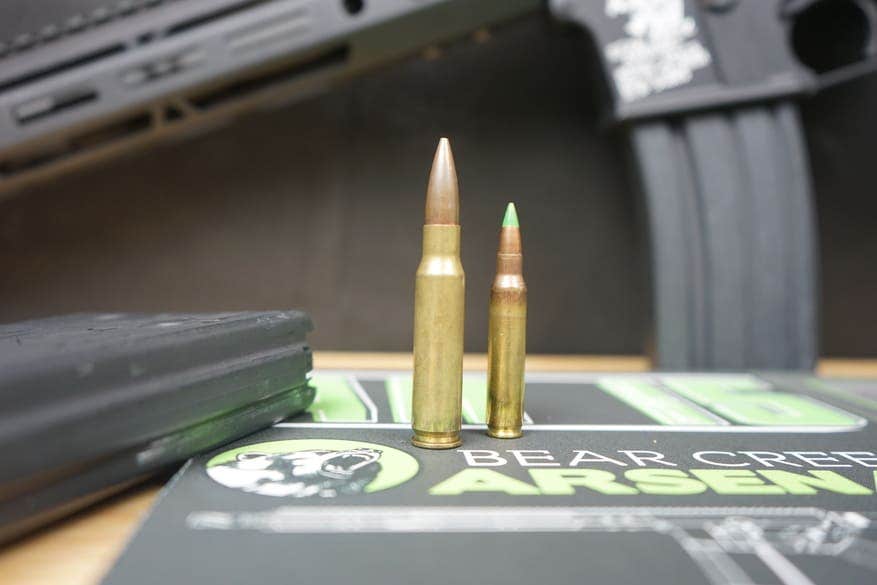
Looking at these two rounds side-by-side, some of the differences are painfully obvious. The 223 Remington towers over the 30 Carbine by over a half an inch, as the 223 has a case length of 1.76” compared to 1.29” for the 30. In terms of overall length, the 223 Rem measures 2.26” long compared to 1.68” for the 30.

In terms of cartridge design, the 223 Remington utilizes a bottlenecked cartridge while the 30 Carbine was designed using a slightly tapered straight-walled cartridge.

Another major difference is the bullet diameter each cartridge fires. The 223 Rem fires 0.224” diameter bullets while the 30 Carbine fires a 0.308” diameter bullet.

The 223 Rem can fire a wide range of bullet weights, typically between 30 and 90 grains with the 50 gr, 55 gr and 62 gr factory loads being the most popular. In contrast, the 30 Carbine was designed to fire a 110 grain FMJ but can fire bullets as light as 85 grains and as heavy as 130 grains. Most factory ammo for 30 Carbine is loaded with 100 grain or 110 grain bullets.

One of the main reasons the 223 has a ballistic advantage over the 30 Carbine is that the 223 Rem has nearly 50% more case capacity than the 30. Capable of handling 31.4 gr of propellant, the 223’s case capacity dwarfs that of the 30 Carbine that can house 21 grains of powder.

With the added case capacity, the 223 Rem also is capable of handling significantly higher chamber pressures than that of the 30 Carbine. With a SAAMI spec 55,000 psi, the 223 has almost a 30% advantage over the 30 at 40,000 psi.

Recoil

Recoil is an important consideration when purchasing a new rifle as a round with heavy recoil will be more difficult to control and will slow your rate of follow up shots. The potential for flinching is also an issue for cartridges with heavy recoil.

Felt recoil will differ from shooter to shooter and is often dependent on firearm choice, stance, and your chosen factory ammo or handloads. However, free recoil is a more objective measure of how hard a cartridge hits based on firearm weight, muzzle velocity, powder charge, and bullet weight.

To compare the 30 Carbine vs 223 in terms of recoil we’ve selected the gold standard load for each cartridge. For the 30 Carbine we will consider the WWII M1 110 gr FMJ 1,990 fps military load and the M193 55 gr FMJ 3,200 fps military load for 223 Rem.
The firearms for this comparison will be a standard M1 Inland Carbine weighing 5.2 lbs and a standard AR-15 weighing 7 lbs for the 223.

Given these criteria, the 30 Carbine will have a free recoil energy of 5 ft-lbs compared to 4.25 ft-lbs for 223.

Although the 223 has a higher powder charge and muzzle velocity, its low bullet weight and heavier firearm help tame the already manageable recoil of the cartridge. On the other hand, the 30 has double the bullet weight and a lighter host firearm, which results is slightly higher recoil.

This is not to say that the 30 Carbine has oppressive recoil, quite the opposite actually, as most shooters would classify the 30 as having extremely low recoil. Both rifles are extremely easy to handle, a joy to shoot, and you can spend a whole afternoon plinking with either and not have a sore shoulder the next morning.

Although the 30 technically has higher recoil, both most shooters would describe both rounds as having low recoil and are excellent options for training new shooters on centerfire ammunition.

Muzzle Velocity, Kinetic Energy, and Trajectory

Previously I mentioned that the 223 Remington outperformed the 30 Carbine in terms of ballistics, but how big of a difference is it?

In this section, we will compare four popular factory loads for both cartridges.

For the 223 Remington, we will consider a Winchester 55 gr FMJ boat tail M193-clone as well as a Federal Fusion MSR 62 grain bonded Spitzer boat tail. For 30 Carbine, the M1 110 gr FMJ round nose military load will be compared with the Buffalo Bore 125 grain hard cast flat nose (FN) round.

30 Carbine vs 223 Rem ballistics table

When it comes to muzzle velocity there is simply no contest as the 223 Rem leaves the 30 Carbine eating its dust. At the muzzle, the M193 55 gr FMJ load for 223 held the highest velocity at 3,240 fps while the 62 gr Fusion came in second at 2,750 fps. The 30 Carbine rounds were the slowest at the muzzle, with the Buffalo Bore 125 gr lead FN clocking in at 2,100 fps while the M1 round was the slowest at 1,990 fps.

Not only is the 223 Rem faster at the muzzle, but it also conserves its velocity more effectively than the 30 Carbine. Both 223 factory loads were still supersonic at 500 yards, while the 30 carbine loads had gone subsonic between 200 and 250 yards.

Staying above the speed of sounds (1,125 fps) helps maintain a bullet’s trajectory, as it allows gravity less time to affect the flight path.

Speaking of trajectory, the 223 Rem simply slaughters the 30 when it comes to bullet drop. At all ranges 200 yards and above, the 223 Remington had less bullet drop than the 30. This is primarily due to the aforementioned supersonic limit of the 30 Carbine.

At 500 yards, the 30 Carbine loads had over three times the bullet drop of both 223 Remington rounds. This makes the 223 Rem a more accurate long range shooting cartridge with over double the effective range of the 30 Carbine.

One of the major critiques of the 30-caliber Carbine was its lack of stopping power. The 223 Remington/5.56 NATO has also had this critique leveled against it based on combat reports from Afghanistan and Iraq.

The 223 Rem has more foot pounds of kinetic energy at the muzzle and conserves its energy more efficiently downrange for both military loads. The M193 223 load has 1,282 ft-lbs of muzzle energy while the M1 110 gr FMJ 30 Carbine rounds has 967 ft-lbs.

The Buffalo Bore load for the 30 Carbine closes the gap in terms of kinetic energy, as it has 1,224 ft-lbs at the muzzle. This load was included in our comparison to showcase the highest levels of performance the 30 Carbine is capable of.

However, the 223 Rem’s efficient bullet design really shines at longer ranges, as it has nearly double the kinetic energy of the 30 rounds at 500 yards.

So, what conclusions can we draw from these results?

The 223 Remington is clearly the more effective long range cartridge. With higher muzzle velocity and a flatter trajectory, the 223 performs best for longer distance shots.

The bullet design of the 30 Carbine doesn’t do it any favors, as it hemorrhages velocity and kinetic energy at range. However, it has two times the bullet weight and leaves a considerably bigger hole than the diminutive 0.224” diameter 223 bullets.

This allows the 30 Carbine to be extremely effective in short-range engagements but is ill-suited for long range shots. The 30 has nearly double the kinetic energy of a mild 357 Magnum load or 45 ACP at the muzzle, so the military was successful at making a round that’s “more than a pistol but less than a rifle”.

Ballistic Coefficient and Sectional Density

Ballistic coefficient (BC) is a measure of how aerodynamic a bullet is and how well it will resist wind drift. Sectional density (SD) is a way to evaluate the penetration ability of a bullet based on its external dimensions, design, and weight.

The 223 Remington continues its dominance in ballistic coefficient thanks to its Spitzer boat tail bullet design.

The Winchester M193 223 factory ammo has a listed BC of 0.255 while the Federal Fusion load has an impressive 0.310 BC. In contrast, the 30 Carbine loads have considerably lower BC at 0.166 for the 110 gr FMJ and 0.126 for the 125 gr lead flat point from Buffalo Bore.

To put it simply, the 30 bullets are short, fat, not aerodynamic at all. On the other hand, the bullets fired by the 223 are considerably sleeker, resisting wind drift and air resistance more efficiently.

For sectional density, the 30 and 223 are relatively equivalent with the 30 having slightly higher SD for the 110 gr FMJ at 0.166 compared to 0.155 for the M193 load for 223. Sectional Density data was not immediately available for the Federal Fusion MSR or Buffalo Bore loads.

Although the 30 Carbine has a slight advantage in penetration over the 223, it is unlikely that most hunters or game animals will be able to tell the difference between them.

Hunting

The 223 Remington is one of the most popular varmint hunting cartridges in North America. A 223 long gun with a decent scope makes for a potent ground hog or coyote slaying machine, as it has incredibly low recoil and a flat trajectory.

The 30 Carbine also makes for a decent varmint cartridge for short-range shots. Although the trajectory of the 30 Carbine cartridge starts to resemble a rainbow at long range, there is something nostalgic about taking your Inland Carbine out into the woods for a little coyote hunting.

But what about whitetail?

The use of either cartridge for deer is a hotly debated issue at deer camps and hunting forums across the world.

The 30 Carbine has been used effectively for deer hunting since its introduction, however standard pressure ammo lacks the 1,000 ft-lbs of kinetic energy typically cited as required for whitetail. This goes to show that shot placement and selecting a quality hollow point or soft point bullet is more important than overall kinetic energy.

Furthermore, some hunters in states that allow the use of 223 Remington for deer hunting report good success with heavier 69+ grain bullets like the Hornady 73 gr FTX. However, many states prohibit the use of 0.224” diameter bullets for deer hunting.

Although both rounds can fell a whitetail with high-power loads and proper bullet selection, neither make for a good deer cartridge.

If we had to pick one, our choice would be the 223 Remington with a proper 69+ grain hunting bullet. However, 12 gauge shotgun slugs or a properly loaded 308 Winchester will make for better deer medicine than a 223 or 30 Caliber Carbine.

Ammo and Rifle Cost/Availability

The 223 Remington cannot be beat for ammo availability, price, and rifle options.

As one of the most popular centerfire cartridges in North America, the 223 Rem has numerous factory loads available for virtually any shooting application your heart desires.

Military surplus ammo is relatively easy to find and buying bulk 223 ammo can really help keep your overall cost per round to a minimum. The 223 has become so popular that ammo manufacturers have now started offering self-defense ammo such as Speer Gold Dots, Winchester PDX-1, and Hornady Critical Defense to cover all your home defense needs.

In contrast, 30 Carbine ammo is not nearly as popular as it was after WWII. Finding surplus 30 Carbine ammo is akin to finding a needle in a haystack and is considerably more expensive than it was after the war.

Modern ammo manufacturers like Remington, Hornady, Sellier & Bellot, and Winchester still make 30 Carbine ammo, but it much lower quantities than other ammo (like 223, for example). There are limited hunting ammo varieties available for 30 Carbine, traditional soft point and hollow point ammo can be had, but most 30 Carbine rounds will be loaded with FMJ’s.

In terms of cost, cheap plinking ammo can be had for around $0.60/round while premium hunting ammo ranges between $1.50-$3/round for 223. In contrast, 30 Carbine FMJ ammo will typically cost you about $1/round while self-defense or hunting ammo usually costs around $2 for each pull of the trigger.

Considering the 223 Remington can be fired from the most popular firearm in in United States, the semi-automatic AR-15, it cannot be beat in terms of rifle availability.

However, if you are not an AR-15 person there are still multiple options available to you. If you prefer a bolt-action rifle for some long range target shooting or varmint hunting, virtually every firearm manufacturer has at least one rifle chambered in 223.

For semi-auto options, the Ruger Mini-14 is perhaps the second most popular semi-automatic rifle for 223. The AK-platform has also been modified to fire 223/5.56 NATO and there are many other popular rifles chambered in the cartridge such as the Kel-Tec RDB, IWI Tavor, Steyr AUG, Galil, and many others.

In terms of AR-15’s, the sky is the limit as all the manufacturers from Anderson to Colt offer at least one rifle chambered in 223.

Pretty much the only type of rifle not chambered in 223 is a lever-action, as the rimless design and pointed bullets don’t play well with tubular magazines.

For the 30 Carbine, your rifle options are somewhat limited to the M1 Carbine.

However, these rifles vary in price considerably depending on their date and company of manufacture. Older WWII era rifles from Winchester, Rock-OLA, or IBM will fetch a premium, while newer production rifles from Auto Ordinance, Iver Johnson, Universal, or Inland can be had for a more reasonable price.

The 30 Carbine has also been adapted to several handguns, most notably the Ruger Blackhawk. The Taurus Raging Bull and AMT AutoMag III were also chambered in 30 Carbine, however these handguns have been discontinued and used models fetch a high price on the used market.

Reloading

Reloading is one method shooters use to reduce their overall cost per round and increase the consistency and accuracy of their ammo. Furthermore, handloads can be tailored to your rifle to meet your specific shooting needs.

Handloaders have been reloading 223 brass for decades at this point, meaning that there is load data available for virtually every bullet and powder combination that makes sense. In the same vein, 30 Carbine load data has been well flushed out and there are plenty of options available.

In terms of bullets, 0.224” diameter bullets are essentially a dime a dozen and extremely simple to find. Military surplus pulled bullets can be had for loading bulk 223 ammo at a low cost per round or you can load precision rounds for matches. Hunting bullets are also extremely inexpensive for 223 and made by reputable companies like Hornady, Berger, Barnes, Nosler, Sierra, and Federal.

If there’s one caliber that’s synonymous with “America” it must be the 0.308” diameter bullet. However, the bullets fired by the 30 Carbine are not as popular as those used by rounds like the 308 Winchester or 30-06 Springfield.

Due to its chamber design, the 30 Carbine cannot utilize Spitzer-style boat tail bullets like most 30-caliber cartridges. This means the 30 Carbine cartridge has to be loaded with round nose bullets that are more popular with lever-action rounds like the 30-30 Winchester.

Finding once-fired brass for 223 is an incredibly simple task as you can often find it lying on the ground at most ranges (just ask the shooter if you can have their brass before picking it up). For the 30, finding brass is a bit more difficult as it’s not as popular of a cartridge as it once was. Factory new brass can be had from companies like Winchester and Starline, while used brass is still available on the secondary market.

Final Shots: 223 vs 30 Carbine

The 223 Remington and 30 Carbine are two military cartridges that hail from two different eras of cartridge development.

The 30 Carbine is a product of the World War I and II era that brought us the 45 ACP, the 30-06 Springfield, and the 50 BMG. It is a round that filled a specific role for support soldiers who needed a lighter weapon for close-range combat.

By modern cartridge standards, the 30 is an anemic round that lacks the stopping power for whitetail deer and is best reserved for varmint hunting or plinking with an old M1 Carbine.

The 223 Remington is a modern cartridge that signaled a change in U.S. military combat policy. It’s an intermediate round that was built for low recoil, a flat trajectory, and be light enough so that soldiers could carry a lot of ammo into battle.

In the civilian sphere, the 223 is one of America’s beloved cartridges that is fired by the AR-15 carbine and is consistently in the top 3 cartridges sold in North America. It’s a versatile round that is the gold-standard for varmint hunting as well as target shooting and general plinking.

Although there is no denying the nostalgia factor of the 30 Carbine, our choice is the 223 Remington. It offers better ballistics with lower recoil and is less expensive to shoot.

No matter which cartridge you choose, make sure you stock up on ammunition here at Ammo.com and I’ll see you on the range!

The Complete Walleye Rod Buyers Guide

0

Walleye is the state fish of Minnesota. It is arguably the most sought-after species during the summer and winter months. Walleye offer excellent table fare, an exciting fight, and they are one of the few game fish that remain active throughout the cold winter months. Because of the popularity of the walleye and the challenge they provide for anglers, many methods have been developed for catching them. At Tuned Up Custom Rods, we have designed a whole arsenal of rods to be used for every known walleye technique. In this blog, we will break down which rods are best for each technique to help you make the best choice in your rod purchase.

All the different lures and presentations can be broken down into two main ways to fish for walleye: Jigging and Dead Sticking. Jigging means you are actively moving your bait and lure with your hand by lifting the rod tip up and down. This lets your lure imitate the movement of live bait. Dead Sticking means you have your rod stationary and you are using live bait (usually minnows). The bait itself makes the action underwater and you wait for a fish to bite.

Let’s look at jigging first. Jigging is active. You are constantly involved in the process and you often are trying to tempt fish with your offering. Sometimes, fish will respond best to large, aggressively jigged lures. Other times, the fish will prefer moderated jigging of a spoon. Still other times, the fish will want you to barely move a small spoon or jig. Having multiple presentations rigged up and ready to go, will allow you to home in on the fish’s mood quickly and effectively.

Different lures have different weights. At Tuned Up Custom Rods, our rods are built to be matched to specific weight ranges of lures. If you fish too heavy of a rod on a light lure, you will not feel or see the bite as well. If you fish too heavy of a lure on too light of rod, you will not have the control of the bait when jigging. It comes down to balance.

We offer three main walleye rods for most lure weights. These rods will be effective for most walleye presentations. The rods are the Precision, the Power Precision, and the Commander.

The Precision is a Light to Medium Light power, fast actions jigging rod. It is designed to handle lures from 1/10 ounce to 1/4 ounce. This is the range most walleye spoons fall into. The Precision is our most versatile walleye rod and will handle most walleye situations. The Precision works great with popular walleye spoons like the VMC Tingler Spoon, Lindy Rattln’ Flyer, and Swedish Pimple. It can also be used for small minnow profile baits like the Rapala Ultra-Light Rippn Rap 04.

The Power Precision is a Medium Power, fast action jigging rod. This rod is heavier than the Precision and can support baits from 1/8 ounce to 3/8 ounce. The Power Precision really shines with minnow profile baits like the Rapala Rippin Raps and Lindy Darters. It also works well for heavier spoons.

The Commander is a Medium to Medium-Heavy power, fast action jigging rod. This rod is our premiere walleye rod. It is very versatile, being able to handle medium spoons up to the largest minnow profile baits and swimbaits. It handles lures in the ranges of 1/8 ounce to 5/16 ounce. The Commander is excellent for targeting the largest walleye and pike in a lake. It has a remarkably sensitive tip and a backbone that can comfortably fight nearly all trophy fish.

29″ Walleye Caught on Commander

If you are looking for a rod that can be used for walleye and for smaller species, such as perch and crappie, we offer two, very different rods for you; the Fusion and the QuickTip. Both rods are intended to be jigging rods and accommodate the smaller end of the baits people use for walleye, including the smallest Rippn Rap 03 and the smallest spoons.

The Fusion is a Light Power, Moderate-Fast action rod. Its slower action allows the rod to load up more during the hookset. The Fusion is a great blend between panfish and walleye, especially if you are targeting eater sized walleye.

The QuickTip is a Light Power, Extra-Fast action rod. The tip transitions lightning quick to the backbone. This allows you to set the hook as soon as you feel a bite. Because the tip is so quick, the QuickTip is somewhat limited in the size of lures it fishes well. You will want to stay at or under the 1/8 ounce size. It is also very important to keep the QuickTip parallel to the ice when you set the hook and fight the fish. High sticking might lead to a broken tip.

Finally, if you are looking for a dead stick rod to place in a rod holder with a slip bobber or a bait feeder reel, the Tuned Up Custom Rods DeadStick is your perfect choice. This is a Medium Power, Slow Action rod. The slow action and the light fiberglass tip allow you to visually watch when a fish begins biting your minnow. You can see the bite happen before the fish knows that they are attached to the rod. This technique is expertly demonstrated in the attached video from In-Depth Outdoors. The DeadStick also works very well in an iFishPro tip-up system.

If you made it all the way to the end, you know now just how much thought and care went into the designing of the Tuned Up Custom Rods Walleye line-up. Which rod is right for you depends on how you like to fish. For many people, the Precision is the perfect starting point. But many people prefer to have multiple rods, to cover all their walleye bases.

Hands-On Mountain Man History Lesson: DIY Tanning Beaver Tails

0

A few weeks ago, my landlord came knocking at my door on a Tuesday morning. When I answered, he said, “I’ve got a dead beaver out here. You want it?”

What are you supposed to say to that?

“Sure, I’ll take it!”

The words fell out of my mouth well before I realized I didn’t have any idea what the hell to do with a dead 37-pound beaver or how to process it even if I did. But I knew I wanted to make like a guy from the 18th century and take a shot at tanning the animal’s tail with nothing but a throwback attitude and the breadth of collective internet knowledge.

It soon became apparent that I did not have the skills to tan an entire beaver pelt, but the tail — I thought I could manage to tan the tail. Maybe. Sort of. And while figuring it out, I would get a glimpse into the rich history of trapping and part of how they processed the beavers they took, first hand.

Smell the Butt, Eat the Beaver Tails

The beaver-trapping business is an old one; its zenith came in the 18th and 19th centuries, mainly due to the fashion industry in the US and especially overseas. Beaver fur was all the rage, and the fur’s excellent ability to repel water made it an especially sought-after material for hats and other garments.

But what about the tail? After processing, beaver tails were extremely useful for making a number of high-quality leather goods. Plenty of folks have also been known to eat beaver tail — no not the Canadian treat made of deep-fried dough topped with cinnamon sugar and whipped cream with the same name — folks do eat actual beaver tails, especially trappers.

There are a number of ways to prepare what was once thought of as a mountain man’s delicacy. There’s no real amount of meat to be had from the tail, but it’s where a beaver stores most of its body fat.

When you skin a beaver, you’re not going to find a lot of subcutaneous fat like you would on a raccoon, because it’s all in the tail. If you were living in the backcountry for months on end, trapping and purely living off the land, that readily available source of good, pure fat would have been most welcome and perhaps necessary for survival and maintaining reasonable health. In a modern context, you can cook the tail, remove the fat, render it, and have a supply of high-quality cooking fat that can be used for all sorts of things.

In the old days, you’d encase the tail in clay and cook it on some hot coals, and then cut through the charred leather and the inner membrane to get to that pure fat. If your landlord ever drops a fresh beaver on your stoop and you’re brave enough, you can do the same by wrapping it in tin foil and throwing it on the grill.

Surprisingly, folks who have eaten that fat report that it’s basically tasteless. It can also be rendered and used like lard to cook other things.

The tails are pretty damn useful when still attached to the beaver, too. Beavers can slap that large, flat tail on the water surface to issue a danger warning, and it works extremely well as a rudder when they swim. On land, the sturdy tail, which is typically a foot long and 2 inches wide, is useful as another leg to help beavers reach branches and to stabilize their bodies when going to work on a tree trunk.

The animals also use their tail as a lever when dragging bulky and heavy branches into position for dam building. Some people think beavers also use their tails to pack mud into their dams, but they actually use their front feet.

Now, about the smell. You may have heard somewhere that beaver tails smell like vanilla. That’s sort of true. Beavers have castor sacs, a scent gland that creates a chemical compound in the form of a thick yellowish goop, called castoreum, which they use to mark their territory. The glands are actually located under the tail, so it’s the beaver’s ass that smells like vanilla, not the tail itself.

Castoreum smells and tastes so much like vanilla that it’s been used as a food flavoring and in perfumes — but these days, most vanilla scents are synthetic and castoreum is rarely used in vanilla extract (but it’s still on the FDA’s list of approved food ingredients, so you never know).

Because of their fur, skin, tails, and sweet, sweet ass-stink sacs, beavers were hunted and trapped nearly to extinction on two continents. There were only 1,300 Eurasian beavers in the wild at the beginning of the 1900s.

The North American beaver was also nearly hunted out of existence for their pelts and vanilla ass juice. There were an estimated 100 to 200 million beavers on the continent. By the early 1800s, there were hardly any.

But time marched on, and so did the fashions that required an abundance of beaver pelts. Demand declined and trappers moved on to other quarries and professions as the American Frontier dwindled.

Since then, reintroduction efforts in the US, Mexico, and Canada have been successful and their populations are once again abundant.

The Eurasian beaver population has also made a comeback, though not as dramatic, thanks to reintroduction efforts in France, Germany, Poland, and in parts of Scandinavia and Russia.

RELATED – Wildlife Scientists Lead the Charge in Montana’s Cwd ‘Zombie Deer’ Fight

Beaver Trapping in the 21st Century

Today, very few people make a living by trapping beavers. Instead, most are hobbyists and amateurs.

Beavers are amazing creatures, but they can wreak havoc on the local landscape, which is exactly what was happening on my landlord’s property. They were felling trees with tremendous speed and building dams that were causing flooding and cutting off the water supply to a large pond in a state-managed wildlife refuge that butts up against the property. That pond eventually empties into a nearly 700-mile-long river. So, with the blessing of the government officials in charge of the refuge, my landlord began setting traps and dispatching beavers. And that’s how I wound up playing 21st-century mountain man.

Tanning Beaver Tails

Before I got to tanning, I hit GoWild, a social media community geared toward the outdoors, and a bunch of users chimed in with their own experiences, best practices, and words of encouragement. I used what seemed like a couple of solid YouTube tutorials as guides, a few meager cutting implements, and just jumped into it. Fair warning: If you aren’t a patient person, you might want to tap out about now.

Lesson 1: Don’t Cut to the Tip on Beaver Tails

The first task, obviously, was to remove the tail, which was accomplished with a pocket knife and little difficulty.

Then, I cut the tail in half along the edges and began removing the outer skin. Most of this process was really easy, but as you get closer to the tip, the tail gets really thin. I made a couple of wrong moves that an experienced hand would not have made, and put some small holes in the tail leather.

I also discovered that any injury the beaver sustained to its tail that had healed over created really tough scar tissue was all but impossible to separate from the thin outer layer of the tail, resulting in a few more small tears.

Actually pulling the tail apart was more difficult. The interior fat is incredibly slimy and slippery, so I clamped the tailbone in a small bench vise and then got a good solid grip and started pulling the two halves away from the bone. The tactic worked, and they came apart relatively easily.

beaver tails
After cutting up both sides of the tail, the author clamped the tail bone in a vise, pulled the tail apart. While fleshing the tail with a skinning knife, he removed a bit too much in some places and not enough in others. A proper fleshing knife would have helped. T. Logan Metesh/Free Range American

Later on, I learned that you don’t have to try to split the tail all the way to the tip. Just get as close as you can without feeling like you’re going to risk poking through. If you get to this point, then the tail is usually thin enough to separate itself cleanly into two pieces just by pulling it apart.

RELATED – Sporting Dog Restrictions Fail in NH, Falter in MD, Progress Elsewhere

Lesson 2: Use the Right Knife

Next, all the fat and other tissue must be removed from the soon-to-be leather. I learned quickly that having a proper fleshing knife for the task, which I did not, would have made this step a lot easier. I made due with my sharp skinning knife, but the blade’s contours weren’t right for the task and it took a lot longer than it should have, and the results weren’t as clean or thorough as they should have been.

Lesson 3: Tendons Are Tough

I also learned that all of the tendons in the tail closest to the spine are incredibly tough. Given the power that a beaver’s tail has, this makes complete sense, but those sinewy little fibers were abnormally strong and definitely gave even my sharpest knife a run for its money.

With as much of the flesh removed as possible, I was set to start the actual tanning process. It wasn’t difficult, but it was time-consuming.

RELATED – Shed Hunting Tips From Connor Clark: How to Rule the West

Salt and Wait, Acid and Wait, Base and Wait, Wash

First, I thoroughly salted the flesh side of the tail halves with regular table salt and let them sit for 24 hours to dry out. After that, the tail was pretty dry and stiff.

Then, the halves went into a bucket of warm water for another 24 hours to rehydrate.

With the tail thoroughly salted and rehydrated, it then needs to be washed with dish soap to remove any remaining salt and beaver grease.

With the prep work finally done, I decided to go with the alum tanning process (aluminum sulfate and salt) because it seemed easiest and I could get the granulated alum at the grocery store.

I added the tails, granulated alum, and salt into a bucket of clean water with a 1-to-2 ratio of alum to salt. Then it soaked for 72 hours. Told you — lots of waiting.

At this point, I was three days in and the tail pieces were beginning to firm up and feel like leather, but I noticed the edges were starting to develop a slight curl.

Next, the acidic alum has to be neutralized with a base. Borax works well. I dumped the bucket, filled it with some more water, added the tail and the Borax, and stepped away to wait for another 24 hours.

That was it for the tanning process and the pieces were ready for their final drying stage.

adding borax
The tanning alum is an acid, so it had to be neutralized with a strong base once the process was complete. T. Logan Metesh/Free Range American

RELATED – Wild Hunting Tactics: How 7 Apex Predators Do What They Do Best

The Final Results

I set them on some paper towels and then left for a week to visit family out of state, which wasn’t the best idea. When I got back, the pieces were definitely dry, but the result wasn’t what I was expecting — they were rock hard and severely curled at the edges. Plus, little puddles of beaver grease had accumulated in places.

too dry
The author let the tail pieces dry for a week unattended, and they took on some severe curls and had grease pools in the thicker spots. It was a rookie mistake, but a good lesson learned. T. Logan Metesh/Free Range American

I wiped up the grease and worked the pieces back and forth in my hands and over the edge of a counter to try and loosen them up into something close to pliable. The edges were rock hard and there was no way to remove the curl they’d acquired. I tried some leather conditioner to add some moisture back in.

The endeavor, I’d say, was a partial success — but I learned a hell of a lot going through the process.

Next time, I will certainly do a few things differently. I’ll be sure to use more appropriate knives and clean the inside of the tail more evenly. Leaving it to dry unattended for a week was also a bad idea. I also want to consider taking this guy’s advice, do some better knife work, and leave the skin as one piece when filleting the tail, so it can lay flat. His method for removing the tail bone by cutting it out looks easier than the vise method, so I’ll try that, too.

I might also sandwich the leather between some iron mesh during the last step and see if that can prevent any curling that might occur.

For now, the pieces of beaver leather are sitting on top of my gun safe, occasionally driving one of my dogs crazy when she catches the scent. Hopefully, the results of my next attempt will be more than just a learning experience and can be made into something useful.

If you come into the possession of a few beaver tails and, like me, have no tanning knowledge and don’t want to risk ruining the leather, you can trim it up according to the directions on the Specialty Leather Productions site, freeze it, and mail it to them. They’ll tan it and send you back perfect beaver leather for $6.50 per half.

READ NEXT – Wolves in Northern Minnesota Helping Moose, Eating Beavers

The Best Camo for Spring Turkey Hunting

0

You may think they’re just birdbrains, but wild turkeys actually see three to four times better than human beings. What’s more, they can see color as well. Their eyes not only detect a human’s slightest movement, but they see it in a vivid, three-dimensional perspective just like we do.

So, while camouflage is always crucial in hunting, for spring turkey hunting, it’s extra important to don the right type.

One camo deemed perfect for a certain environment or hunting style could be totally useless in another. The best camo pattern is going to depend on your surroundings.

Determining the Best Turkey Hunting Camo

Good turkey camouflage needs to be right for the environmental and weather condition. First, you need to know whether there’s budding green colors among the spring changes where you’re headed. As green emerges, is your camo choice reflecting that?

Then, consider what kind of layers you’ll need—base layers, warm jackets, or spring light longsleeves?

Other considerations for turkey season include a turkey vest, camo facemask decoys, and a good call. But for continued success in the field, the best turkey camouflage pattern for your needs will ensure you’re seeing success each and every turkey hunting season.

And when you’re wearing the right camo, it can all come together for an unforgettable hunting season. There are so many good camo companies to choose from, but here we’re focusing on two of the leading brands, Mossy Oak and Realtree, which have stood the test of time—not to mention a wild turkey’s eyesight.

Mossy Oak Bottomland

Mossy Oak Bottomland camo pattern Perhaps Mossy Oak’s best representation comes from the turkey hunting community in the southeastern U.S., where Bottomland is still worn and revered consistently, year after year. This is where it all started for the Mossy Oak brand, with its natural bark elements and color tones that blend in seamlessly.

However, Bottomland has quickly become a staple across the camouflage market, worn as frequently with casual wear as it is in the woods. Outdoorsmen of all kinds seem to really appreciate the aesthetic this pattern has to offer, and hunters find it to be a strong cross-purpose option for when they need one pattern to get the job done in a variety of environments.

Mossy Oak Greenleaf

Greenleaf is a classic pattern that is ready made for spring turkey hunting with just the right amount of green and brown to cover you up. Honestly, Mossy Oak’s Break-Up, Break-Up Country, and Infinity patterns conceal incredibly well, but are just a bit lacking in the green department for spring gobbler hunting.

This pattern, however, does a fine job of incorporating each of those concepts and giving it just enough spring pop for when those gobblers begin strutting.

Realtree Hardwoods Green HD Camo

This super-realistic camouflage pattern is effective and versatile wherever green is visible, and that certainly means the spring turkey season in the woods. Hunters seem to be hit or miss on the high-definition camo concepts, but there’s a reason this particular pattern has made such an impact on the industry.

Additionally, if there would ever be a time you’d want your camo pattern to be as realistic as possible, it would be when you’re chasing after those keen-eyed gobblers.

Realtree Xtra Green Camo

For the serious bowhunter who doesn’t put away the archery gear just because it’s turkey hunting time, this excellent pattern will keep you out of the turkey’s eyesight long enough to raise up, pull back, and lose an arrow.

As you can see from the photo above, this particular pattern does great when a hunter is up against a tree, which is great news for all of those bowhunters who enjoy hunting from the ground.

Realtree Original Camo

For many hunters, this is where it all began in the spring. We knew our spot, scouted our bird, and were wearing this vaunted pattern when we took a bird.

Other good patterns include Realtree APG, Advantage Timber, and Advantage Classic since they have a lot of the green and brown mixes that bowhunters know and love.

READ MORE: 5 BEST TURKEY HUNTING STATES OVER THE NEXT 5 YEARS

Best all terrain tires for snow

0

Best all terrain tires for snow: In the world of all-terrain tires, navigating through the plethora of options can be a daunting task, especially when it comes to finding the perfect set for snow. Two common classifications of tires that you may come across are the M+S (Mud and Snow) and the 3-Peak Mountain Snowflake (3PMSF) certified tires. But how do you know which one will provide the best performance in snowy conditions? In this article, we will focus on the top 3-Peak Mountain Snowflake certified all-terrain tires, as they have been proven to deliver superior traction and safety in snow compared to their M+S counterparts.

M+S tires are designed to offer improved traction in muddy and light snow conditions, but they do not undergo the same rigorous testing as 3PMSF certified tires. The 3-Peak Mountain Snowflake symbol signifies that a tire has met or exceeded stringent industry standards for severe snow performance, making them the optimal choice for those who frequently drive in heavy snow or icy conditions. So, without further ado, let’s delve into the world of 3-Peak Mountain Snowflake all-terrain tires and discover the best options for conquering the snowy terrain.

Off road segmentation

When it comes to a pick up truck, the main segmentation of tires comes in the form of on/off road terrain groups. However in this class of tires, there is an even further distribution as below:

SegmentOff roadOn road

All terrain road (ATR) is a relatively new segment mainly driven by the R117 regulation over in Europe to ensure tires meet a maximum threshold of noise level as determined by regulation. Due to the relationship between pattern void volume and noise, this forces the industry to shift towards a lower void design to meet the noise requirements. Hence this spurred the creation of this new segment which has 70% on road & 30% off road focus.

All terrain (AT) is a well known segmentation whereby users do tend to enjoy the fair share of off road activities. Most of the pick up trucks who want to explore the off road activities on a monthly basis do tend to choose this segmentation. The AT segment has a 50% on road & 50% off road focus. There is however an even higher off road segmentation called mud terrain (MT) which has 70% off road and 30% on road. Recently most ATR segment tires.

All season 3 peak mountain

All season tires have always been the go to tires for the American market and this segment has been well established across the years. There are 2 types of all season tires, one with 3 peak mountain & one with only M+S. We have covered these 2 types of tire head to head with Michelin’s Defender T+H (M+S) vs Cross Climate 2 (3 peak mountain) and the M+S all season tires usually are worst in winter performances but excel much better in mileage.

If you are in an area which snows quite heavily, 3 peak mountain all season tires would be definitely a good choice. Below are the best all terrain tires for snow rank based on a compilation of test results.

All terrain road (ATR) with 3 peak mountain

1. BFGoodrich Trail-Terrain T/A

When it comes to off-road tires, no brand is as well known as BFGoodrich. Many consider them as the “God” of all/mud terrain tires and have made their name true countless tire wins in the Baja competitions. BFGoodrich launched its latest foray into the ATR segment with the product called “Trail-Terrain T/A” in 2021. Based on the test results, Trail-Terrain T/A had a big advantage in snow & ice performances while having a low wet & dry performance. The main trade off is between winter against summer performance in this case. If you need a winter performance tire, Trail-Terrain T/A would be definitely a good choice for you.

  • BFGoodrich Trail-Terrain T/A
    • Launch: 2021
    • Press test wins: 0/1
    • Strength: Excellent snow.

Check out our head to head comparison of Trail-Terrain T/A against its competitors.

BFGoodrich Trail-Terrain T/A vs

  • Falken WildPeak A/T Trail

Price

  • 265/60R18 : $244

PS: Updated snow results

BFGoodrich Trail-Terrain T/A vs Yokohama Geolandar A/T G015 vs Falken WildPeak A/T Trail winter results.

The BFGoodrich Trail-Terrain T/A demonstrates superior snow and ice performance compared to its competitors, the Falken WildPeak A/T Trail and the Yokohama Geolandar A/T G015. In snow braking, acceleration, and handling (both subjective and lap time), the Trail-Terrain T/A consistently outperforming the WildPeak A/T Trail and closely matching the Geolandar in certain aspects. Furthermore, on ice braking, the Trail-Terrain T/A still held its top position with a score of 100%, whereas both the WildPeak A/T Trail and Geolandar A/T G015 lagged behind by up to -20%. In summary, for snow and ice conditions, the BFGoodrich Trail-Terrain T/A is the clear front-runner.

2. Yokohama Geolandar A/T G015

Introduced in 2016, the Yokohama Geolandar A/T G015 has quickly become a popular choice for drivers seeking a versatile all-terrain tire with impressive snow performance. While it came in just slightly behind the BFGoodrich Trail-Terrain T/A in Tire Rack’s testing, the Geolandar A/T G015 still offers excellent traction and handling on snow-covered roads. Combining Yokohama’s advanced tire technology with a focus on durability and comfort, the Geolandar A/T G015 has proven itself to be a reliable option for those who face a variety of terrains and weather conditions.

  • Geolandar A/T G015
    • Launch: 2016
    • Press test wins: 0/3
    • Strength: Snow & ice

Check out our head to head comparison of Geolandar A/T G015 against its competitors.

Geolandar A/T G015 vs

  • Falken WildPeak A/T Trail

Price

  • 265/60R18 : $239

3. Falken WildPeak A/T Trail

The Falken WildPeak A/T Trail is renowned for its outstanding performance on both wet and dry terrains. It consistently delivers impressive traction and stability during rainy seasons and on dry roads, making it a top choice for those in predominantly wet or summer climates. However, when it comes to snow and ice, the WildPeak A/T Trail shows some limitations, especially when compared to the Trail-Terrain T/A which excels in winter conditions. For those prioritizing snow and ice performance, the Trail-Terrain T/A stands out. But for those in milder winter conditions and dominant summer weather, the WildPeak A/T Trail is hard to beat.

  • WildPeak A/T Trail
    • Launch: 2019
    • Press test wins: 0/1
    • Strength: Wet & dry

Check out our head to head comparison of WildPeak A/T Trail against its competitors.

WildPeak A/T Trail vs

  • Nitto Nomad Grappler
  • Yokohama Geolandar A/T G015
  • BFGoodrich Trail-Terrain T/A

Price

  • 235/60R18 : $209

4. Cooper Discoverer AT3 4S

Launched in 2018, Cooper’s Discoverer AT3 4S has quickly made a name for itself in the world of all-terrain tires. With outstanding snow performance as verified by Tire Rack’s comprehensive tests, this tire has proven to be an exceptional choice for those who need reliable traction and safety in snowy conditions. The Discoverer AT3 4S combines innovative technology and Cooper’s years of experience to deliver a tire that excels in both on-road comfort and off-road capability, making it a top pick for drivers looking to conquer any terrain.

  • Cooper Discoverer AT3 4S
    • Launch: 2021
    • Press test wins: 2/4
    • Strength: Excellent in wet & snow

Check out our head to head comparison of Cooper Discoverer AT3 4S against its competitors.

Cooper Discoverer AT3 4S vs

  • Kumho Road Venture AT52
  • General Grabber APT
  • Continental TerrainContact A/T

Price

  • 265/60R18 : $264

5. Firestone Destination A/T2

The Firestone Destination A/T2 is a noteworthy contender in the all-terrain tire market, having achieved reasonable snow performance results in Tire Rack’s testing. This tire not only offers a dependable grip on snowy surfaces but also excels in various other conditions. Adding to its list of accolades, the Destination A/T2 recently emerged as the best tire in the highly popular 2022 Tyre Reviews All Terrain Tyre Test. With a well-rounded performance across different terrains and a growing reputation for reliability, the Firestone Destination A/T2 is undoubtedly a solid choice for drivers seeking a versatile and high-performing all-terrain tire.

  • Destination A/T2
    • Launch: 2019
    • Press test wins: 1/3
    • Strength: Dry

Check out our head to head comparison of Destination A/T2 against its competitors.

Destination A/T2 vs

  • Continental TerrainContact A/T

Price

  • 265/60R18 : $259

All terrain (AT) with 3 peak mountain

1. Mickey Thompson Baja Boss A/T

Mickey Thompson Baja Boss A/T: A Legacy of Dominance

Mickey Thompson’s Baja Boss A/T is not just another tire in the market; it stands tall on a legacy of tire-making excellence. Combining aggressive aesthetics with unparalleled on-road handling and performance, this extreme hybrid all-terrain tire symbolizes the very essence of Mickey Thompson’s commitment to quality. The asymmetrical tread design ensures reduced noise and superior all-weather performance, while its Extreme Sidebiters® offer an extraordinary look and exceptional off-road traction. Enhanced with the Powerply™ XD and a Silica-Reinforced Compound, it guarantees puncture resistance, quicker steering response, and improved wet handling. And with a 50,000-mile tread wear warranty, the Baja Boss A/T doesn’t just talk the talk but walks the walk.

Winter Performances: Defining Snow Mastery

When pitched against its close competitors, the Falken WildPeak A/T3W and the Toyo Open Country A/T III, the Baja Boss A/T showcases distinctive prowess in snow conditions. Let’s dissect the numbers:

AT snow results
  1. Snow Braking: With 60.30 feet, the Baja Boss A/T stops more abruptly than both the WildPeak A/T3W and the Open Country A/T III, requiring 82.20 and 80.60 feet respectively.
  2. Snow Acceleration: This metric is where Baja Boss A/T shines brightly. At just 13.60 feet (0-12 Mph), it accelerates significantly faster in snowy conditions than the WildPeak A/T3W and the Open Country A/T III, which require 19.10 and 19.40 feet respectively.
  3. Snow Handling (Subjective): Scoring 4.92 out of 10, the Baja Boss A/T is ahead of the WildPeak A/T3W’s 3.83, though slightly trailing the Open Country A/T III’s 4.67.
  4. Ice Braking: On icy terrains, the three tires are closely matched, with the Baja Boss A/T stopping at 57.50 feet, slightly ahead of the others.

In conclusion, the Baja Boss A/T by Mickey Thompson doesn’t merely ride on its legacy but establishes itself as a leader, particularly in snowy conditions. The numbers are clear: for those prioritizing winter performance, the Baja Boss A/T stands out as the best snow tire in the market.

  • Baja Boss A/T
    • Launch: 2021
    • Press test wins: 0/1
    • Strength: Excellent snow !

Check out our head to head comparison of Baja Boss A/T against its competitors.

Baja Boss A/T vs

  • Falken WildPeak A/T3W
  • Toyo Open Country A/T III

Price

  • 265/60R18 : $291

2. Toyo Open Country A/T III

The Toyo Open Country A/T III is an embodiment of technological advancement in the realm of all-terrain tires. Designed to cater to the needs of light trucks, SUVs, and crossovers, it stands as a testament to Toyo’s commitment to revolutionize the tire industry. Following the footsteps of its predecessor, the Toyo Open Country A/T II, this latest iteration introduces a more aggressive tread pattern, advanced rubber compounds, and numerous features that enhance its grip and durability. Among these, its new tread compound ensures enhanced wet braking, improved handling, and resists cut-and-chip, making it a reliable companion for both off-road adventures and city drives. The tire’s evenly distributed void area improves traction, both on and off the road, and ensures stable handling. Its staggered shoulder lugs offer impressive off-road traction, while the increased lateral grooves magnify its prowess on varied terrains, including snow. The 3D multi-wave sipes not only improve wet and snow traction but also diminish irregular wear. Lastly, the stone-ejecting blocks ensure that the tire remains undamaged, maintaining its performance in tough conditions.

Diving into its winter performance and comparing it to its peers like the Mickey Thompson Baja Boss A/T and the Falken WildPeak A/T3W, the Toyo Open Country A/T III showcases notable strengths. In snow braking, it demands only 80.60 feet to come to a halt, closely tailing the Baja Boss A/T but surpassing the WildPeak A/T3W. When we assess snow acceleration, the Open Country A/T III registers a commendable performance, requiring just 19.40 feet from 0-12 Mph, which is almost at par with the WildPeak A/T3W. As for snow handling, it scores an impressive 4.67 out of 10, beating the WildPeak A/T3W and just slightly behind the Baja Boss A/T. However, its true dominance is evident in ice braking, where it halts at a mere 54.80 feet, outperforming both of its competitors.

  • Open Country A/T III
    • Launch: 2020
    • Press test wins: 0/1
    • Strength: Great snow handling !

Check out our head to head comparison of Open Country A/T III against its competitors.

Open Country A/T III vs

  • Falken WildPeak A/T3W
  • Mickey Thompson Baja Boss A/T

Price

  • 265/60R18 : $283

3. Falken WildPeak A/T3W

When it comes to exceptional winter performance in all-terrain tires, the Falken WildPeak A/T3W undoubtedly stands out. Specifically crafted for those who seek unmatched performance without compromising on safety and durability, this tire is a testament to Falken’s dedication to innovation and quality. Its advanced engineering ensures that the tire not only grips the road seamlessly in harsh snowy conditions but also offers longevity and reliability.

Looking at its winter performance metrics and juxtaposing it with competitors such as the Mickey Thompson Baja Boss A/T and the Toyo Open Country A/T III, the WildPeak A/T3W showcases its merits. In the snow braking test, it requires 82.20 feet to stop, which is slightly longer than both the Baja Boss A/T and the Open Country A/T III. However, it’s in the snow acceleration where the WildPeak A/T3W weakness was shown, registering an 19.10 feet from 0-12 Mph, placing last in the group. While its subjective snow handling score of 3.83 out of 10 trails the other two tires, it’s essential to note that this is a subjective measure, and preferences can vary based on individual experience. But where the WildPeak A/T3W genuinely shines is in ice braking. Stopping at just 55.80 feet, it surpasses the Baja Boss A/T and is incredibly close to the leading Toyo Open Country A/T III.

  • WildPeak A/T3W
    • Launch: 2013
    • Press test wins: 0/4
    • Strength: Good ice braking

Check out our head to head comparison of WildPeak A/T3W against its competitors.

WildPeak A/T3W vs

  • Mickey Thompson Baja Boss A/T
  • Toyo Open Country A/T III
  • Bridgestone Dueler A/T Revo 3

Price

  • 265/60R18 : $275

4. Goodyear Wrangler Workhorse AT

Goodyear’s Wrangler Workhorse AT was launched in 2021 with an all season focus and it is specific only for the American market. Based on the head to head comparison below, Wrangler Workhorse AT was good in dry, noise & objective ice/snow but was weak in wet and subjective snow performances.

  • Wrangler Workhorse AT
    • Launch: 2021
    • Press test wins: 0/1
    • Strength: Dry. noise & objective ice/snow

Check out our head to head comparison of Wrangler Workhorse AT against its competitors.

Wrangler Workhorse AT vs

  • Cooper Discoverer Rugged Trek

Price

  • 265/60R18 : $251

5. Cooper Discoverer Rugged Trek

Cooper’s Discoverer Rugged Trek was launched in 2021 and has been developed specifically for the North American market. Based on the head to head comparison below, Discoverer Rugged Trek was strong in wet and subjective snow performances while lacking behind dry, noise & objective ice/snow.

  • Discoverer Rugged Trek
    • Launch: 2021
    • Press test wins: 0/1
    • Strength: wet & subjective snow

Check out our head to head comparison of Discoverer Rugged Trek against its competitors.

Discoverer Rugged Trek vs

  • Goodyear Wrangler Workhorse

Price

  • 265/60R18 : $275

Summary

In conclusion, selecting the right all-terrain tire for snow is crucial for ensuring optimal performance, safety, and driving comfort. Among the top contenders, the 3-Peak Mountain Snowflake certified tires stand out for their superior traction and handling in snowy conditions. Each tire mentioned in this article offers its unique set of strengths, making it essential for drivers to weigh their specific needs and preferences. Whether it’s the Cooper’s Discoverer AT3 4S, Yokohama Geolandar A/T G015, Firestone Destination A/T2, Mickey Thompson Baja Boss A/T, or Toyo Open Country A/T III, all of these options have proven their worth in the all-terrain tire market. By carefully considering the features and performance aspects of each tire, you can make an informed decision and confidently conquer the snow and various terrains that lie ahead.

What Do the Numbers on a Fly Rod Mean? (With Fly Rod Chart)

0

When entering the world of fly fishing, there are certain aspects of it that become overwhelming. Learning the rod weights and correlating numbers takes time. Having a full understanding of these numbers will help you fish your waters in a much more efficient way. It took me several months to understand what weight rod I needed and when I needed it, but the extra research has paid off in the long run.

What do all the numbers mean on fly rods?

The list of numbers include weight, length, number of sections, action as well as the necessary size of the fly line. The higher the number, the larger the flies and line and the smaller the number, the smaller the flies and line.

Numbers on a Fly Rod

Which Fly Rod Weight Should I Get?

Choosing the proper weight of a fly rod is going to allow you to better target the fish and do so in an efficient way. You can make the proper distanced casts and have enough power to fight fish.

2-3 Weight Fly Rods

These fly rods are a blast to use. They’re a bit limited in where they can be fished, but they create wonderful experiences. 2-3 weight rods are ideal for casting delicate flies at small trout in skinny water. At some points, you’re reaching out with the fly, dropping it a bit upstream and letting it drift down in front of the fish.

How to fly fish for brook trout
Learn 👉 How to fly fish for brook trout

If you know you’re going to spend time on skinny water, do yourself a favor and pick up a finesse rod and enjoy all that it has to offer. They’ll allow you to really test your skills with presentation and casting.

You’re not going to throw 40-foot casts with these rods. Your max distance is going to be around 25 or 30 feet.

4-6 Weight Fly Rods

The 4-6 weight rods are the most common rods in a trout angler’s arsenal. These are perfect for small to large rivers. If you’re fishing out west in Montana, a 5 or 6-weight rod is perfect. You can get enough power to cast, but still delicately present flies if needed.

Casting a 9 foot 5 Weight Fly Rod

Many anglers choose to purchase a 4 to 6-weight rod for their first rig. It’s versatile and will fight the majority of freshwater fish that you find. If you know you’re interested in getting into the sport, but are unsure of what rod, then go with the 4-6 weight. You can throw streamers, dries and nymphs without having to worry about switching rods.

Guide Tip: I absolutely love 4 weight fly rods. Read what to use them for in this article 👉 What is a 4 Weight Fly Rod Good For

You’ll be able to throw 50 to 60-foot casts on a good day with some quality fly line. These rods are great to fish in rivers as well as still water. The versatility is ideal.

7-8 Weight Fly Rods

Your 7-8 weight fly rods are ideal for those larger freshwater fish as well as some saltwater fish. If you’re on your way to Alaska or Canada, a 7 or 8-weight will help in your attempts to catch steelhead. Also, these are great rods for pike, bass and muskie! Some would consider these to be a bit light, but depending on where you are, they’ll work just fine.

You can throw large streamers and poppers with these rods. They’re not great for finesse fishing due to the extra power that you receive with them. If you’re fishing flats or after other smaller saltwater fish, then the 7 or 8-weight would work well.

You can easily get 60 to-70-foot casts through strong current as well as larger lakes. At times, the extra power is necessary to help you get to the fish as well as fight them. While this is a bit more of a specialty rod, if you know you’re primarily after big fish, it’s well worth the investment.

Guide Pro Tip: Do you want a “general purpose fly rod” read this article for my recommendation 👉 What is the Best All Around Fly Rod

9-10 Weight Rods

Most anglers would say a 9 or 10-weight is perfect if you’re targeting salmon, striped bass, snook as well as other saltwater fish. You’ll see spey rods come in this weight as well! Again, they’re a specialty rod, but if you live in an area with these large fish or often travel to remote areas with large fish, then a 9 or 10-weight would work for you.

King Salmon Fly Fishing

You can make extremely long casts with these rods and fight double digit fish with no problem! Streamers are going to be the primary flies you throw with a 9 or 10-weight rod. Get after those big fish and put it to the test. You won’t regret it! There are few things that are more fun than a salmon on a 9-weight rod. You have to give it your all.

10 and Higher

Any rod over a 10-weight is created to be used in saltwater. Targeting tarpon, Giant Trevally, Sailfish and other large saltwater fish is going to require as much power as you can muster. Saltwater fish fight much harder than freshwater fish and will fight to their death. You need to be prepared to throw a heavy fly, heavy leader and fight monstrous fish.

Saltwater fly fishing excursions are wonderful. If you’ve never tried it, give yourself an opportunity to do so. Hiring a guide will help you learn a lifetime of useful information. These rods tend to be a bit more expensive due to their specific use, but if saltwater is your primary water, then it’s well worth the investment.

Fly Rod Selection Chart

To help fellow fly flingers choose a rod, I’ve put together a chart and a download – FREE. Look it over and download a copy to your phone.

Fly Rod WeightWhat Kind of Fish

Click on the below picture to get the a 3 page download that talks all about fly rod definitions. The best part – It’s FREE

Fly Rod Action

After you have chosen the necessary weight of your rod, the next step is choosing the proper action. The right action is heavily dependent on your experience, skill level and the type of fishing you’re doing.

Fast Action

A fast action rod is great for experienced and strong casters. They have the least amount of flex of any action and that allows for a strong fight as well as power to cast through the wind. In order to succeed with this rod, your technique and timing needs to be in line.

Medium-Fast Action

A medium or moderate fast action is quite versatile. You’ll find many 4 to 6-weight rods are moderate-fast action. You can throw dries, nymphs and streamers with ease. You’ll find that these rods have a bit more bend in the blank and not quite as much power.

You won’t be able to cut through the wind as well as you would with a fast action rod, but it does the job. If you’re new to the world of fly fishing, go ahead and give a moderate or medium-fast action a try. Bringing one rod to the river is much easier than several! Many expert anglers still use a moderate-fast action rod because of the sensitivity it provides.

Medium Action

A medium action rod is a solid choice for new fly anglers. It’s even more forgiving than a moderate-fast action rod, but it’s not nearly as powerful. You have to be careful with the size of fish you target when using a medium-action rod. Since it has a bit more bend, you won’t have the power to fight a larger fish.

Many affordable rod options are made with a medium action. You’ll find lighter weight rods with this action because you can nicely lay down small dry flies with the more rod bend. You’ll see about half of the rod bending as you cast.

Slow Action

Many classic fly rods are slow action. They’re a perfect option for the anglers looking to fish small streams and gently lay down small dry flies. Nearly the entire rod bends as you cast. If you’re new to fly fishing and are spending time on small streams, a slow action rod is a great choice.

The rod won’t make you feel as if you’re losing control of your line as you cast. Beware of using a slow action rod in windy conditions! It’s not ideal and you won’t make much progress if you’re looking to make casts over 20 feet.

Fly Rod Length

Fly rods often vary in length, but there are a few standard lengths that you must have. Try to equate the length of the rod to the control you’ll have over the fly line. Often being able to reach out just a bit farther can make the difference.

large open loop fly casting

9-Foot Rods

9-foot fly rods are common in 5 and 6-weights. These are long enough for you to throw dry flies, but also launch streamers quite a distance. A 5’ 9-weight rod is a great versatile option that you can use in almost any scenario that you would like.

8’ 6” Rod

8’ 6” rods are also another common length for 5 and 6-weights. They aren’t going to present dries as nicely, but they can work well with streamers and nymphs. The 8’ 6” length is the most versatile length that you’ll find on the market.

Rods Less than 8 Feet

Rods shorter than 8 feet are best used on small rivers and streams. They allow you to cast in tighter areas and do so accurately. If you know that you’ll be spending the majority of your time in skinny water, then a rod under 8-feet is going to be your best friend. Depending on your skill level, you can choose a different action.

Rods Longer than 9 Feet

Rods longer than 9 feet are often used for euro nymphing. These are ultra-finesse rigs and excel in tight conditions. Longer rods can be a challenge to cast and will get tangled in trees on the banks. However, they allow for a longer reach onto the water and extremely realistic fly presentations.

Number of Sections in a Fly Rod and Why

Most fly rods are either two or four pieces. When fly rods were first created, they were made in two pieces. As technology has developed, they are made primarily in four pieces.

As far as travel is concerned, a four-piece rod is ideal. You don’t have to pay to check your four-piece travel rod tube. If you travel with a two-piece rod, you’ll find that the majority of airlines are going to make you pay for it.

7-Piece Fly Rod, Great for traveling

You’ll even find fly rods that break down to seven pieces. These will fit on a personal item in your backpack! If you can’t take much on the plane, but still want to fish, then the 7-piece rod is perfect.

What’s a Great All-Around Fly Rod?

A great all-around fly rod is an 8’6” 5-weight fly rod. You can use these on small rivers, lakes as well as large rivers. If you choose a rod with this weight and length, make sure you have a moderate-action.

This provides you with the sensitivity to lay down dry flies, but still gives you enough length to make those longer casts with streamers. An 8’6” 5-weight fly rod is one that you can always use no matter where you’re fishing. It’s not a bad idea to own a couple of these rods depending on how much fishing you do.

Fly Rod Selection Guide

What Does a 5/6 Weight Mean?

A 5/6 weight rod is not uncommon to see. Essentially this means that the rod can hold both 5 and 6-weight line. If you do purchase one of these rods, it’s best if you go with a 6-weight line. It’ll give you a bit extra weight so you can make longer casts and get a true feel for the fly rod.

Do You Need More Than One Fly Rod?

The answer to this question depends on how much fly fishing you do. If you fly fish in large rivers, small streams and lakes, you’re going to want more than one fly rod. You won’t be able to fish all of these waters well with only one rod.

However, if you fish similar sized water and fish all the time, one fly rod will work great for you. If you’re like most fly anglers, you’ll quickly fall into the addiction of buying new fly rods.

Last Cast with the Perfect Weight Fly Rod

For beginners, choosing the right size rod can be intimidating. The numbers are confusing at first, but with a bit of research they all begin to make sense. If you match the rod, reel and line numbers, you should be in good shape. An improperly weighted rod is frustrating to use so make sure you put in the time to create a well-balanced setup.

Best Air Rifle Deals

Popular Posts

Air Gun 101: What You Should Know about Air Rifle Barrels Before Buying

0
Have you ever heard the phrase: “Imitation is the sincerest form of flattery”? The Chinese must have been very sincere in emulating this proverb. I...

PCP vs Gas Piston: Which One is Better?

0
The perfect airgun is a difficult pick when you are new to gun-hunting. There are a lot of things to keep in mind, starting...

Air gun 101: What is a PCP air rifle? Is PCP gun the best...

0
A PCP air gun is one of five types of air rifles in the market today. PCP air guns have become more and more...