Fish also make a viable bait source, which is great for those of us who love to spend time angling as well as hunting. They can be used in many of the same ways as the above methods: just save the heads and guts in the freezer and make a pile.
One of the main ways they’re used as bait by experienced coyote trappers and hunters, however, is by salting them. When salted, the fish can be kept almost indefinitely without making your house reek or taking up room in your freezer that could probably be better used by stocking with more edible game.
It’s not a bait of last resort, it’s actually quite effective, but it is a bit specialized when it comes to making sure you have some on hand.
Related: “When Is The Best Time To Hunt Coyotes?” Searching For The Perfect Shot
6. Chicken liver
This is one of the most popular baits for coyote, and it’s not hard to see why. It’s a strong scent that will often bring them in from long distances, and they love to eat it.The main downside of using chicken liver as bait is that it can be expensive if you go through alot of it, and it doesn’t store well. You can’t just keep a bunch in your freezer like you can with some of the other types of baits on this list.You’ll have to either use it fresh or find a way to preserve it, which means figuring out how to keep it from going bad too quickly or learning how to salt it properly so that it lasts a bit longer.
8.) Coyote urine
If you want to guarantee that a coyote is going to show up, using coyote urine as bait is about as close as you can get. You can purchase it online or at many sporting goods stores, and all you have to do is let it drip onto the ground near where you’ll be waiting with your gun.The downside to using this method is that it can be quite expensive if you go through alot of it, and it also doesn’t store well. Once opened, a bottle of coyote urine will only last for a few months before it starts to lose its potency.You’ll also want to be sure that you don’t use too much, as the coyote will be able to smell it from quite a distance and if there’s too much they may just avoid the area altogether. A little goes a long way with this method.
9.) Fruits and vegetables
You might not think of fruits and vegetables as being good bait for coyote, but in reality they can be quite effective. This is especially true if you happen to live near an area where farmers are growing crops. Apples, watermelons, and other fruits make excellent bait, as do corn and other vegetables. The key is to find a way to keep them from going bad too quickly. One method is to soak them in salt water overnight, which will help to preserve them.You can also add some sugar to the mix, which will make the bait even more irresistible to coyotes. Just be sure not to use too much or you’ll end up attracting bears and other large animals that you don’t want to deal with.
10.) Bacon
Bacon is another bait that can be quite effective, but it shares many of the same drawbacks as chicken liver. It’s a strong scent that will often bring coyotes in from long distances, but it doesn’t store well and can be quite expensive if you go through alot of it.You can keep bacon fresh for a few days by wrapping it in plastic and stored in a cool, dry place, but after that it will start to go bad. You can also salt it or smoke it to help preserve it, but this will change the taste and smell somewhat.
11.) Coyote food
One of the best baits you can use is something that the coyote would normally eat. This could be anything from a small animal to a piece of meat that you’ve been able to trap.The key is to make sure the bait is fresh, and that you’re using something that the coyote is likely to be attracted to. You can also use a scent attractant to help bring them in, but this isn’t always necessary.
12.) Sausage
Sausage is another type of meat that can be quite effective as bait for coyote, but it has the same drawbacks as bacon. It’s a strong scent that will often bring them in from long distances, but it doesn’t store well and can be quite expensive if you go through alot of it.You can keep sausage fresh for a few days by wrapping it in plastic and stored in a cool, dry place, but after that it will start to go bad. You can also salt it or smoke it to help preserve it, but this will change the taste and smell somewhat.
13.Kitten food
Kitten food can be an effective bait for coyote. The key is to use something that is fresh and that the coyote is likely to be attracted to. You can also use a scent attractant to help bring them in, but this isn’t always necessary.
14.Cheese
Cheese is a common bait that can be used to catch many different types of animals, and it also works well for coyote. The key is to use something that is fresh and that the coyote is likely to be attracted to. You can also use a scent attractant to help bring them in, but this isn’t always necessary.
It’s a game changer! The innovative new Benjamin Pioneer AirbowTM ushers in a new era in big game hunting, creating a whole new category of weapon that’s safer than a crossbow, easier than a compound bow, and just as simple to use as an air rifle. Based on Benjamin®’s proven Pre-charged Pneumatic (PCP) system, the Pioneer can be cocked with just two fingers, and de-cocked just as easily. It’s easy to handle, remarkably accurate and delivers wicked-fast 450 FPS velocity and 160-ft.-lbs. of wallop that can take down big game, predators, hogs and more.
Power and accuracy. You can feel it in the air.
Driven by 3,000 psi of compressed air, the Benjamin Airbow shoots up to 450 F.P.S. with 160 ft.-lbs. of energy for devastating effect on any size game. Plus, the unique design of the Airbow propels the arrows form the front of the weapon, rather than the rear, which means no archer’s paradox or canting effect. 2″ groups at 50 yards are easily achievable. In addition, arrows fired from the Airbow stabilize quickly while in flight, providing an expanded kill range for any game animal.
Easier to cock and de-cock.
The Benjamin Airbow is easily operated by an ambidextrous cocking bolt that takes little effort to cock and de-cock… just 2-lb. of cocking force. That means almost anyone, regardless of size or strength, can handle this weapon. And, with no cocking rope to lose or tangle, the Airbow is especially safe for treestand use.
CHARGE IT. COCK IT. FIRE IT. UP TO 8 TIMES.
Unlike crossbows which require re-cocking after every shot, the Benjamin Airbow can fire 8 shots on a single pneumatic charge in the same amount of time it takes to fire 3 shots from a crossbow. Plus, the Pioneer fires full-length arrows with full-weight broadheads and requires very little maintenance, all of which give it a clear advantage over crossbows. Benjamin offers a High Pressure Hand Pump (item 660427 ) and 4,500 psi Charging System (item 660428) as filling solutions.
DRAW A BEAD WITH SPECIALLY DESIGNED OPTICS.
For deadly accuracy, the Benjamin Airbow includes a CenterPoint® 6×40 mm scope that was specially designed with the Airbow in mind. The adjustable objective provides parallax settings from 5 yards out and the custom MTAG reticle provides aiming points out to 75 yards. A canted Picatinny base provides 20 MOA of additional adjustment.
Powered by 3,000 psi of compressed air
Integrated pressure regulator delivers 8 consistent shots at 450 FPS
Ambidextrous top cocking bolt is simple to operate
Delivers a game-stopping 160 ft.-lbs. of energy with 375-gr. arrows @ 450 FPS
Bullpup configuration is just 33.5″ in length, making it easier to handle, pack and store
Includes 3 custom 375 grain arrows with 100 grain field tips, hand-fletched helical vanes with unique spine alignment and nano ceramic Victory ICETM coating for increased speed, greater penetration and easier retrieval
Picatinny rail system for mounting accessories
Also includes 6x40mm Scope, Sling and Quiver
Length: 33.5 inches
Weight: 7 lbs.
Be among the first to experience an exciting new way to hunt! Order yours today!
Key Specifications
Item Number: 665642
Stock: Synthetic
Power Plant: Benjamin® PCP
Velocity: Up to 450 FPS
Energy: 160-ft.-lbs.
Overall Length: 33.5″
Overall Weight: 7 lbs.
Scope: 6x40mm
Special Features: includes 3 custom 375 grain arrows with 100 grain field tips, Sling, and Quiver
No Returns on discounted items – feel free to call us for information on accessories and regulations 205-664-3431
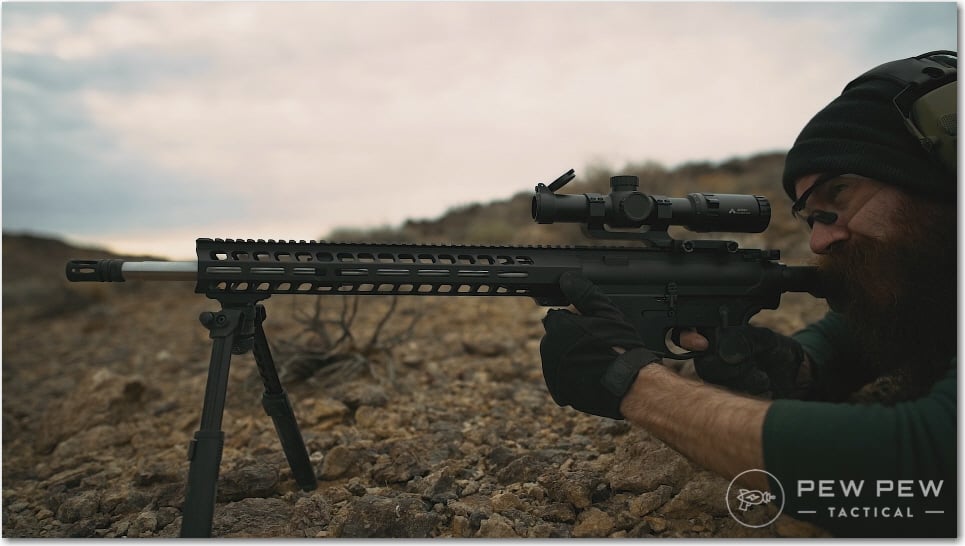
If you’re doing any kind of precision long-range shooting with your AR, you’re probably going to be shooting from a bench rest or a prone position…more so the latter if you’re really trying to reach out and touch something far away.
Stable shootin’ is good shootin’.
I’ve gone through several bipods, from the cheap to the “guess I’ll just skip eating this month,” so I like to think I have a pretty good idea of what to look for in a bipod, particularly one for an AR-15.
What makes a good AR-15 bipod?
Well, for me, an AR bipod and a bipod for a bolt gun are pretty similar, but there are a few considerations for an AR bipod that make certain ones slightly better than others.
Let’s talk about what makes a good AR-15 bipod and what bipods you should be looking at if you’re interested in shooting with one.
THE QUICK LIST
Why a Bipod in the First Place?
Shooting off bags or with a ransom rest is great and all, but good luck hauling those around if you’re hunting, participating in action shooting sports, or, worse, actual combat.
A bipod can help tremendously when shooting off of less-than-ideal surfaces.
A bipod, when appropriately used, gives you a lot more stability than trying to shoot free-hand, and it attaches directly to your rifle, so you don’t have anything else to lug around — though it does add some weight to the front end.
What Makes a Good Bipod?
Let’s talk about some of the considerations when choosing a bipod for your AR-15.
Find Something that Matches Your Caliber
Like a lot of things, the best bipod for you depends on your application. If you’re shooting a big .50 cal, you’re going to need something extremely robust and sturdy.
If you’re shooting a lightweight .22 target rifle, you still need something that will give you a stable shooting platform, but you can get by with something a little less robust.
Most AR-15s are fairly light in the recoil department, and you’re likely to be moving around with it unless you’re just doing some target shooting at the range, so you are best with something lighter if you can get it.
As with most things, you get what you pay for, so if you think you can get by with a $50 airsoft bipod on your expensive precision rifle, you are sadly mistaken.
This segues nicely into the next big consideration…
Durability of the Bipod
Your bipod is going to undergo a lot of stress between the recoil and supporting the forward load you put on it to control said recoil.
Adjustability is nice, but only if your bipod doesn’t snap in half during hard use.
Because of these stresses, we want a bipod that is going to stand up to repeated use and abuse. Now, if you’re looking for a rifle you shoot twice a year, you can skimp a little here. If you’re looking to hunt or compete with your bipod or plan on target shooting a lot, buy once, cry once.
Go with a nicer one. It’ll save you money in the long run when your cheapo knockoff doesn’t lock in place anymore.
Height of the Bipod
Height is another thing you need to choose based on your specific circumstances.
For one thing, the bipod needs to be able to reach a height that is comfortable and appropriate for the shooter. It’s absolutely possible for a bipod to be too low.
Most bipods have legs that adjust from 6 to 9 inches, which is a pretty standard height, but I personally like legs that go up to at least 15 inches to accommodate a broader range of shooting positions and angles.
Other Features
Some other little quality-of-life things are worth considering as well.
Bipod Feet
Are you mostly shooting on hard-packed dirt in the desert, or are you hunting over mostly soft-ish ground? Are you shooting off barricades and obstacles? Maybe you’re using the side of your deer stand or a tree limb most of the time.
There are specialized feet that excel on all these different terrain types and in these situations. I like a bipod with interchangeable feet so I can have whatever I need when I need it, but in general, I’d say go with a more aggressive foot than you think you’ll need.
Soft surfaces are stable surfaces, and hard-packed turf can cause your rifle to bounce more under recoil, which can make your follow-through and follow-up shots more difficult.
You may not always be shooting off a stable surface. Having the appropriate feet can help you get the most out of your bipod, no matter the conditions.
In general, your sights should stay on target through the recoil impulse, so if you find your crosshairs way off after a shot, there’s a chance your bipod isn’t gripping and is bouncing off the surface.
This is why we push forward to “load” the bipod, which is made easier with a more aggressive foot that grips the ground or other surfaces better than a smooth rubber one.
Notched Legs
This isn’t strictly necessary but notched or otherwise marked legs that let you get a really precise level are nice. These are also nice if you regularly shoot from the same bench and want to have a consistent height.
Pan and Tilt
A bipod that can pan left and right and tilt up and down is great for folks that may need to track a moving target, or otherwise have a large area they need to cover.
It’s not strictly necessary if you’re, for example, target shooting or even doing something like 3-Gun where you’re generally going to be shooting in one direction for safety purposes.
Attachment Method
Many bipods come ready to attach to the forward sling swivel on a bolt gun, which is something your AR probably doesn’t have, so may sure either you get one that works with your handguard, or you get an adapter that has a sling swivel for the other style.
Generally, a Picatinny mount with a QD lever is the way to go.
Best Rifle Bipods
Alright, with the criteria out of the way, let’s look at some recommendations. These are generally going to be for brands or particular lines rather than specific bipods because you’ll need to choose the one that meets your particular needs.
1. Harris Engineering Bipods
Harris bipods are perfect for those on a budget, especially since your AR isn’t going to put the stress on it that a larger caliber would.
I like the Harris 1A2-LM in particular because of its lightweight and easy-on-the-wallet price tag. If you’re looking to give this bipod thing a try, this is the perfect entry-level bipod in my mind.
They can regularly be found on sale in the $60 range, which is quite good for the quality and very good when you consider that some high-end bipods (that we’ll get to in a minute) can easily hit ten times that price.
2. Atlas Bipods
My preferred flavor of bipod comes from Atlas, and I will fill you in on why.
I’ve dragged mine through dirt, and mud, lost it off the side of a boat for about 15 minutes (no, it wasn’t my fault, yes I was furious), and generally abused it and never had a problem.
They are north of $200, but that’s actually pretty cheap compared to some of the really high-end bipods out there.
I’ve used this bipod on a .300 Win Mag rifle with no problems, so I can comfortably say it’s as bomb-proof as you can get at this price point, and it doesn’t bounce under heavy recoil.
It also has a really solid height adjustment and a wide variety of OEM and aftermarket feet you can easily swap out to suit your personal preference.
What’s your take on the Atlas? Rate it below!
3. GG&G Bipods
GG&G is another middle-of-the-road bipod option that is also good in this price range and is also made in the U.S., like Atlas bipods.
I include this one because I’ve heard such good things about it from other serious shooters.
Daniel Defense MK12 with a GG&G XDS bipod. (Photo: Primary Arms)
You can get a GG&G bipod for about the same price as a base model Atlas, but when you start looking at higher-end Atlas offerings, the price difference might come into play.
In general, I’d say go for either one, depending on which one is cheaper and how important some of that Atlas line’s extra features are.
4. Elite Iron Rev Lution Bipod
Are you one of those “overkill is underrated” types? Me too.
If you want a bomb-proof bipod that you can also use as a club once you run out of ammo, the Elite Iron Rev Lution is where you should look.
This is the bipod I’d buy if I needed just one to move from rifle to rifle with the confidence that it could handle anything from a .22 LR to .408 (no that’s not a typo).
Its extended legs can rotate 360 degrees within the mount, and thus you can get away with all manner of angles and configurations.
All-steel construction features no exposed springs, and an easy-locking will let you have a rock-steady shooting platform, even at weird angles.
The only downsides are the price ($600+) and the weight at 34 ounces, but if you’re looking for one bipod to do it all, this is the one.
5. MDT CKYE-POD Gen 2 Bipod
The MDT CKYE-POD might be the premier bipod on the market. I can’t think of one better than the CKYE-POD if you are a professional shooter who needs a top-tier match bipod.
Even the base model CKYE-POD allows for an extremely wide range of adjustments. (Photo: RifleShooter)
MDT designed the bipod to be easily adjustable with a single hand to allow positive control over the rifle as the bipod is deployed and put into action.
Adjusting the CKYE-POD’s leg height can be done with a single hand without much challenge. It’s quick, simple, and allows for broad adjustments.
On the standard model, adjustments range from 4.5 inches to fairly tall 15.5 inches. The height of the legs can also be adjusted independently of each other.
With 170 degrees of cant and 360 degrees of pan, your ability to move the rifle from target to target is unparalleled. There is also a pan-free version if you don’t care for the pan feature.
There is a separate tension adjustment for both pan and cant, and you can also swap the feet to best fit your shooting environment.
It comes in either left or right-handed designs, so even you wrong-handers can feel at home.
On top of all the fancy features, the CKYE-POD also featured a rugged design. It is made to last and refined with a tumble deburring process for smooth and easy operation.
This lightweight, high-tech bipod is designed with input for Norwegian special operations, earning it the Valhalla namesake.
It uses a rather ingenious and unique attachment system. You attach an included adapter, be it M-LOK or Picatinny, and then attach the bipod to the adapter.
This allows you to quickly remove and attach the bipod on the fly. Bipods are great when you need them, but when you don’t, they are boat anchors that unbalance your rifle.
After you remove the bipod, you are left with an adapter that weighs a few ounces at most, making it much easier to handle or store your rifle.
The Valhalla features 7075 construction with a hard-anodized finish. The feet feature tungsten carbide tips with textured synthetic slip-on ‘boots’ to accommodate multiple environments.
Spartan Precision designed the legs to be easily adjustable with a single hand, and they are spring-loaded for rapid deployment.
It’s a bipod designed for hunting, competition, and tactical shooting. It’s one of the most modular bipod platforms on the planet, and if you prefer that flexibility, this is the route to take.
7. Magpul Bipod
Magpul does a great job of delivering a product, and they did so again with their newly released bipods. These are half polymer and half Aluminum, meaning they are robust and lightweight.
Available in M-LOK, A.R.M.S. 17S, and Picatinny rail mounting options and in both Black and FDE colors — it’s fairly easy to find the right one for your rifle and tastes.
Adjustable between 6.3 and 10.3 inches gives most people the height options they need without adding undue weight to the system.
Weighing in at only 11 ounces also puts it at a fairly low weight comparatively, making it easy to hike and move with.
The feet aren’t our favorite we’ve used, but they do a good enough job on most surfaces and are durable even on ragged rock.
Plus, it’s got a nice clean look to it.
Final Thoughts
There are a lot of great AR-15 bipod options out there. Hopefully, this has given you some ideas about what makes a good bipod, how to choose, and some good places to start your search.
What do you think of these bipods? Do you have a favorite? Be sure to let us know in the comments below!Going to be shooting prone often? Check out our article on the 5 Best Shooting Mats!
DULUTH — Northern Minnesota’s moose have been hanging on for the past decade, reproducing and surviving at a rate barely able to keep up with an onslaught by wolves, bears, ticks and brainworm from deer.
First it was northwestern Minnesota’s moose that disappeared, in the 1990s, from thousands to virtually none over just one decade.
Then, northeastern moose numbers crashed by 70% from a modern high of 8,840 moose estimated in 2006 to just 2,700 by 2013.
The only good news since then is that their numbers haven’t dropped any more, hanging near the lower number with glimmers of hope that they might bounce back.
Now, an effort is underway to bring multiple groups together to bolster moose habitat and maybe work on other threats so moose can thrive — to build back to the moose numbers of 30 years ago.
“Our goal is not to have our moose population always hanging by a thread,” said Kelly Straka, wildlife section manager for the Minnesota Department of Natural Resources. “Our goal is to see them thrive. … Moose are iconic in Minnesota. They are critical to our ecosystem in the north. And people want to see them.”
To that end, Minnesota’s moose just received a big Christmas gift from the National Fish and Wildlife Federation, a federally funded grant of $443,600 to form a new moose collaborative that will lead to large-scale habitat projects in core moose range. It was one of 55 projects selected out of 500 applicants for the America the Beautiful Grants. The Minnesota DNR and tribal natural resource agencies are adding another $43,000.
The goal is to restore massive tracts of moose habitat over the next decade — at least three areas of 10,000-50,000 contiguous acres, 15-75 square miles each — considered huge parcels even in the vast wilds of Northeastern Minnesota.
The patchwork of tribal, federal, state, county and private land in Northeastern Minnesota makes large-scale habitat restoration particularly challenging. The grant isn’t buying any land or paying for any actual work on the ground.
Instead, it’s aimed at hiring a coordinator and bringing multiple parties together: the U.S. Forest Service, tribal resource agencies, the Minnesota DNR, county forestry departments, conservation groups like the Ruffed Grouse Society and Nature Conservancy as well as many private landowners.
The grant will pay for workshops through 2024 and into 2024 to see if the participants can get past the social, political and practical barriers and agree where it’s possible to conduct massive habitat work — either intentional fires or logging or both.
“The goal is to have a plan, to get all their parties at the table and come up with a plan to see where it makes the most sense for moose, and where it’s possible for us, to create some really large-scale habitat blocks,” Straka said. “It’s not that forest management hasn’t been occurring. It just hasn’t been big enough to really help moose.”
More logging, more fires, more moose
Mike Schrage, wildlife biologist for the Fond du Lac Band of Lake Superior Chippewa, watched moose numbers decline from his seat in a helicopter as part of a team of biologists who count moose each January in an annual aerial survey coordinated by the Minnesota DNR. What he saw most winters was depressing for anyone who enjoys moose.
Part of the problem is that large areas of Northeastern Minnesota, especially in the core Boundary Waters Canoe Area Wilderness and other blocks of the Superior National Forest, have trees that are too old for moose to thrive. Efforts to snuff most wildfires, a prohibition on logging in the BWCAW and a reduction in logging across the Superior National Forest and on private land has led to an older, mature forest that doesn’t offer great food for moose.
But Schrage noticed a few places where moose seemed to be doing better, namely wherever a large forest fire had occurred in recent years, like the 92,000-acre Pagami Creek fire inside the Boundary Waters Canoe Area Wilderness in 2011 and the 75,000-acre Ham Lake fire along the end of the Gunflint Trail in 2007. Apparently, size matters when it comes to moose habitat, and these were the state’s largest wildfires since the 1930s.
It didn’t take an expert in moose biology, Schrage noted, to see what was going on. It’s in those big burned areas, now lush with new growth, where the highest moose densities have been seen in the past decade. That gives Schrage and others hope that moose will respond quickly to any large-scale habitat work conducted as part of the new collaborative.
Not every tree was burned of course, pockets of older trees remained — good cover for moose to hide in — but enough trees were gone to open the forest floor to sunlight and a new crop of vegetation for miles on end.
“I think we can double, maybe even triple moose numbers in those (habitat project) areas, if they are large enough,” Schrage added. “In the areas of the big fires, when we fly now, we may see 10 or 20 moose per 13-square-mile unit, compared to one or two moose, or none at all, in some areas outside the fires.”
Research crews for the Grand Portage Band of Lake Superior Chippewa now have about 30 moose wearing transmitter collars in and around the Grand Portage Reservation. In January, they will begin collaring another 25 moose in Minnesota and another 25 on Isle Royale as comparisons continue between the mainland and island moose herds.
Seth Moore, director of biology and environment for the Grand Portage Band of Lake Superior Chippewa, is especially interested in how moose respond to the 26,000-acre Greenwood fire from 2021 in Lake County, near Isabella. While that fire forced evacuations and destroyed several cabins and homes, it also created prime moose habitat. Moore’s already seeing more moose in that area and he expects the ongoing aerial surveys to show a noticeable jump.
It’s unlikely that huge, intentional fires will be a major part of the moose habitat project — there’s simply too much opposition from home and cabin and owners now numerous across much of the moose range. But a series of smaller fires, or much larger-scale logging operations, or both, could mimic the same results as a single, larger fire.
“We have in our minds what the forest, what the northwoods, should look like. Big, old trees are usually in that picture,” Straka said. “But variety is important. Moose need variety. They need old trees for cover and they especially need young forest for food.”
Moore said social attitudes will need to change if efforts to truly restore the state’s moose population are going to succeed: attitudes about managing and killing some wolves, attitudes about large clear-cut swaths of forest and attitudes about wildfire.
Fire, Moore noted, is how nature created moose habitat for millennia.
“We’re going to have to make some difficult decisions to keep moose on our landscape in northern Minnesota,” Moore said. “I’m not sure how we got to a point where people think clear cuts are all bad. … It’s how we keep part of the forest young. And moose can’t make it without young trees to eat.”
Schrage agreed. While some people may bristle when miles of forest briefly appear blackened from fire, or void of big trees after a logging operation, Schrage says they will also be surprised at how fast the forest regenerates. And it’s that young growth that moose need most: shoots of aspen, paper birch, alder and balsam fir. Many species of tree and brush that moose favor regenerate on their own.
“I think people wouldn’t mind looking out over a clear cut if there was a moose in the middle of it,” Schrage said.
For Minnesota moose, many maladies
It seems at times as if humans and Mother Nature are ganging up on moose, throwing a bevy of problems at the big animals that they seem unable to overcome.
Perhaps foremost is the warming climate, with warmer summer temperatures taking a toll on the big, dark animals that tend to stop feeding when it gets too hot. Warmer winters allow white-tailed deer to thrive farther north and allow tick numbers to build.
Related Articles
Minnesota DNR approves Twin Metals plan for mineral exploration in shadow of Boundary Waters
Biden touts investment in rural areas in Minnesota, the home state of his primary challenger
This was the second snowiest Halloween on record in the Twin Cities
Camp Ripley testing finds ‘forever chemicals’ in nearby wells
White Earth Nation says water ordinance is allowed under 20th-century treaties
So-called “winter ticks” have become a huge problem for moose, with sometimes thousands of them building up on a single animal. Moose, for whatever reason, don’t seem to notice the ticks until it’s too late, then begin to furiously scratch their thick hides on trees in an attempt to get rid of the parasites.
That causes moose to lose their insulating hair, and many of the tick-infested moose eventually have so much bare skin exposed that they die due to exposure to the elements.
Generally, warmer winters also have allowed deer to thrive farther north over the past 50 years. Whitetails were not native to the northern forest but moved in after the massive logging and fires of the early 1900s. Deer numbers peaked during a string of mild winters in the early 2000s, thriving far into moose territory and bringing along a parasitic brainworm, P. tenuis, that, while harmless to deer, is fatal to moose.
The brainworm’s unusual life cycle requires that it passes through a snail first, and then is picked up by moose as they forage. Moore’s research found that 25% to 30% of moose mortality in Northeastern Minnesota was from brainworm, a larger percent of adult moose than are killed by predators.
Snowier winters, fewer deer may be helping
A string of deep-snow winters in the past decade has substantially reduced the region’s deer population, which is good news for moose. To curb the brainworm problem, Moore said, deer numbers should be kept to six or fewer per square mile in moose territory.
“We thought 10 (deer per square mile) would be low enough. But in areas where we had that many deer we still had a lot of brainworm,” Moore said.
The number of moose infected with brainworm seems to be dropping some as deer numbers have dropped in recent years, Moore added. But when deer numbers rebound from the tough winters, as they always have in past decades, Moore wants the Minnesota DNR to encourage more hunters to kill more deer in the state’s moose range by offering more doe permits and longer hunting seasons.
The DNR already has designated much of eastern St. Louis, Lake and Cook counties as primary moose habitat. But intentionally keeping deer numbers very low is likely not something many deer hunters in the region would support.
“The deer will come back after a few mild winters. And we need some sort of ongoing effort to keep their numbers down,” Moore said.
Wolves, bear taking most calves
A cow moose and her calf. A new national grant aims to bring landowners and agencies together to create large swaths of better moose habitat in a long-term effort to increase moose numbers in Northeastern Minnesota. (Courtesy of Pete Takash/Minnesota DNR)
Moose have lived alongside wolves for millennia. But, in northern Minnesota, wolves have grown to higher densities thanks to white-tailed deer – some of the highest densities of wolves anywhere in the world. Wolves are most numerous in areas where deer are more numerous because it’s far easier for wolves to kill a deer than kill a moose or elk.
But now that deer numbers have declined in the northeast, wolves either move out, starve or turn to other prey. And, for several weeks each summer, wolves and black bears are feasting on moose calves too small to escape. The number of calves surviving their first year, and getting old enough to reproduce on their own, is extremely low, barely enough to keep moose numbers stable. Until more calves make it, Minnesota’s moose population can’t grow.
“The primary cause of calf mortality is predation,” Moore said. Of the calves researchers have collared, 80% are killed in their first two weeks by wolves and bears.
Wolves in Minnesota are considered an officially “threatened” species, with slightly less protection than endangered status. That’s allowed an ongoing federal program to trap and kill wolves near farms where livestock have been killed. Moore thinks that would be a good idea in prime moose range, too, if public hunting and trapping moose remains off the table.
“Moose are the primary subsistence species of the Ojibwe people, that’s their livelihood, their crop, so to speak. And you wonder why we can have a management program for farmers to protect cattle but not a wolf management program to protect moose,” Moore noted.
Moore added, however, that several tribal officials across northern Minnesota remain opposed to any wolf killing efforts.
“It’s a difficult topic. … I realize some tribal people are opposed to killing any wolves. But we have to realize what’s at stake here? Do we want to lose moose in Minnesota?” Moore added.
Good news, then bad news, but still hope
Last winter, the annual state survey of moose in Northeastern Minnesota showed an increase to about 4,700 moose after their numbers appeared stuck around 3,500 for several years. Crews will be back out next week to start the 2024 survey, with results released in spring.
The 2022 aerial survey found calves comprised an estimated 19% of the population with an estimated 45 calves per 100 cows. That’s the highest both indicators have been since 2005, when the population was near its peak and considered healthy. Both factors are indicators of potential improvement in reproductive success, critical to increase overall moose numbers.
In 2005, when the moose population was healthy, 52% of all cow moose surveyed had a calf still alive in January. That number dropped as low as 32% in the worst years recently but rebounded to 45% in 2022, the 2022 survey found.
But the 2022 survey was conducted in January, still early in a winter that became so severe that even long-legged moose struggled to survive, Moore noted. Some areas of moose range had nearly three feet of snow on the ground well into spring.
“We lost most of our collared deer due to winter severity last winter. But we also lost probably 25% of our collared moose. They started going in April and were still dropping even into July … they just got so weak during winter they couldn’t recover and died,” Moore said. “I have a feeling that the (2024) moose survey is going to be back down again after seeing so much mortality after last winter.”
Moore wants to see a cooperative effort eventually agree to a Minnesota moose recovery zone — an experimental area where extra efforts would be tried to see if moose numbers can be increased. That would mean not only large-scale swaths of fires and logging, but also an ongoing effort to keep deer numbers very low as well as some sort of focused wolf management, at least short term, to give moose calves a fighting chance at growing up.
Moore said he believes the effort can work if obstacles are overcome.
“I have some hope. I think it’s possible to keep moose on our landscape, but we have to act soon,” Moore said. “The good news is that the (Minnesota) DNR seems to be reinvesting some time, energy and thought into moose again, and that hasn’t really happened for a while. We need the DNR, and the Forest Service, fully engaged to really make this work.”
Related Articles
GroundBreak, Center for Economic Inclusion expand efforts to close wealth gaps
Homeless man taken in by elderly Iron Range couple is charged with fatally beating them
Minnesota appeals court protects felon voting rights after finding a lower court judge overstepped
Minnesota justices appear skeptical that states should decide Trump’s eligibility for the ballot
Flurry of last-minute submissions boosts entry pool for new Minnesota state flag/seal to 2,633
Limiting the best rifle calibers to only three options can be a daunting task when considering most big-game animals, and this can be especially true when referring to wild hogs. Any avid hunter knows that these pigs can come in many different shapes and sizes, making it a challenge to select that caliber of choice in order to bring home the bacon. For some, it’s all about that massive, trophy hog, commonly referred to within the hunting community as “Hogzilla.” However, some hunters might just want to take what they can get considering the destruction these razorbacks cause to farmers. Plus, the smaller ones make great table fare as well.
Regardless of what category you fall into, these three caliber options, proven by the evidence in each entry’s video, will pack the punch you need to bring some boars down and put some bacon on the grill.
1. .308 Winchester
It seems firearms chambered in .308 Win. get the job done the best. Some great firearm choices for hog hunting, when chambered in .308, are the Smith and Wesson M&P 10 and the Browning BAR ShorTrac Hog Stalker.
If for some reason you have doubts about shooting this ammo at a wild boar, or anything while big game hunting, just take a look at what happens at the 3:25 mark in the video!
2. .30-06 Springfield
Very similar to the .308, the .30-06 has been one of the most widely used whitetail deer hunting rifles a long, long time. Well, guess what? It works great for shooting hogs, too. This caliber is accurate, powerful and deadly, even in the hands of novice hunters.
To check out a great summation of the differences between the way each performs in the field, listen to this guy break down the nitty gritty.
3. .270 Winchester
Also known as a deer rifle, the .270 is just simple and effective. With the right shot placement on a broadside pig, a bolt-action .270 packs enough punch and penetration to get the job done on the little piglets, as well as the full-grown feral hogs!
Be sure to jump to the 4:55 mark in the video to see the way a .270 can make a Texas hog drop right in its tracks from long range!
If you’ve spent any time chasing these razorbacks through the southern terrain, you know just how tough these animals are, and how much damage they can take and still continue to keep running. Using a rifle caliber that is proven to be deadly is always a plus, but nothing replaces steady aim and ethical shot placements, regardless of what gun you are using.
Some people might be surprised that the Remington .223 didn’t make the list, but honestly, these calibers listed speak for themselves in regards to their lethality on feral hogs. Having said that, deciding which caliber to use really depends on your experience and comfortability with certain rifles, and this should just serve as a great baseline and information resource. The important part is that you get out there, enjoy the great outdoors, help battle this country’s ruthless hog problem, and bring home some of the best wild game nature has to offer.
READ MORE: HERE ARE THE GUNS THAT DONALD TRUMP CARRIES EVERYDAY
When I turned 12 and could begin to hunt big game, I drew one of the lottery-draw turkey tags. Turkeys in western Montana were starting to have a huntable population, and you had to put in for the license. As a 1st time hunter, I could hardly wait for the month between my birthday and the season. Dad called in a bearded hen, and I remember watching him sprint from where he was calling when the bird went down. He has seen them jump back up and wanted to secure it just in case. I was shocked and slightly, okay, very amused at the time. It was a great day and a great beginning! I still laugh at how small I was in that 1st picture of me with my first big game.
Hunting in Eastern Montana, Dad split and went around to hunt the other side of the hill. There had been a flock of turkeys around this ranch, and dad was packing his Marlin 25-20 Winchester. I heard the report of his gun and found his turkey in hand. Since then, the 25-20 lever action has always held a particular fascination in my life. My father has always loved lever guns and now makes peep sights for all sorts of lever and other firearms. I now get to test Skinner Sights every year! Don’t knock the perks!
A couple of years ago, on the last day of the year, and correspondingly the turkey season, I borrowed a 25-20 Winchester from dad, and we went hunting. Turkeys don’t respond to a call much this time of the year, but we found a flock working its way through some small trees and sagebrush. A hen came into view between some brush and hesitated. The hundred-plus-year-old Winchester took care of her without ruining much meat. Dad followed the flock, and I heard his Ruger International in 22 Magnum fire. We both had hen turkeys in an area where Fish Wildlife and Parks was trying to reduce the turkey numbers. Good deal!
Hunting deer one day, and I chose to pack my CZ 17 Hornet rifle in case we bumped into any turkeys. About 10 Merriam toms started to run across a bog from us. I lined up on the back of one and tripped the trigger. He fell where he was, and I had to wade across the slightly frozen marsh to get him. He probably made my best turkey hunting pic! Montana has both Eastern and Merriam turkeys. I still need to find a Rio somewhere down south to complete the Slam!
On another post-Christmas hunt, dad and I were hunting turkeys in the snow. We came around a corner and found three toms. He shot him with a Savage 17 Hornet, and I used my CZ. Two turkeys down! What great memories!
Of bows, shotguns, pistols, and rifles, I enjoy hunting turkeys with rifles the most. Montana doesn’t allow for this method of spring turkey hunting, but it does in the fall. Some other states allow rifle hunting turkeys in the spring and fall, and some allow air rifles during some of their seasons (CA, GA). States that allow turkeys for rifle harvest include Colorado, Florida, Maryland, Missouri, Montana, Oklahoma, Utah, Virginia, West Virginia, and Wyoming. Keep in mind; this list may change with recent legislation changes; always check your regulations before you go!
So, let’s discuss the big questions: ethics and reasoning. Many hold the position that turkeys should only be hunted with a shotgun or a bow. In many areas, these hunters are right. Tight population densities and short-range hunting expectations leave rifles out of either need or safe practice. But yes, there is another option. I live in Montana, and our state is larger than the country of Germany. Couple that with just over 1,000,000 people, and you have a lot of space without the population density. Also, many of our turkeys live in the wide open. Creek bottoms, big fields or pastures, and mountainsides make up much of where we find turkeys. In our state, only toms are harvestable in the spring. When turkeys don’t come running to a call in the fall, they open it up to either sex and longer-range guns. This is ethical and safe in our part of the world.
Montana allows for the harvest of mountain grouse with big game rifle calibers. Many hunters love to add this table fare to their backpack as they hunt the mighty elk and deer. Picture this: you’ve been hunting all day, six miles up the mountain, and are just returning to the truck around noon. You have a Cup-o-Soup at the vehicle and a jet boil camp stove. Half a mile before you are going to round the corner and see that beautiful 4-wheel drive; there is a ruffed grouse just above the old logging road you’re walking down. You pull your 300 Winchester Magnum off your shoulder, adjust for close-range trajectory and shoot the ruffed grouse in the neck. No meat spoiled and the best wild meat (in my opinion) in Montana to add to your lunch.
Turkeys afford the same opportunity. You don’t have to carry two guns just in case you bump into this other species. A safe hunter always makes sure of their target and beyond and should not fire unless they know where that bullet will wind up. Not all states allow any caliber for hunting turkeys like Montana for apparent reasons.
When picking a rifle or pistol caliber to hunt turkeys specifically, I don’t think it gets any better than the 17 Hornet. The penetration is perfect, and you can choose the neck, head, or center of the back. I say this as a spine shot that penetrates the lungs and heart area is a perfect shot for a bullet that isn’t going to go all the way through this size of a bird. The standard 22 Hornet and 223 Remington are also suitable calibers, but you will need to pay more attention to where you hit as more meat will be ruined. The time-honored 25-20 WCF is comparable in these considerations. A 22 Long Rifle and 22 Magnum are good turkey calibers in the right hands under the right circumstances (distance, moving or still target, the accuracy of shooter and firearm).
One of the things that make our country great is the right of choice and the freedoms we have. Responsible hunting keeps more of these freedoms open to us. Go have fun hunting turkeys with whatever legal means available to you! Not everyone will agree or want to participate in the different modes of turkey hunting, but not finger-pointing or condemning helps everyone. I, for example, have no interest in hunting from a tree stand. It is just not something we do much where I hunt, but that doesn’t make it wrong, worse, or better.
I will always advocate that hunting with someone makes a bond that you can’t get almost anywhere else. My father and I are best friends primarily based on this time and experience together. I think back to that first time I heard a turkey harvested with that 25-20 and the hope and desire it created within me. Aspirations and goals spur us on to progress, and living lives focused on what’s next! Don’t live in the has-been; go live in the what’s ahead!
There are a ton of different stabilizers types, styles, sizes, and mods out there, so it can be difficult navigating the world of stabilizers. We’ll go over everything you need to know and give you all the juicy details.
Make sure to check out our in-depth guide on how to build a keyboard.
What is a Stabilizer?
Stabilizers are a essential keyboard component placed under the larger keys such as space bar, backspace, and shift, to keep the keys from shaking, rattling, and tilting while typing. The stabilizers keep the keys balanced so you can have a stable typing and gaming experience.
The Different Stabilizers Types
There are a few different stabilizer types out there, Cherry style, Costar, and Optical. They are each significantly different, so we’ll explain what makes them unique.
Cherry Style Stabilizers
Cherry style stabilizers are the most common stabilizers out there. They are the preferred stabilizer type as they are easy to mod and have a lot of different options when it comes to mounting styles, colors, and material types.
Cherry stabilizers have the shape of a Cherry MX switch stem, hence the name Cherry style stabilizers. They make adding and removing keycaps a breeze.
In this guide, we’ll be focusing primarily on the Cherry stabilizer type when explaining all of the different options available. It’s possible to get Cherry style stabilizers in screw-in, snap-in, or plate-mounted variations.
We highly recommend getting a keyboard with Cherry stabilizers as they are the most versatile stabilizers out there.
Costar Stabilizers
Costar stabilizers are a less common stabilizer type, as they are primarily only found on older keyboards, although some newer keyboards may have them.
Costar stabilizers are quite difficult to use and have to be hooked into the keycap to fit. Getting the stabilizer bar to insert properly into the keycap can be a frustrating and lengthy process.
If you like to remove your keycaps and clean your keyboard regularly, these stabilizers can be quite the headache.
They are also difficult to mod and makes replacing the keycaps on your keyboard quite difficult.
Costar stabilizers are great if you want to install them and forget about em. No modding required, pretty good performance, and are affordable to replace. However, not the best if you enjoy tinkering with your keyboard and swapping out your keycaps regularly.
We talk about installing a spacebar with Costar stabilizers here.
Optical Stabilizers
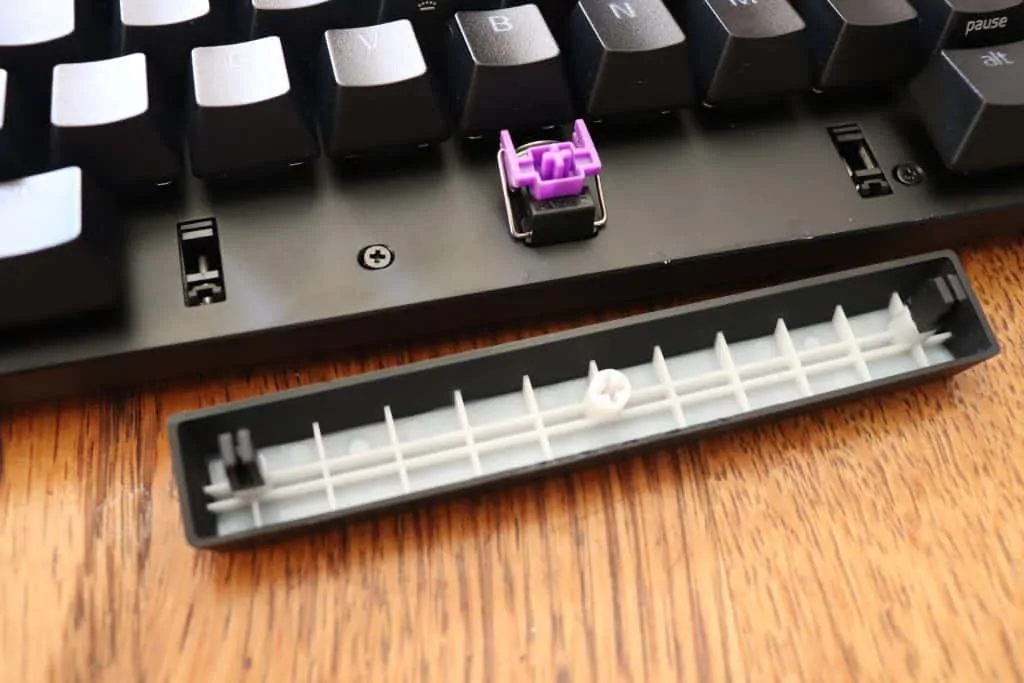
Optical stabilizers are typically only found on keyboards with optical switches, and have a funky design (such as the Razer Huntsman Mini). They have small clips that insert into the keycap that you snap into the stabilizer bar under the plate of the keyboard.
There isn’t a good way to modify these stabilizers to improve them, although you could apply a small amount of lubricant to reduce the sound and rattle noises.
From our experience, these stabilizers are quite rattily, but if you use optical switches, you’re pretty much stuck with them. Not much else to say about these stabilizers.
Stabilizer Size Guide
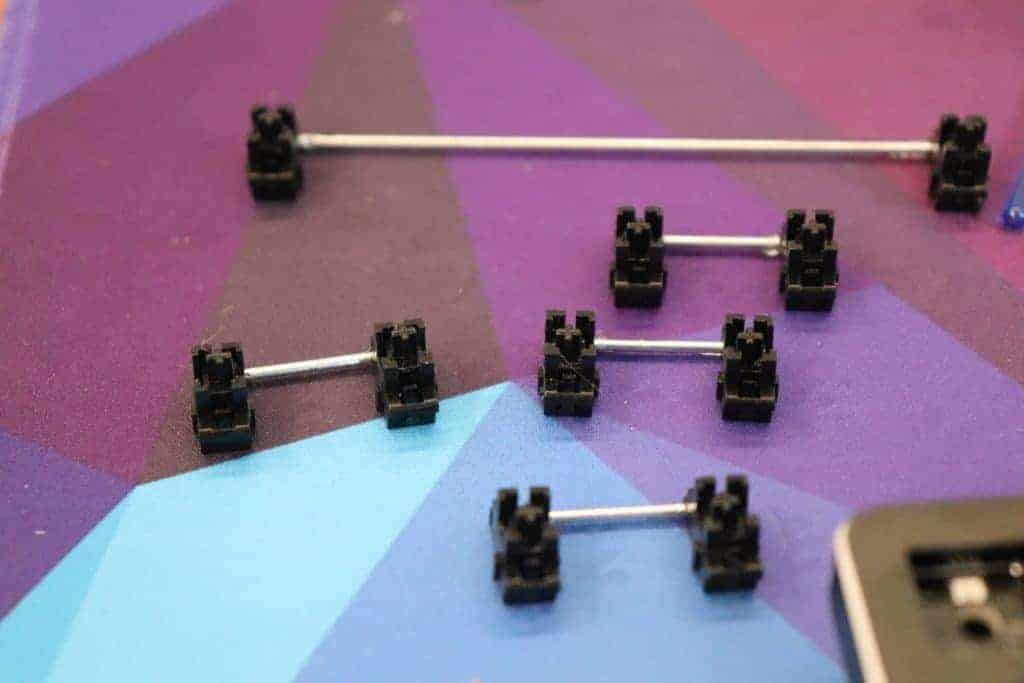
There are three stabilizer sizes you can purchase: 7u, 6.25u, and 2u.
The stabilizers follow the same measuring system as keycaps, where 1u = the width of one keycap.
The 6.25u size is what you’ll need for a standard spacebar, unless you have a non-standard keyboard layout, in which case you’ll need the 7u size. For the most part you can ignore the 7u size, unless you have a custom keyboard.
All of the other larger keys on your keyboard (that aren’t the spacebar) will require a 2u stabilizer.
If you have a full-sized keyboard, you’ll need:
6.25u stabilizer x1
2u stabilizer x7
If you have a tenkeyless keyboard, you’ll need:
6.25u stabilizer x1
2u stabilizer x4
For the smaller layouts, the stabilizers required can vary based on the layout of the keyboard, so there is no exact amount.
A Closer Look at Cherry Style Stabilizers
Now that we’ve gone over the three main stabilizer types, let’s take a closer look at the Cherry style stabilizers as they are the most common and the go-to stabilizer if you’re building a keyboard.
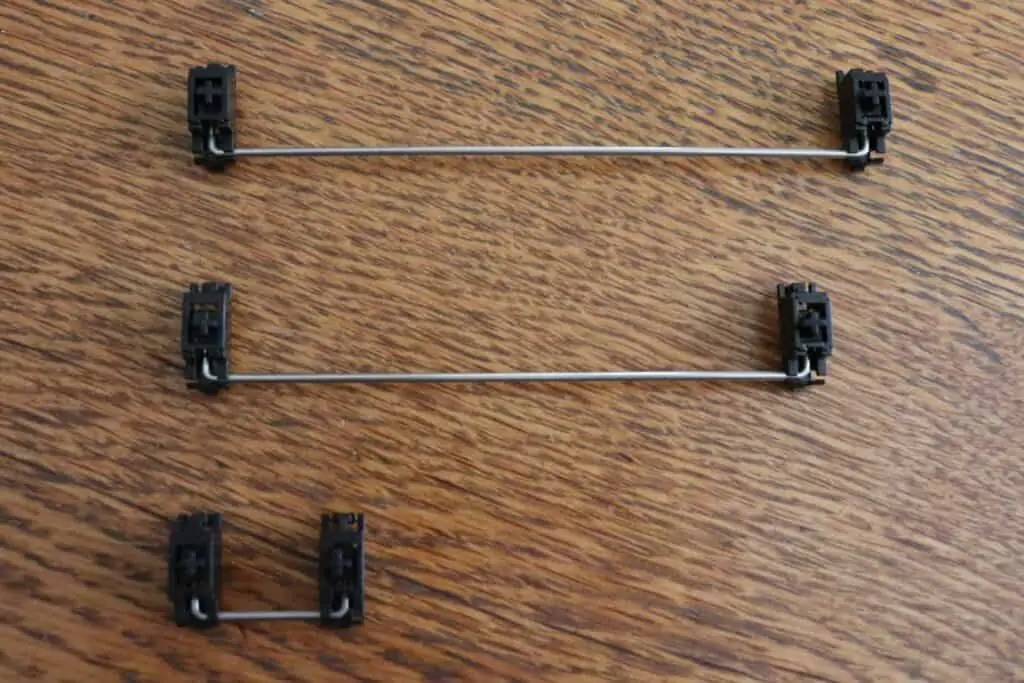
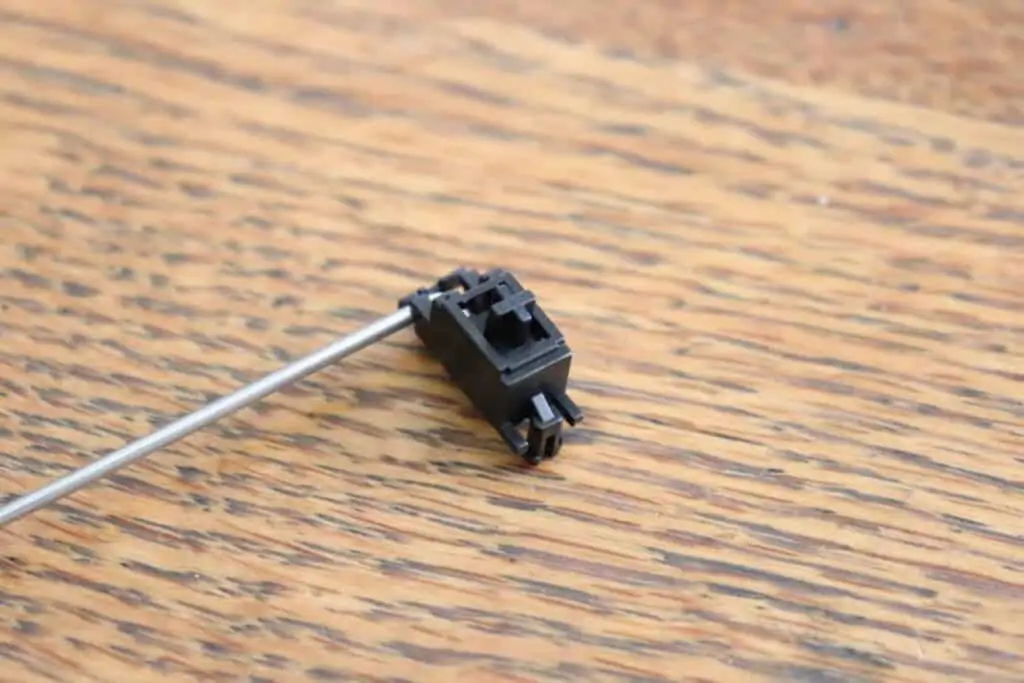
Cherry stabilizers are made up of three main components, the stabilizer bar, insert, and housing. These three components work together to keep the larger keys stable and reduce rattle.
Each key will have one stabilizer bar, two inserts, and two housings. The stabilizer bar keeps both sides of the key from tilting when typing. The stabilizer bars come in several different sizes based on which key it is for, but we’ll get into that later.
Different Mounting Styles for Cherry Stabilizers
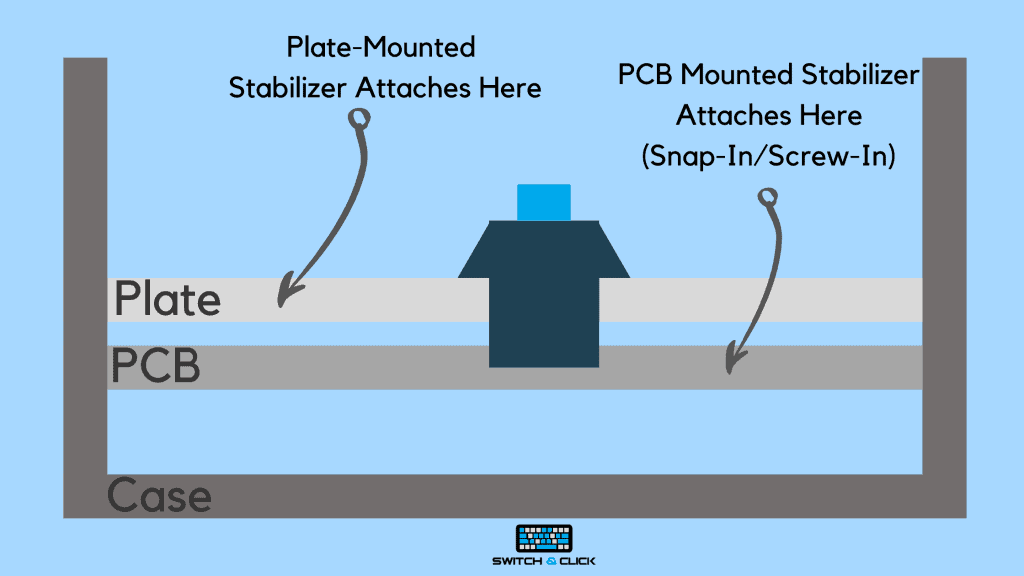
There are three different mounting styles for Cherry style stabilizers, they can attach differently and are compatible on certain keyboards. Plate-mounted stabilizers attach to the metal plate, while the other two attaches to the PCB (printed circuit board).
Shown below is a side view of a keyboard with a metal plate and PCB. Read more about PCB vs plate-mount.
Plate-Mounted Stabilizers
Plate-mounted stabilizers are the most common mounting style and are typically found on almost all pre-built mechanical keyboards. These stabilizers attach to the metal plate inside the keyboard instead of directly to the printed circuit board (PCB).
Plate-mounted stabilizers are considered the least effective mounting style as they tend to rattle more and vibrate with the aluminum plate when typing. It’s possible to improve these stabilizers by modding them which we’ll get into later.
The stabilizers attach by clipping/snapping into the metal plate. This style of connection is not the most secure and adds to the overall amount of shaking and rattling.
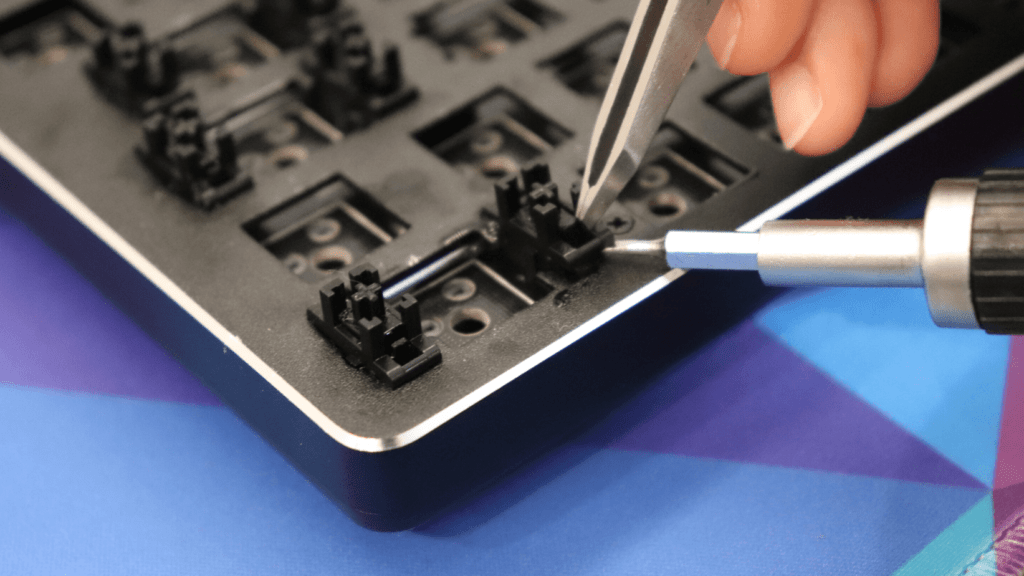
You can remove these stabilizers by first removing the switch, then pressing on a small plastic tab on the stabilizer, while simultaneously lifting up on the stabilizer.
Screw-In Stabilizers
Screw-in stabilizers mount directly into the PCB and are attached with screws. This mounting style is considered the best because the stabilizers are much more secure and will vibrate less.
In addition, the screw-in stabilizers remain in place when taking off the key caps, unlike the snap-in style which tend to dislodge.
The PCB also tends to vibrate less than the metal plate, which makes it a better mounting location for the stabilizer.
Screw-in stabilizers are typically only found on custom-made keyboards and not on pre-built keyboards, which makes them less common, but highly sought after.
We highly recommend the screw-in stabilizer type if you plan on building a keyboard.
Snap-In Stabilizers
Snap-in stabilizers are another PCB mounted stabilizer type. They are better than plate-mounted, but not quite as effective as screw-in stabilizers.
Since snap-in stabilizers mount to the PCB, they tend to vibrate less than plate-mounted, which makes them a better option. The only downside is they are much less common than plate-mounted, and they are typically only found on custom keyboards.
Screw-in stabilizers are usually a better option than snap-in as they vibrate less and are more secure. The only situation where we would recommend this stabilizer type is if you can’t find a keyboard with screw-in stabilizers.
As mentioned before, snap-in stabilizers can pop out the PCB when trying to remove the keycaps, where screw-in stabilizers do not have this problem.
Different Brands that Make Cherry Style Stabilizers
There are a few main companies that manufacture Cherry stabilizers and they typically come in a variety of different colors and materials.
Durock Stabilizers
Durock stabilizers are interesting because the stabilizer housing insert come in a nice translucent purple with a gold-plated stabilizer bar, if you’re feeling a little fancy. Perfect for building a keyboard with each component adding to the overall aesthetic.
These stabilizers are actually quite affordable considering how unique they look, which makes them an excellent option. We find them to be smoother than the standard GMK stabilizers.
Durock stabilizers only come in the screw-in style, so you can really only use them on a custom keyboard. All of the three sizes are available for purchase (2u, 6.25u, and 7u).
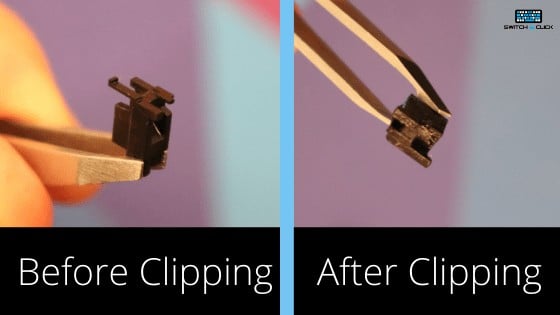
Durock stabilizers come pre-clipped, which mean the little feet on the bottom of the stabilizer housing are removed to make them more stable and improve the typing experience. Many people will do this manually to GMK stabilizers if they mod them.
We also recommend ordering these off of Prevail Key Co.
GMK
GMK is mainly known for their high-end keycaps, but they also produce genuine Cherry style stabilizers. This means they actually hold the tooling to make the “proper” Cherry stabilizers. If you have a keyboard with Cherry stabilizers, most likely they were produced by GMK.
GMK makes very plain and normal looking stabilizers, with a black stabilizer housing and insert, along with a grey metal stabilizer bar. You can get GMK stabilizers in all three mounting styles: plate-mounted, screw-in, and snap-in.
We typically order GMK stabilizers off of NovelKeys as they have them stock-in more often than other stores.
ZealPC
The most expensive stabilizers on the list ($30). Coming with a gold-plated stabilizer bar and clear housing, the ZealPC stabilizers have a design that can work with almost any colored keyboard (unlike the purple Durock stabilizers).
The stabilizers are pre-clipped which makes them rest on the PCB in a more stable fashion and improve the typing experience.
The ZealPC stabilizers are offered only in the screw-mount style, with a custom nut design to prevent stripping the threads.
It’s hard to recommend these stabilizers due to the super high price, when the Durock stabilizers are available with many of the same features at a fraction of the cost.
You can find these stabilizers on the ZealPC website.
Everglide
Everglide stabilizers come with a gold-plated stabilizer bar and clear housing, very similar to the ZealPC stabilizers. They are also pre-clipped, come in the screw-in style, and are a decent price.
These stabilizers come in all three sizes, or you can buy them as a package to save money depending on what size keyboard you have.
You can find them on the kprepublic website.
How to Improve Cherry Stabilizers
If you are willing to put a little extra work in, your Cherry stabilizers can benefit from some custom modifications, the most common being band aid, clip, and lube.
The band aid modification includes applying band-aids where the stabilizer insert hits the PCB to dampen the sound and create a much nicer acoustic.
Clipping the stabilizer feet makes the key feel more stable and less rickety. Many stabilizers come with the feet already clipped.
Lubricating the stabilizers reduces the friction when typing and makes them feel smoother and more consistent.
After these modifications, the stabilizers will feel much better and the difference will be night and day. I recommend everyone with the time and patience to try this mod out.
We have a couple guides on our site to walk you through these mods. Depending on if you have soldering equipment or not, there are few different methods:
How to Band-Aid Mod, Clip, and Lube Stabilizers
How to Lube Stabilizers without Desoldering
Click test before and after modification
Conclusion
There is a lot of tribal knowledge in the mechanical keyboard community about stabilizers that everyone assumes you know already, so we hope this post laid out the information for you in a clear and easy-to-read format.
There is a lot of small complexities to sort through when picking out a stabilizer for you next mechanical keyboard. There are many stabilizer sizes, types, manufacturers, and mounting styles, not to mention all of the modifications.
For your first mechanical keyboard build, we highly recommend picking out a keyboard that supports screw-in Cherry stabilizers and going with the Durock or Everglide variations depending on which colorway/price works best for you. These two stabilizers offer the best bang-for-your-buck and offer a smooth, stable typing experience.
If you have a pre-built mechanical keyboard, you’ll usually be stuck with plate-mounted stabilizers (even if it’s hot-swappable). Screw-in and snap-in stabilizers are typically reserved for custom mechanical keyboards.
We also recommend taking the time to mod your stabilizers to improve them even more. A little bit of lubricant and band-aids goes a long way.
I’ve written a bunch about the act of nymph fishing, but I haven’t talked much about nymph flies themselves. Using a nymph while fly fishing is probably the most effective method of catching trout. It doesn’t have the glamor of dry fly fishing, but nymphing can change a skunk into a productive outing.
What is a Nymph Fly?
A nymph fly is a fly fishing lure that simulates a sub-surface bug with a hook in it during the larval stage. Mayflies, damsels fly, stone flies and caddis flies start life as eggs on the stream bottom. The eggs hatch into a nymph or larva and become a prized meal for trout.
Examples of Nymph Flies
Nymph Fishing Flies
Pheasant Tail Nymphs in size 10 through 16. These flies should be in every fly box. Proven effective, and easy to tie if you’re a fly tier. Get a couple with beads and you’ve got most situations covered.
Hares Ear Nymph in size 12 through 18. I like using a hare’s ear as a dropper in size 16 off a buoyant dry fly. The light color of the hare’s ear simulates so many bugs. If you want to fish this nymph a little deeper find flies with brass beads.
Green Caddis size 10 to 16. When the trout are keyed into green caddis you’ve got to fish them deep and on the bottom. I’m always amazed at how vibrant green these nymphs are.
Tips for Selecting an Effective Nymph for Fly Fishing
A common quote in fly fishing circles goes like this. So what are they biting on? Those little brown flies about 3/8 inch long with a hook inside.
This hits home the important factors in selecting a nymph fly. If you pickup a river rock or submerged log and get your nose down close and look. If the water you’re fishing has trout, odds are you’ll see lots of little brown bugs crawling around.
Here’s the tip: Size up those creepy crawlies you see under rocks and woody debris and select a fly that’s close in color and size.
Green Caddis are really common on my home water. I’ve learned through years of experimenting that the best nymph for me to start out with are those green beauties.
caddis fly nymph bug and fly
How to Fly Fish with a Nymph
The simplest way to start nymph fishing is to use an indicator. Basically rig up a longer leader 9 to 12 feet is best. An indicator is a float that can be positioned along the leader. I start by placing the leader 3 times the water depth when fishing in a moderate current. Tie on a fly like the hares ear or green caddis and hang on!
Read more about nymphing with an indicator in this article. What is a strike indicator in fly fishing
Another method is called “high stick” nymphing. This method uses a fast sinking nymph fly and fish relatively close (10 to 15 feet away) Instead of letting the fly drift in the current, while high sticking the angler actually leads the nymph through the fishy water.
I’ve written a great article that goes into all the details of high sticking. How to High Stick Nymph Fly Fish
If you see occasional trout rising, setup a dry fly with a dropper nymph. This combination can be super effective, and you can get a double hook-up. I like the floating lead fly to be something like a Elk Hair Caddis or a Yellow Humpy. The hollow hairs used to tie these flies help them float. If you can remember treat these flies with floatant before getting to the water. If you give the floatant plenty of time to dry they’ll float longer.
I wrote an article all about rigging up a Dry/Dropper in this article: How to Setup a Dry Fly with a Dropper for Fly Fishing
Recommended Fly-Fishing Gear for Fly Fishing Nymphs
If asked I would say the number one item I would recommend is a nice fly rod. Behind that a decent selection of flies followed by fluorocarbon leaders and tippet.
I really believe in investing in getting the right gear to fly fish. You might plan a trip for weeks and you’re excited about the chance to catch a trophy. When nymph fishing fluorocarbon leaders and tippet is an inexpensive way to improve your odds to netting that trophy.
Nearly invisible and stronger than nylon in the same diameter fluorocarbon lines have less stretch making them more sensitive. Pick-up a couple fluoro leaders and tippets – highly recommended.
Fly Selection – in one way you could say an item that costs between $1-$3 is cheap. Having 2-5 fly boxes filled with 100s’ of flies is an investment. To fish nymphs effectively you will lose flies. Trout like to hide in wood and around rocks so snagging and breaking-off will happen.
Fly rods above 9 ½ feet in length excel when nymph fishing. Water current speeds vary across the top of the water and through the depth. The more fly line that can be held off the water will minimize the amount of drag/pull inflicted on the fly.
Longer fly rods also enable the fly fisher to “reach-out” into little pockets of trout holding water. Example: those back eddies behind a boulder
Tips from Fly Fishing Guides When Using Nymph Flies
Many times, when you’re not catching anything the first thing you do is switch out the fly you’re using. DON’T SWITCH – if you’ve picked a fly that remotely resembles the natural bugs – FIRST add a little bit of weight. Nymphs and fish are on the bottom, your fly needs to be close to the bottom as well.
Bouncing a nymph on the bottom will dull a hook fast. Regularly check the hook for sharpness and carry a hook file to re-sharpen.
Add a little bit of tippet length to get down deeper. Nymph fishing is way harder that dry fly fishing on the surface. Usually you can’t see the fly, in turn you don’t know what’s happening. Adding tippet length until you start ticking on the bottom will improve your hook-ups.
Set the hook often. Learn to strip set whenever you even think the fly has paused, ticked or changed direction. Fish learn to spit-out anything that isn’t food – SUPER fast.
The strip set is a method of tightening the fly line and hooking a fish without completely pulling the fly out of the water.
How to strip-set: The key is to keep your rod tip stationary. I hold the rod with my right hand and have the fly line in my left.
To set the stage, your nymph is drifting nicely with an occasional tick on the bottom. Then you see a pronounced pause in the line – with your rod tip stationary QUICKLY jerk/pull the fly line back 2 feet or so with left hand.
Another benefit of the strip set is that often after striking you can continue drifting the fly through the holding water without re-casting.
More Articles about CATCHING Fish on a Fly Rod
Learn the ins and outs of catching Brook Trout in this article: How to Fly Fish for Brook Trout
A perfect summer evening for me is fly fishing for Bluegills. I detail the steps in this article: How to Fly Fish for Bluegills: A Complete Guide
Read about my favorite fly rod – especially for nymph fishing in this article. The Best Fly Rod, Reel and Fly Line for Nymph Fly Fishing
When laser rangefinders hit the market, they did more than just replace the shoddy rangefinders of the past.
With advanced technology and innovative features put into the mix, laser rangefinders came with greater durability, longer range, and better performance.
There’s no doubt the better features such as built-in pressure sensors, wind calculators, and ballistic drop corrections are what make laser rangefinders a must-have in the field.
But the one feature that’s highly underestimated and no hunter should go without ever again, is Rangefinder Angle Compensation.
When you’re in your tree blind, out in the canyon, or in mountainous terrain, you’ll need a laser rangefinder to make sure you get the right distances to your target. Trying to eyeball a distance can be risky. You could end up with a misplaced shot.
Now, trying to eyeball a distance while on an incline or a decline can end up being a disaster of a shot. But if you have an angle compensating rangefinder that can do the math and the measuring for you, you’ve just improved your chances of taking home your prey. Make way now for Angle Compensation.
Angle Compensating Rangefinder: To Have or Not to Have?
Every long distance shooter, whether it’s the bow or rifle you prefer, knows that gravity is like the third wheel that you just can’t get rid of. So you make room for it, and every shot you make in the field, you compensate for its effects. There’s two distances that need defining if you want to get an accurate shot.
Line of Sight: the actual measured distance between you and the target
True Horizontal Distance: the distance which gravity will act over; the distance you’ll need to aim for
Of course, if you’ve got the perfectly flat terrain with the broad side of that elk facing you from about 40 yards, then the line of sight distance is going to be the same as the true horizontal distance.
Gravity won’t have much of an effect to affect either the bow or the bullet. Some people decide to forgo the angle compensation feature, saying it just makes a rangefinder more expensive than it needs to be since you can get by without it. “It’s only a few yard difference” says the skeptic.
However, no matter how ideal the perfectly flat terrain can be or how good your distance estimating skills are, hunting can take you to high-angle areas that just might show you how much of a difference those five yards can make.
Errors between 20 to 25 percent can make all the difference. For the bow hunter, that could be a complete miss. For the rifle shooter, a 20 percent error at 200 yards is a 40 yard difference. That could also be a complete miss or worse, a wounded animal.
“But why would shooting at a target on an incline or decline make a difference?”
Have you ever played one of those carnival fair games where you have to toss a ball into a bucket from about 10 feet away? In your mind’s eye, you know you have to toss a little higher to create an arc for the ball to land into the bucket.
Easy right? Well, take that bucket and put it on the top of the Ferris wheel, still only 10 yards away. Thinking your imagined trajectory path may need some tweaking now?
The rangefinder angle compensation feature can take into consideration the angle shot and the actual distance to give you a corrected value as accurately as it can, even to -/+.5 of a yard. The only thing left for you to do is to adjust your sights to match what the rangefinder calculated.
Since most optics are zeroed in on flat ground, you might want to consider a rangefinder that has further ballistic calculating capabilities where you know how many “clicks” you need to make to adjust for angle degrees.
Let’s take a look at a scenario…
You’re up in a tree blind and you spot an elk stroll into your ranging spread. Your line of sight distance to the elk is 70 yards, but the elk is only 23 yards away from the base of your tree stand.
What’s the actual distance you should aim for? On top of that, for the bow hunter, what’s the angle you should launch your arrow for? How many degrees do you adjust your scope for? For the rifle hunter, how far will your bullet get before a complete drop takes place due to the effects of air resistance and gravity?
Do these kinds of distances matter on trajectory anyway? Anyone have an electronic level or a protractor on hand? Anyone know what the acceleration rate of gravity is? Wait a minute, you didn’t sign up to be in math class right?
As the above scenario illustrates, calculating the correct distance to make an accurate shot from either an incline or decline to your target can be quite the math challenge. To make it simpler, a rangefinder with angle compensation can do all the hard work for you.
Your rangefinder should tell you the line of sight distance is 70 yards to the elk, but your true horizontal distance is 23 yards.
For the Bow Hunter…
If you’re an archer, these distances are going to be very important to distinguish between which ones are important for your shot. The line of sight distance tells you that although the elk is further away to your eye, you should use the horizontal distance and aim as if it’s 23 yards away because gravity only acts over a horizontal arrow path.
If you aim for anywhere near 70 yards, you’re going to miss and lose that arrow. That’s because you overcompensated the trajectory path by 47 yards which is a 70 percent error rate. That’s a big difference when 15 percent is considered accurate.
For the rifle shooter…
For the firearm user, these distances won’t make a difference, nor would it be a problem. But if the distances were more extreme, and the angles were steeper, you’d need better math skills or you’d need to get yourself a rangefinder with angle compensation. If you had a line of sight distance of 400 yards to your target at a 40 degree incline, you’re going to want to aim low and use the horizontal distance of 335 yards.
Rangefinders with ballistic calculators can tell you what your bullet drop holdover will be according to your rifle’s zero and the type of ammunition being used. Gravity acts over a horizontal path, so the bullet is only going to drop the more parallel your rifle is to the ground.
It’s important to remember that there is going to be less of a bullet drop whether you’re aiming up or down, and to always aim low.
Where to Use Angle Compensation
Both rifle shooters and bow hunters alike can benefit from using rangefinders with angle compensation. Situations that they could prove helpful for include:
Rifle hunters with extreme distances
Archers in a tree blind
Mountain goat hunting in canyons
Ranging in mountainous areas
Ranging in unknown territory
With this in mind, check out 6 of our most recommended angle compensating laser rangefinders in the table below.
6 Best Angle Compensating Rangefinders
Laser rangefinders with angle compensation have made it possible to be done with the days of carrying around bullet drop cards with you, and having to tediously do the math before every shot.
Even if you don’t know that you’d need angle compensation for any of your hunts, it’s better to be prepared than to be without.
Images Source: https://www.bushnell.com/
Further Reading
HANDS ON: Sig Sauer Kilo1600BDX Review (6x22mm Rangefinder)
How Do Laser Rangefinders Work? (Everything You Need To Know)
Leupold RX-Fulldraw 4 Rangefinder Review
Vortex Fury HD 5000 AB Rangefinding Binoculars Review
Sig Sauer Kilo 3000 BDX 10×42 Rangefinder Binoculars Review
What You Really Need To Know to Hunt Swamp Country Bucks
Water Barriers
There’s a reason mid-evil castles were built surrounded by a moat. A buffer of water between defender and assailants was a matter of life and death. It warranted a barrier of protection and served as an alert of intrusion.
I used to hunt an abandoned farm years beyond the days of its land being worked. A river abutted the backside of the property with connected drainage ditches lined by tag alders and dogwood woven throughout. The fields had long since grown over with switchgrass, bus-sized dogwood clusters and the occasional weathered cedar fence post reminders of how the land used to be. It was a whitetail paradise.
Every spring the river swelled from the thaw and flooded the land. After years of soggy bottoms, cattails prevailed as common across much of the land once tilled and rotated between a bounty of crops.
By May the flooding would subside, and resident deer moved back in.
I lost a lot of blood watching deer movement the first couple summers, mosquitos were horrendous. I posted up on the edge of timber and watched for evening movement. I would catch glimpses of their bright, orange-colored bodies moving from a square section of cattails surrounded by a drainage ditch towards the neighbor’s crop fields. The sound of water as they crossed the ditch was a calling card and drew my eyes in that direction.
If I could hear the water from a distance, it’s a no-brainer they used the sound as an alarm for intruders. These deer had innately chosen to bed in an area surrounded by a moat. Maybe the deer were bedding in these squares of cattails surrounded by drainage ditches because the coyotes were reluctant to cross the water.
Every winter the snow-covered ice on these frozen ditches were traced with coyote tracks weaving back and forth into the cattails squares I knew the deer to bed in before the water turned to ice. During the season, however, I never once witnessed a coyote cross the ditches to access those cattail squares. It was the first time I had ever equated the concept of a water barrier between landlocked deer bedding and surrounding dry ground.
The combination of deterrence and sound making areas of high ground surrounded by water likely bedding habitat.
Sanctuary Myth Buster
“Don’t go in there!” We’ve all heard it before and many of us likely implore it. It’s no secret deer bed in marshes and swamps. It’s been written about, professed in seminars and surely neighbors of the wetland area next door have voiced an opinion that intruding into that marsh will “kill the deer hunting in a hurry around here.”
Thick cover, like cattails and tag alders, is hard to navigate stealthy. The suction of footsteps in mud and splashing of water contribute to the sound of rustling brush and breaking branches. Without the cover of wind or other distracting background noise, like nearby train or road traffic, sneaking up on a deer bedded in a marsh is close to impossible. This is the very attraction deer have to marshes and it is what makes killing a deer in the marsh more complicated.
Then why hunt marshes?
Simply put, the challenging obstacles of deer hunting wetland habitat are the very same details that attract more deer to those areas. I’ll take those odds.
I used to hunt the fringes starting off observing from a distance and then moving in to hunt the edges. I had read an article stating the importance of leaving core bedding areas alone and treating them as sanctuaries to hold more deer on your property. It made sense, why would the deer leave if I avoided pushing them away?
I had my share of opportunities hunting the way I did, but most mature buck encounters occurred during the seek phase of the rut. From the last week of October to the end of the first week of November I would stick to the edges of the area I had left alone all season. It was a waiting game and never really felt like I was actively hunting or pursuing. To each their own, hunting is personal after all, but a successful hunt after applying aggressive tactics tends to climb the ranks of my most memorable days in the woods.
It was Dan Infalt who convinced me I was missing out. Of course, I looked back on several great bow kills hunting the fringes of the very place I called a sanctuary, but I was being defensive.
Dan asked a very simple question – how many of those bucks I had killed hunting the sanctuary fringes were outside of the rut?
My answer – “None.” Short and sweet.
If you know the deer are in there, why not go in and get after them? Let that sink in.
"Master the art of precision shooting with dry firing air rifles. Enhance your aiming skills, trigger control, and muscle memory without using ammunition. Discover...