
Are you a newcomer to the world of crossbow hunting. Or have you been away from the sport for a few years and just need a refresher on the basics? Either way, having a working knowledge of all the components of your crossbow is both useful and critical.
Being familiar with the parts that make up your crossbow and how each part works will make it easier to maintain your bow. Proper maintenance will help you get optimal performance from your crossbow when you need it.
Two different styles of crossbows exist – compound bows and recurve bows. These crossbows do share some common basic parts. In its simplest form, a crossbow resembles a rifle with a horizontal bow mounted to the stock. It launches a bolt (or arrow) from the rail fixed on top of the barrel instead of firing a bullet.
How does each component of a crossbow work? Here’s an overview of each part and how it functions:
A. Stock
The portion of the crossbow you hold, away from any danger points, when you shoot a bolt. It rests against a shooter’s shoulder when in use. A stock is usually composed of wood or is injection molded from plastic or other composite materials. It serves as the functional base of the crossbow, tying the barrel, trigger and sight bridge together. Stocks are available in many configurations.
B. Foregrip
Your aiming hand rests under this part of the crossbow. Foregrips help give you better control of your shot so that you don’t fire off an errant bolt as easily. It helps you steady your aim and keep lined up with your target. Some crossbows feature removable foregrips or collapsible foregrips.
C. Trigger & Safety
The trigger is what releases the string and fires your bolt. Trigger mechanisms utilize two basic designs. It is either located directly underneath the latch that holds the string in a cocked position or the latch mounted behind the trigger. A safety prevents accidental release of a bolt and may engage manually or automatically once a crossbow is cocked. Some crossbows feature a dual safety system.
D. Barrel
A component also known as a rail or track, the barrel features a grooved track on top that aligns a bolt with the string. This creates consistent accuracy each time you shoot. Barrels can be composed of multiple materials. Polymers or plastic are common material for barrels in cheaper bows. Aluminum barrels are more common in higher end crossbows. It is light and stronger than plastic and stays straight. Carbon fiber barrels are also becoming more popular because they reduce overall weight on the crossbow.
E. Risers
This is the section of the crossbow where the limbs attach. Risers come in multiple configurations. It serves a primary purpose of holding the limbs of the bow at a certain angle. Typically risers are made from cast aluminum or machined aluminum. Some crossbows will feature a magnesium riser. Carbon fiber risers are also becoming an option.
F. Limbs
These are the ends of a horizontally mounted bow. Limbs are longer in recurve bows than compound bows because the length is needed to create similar power to that generated in a compound crossbow. The string connects to the end of each limb. Limbs on a crossbow are much heavier than on a vertical bow because the power stroke in a crossbow can be more than half as short as a typical vertical bow.
G. Cams
In a compound crossbow, cams are wheels mounted at the end of each limb. The string is attached to the cams and when it is pulled back, the wheels turn. This motion bends the limbs and stores a large amount of kinetic energy, which is then released once the trigger is pulled. These wheels can be round or oval shaped. The shape dictates the draw force curve of a bow and how much energy is transferred and stored when the string is pulled back.
H. Cable
Another component that is exclusively found on compound crossbows. The cable works in tandem with the cams for the purpose of reinforcing the crossbow and adjusting its firing power. Cams act like pulleys in keeping the cable taut underneath the barrel as the string is pulled back.
I. String
The most essential crossbow component. It is what propels a bolt forward. A string will influence the crossbow’s firing power and performance. It determines the feet per second (FPS) that a crossbow launches a bolt. Commonly used string materials include polyester fiber, synthetic fiber, and natural fiber. The material is chosen based on breaking strength, weight, and stretch capability. A string must be both light and durable in order to effectively transfer maximum energy from the bow to the bolt.
J. Serving
Wound tightly around the string, a serving protects a string from the arrow retention spring which holds it in the cocked position. The serving is approximately four inches long. It contacts and rides across the rail once the trigger is activated and the crossbow is fired at its intended target. It should always be centered on either side of the latch to assure that each shot will be consistent.
K. Flight Groove
A grooved track on top of the barrel between bow and latch. The flight groove serves an extremely important purpose. It allows the arrow to lie in perfect alignment with the bow’s string. This creates consistent accuracy each time a bolt is shot at an intended target. The flight groove goes right down the center of the barrel and allows the fletching to glide down the barrel without interference.
L. Arrow Retention Spring
A metal bar designed to hold the bolt in the flight groove until the trigger releases the latch. It keeps the bolt from slipping out so that you can transport the crossbow from one location to another and keep it cocked so it is ready to fire if an animal suddenly emerges. You can flip it over or point it straight down without jarring the bolt loose. The retention spring is typically molded using steel or plastic.
M. Latch
This is the mechanism that’s designed to capture the string when the crossbow is drawn. The latch works by holding the string in place and keeps it taut until it is released by pressing the trigger.
N. Sight
Aids in aligning the bolt with the intended target to improve accuracy when a shot is fired. Three types of crossbow sights include pin and peep, red dot and scope. Pin and peep sights feature an adjustable pin as a front aiming point and a rear sight peep hole molded from metal or plastic. This type of sight does not fog up or require batteries. Red dot sights are battery operated and have one to three aiming points. Scopes are the most widely used sighting method and offer multiple options in aiming points and magnification. Crossbow specific scopes vary from a rifle scope in that they are specially designed to meet ballistic performance and vibration of a crossbow.
O. Sight Bridge
This is where you mount a sight on the crossbow and hold it in place. It is a vital feature for any crossbow. A sturdy sight bridge gives a sight a solid base and that is so crucial for achieving consistent accuracy with each shot. Some crossbows connected the sight bridge to the trigger housing. Others bolt it to the stock. Sight bridges are typically made from a strong lightweight metal like aluminum.
P. Cocking Stirrup
A metal foothold used to aid in cocking the crossbow. It is a hoop-shaped piece of metal at the front of the crossbow. You place your foot directly inside the stirrup to prevent the bow from slipping while you draw back the string into cocking position. It is mounted to the end of the barrel or riser. The stirrup also protects the end of the bolt from being damaged while on the move.
Q. Quiver
Container for carrying bolts. Quivers are available in multiple shapes, sizes, and configurations. You can mount a quiver under the bow or on top of it. Some quivers can also be mounted parallel to the bow itself or mounted parallel to the barrel. A typical quiver holds 3 to 4 bolts and includes a plastic hood to protect broadhead blades from getting damaged or causing damage.
Parts of a Crossbow Bolt
Crossbow bolts are hunting arrows specifically designed to use with a crossbow. A traditional compound bow cannot fire a bolt. They work exclusively with crossbows. The design is similar to hunting arrows, but bolts are shorter in length because of the power stroke difference with a crossbow. Most bolts range from 16 inches to 22 inches long. 20 inches is the average length.
Bolts are composed of these specific elements:
A. Shaft
This is the main body of a bolt. The shaft is typically composed of aluminum or carbon fiber. These materials are lightweight and do not splinter like wood or cheap plastic. They are also highly resistant to bending.
B. Spine
Each shaft offers varying degrees of stiffness or resistance to bending. This stiffness is termed as the shaft’s spine. Greater resistance to bending means a shaft has more spine.
C. Grains
This is the unit used to measure the weight of the shaft. Manufacturers will either list the total weight of grains on a bolt or list a grains per inch (GPI) value for the bolt. To calculate the total weight of a bolt from its GPI value, just multiply the GPI value by the length of the shaft. You can covert the weight from grains to grams simply by multiplying the total number by 0.0648.
D. Nock
A plastic or aluminum attachment that fits directly onto the back of the shaft. The nock serves the purpose of keeping the bolt in place while you line up to take a shot. Multiple varieties of nocks are available. The primary types are the half-moon nock or flat nock. Capture nocks, multi-groove nocks, and Omni nocks are other options. Different nocks carry different requirements. With a half-moon nock, for example, it has a groove you need to align with the bow’s string before firing a bolt.
E. Fletching
The vanes or wings at the back of a bolt. Arrow fletching is located in close proximity to the nock. It helps stabilize the bolt during flight. The fletching keeps the bolt from pitching or swaying in the air and keeps it going in the right direction toward the intended target. It causes the bolt to spin on its axis after it is released from the bow in order to increase stability. Bolts typically come pre-fletched with vanes molded from plastic and varying in length. Longer fletching is used with longer bolts.
F. Head
Crossbow bolts use two types of heads: field points and broadheads. Field points are ideal for target practice. They offer a pointy tip and no sharp edges. Field points aren’t recommended for hunting anything except some small game because they won’t strike with enough force and do enough damage to quickly kill larger prey. Most field points weigh from 125 to 150 grains and can be screwed into the front of the bolt shaft. Broadheads possess a sharp blade and are used for hunting. Crossbow shafts can utilize three different types of broadheads – fixed blade, removable blade, and expandable blade. Just like field points, they weigh from 125 to 150 grains. You can shoot regular compound bow broadheads, but you’ll get the very best performance with the specialized crossbow heads.
Time to Go Shoot!
One of the best parts of using a crossbow is learning how each component works. It helps you understand how to properly use it and care for it. Now that you know every inch of your crossbow from top to bottom, there’s only one thing left to do. Time to get it tuned up and get yourself ready to enjoy hunting season!
There should not be any land mammals living in the wild on any of the Hawaiian islands. There shouldn’t be many wild mammals, period; the only endemic mammal in Hawaii, besides marine mammals, is a single species of bat. But there are many mammals traversing the eight main islands in the archipelago today. There are wild sheep, goats, cattle, mongoose, wild boar, rabbits, rats, mice and a small but stable population of brush-tailed rock wallabies on Oahu. None of them should be there.
But the most important invasive species for a few islands, especially Maui and Molokai, is the axis deer. On Molokai, an island of only around 7,000 people, there are somewhere around 70,000 axis deer. On Maui, there are around 50,000.
The axis deer are a fascinating and multi-dimensional inhabitant. They are simultaneously invasive and part of traditional culture; they destroy food supplies and are an extremely important source of food themselves; they are protected by law and despised by some parts of law enforcement; they are wildly destructive to Hawaii and also, during the worst of COVID-19, were a beacon of hope.
***
Axis deer, which are sometimes known as chital, are native to Sri Lanka, parts of India and Nepal. They’re sometimes known as the spotted deer, because they have white spots on their tawny coats, and sometimes as the barking deer, because they are extremely vocal. They first showed up in Hawaii in 1867, given as a gift to King Kamehameha V: three bucks, four does and one male faun, for a total of eight deer. The gift-givers were from Hong Kong, then a colony of Britain. The deer were initially released on Molokai, and they multiplied quickly; some were later moved to Oahu, Lanai and, eventually, in 1959, to Maui.
“Introducing grazing animals here was considered a good thing,” says Jeff Bagshaw of the communications and outreach team for Hawaii’s Department of Forestry; he focuses on deer in Maui. Hawaii was a base to explore the Pacific and a halfway point to Asia, but some of the early sailors found it tough to restock their ships without land mammals to hunt. A few different peculiarities of the Hawaiian islands made it a great home for the axis deer. As grazers, they prefer to eat grass, but they will browse for just about anything. And Hawaiian plants, without any native mammals that might eat their leaves or shoots, never bothered to evolve thorns, spines or toxins to discourage herbivores. There’s even a variety of native Hawaiian raspberry, called the akala, that doesn’t have any thorns.
The deer found no predators in Hawaii, either; none of the wolves, big cats, terrestrial snakes or alligators that prey on them in Asia. But because they had so many predators in Asia, the deer evolved to give birth much more often than other deer species, in the hopes of outpacing the rate at which they get eaten. In Hawaii, they have no predators, but they still give birth year-round.
The dream of those early sailors was realized, but far too well: Soon, Hawaii had an absurd number of land mammals to hunt. The deer, on a few of the islands, became an environmental and sometimes a public health disaster. “They have a huge impact on all our native species,” says Bagshaw. One example: The ōhia tree, which grows in high elevation forests, is both sacred to Hawaiians and vital for the state’s water supply (when clouds come into contact with the tree, condensation forms and drips onto the ground, eventually flowing down the mountain into rivers and reservoirs). Starting in 2010, two new-to-science types of fungus were found on the tree that are harmful to it. Trees do have the ability to heal scars in their bark, which would eventually block the fungal infection, but ōhia trees heal slowly and much more slowly now because the deer nibble and rub on the bark, keeping those wounds open and the infection much more deadly.
There are more common environmental problems, too. The deer trample the land, damaging the nests of ground-nesting endemic bird species. They’ll eat a wide variety of plants, including endangered ones, which has cascading effects on insects and birds. They’ll eat just about anything, really, including crops: Farmers have reported big losses in fruit crops and vegetables, as well as damage to sugarcane. They’re a public health issue, too: They provide food for (also non-native) mosquitoes and, when they die, they can poison delicate water ecosystems. This became a much larger problem recently, when drought led to Molokai deer dying of starvation by the hundreds—although not in large enough numbers to put their population in any jeopardy. And they’re extremely dangerous to drivers; axis is just one of many deer species that seems magnetically attracted to moving vehicles.
Given all of this, it’s not unreasonable to wonder whether the deer should simply be completely eradicated from Hawaii. And, in truth, Hawaii has taken some measures to keep the deer population from spreading: It is now illegal to move deer from one island to another, and when they were illegally brought to the Big Island in 2009, it took only a few years for the government to remove them all. Even in Maui, the Department of Forestry will remove deer from particularly delicate ecosystems, especially watersheds or places where there are endangered species, provided those places are on state land. “We’re the most isolated landmass on the planet,” says Jake Muise, one of the owners of Maui Nui, a commercial venison operation in Maui. (Muise also handled removing the deer from the Big Island, a few years back.) “If our watersheds aren’t functioning properly…water is the most valuable thing we have.”
Hawaii’s governor, David Ige, has committed to what’s referred to as the “30 by ’30” plan: to fence in 30 percent of the state’s priority watersheds by 2030, largely to protect them from the deer. That may not sound like all that ambitious of a plan—only 30 percent?—but the difficulty of constructing this fencing is truly staggering. Bagshaw says that a minimum height of seven feet is necessary for hog fencing to keep out the deer, and Muise says that even that isn’t guaranteed; the deer are clever and persistent. They’d love to construct 12-foot fences instead, with proper skirting on top and bottom, but the expense is daunting. All the steel must be imported from the mainland, and constructing long expanses of fencing on extremely rugged state lands, over rivers and creeks and mountains, is a major undertaking. That same cost of installing fencing can eat into farmers’ profits too much for it to be worth it.
But for whatever efforts the Department of Forestry has taken, the process for actually eradicating these deer from Hawaii would be insanely expensive and maybe impossible; while the Department can remove deer from state land, that land is often remote and rugged and not really the preferred habitat for the deer. Getting permission from every private landowner with deer on their property, and figuring out the liability situation for having government agents with guns there, all in the service of somehow killing and removing more than a hundred thousand deer? It’s just not going to happen.
Another reason it’s not going to happen, beyond the practicalities, is that, according to Bagshaw, the deer are legally protected. The state constitution, dating back to at least 1950, has included a clause meant to protect the traditional subsistence practices of Hawaiians. But therein lies the question: What exactly is “traditional”? Hawaiian courts have set the precedent that any practice that existed in Hawaii before November 25, 1892 counts as “traditional.” That date was chosen for its importance to Hawaiian law; it was the last reorganization of the Kingdom of Hawaii’s judiciary system prior to American annexation. And the axis deer, of course, had arrived a couple of decades prior to that date. So the law that protects traditional subsistence practices applies, just barely, to a wildly destructive invasive species.
Not only is the Department of Forestry not allowed to completely eradicate axis deer from Hawaii, it is theoretically required to ensure that the population is stable and secure. Of course, that’s not a problem it’s really worrying about; the deer is so overpopulated that the idea of saving the deer is laughable. But it would have to, if it came to that.
***
Despite the fact that the axis deer doesn’t belong in Hawaii, that bit about it being protected as a subsistence practice isn’t actually that crazy. Deer hunting, although only 150 years old, has legitimately become a tradition on the islands of Molokai, Maui and Lanai. Deer, especially but not exclusively in the more rural parts of those islands, is a major part of the culture. Many families have extra chest freezers to store axis deer, and you can find it on the grill at backyard barbecues. (Most often, it’s sliced thin and marinated in teriyaki sauce, according to Muise.)
The deer also serves a pretty vital role as a source of protein. While Hawaii was perfectly capable of feeding its own population prior to European contact, the late 19th and early 20th centuries destroyed Hawaiian agriculture. Instead of planting crops that could feed the Hawaiian people, such as taro, breadfruit and coconut, Europeans (and soon, Americans) tore all that out to plant the crops that could feed foreign imperialists, such as sugarcane and pineapple. By 1936, Hawaii was, according to a University of Hawaii study, in desperate straits: Only 37 percent of its food was grown locally. The rest was, and remains today, imported, at great expense and significant risk, mostly from the mainland United States.
On Lanai, for example, the 3,100 or so residents rely in large part on the barges that deliver their food. If there’s a disruption in that service, from, say, a devastating global pandemic, store shelves are empty. Those on Lanai and Molokai, and to a lesser extent Maui, have to figure out some other way to feed themselves, and the incredibly abundant axis deer are a major part of that equation.
Of course, the deer aren’t exclusively a help. Fresh produce imported from the mainland is quite expensive in Hawaii, and backyard gardening is more than just a hobby for many Hawaiians. But as anyone who lives near a deer population knows, there are few things deer like more than absolutely destroying a carefully planted garden. They are damnably difficult to keep out, requiring at least an eight-foot fence, which is not affordable for most people. So the deer provide subsistence, but they also might take some away.
The Department of Forestry is engaged in an awkward dance regarding the deer. It can’t eradicate the deer, even if that makes ecological sense. But it’s also the agency that hands out hunting permits, and boy, is it ever handing them out. “On Maui and Molokai, there is no bag limit and there is no season,” says Bagshaw. “You can hunt ’em like a videogame from sunrise to sunset, if you want.” The permits cost $20 for the year and require no more than a gun license and an easy online application. Frankly, the Department of Forestry would love it if hunting was even more common than it is.
But the state’s resources for actually dealing with the deer problem are extremely limited. With most of the deer on private land, the ability to actually hunt on prime land tends to come down to one-on-one relationships between landowner and hunter, which isn’t much good for efficiency.
Commercial operations have been slow to take hold. Muise, a Canadian who came to Hawaii on a volleyball scholarship more than 20 years ago and never left, started Maui Nui with his wife, Ku’ulani. Muise grew up in an extremely rural part of far northern Alberta, and the self-reliant subsistence he learned there carried over to a place that’s about as different, ecologically, as any place on the planet. Maui Nui is one of the only companies selling axis deer commercially at scale, and the reason for that is, well, it’s insanely difficult to do so.
“The process of harvesting a wild animal has crazy amounts of overhead that go into it,” says Muise. It is legal to give hunted meat to anyone you want, in the United States, but to sell it, it has to be inspected. Unlike some states, Hawaii has no state meat inspection service, so Maui Nui has to go straight to the USDA. On every single hunt, a USDA inspector must accompany Maui Nui’s hunters and examine every single wild axis deer for health before giving a thumbs up to the hunter to take a shot. And that hunter can only take that one shot; the USDA regulations for humane commercial hunting strictly require that the animal be rendered unconscious immediately, with a single shot to the skull. This process is slow and liable to spook the deer, so it has to be done at night, when the deer are more calm, which requires all kinds of equipment. Maui Nui’s hunters use military-grade infrared binoculars and, as of recently, a drone, to locate deer in the dark.
Until very recently, there were no USDA-approved butchers for deer in Maui, so Maui Nui had to, at truly ridiculous expense, send whole deer carcasses via barge to processors on the mainland, and then have the broken-down deer shipped back. It now has its own butcher, but all of this—the equipment, the hunting training, the hourly fee for the USDA inspections, the butchering facility—requires an insane level of investment. The idea of, say, selling axis deer in Whole Foods? It’s not nearly as easy as going hunting.
Other states have programs to make use of overpopulated game animals. In Pennsylvania, a public-private partnership called Hunters Sharing the Harvest operates a network of deer processors throughout the state. Hunters can bring in a kill to any of these facilities, it’ll be broken down and venison—highly valuable protein!—will be put into the food bank system. Hawaii has no version of this, owing to the lack of state resources to inspect and approve processors. And that’s especially galling, because, unlike the white-tailed deer of Pennsylvania, the axis deer in Hawaii is apparently delicious. As a subtropical species, the axis deer has much less intramuscular fat, which carries that gamey flavor that many find unpleasant in other deer species. “When we talk about people eating venison, there’s a general apprehension because it’s most associated with something gamey they’ve had in the past,” says Muise. But he describes axis deer as an extremely clean, non-gamey meat, somewhere between beef and lamb in flavor.
To Muise, there’s a balancing act involved and some point at which the damage caused by the deer and the value of the animal to Hawaiian society can meet in the middle. But his operation by itself isn’t nearly large enough to slow down the population growth of the deer, let alone reduce the population to a sensible number. Neither the public nor the private sector has the ability to get the axis deer under control. And given their damage to public health, the delicate ecosystem of these islands and agriculture, the time might have come for a better plan.
Learn how to find and identify the best wood for Bow Drill to start a fire using a Bow Drill Kit. The top trees and plants in North America for bow drill friction fire kits.
Choosing the best wood for your Bow Drill Kit is critical to success. Even if everything else is PERFECT, choosing the wrong wood will likely result in failure. This article will highlight the best trees and woody stalked plants in North America to use for carving your Bow Drill Kit. Before we get into the specific species, let first discuss some basic wood properties.
DOWNLOAD my 6 Identification Guides for the Best Bow Drill Woods in North America – FREE – just enter email below.
Best Wood for Bow Drill: Wood Properties & Selection
Dry
If the wood you choose is not bone dry then you will not succeed in making fire with your bow drill kit. An ember can only be born in the near absence of moisture. For this reason, live green wood should never be used for the spindle or the hearth board. (Live green wood is actually preferred for the bearing block, which we will discuss later.)
EXPERT FIELD TIP
It can sometimes be difficult to determine by touch if a piece of wood is dry. I’ve found that the lips, cheeks and chin are more reliable than my fingertips in determining if a piece of wood contains moisture.
If at all possible, wood for the spindle should not be gathered from the ground. With few environmental exceptions (such as extremely arid locales) wood found on the ground will be less desirable because it will have absorbed moisture. Dead standing wood and low-hanging branches are almost always drier because they are exposed to sun and wind.
Wood Types
Although I have successfully used many different types of wood for spindles, certain varieties work best. While I want you to be familiar with specific trees and plants that make excellent spindles, it’s important that you first understand their key properties.
Soft and lightweight woods are preferred over hard and dense varieties. A popular rule of thumb [LM1] is that you should be able to use your fingernail to make an indentation in the wood with little effort. While soft is preferred, the wood should not be ”punky” or rotted. It should be firm.
EXPERT FIELD TIP
I prefer to use the same exact type of wood for both the spindle and the hearth board. I’ve had the most success with this arrangement. Exceptions can be made, of course, but I prefer to cut both components from not only the same type of wood but the same piece of wood as well.
I also like to use tree branches and suckers (these are saplings growing from the base of larger trees) as opposed to the main trunks. This faster-growth wood has a more porous texture than the dense, main trunk and creates a faster ember with less effort. Along that same line, I’ve found that the faster the tree grows, the better it is for bow drill spindles. Single-season growth is always an excellent choice. It just so happens that the tree varieties that work best for bow drills also grow extremely fast.
Finally, any wood you choose should be as straight as possible and free of knots or cracks.
Drying a Green Kit
You may not find dead, standing wood of the variety you need, but you can cut live green wood and let it dry. For one kit, I typically cut a branch or sucker (preferred) about the diameter of my wrist and at least one foot long. I then split this piece in half and let it dry on a south-facing window sill for at least a week. Splitting the branch allows for a faster drying time.
DOWNLOAD my 6 Identification Guides for the Best Bow Drill Woods in North America – FREE – just enter email below.
Best Wood for Bow Drill: Specific Tree Species
As mentioned earlier, soft woods make ideal bow drill kits. Below is a list of trees in order of my preference for both the spindle and hearth board. Where applicable I also list other noteworthy facts about these incredible survival resources.
Best Bow Drill Wood: Basswood (American Linden) (Tilia Americana)
Besides balsa, I know of no softer wood than basswood. Also known as the American Linden, basswood is a favorite of wood carvers and one of the best woods for bow drill. My friends from Britain refer to this tree as Lime. Except for areas of extreme climates, basswood can be found in most of the northern hemisphere. It is a water lover and will almost always be found growing around water.
Basswood leaves are somewhat heart shaped and almost always asymmetrical. They have a small, pea-shaped fruit that dangles from a tongue-shaped bract. Young, tender basswood leaves are among my favorite wild edible greens. I make basswood salads several times a week in early spring.
The ”bass” in basswood comes from the word ”bast,” which means fiber. The inner-bark fibers of the basswood tree make incredible natural cordage. Instant basswood bark cordage can easily be obtained in spring and summer months by peeling the bark from younger suckers or saplings. You will find this cordage to be flexible and strong. I have made many a bow drill string using basswood cordage. The bark from slightly older basswood trees (3 – 5 inches in diameter) can be pounded and peeled from the trunk during the same time of year when the sap is flowing heavy. After soaking in water for 3 – 4 weeks (called “retting”) the inner bark fibers will easily peel away from the rough exterior bark in long, ribbon-like sheets.
I recall one summer when lightning struck a large basswood tree at the edge of the pond near my training facility. This powerful strike caused the bark of that large tree to be blown from the trunk in several massive sheets, around 2 feet wide and 20 feet long. After soaking them in the pond I was able to gather several wheelbarrows of basswood cordage, which I used in training for many years after.
While I’ve used basswood of every age and type for bow drill kits, my favorite is that which is sourced from sucker trees that are 2 – 4 inches in diameter. The consistency of fast-growing sucker wood is unlike wood cut from the main tree. However, green sucker wood will require drying time. If you find a standing sucker tree that’s already dead, count yourself lucky. If suckers are not available, low-hanging branches are a good second choice.
Best Bow Drill Wood: Eastern Cottonwood (Populus deltoides)
Cottonwoods were a favorite among Native Americans across North America, as the trees were used to make dugout canoes. (Often, these were coal burned.) Cottonwood trees have a triangular-shaped leaf with toothed edges. The bark is deeply fissured. Like basswoods, cottonwoods grow primarily around water. I’ve seen massive cottonwoods along streams from Arizona to Virginia. When it comes down to it, some would argue that cottonwood is the best wood for bow drill.
Cottonwoods grow very fast—almost too fast for their own good. The combination of this fast growth and their soft wood makes for very weak branches, which is a good thing when searching for stock to make your spindle and hearth board. Dead, broken branches can almost always be found littering the base of large cottonwoods and hung up in smaller trees or underbrush nearby.
During the spring, when the cottonwood bears the source of its name, one can gather not only wood for the spindle and hearth boards, but tinder bundles as well. Cottonwoods produce seeds that are covered in cotton-like down. When gathered together, these downy clusters make a very flammable tinder bundle.
Best Bow Drill Wood: Eastern Red Cedar (Juniperus virginiana)
The eastern red cedar grows primarily in the northern woods of the United States and into Canada, but I’ve had success with many different cedar varieties including western red cedar from the Pacific Northwest. Cedars are coniferous evergreens and are easily identified by their flat, fan-like branches with scaly leaves.
The dead lower branches (also known as “squaw wood”) often make excellent spindle and hearth board choices. Shredded cedar bark makes one of the most effective tinder bundles. It can easily be processed by scraping a knife at a 90-degree angle against the tree. The bark will shred off in fibrous masses that can be further processed by rubbing the shredded bark between the palms of your hands until they reach a hair-like consistency.
LEAD MAGNET: DOWNLOAD IDENTIFICATION GUIDES
Best Bow Drill Wood: Willow (Salix spp.)
There are hundreds of species of willow throughout the world, and for many, it is the best wood for bow drill. They belong to the genus Salix, and are simply called that in many areas. They love water and grow in nearly all temperate regions of the world where water is available. I’ve seen them along the banks of arroyos in the Sonoran Desert and in the marshy swamps of Maine. They grow in nearly every roadside ditch, along rivers, and at the edges of ponds. If you cut a live willow twig (called a cutting) off the tree and shove it in the ground, it will likely root and grow into a tree of its own. I’ve planted hundreds of willow trees on my own property using this method.
Willow leaves are typically long and narrow. They are widest in the middle and taper to a point on both ends. The leaf margins are finely toothed. The upper-side of the leaf is bright green, and the underside is often pale green, which gives many willows (such as the white willow, Salix alba) a silvery appearance from a distance. The bark of young trees and branches is very smooth and becomes darker and furrowed with age. Many varieties of willow, especially those related to Salix alba have brightly colored bark in early spring that can range from yellow to red.
Best Bow Drill Wood: Sycamore (Platanus occidentalis)
The sycamore tree, another water lover, is nearly impossible to misidentify and is a good wood for bow drill. Its very unique bark has a winter camouflage effect: mottled with whites, tans, creams and grays. As the tree grows, the exterior bark peels off to the ground in thin, brown curls, leaving a pure white base layer exposed. No other tree in the forest has bark that looks like or behaves like the sycamore’s. When layered into a large cigar-style roll, a thick tube of sycamore bark also makes for an excellent fire carry. It will smolder a red hot ember, which can be used to blow a tinder bundle into flame when desired.
The sycamore tree also produces small balls of clustered seeds in the fall, which can be broken apart and incorporated into a tinder bundle. The seed clusters alone don’t make an ideal tinder bundle, but they are great filler when mixed with dried grasses, pine needles or bark fibers.
Like the cottonwood, the base of all sycamores will be littered with dead and broken branches all year round. These branches make very serviceable spindles and hearth boards. Sycamores also grow suckers at the base, which can be used.
Other noteworthy bow drill trees are:
Red Alder
Staghorn Sumac
Aspen
Tulip Poplar
Best Wood for Bow Drill: Woody Stalked Plants
My first successful bow drill kit wasn’t made from a tree at all, but from a woody, stalked plant – the yucca. In fact, there are several noteworthy plants with woody stalks that make fantastic bow drill spindles and hearth boards. Some of the fastest embers I’ve seen generated with a bow drill were from those carved from woody, stalked plants. Let’s discuss a few of the most popular of these.
Yucca (Yucca spp.)
I list yucca first because it has a special place in my heart since it was the first material I learned to use in my bow drill kit. It makes an excellent choice for first-time drillers. Yucca is a plant native to America’s Southwest, not to be confused with yuca, also known as manioc or cassava, which has an edible root. Yucca is a popular ornamental plant and can now be found all over the United States and throughout the world. It grows in arid deserts as well as the four-season eastern woodlands. Even the harshest of winters will not kill it. I’ve often found it growing in old cemeteries, where it no doubt was planted as an ornamental.
The leaves of the yucca are green and sword-like. Beware of the very sharp points on the tips. They grow from a central rosette and remain green year-round. There are many different species of yucca (some even growing into large yucca trees). While not edible, the yucca root is loaded with saponins and can be crushed and used as soap for washing.
Yucca’s claim to fame is its fibrous leaves, which are filled with long, strong fibers that can be woven into durable survival cordage. (This process is covered in great detail in my Pocket Field Guide entitled NATURTAL CORDAGE.) Immediate cordage can be sourced from the green leaves, but I prefer to use the dead leaves that typically can be found around the base of the plant. It is very easy to slough off the brown, flakey exterior and extract the fibers from the already-dead, dried leaves. I have successfully used yucca leaf cordage combined with a yucca stalk spindle and hearth board for many bow drill kits. Yucca is nearly a one-stop shop when it comes to gathering bow drill kit components.
The stalk of the yucca grows from the center of the plant starting in early spring. The height and diameter it reaches depends upon the species and age of the plant. Beautiful white flowers (which are actually edible) bloom all around the stalk, creating a very impressive display in spring and summer. Soon after full bloom, the yucca stalk begins to die, dry, and harden. By late fall and all through the winter it’s ready to be cut off at the base and used for a bow drill spindle and hearth board. The lightweight, porous consistency of this dead, dry, woody stalk makes for one of the best bow drill spindles available on earth. The trick can sometimes be finding a stalk that is thick enough AND straight enough to be used as a drill and hearth.
Sotol (Dasylirion spp.)
Sotol, also known as desert spoon, is similar in appearance to yucca. It, too, is an evergreen and produces long, thin, sword-shaped leaves in a circular pattern around the base. Unlike yucca, sotol cannot handle prolonged cold and therefore grows exclusively in the warm, arid environments of America’s Southwest, including the Sonoran Desert of Arizona.
Like the yucca, sotol produces a central flower stalk that is adorned with a bristle-like plume of tiny white flowers. This stalk can grow as tall as 20 feet, and I’ve seen them as large as 2 – 3 inches in diameter. The leaf edges are lined with sharp, barbed thorns, so use caution when cutting the stalk from the base.
The dead, dry, and woody stalk is used extensively for the fire plow method of friction fire-starting and is large enough to make many bow drill kits. This stalk works incredibly well for bow drill and is highly recommended if you reside in an area where the sotol plant is native.
Elderberry (Sambucus spp.)
Elderberry is a deciduous shrub found throughout the Northern Hemisphere, except in areas with extreme climates. A year-round identifying feature of the elderberry it its bark. The exterior of the bark is covered with evenly spaced little raised ”bark warts.” This is a very unique feature of the elderberry.
In spring, the elderberry bush produces flat, dinner-plate-sized flowers, which are actually made up of many small white flowers. These flowers can be battered and fried (elderberry fritters), but they are traditionally used to make elderberry syrup after being steeped in sugar water. If left to their own devices, the flowers will ultimately transform into clusters of berries colored from purple to black. These are used to make jellies, jams, wines, and all sorts of other delicious treats. All other parts of elderberry are poisonous.
The elderberry branch is unique in that it has a very large pith with a Styrofoam consistency. It’s one of the very few bushes/trees/woody, stalked plants that can be hollowed out. It’s the soft wood of the elderberry combined with its pithy center that makes it a wonderful bow drill spindle candidate. An elderberry spindle is better paired with a hearth board made from a different type of wood. It’s challenging to create a proper hearth from an elderberry stalk because of its central pith.
*Special Note: Because of the pithy center, it can be difficult to carve the top of the spindle to a point. Consequently, it is better left rounded.
Download my 6 Bow Drill Wood Identification Guides – FOR FREE! Just enter your email below!
Mullein (Verbascum thapsus)
The dead, dry stalk of the mullein plant in fall and winter makes a very suitable bow drill spindle. Much like elderberry, it is better paired with a hearth board made from a different wood because a suitable hearth board is difficult to split out from a pithy-centered mullein stalk.
Mullein, also known as lamb’s ear, has large, pale-green, fuzz-covered leaves in spring and summer. The plant has a two-year life cycle. The first year it grows a low rosette of large fuzzy leaves that are nature’s perfect toilet paper and padded inserts for shoes. During its second year it shoots up a tall, straight, and woody stalk topped with masses of beautiful little yellow flowers. This stalk is almost always perfectly straight and I’ve started many a bow drill fire with a mullein spindle.
The woody stalk is firm, yet soft, and the center is filled with a dense pith. One fall I built an entire bow drill kit (excluding the bow string) from one giant mullein. I used the root for the bearing block; the stalk for the spindle, hearth and bow; and the leaves and seed head for the tinder bundle.
*Special Note: Because of the pithy center, it can be difficult to carve the top of the spindle to a point. Consequently, it is better left rounded.
Best Wood for Bow Drill: Carving Your First Kit
Material selection is only one component that you have to get right when starting a friction fire using the Bow Drill. You must also carve the kit correctly. To help make sure you carve the kit correctly, I’d like to give you my BOW DRILL CARVING TEMPLATES to use as your guide. They are FREE for you to use – all you have to do is enter your email below so that I know where to send them!
Download my FREE Bow Drill Carving Template by entering your email below!
Thanks for checking out my article about how to choose the best Bow Drill Wood – I hope you’ve found it helpful!
Peep sights work by being a small aperture that you look through. The peep sight is attached to the back of a rifle and allows you an improved view – without having to take your eye off the front sight / point of impact .
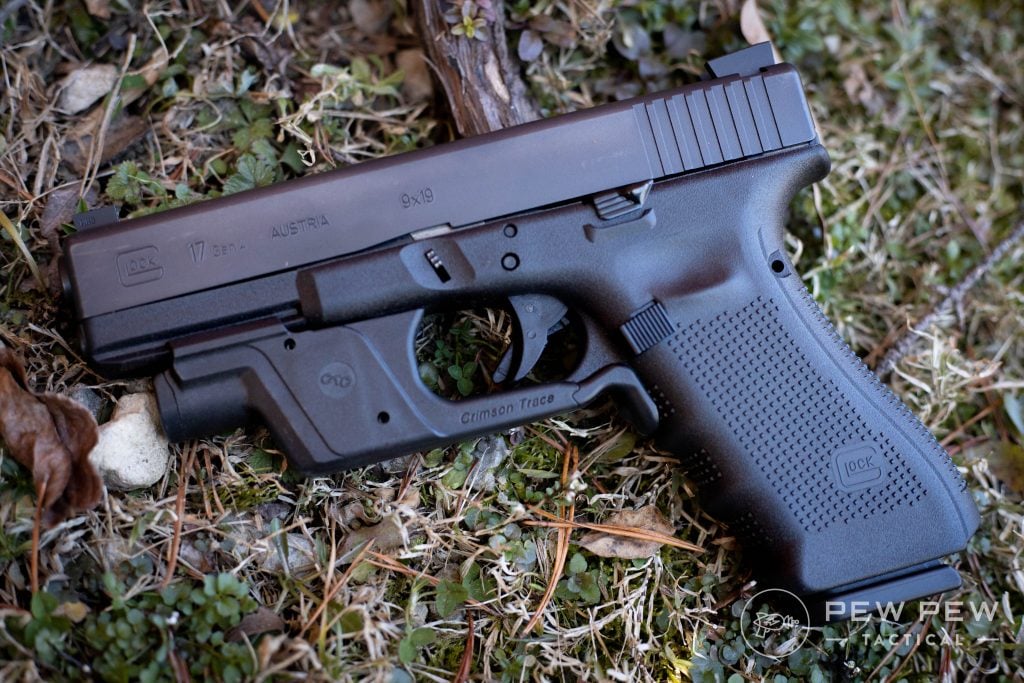
People who use peep sights on rifles tend to enjoy an enhanced level of vision as well as better accuracy. Simply looking through a peep sight has been found to improve vision by about 5 percent , and this number increases if peep sights are used regularly. This improvement in vision has greatly benefitted hunters who hunt at dawn and duskPeep sights are becoming more popular by the day, especially on lever action rifles, because of the easy installation and more accurate field of vision, as compared to other sights. If rifle peep sights are new to you, it’s advisable to give them a shot before you completely write them off as something that doesn’t work in your favor.
Read ahead to find out more about how peep sights help in not only improving your vision, but also your overall shooting experience!
In the early days of peep sights, hunters used peep sights on rifles to help them shoot more accurately in low light conditions. Peep sights were found to be very helpful in hunting during twilight hours when the game was most active but the sun had not risen yet or had already set. The aperture in a peep sight collects light and amplifies it as you look through it, which improves your ability to see your target in dim conditions.
People have long known peep sights to improve vision, so peep sights on riflesare widely used across the world. This improvement in vision is especially useful when aiming at targets during low light-time, or hunting during twilight hours.
However, although peep sight installation on rifles is becoming more popular than ever, some shooters are still hesitant to use peep sights because they’ve never tried them before or do not understand how peep sights work and how they improve vision.
How do peep sights improve your vision?
Rifle peep sights greatly improve daylight vision, as well as work well in low light conditions – which has helped many shooters hit their mark with greater ease than ever before. Peep sight usage is becoming more popular every day among rifle owners who would like an easy way to improve their ability to see targets when shooting at night or in twilight hours.
The benefits of installing peep sights on your rifle are many and varied, but the ability to see your target more clearly in low light conditions is one of the most important reasons to install peep sights on your rifle.
Peep sights also don’t obstruct the target as much as other types of rifle sight due to their sleek design and peep sight installation is easy to do. Additionally, the wide field of view that peep sights offer makes it easy for shooters to follow the action and keep track of their targets.
Even in low light conditions, peep sights will help you see the target more clearly so you can make that perfect shot. Some good examples of peep sights are the Marlin 1894 peep sights and 1895 peep sights.
The merits of installing peep sights on your rifle:
1) Peep sights don’t magnify the target like telescopic sights do, which can be a benefit or a drawback depending on the shooter’s preference.
2) Peep sights don’t require batteries to operate as telescopic sights do.
3) Peep sights handle recoil better than telescopic sights do.
4) Peep sights offer a wider field of view than telescopic and prismatic sights.
5) Peep sights are easy to use, even for beginners.
6) Peep sights are an excellent choice for all types of competitive shooting.
7) Peep sights work well in low light conditions, making them perfect for hunting at twilight hours.
8) Peep sight installation is simple and easy to do; and they work on many different types of rifles without needing tools for installation.
Moving ahead, let’s get a better insight into how to use a peep sight on a rifle, and what’s the way to pick the best fit.
How do I pick the right peep sight for my rifle?
1) Determine the peep sight aperture size you need for low light (smaller) or full light shooting (larger).
2) Decide on a peep sight mount style that will work best with your firearm model and shooting preferences.
3) Determine peep sight windage and elevation settings to align with your front sight..
4) Check customer reviews of peep sights from reputable brands to ensure quality is up to par before you buy.
5) Once you have chosen the peep sight that you want to purchase, make sure to measure the size of your rifle’s existing rear sight aperture and order a peep sight that is the same size or larger.
6) If your rifle does not have a rear sight aperture, choose a peep sight with a built-in aperture ring that fits the diameter of your barrel.
7) Some peep sights come with interchangeable aperture rings in different sizes for shooters who want to customize their sighting system.
8) Follow the manufacturer’s instructions for peep sight installation.
9) Test your new peep sight at an outdoor shooting range before taking it on a hunt. Sight in your rifle with the new peep sight to make sure the shots are landing where you expect them to.
Wrapping up
At the end of the day, peep sights are a great choice for shooters and work to greatly improve their vision when shooting in low-light conditions. Whether peep sight installation is right for you depends on your preferences, but you’re sure to go home with dinner if you’ve installed peep sights on the rifle you’re using.
Moreover, peep sights are a great way to improve your vision when shooting in low light conditions, and they offer several other benefits that make them a better choice than other sighting systems. Whether you’re a hunter, shooter, or gun enthusiast, peep sights are worth considering as an upgrade to your rifle.
Bushcraft skills are essential for survival, especially if you plan on bugging out to a remote location.
The ability to use resources from the environment can save your behind when SHTF—and even help you thrive after—so it’s important to take the time to learn them.
In this article, we discuss bushcraft 101, from basic bushcraft tools to vital skills like foraging, building shelters, making fires, acquiring food, and more. You’ll also find useful tutorials throughout the article, so if you think you need to sharpen those bushcraft skills, read on:
Bushcraft 101: What Is Bushcraft and How Will It Help You Survive TEOTWAWKI?
Here’s the simple truth: Mother Nature provides all of your needs. All you have to do is figure out where to find these resources and know how to use them.
Bushcraft, used interchangeably with “wilderness skills,” focuses on using resources available in the natural environment for survival. This skill set includes fire making, foraging food, tracking, trapping, hunting game, and shelter-building using basic bushcraft gear.
Learning and mastering bushcraft skills will inevitably help you when SHTF.
Remember, in a large-scale disaster, most modern conveniences will go to the dogs. Without the grid, food supply, clean water, functional sewage, and the internet, society as we know it will plunge into chaos.
People will have no choice but to learn the old ways or perish. As a prepper, you’ll have to learn how to make fire, forage for food, purify water, build a shelter, and make tools with what little you can find.
By arming yourself with a sharp set of bushcraft skills, you’ll learn how to survive in a short-term emergency and even be self-sufficient in long-term scenarios. Once you’ve mastered these skills, you can go on to teach others.
Essential Bushcraft Tools
To do bushcraft, you must have the right bushcraft tools. Here are some of the basics to have in your arsenal:
Knife
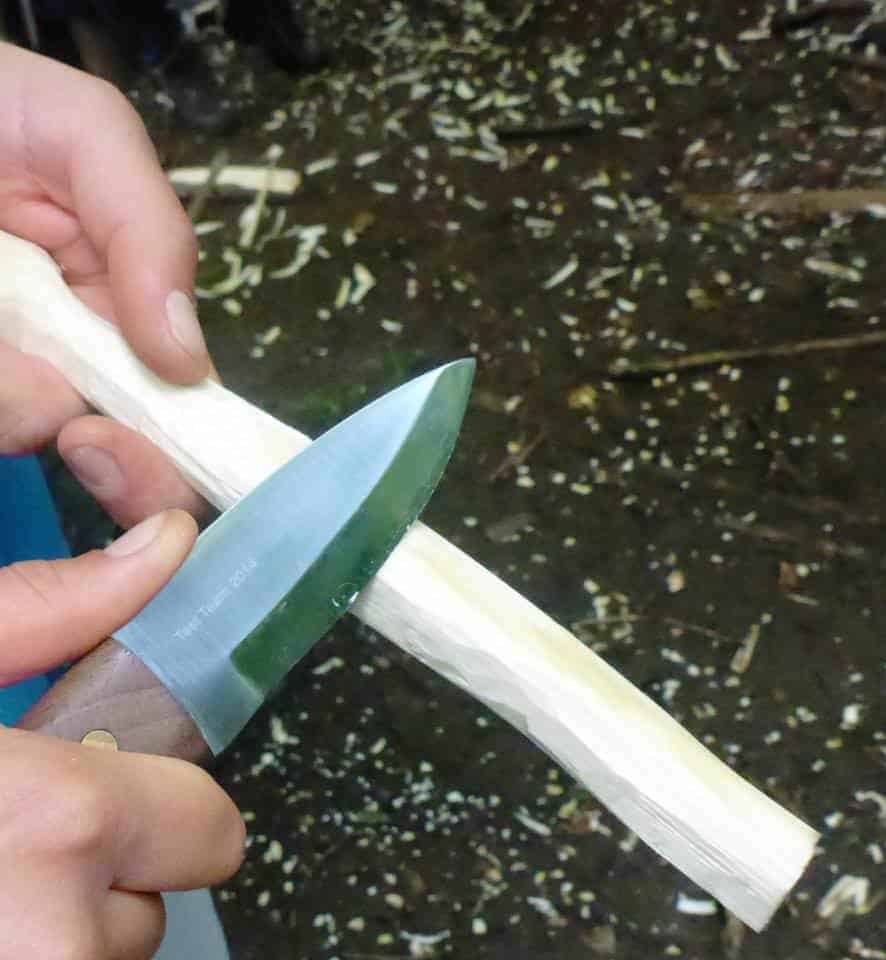
A sharp and sturdy knife is indispensable in bushcraft. Without it, you’ll be unable to make fire, set up your shelter, hunt and prepare your food, carve other tools—plus a slew of other small tasks.
A durable full-tang knife with a fixed blade is often used for bushcraft. Full tang means the knife’s steel extends all the way through the handle, making it less prone to breakage and damage.
While folding knives are portable and great for EDC, they’re not exactly the safest or most reliable for tasks like woodworking, so stick with a fixed-blade knife instead. A knife with a drop point and a flat or Scandi grind is great for most bushcraft tasks, too.
How long should bushcraft knives be?
Bushcraft knives are usually around 3 and a half to 6 inches long. This length allows them to do both small, detailed tasks and heavy-duty work. Anything smaller will be hard to handle; anything bigger, on the other hand, will be a machete.
Should you go for a high carbon steel or stainless steel bushcraft knife?
As far as material goes, it’s a contest between high carbon and stainless steel. Your choice of steel will depend on your needs.
Carbon steel blades are durable, easier to sharpen, and tend to throw better sparks when used with a ferro rod. They’re more prone to rust and oxidation, however, so they need higher maintenance compared to their stainless steel cousins.
Stainless steel blades, on the other hand, take longer to sharpen, but they keep their edge longer. They require little maintenance and are virtually rust-proof, making them great for humid environments.
Don’t forget about the knife handle
The knife handle should feel good in your hand, too. Bushcraft knife handles are usually made from hardwood, but this absorbs moisture over time, so you can go for synthetic materials like Micarta or G10 fiberglass.
Knife Sharpener
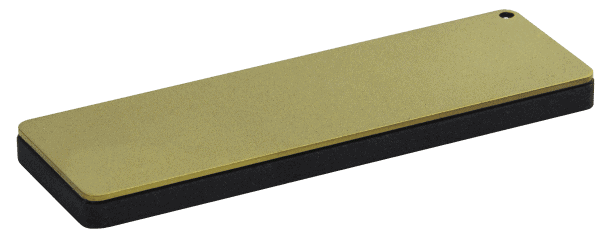
Since you’re using a knife, it only makes sense to include a sharpening stone among your bushcraft tools. There are many knife sharpeners out there—the most common of which include Japanese water stones, whetstones, or oil stones.
Most sharpening stones have two sides: a coarse side for the initial sharpening and shaping, and a finer surface for the finishing touches. Leather belts also make for good stropping materials to keep your knives sharp even when on the field.
Check out the video above if you need pro tips on how to sharpen your knife while on the field or in your bushcraft camp.
Bushcraft Axe
Next up on our list of must-have bushcraft tools is an axe.
This bad boy is capable of doing tasks your knife can’t or shouldn’t do, like felling and limbing trees, cutting and splitting large pieces of firewood, and building permanent shelter.
Like your knife, axe blades can be made from high carbon steel or stainless steel. A bushcraft axe doesn’t have to be the biggest or longest, either.
Large axes with heavy bits may penetrate wood better, but they also require more energy for you to swing. That’s why most bushcrafters prefer using smaller, lighter axes they can conveniently stow away in a backpack. These are easier to carry around and can be used with only one hand.
Another important factor to consider when choosing this bushcraft gear is sharpness. An ideal axe should be able to keep its edge well even after use and abuse.
Lastly, an ergonomic hardwood handle is key for a good grip and chopping power.
Bushcraft Saw
Not all bushcrafters carry axes. Some enthusiasts prefer using a folding saw for woodworking since it’s significantly lighter and easier to carry around. It also makes for straighter cuts in the wood, which is great for building shelter, especially if you want a sturdy one to outlast the elements.
Saws are also more efficient since these bushcraft tools take less energy to cut through wood and produce more output in the same amount of time. Less effort means you have more time and energy left to do other tasks necessary for survival.
Compass
A compass is a pretty straightforward device. You don’t need a lot of bells and whistles in a compass; you just need to have a reliable one that orients accurately. Moreover, you have to know how to use one to find your way in the wilderness.
Firestriker
The last thing on our list of essential bushcraft tools is a firestriker.
Firestrikers or ferro rods are capable of creating fire through friction. Unlike lighters or matches, fire strikers work even when wet, are effective at any elevation, and don’t need fuel. They’re also easier to use compared to their flint-and-steel counterparts.
To know more about ferro rod fire starters, check out this comprehensive review.
Bushcraft Skills You Need to Learn
Now that you know the basic bushcraft tools, it’s time to dive into the skills you need to possess. Remember, it doesn’t matter if you have the sharpest knife or the most accurate compass out there if you don’t have any idea how to use them properly.
Below you’ll find an extensive checklist of all the bushcraft skills to have under your belt:
Foraging for Food and Medicine
Foraging, by definition, is the act of finding and gathering flora and fauna mainly for food. However, you can also use your foraging skills to find medicinal plants and herbs, natural cordage, firestarters, or materials for shelter.
Foraging for Food
Humans started out as hunter-gatherers. Before the dawn of agriculture and industrialization, the forests were our ancestors’ grocery stores.
Some examples of food you can forage in the wild include:
Fruits
Berries
Nuts
Mushrooms
Tubers
Shoots
Flowers, seeds, and weeds like dandelions and nettles are less obvious choices, but you can also forage and eat them when the going gets tough.
Know Your Local Geography
To be a good forager, you first have to know the lay of the land. What types of plants, fruit-bearing trees, and vegetation grow in your area? Where can you find them?
Take cattails, for example. This wild edible is common in most parts of North America and can be found near ponds and marshes. Cacti, on the other hand, are common in the West and Southwest regions of the States and can be found in dry, arid areas like deserts.
Plant Identification
Plant identification is crucial in foraging. Make a mistake, and you’ll end up with a bad allergy, a busted stomach…or you might not live to tell the tale at all.
Remember, Mother Nature may provide for all your needs, but she also has a lot of plants that can kill you on the spot, too, so it’s important to know how to distinguish friend from foe.
Ask yourself:
What do these edible plants look like? What are their distinct qualities, and how can you tell them apart from dangerous ones?
Some wild edibles, like root crops and bulbs, grow underground, so you also have to know how their leaves and shoots look above the surface.
If you’re a complete beginner, keeping a pocket guide with colored illustrations can help a lot. Make sure this pocket guide covers the area or climate that you’re in and carry it with you when out camping or backpacking. Try to identify the plants you can find along the way and take down notes with your personal observations.
You can also take classes with a forager to help you learn faster. These experts have years of insight and may have tips and learnings from their experiences that you can’t find in guidebooks about bushcraft skills.
Growing Seasons for Foraging
Aside from knowing the plants’ geographic location and appearance, you also have to be familiar with their growing seasons. When do these wild edibles grow most abundantly? Are they available only in certain seasons, or can you find them all year round?
Many edible mushroom species, for example, grow abundantly during the hot and humid summers. They grow at the edge of forests at the start of the season, especially after a nice, warm rain shower. By July to August, you can find tons of mushrooms in oak and beech groves or in areas where evergreen trees grow. They can also be abundant in south-facing hill slopes since these areas receive more warmth.
Foraging for Medicine
Plants aren’t only good for food. Many of them also have medicinal properties. To take advantage of these, you must know which parts of the plant to use and how to use them.
Here are some examples of common medicinal plants and what they can help with:
You can steep willow bark into a tea and use it to treat aches, pains, fever, and swelling.
Fennel tea also helps soothe an upset stomach and fight bloating and nausea.
Yarrow leaves and flowers can be used to aid in blood clotting to slow down bleeding. You can also use it to treat fevers and coughs.
Dandelions, usually passed off as weeds, can be turned into a salve for muscle aches and joint pain.
Plantains have excellent anti-inflammatory properties and make good poultices.
Comfrey poultices or compresses are great for fixing wounds and fractures.
Dos and Don’ts When Foraging
Building Bushcraft Shelters
Exposure to extremely harsh conditions can kill you in a matter of minutes, so knowing how to build temporary and long-term shelters is one of the most important bushcraft skills to know.
The good news? There are tons of ways to make bushcraft shelters from just about anything you can find in the environment.
Making cordage using natural materials
Cordage is one of the most vital components of bushcraft shelters. If you find yourself without rope or 550 paracord, you can use natural cordage to assemble frames or lash poles together for your shelter. You can also use cordage for other purposes, like climbing—and creating snares, traps, fishing lines, or bow drills for fire.
Cedar bark is one of the best sources of natural cordage. You can find these trees all over the country, especially if you’re in the Pacific Northwest region. To make cordage from cedar bark, you want to harvest the inner bark or bast of the tree. That’s the stringy, fibrous layer right under the protective outer bark.
As you can see in the video above, you’ll need to peel the outer bark off in one go and harvest the bast to create cordage from the fibers. You’ll want the bark to dry and age before turning it into ropes, though, since moist bark can shrink over time.
Plants like nettles also make for good cordage. Remove the leaves, flatten the stem, and carefully peel the nettle skin off. Once you’ve done that, twist the fibers until you form cordage. Unlike cedar bark, you don’t have to wait for the nettle stalks to dry out before you can use them. They’re also strong and capable of withstanding tension.
Just wear gloves when harvesting these plants—they’re not called stinging nettle for nothing.
Other natural materials you can use as cordage include some species of tall grass, willow saplings, roots, and jungle vines.
Tying Knots
Knot-tying is another one of the most basic but essential bushcraft skills to learn. If you don’t know how tie decent knots, cordage would be of little use.
There are various knots for different purposes. Here are some of our go-tos:
Square knot – This is a multipurpose knot great for tying or connecting two lengths of rope.
Figure eight – This knot retains the strength of the cordage well. It doesn’t unravel with pressure, so it’s good for climbing, creating footholds, or pulling someone to safety.
Bowline knot – Also retains the strength of the rope or cordage. You can tie this with one hand, making it excellent for rescues or for tying down objects.
Clove hitch – This is a quick-release knot for securing cordage to trees.
Tautline hitch – It’s used to adjust the tension on tarp shelters.
For an in-depth look at more knots you can use for bushcraft and survival and how to tie them, check out this post.
Basic Types of Bushcraft Shelters
Bushcraft shelters come in all shapes and sizes. You can find shelter in nature, as in uninhabited caves, under rock overhangs, or near large fallen trees. You can also construct your own from tree limbs, branches, and foliage. Some types of bushcraft shelters you can make include:
Lean-to shelter – a common free-standing shelter with three walls and an open side. This is one of the easiest bushcraft shelters you can construct.
A-Frame shelter – has a triangular, A-shaped frame with a main ridgepole that runs along the top. Also known as the double lean-to shelter.
Dug out shelter – a shelter made by digging a trench on the ground
Fallen tree shelter – a shelter made from the flat base of a tree root
You can read more about how to build these bushcraft shelters and more in this article.
General Shelter Building Guidelines
Whatever type of shelter you’re looking for or are making, here are some things to consider:
Pick a good location. Your shelter should be able to offer adequate protection from the environment and shield you from harsh rain and wind. It should also be located a safe distance away from your water source (about 200 meters).
Choose a relatively flat location to avoid floods.
Avoid setting up camp under large trees. While they offer shelter from rain, they also have thick branches that can fall on you. Plus, they’re prone to lightning strikes and their leaves will drip long after the rain has stopped—their cons outweigh the pros.
Your shelter should be able to reflect and conserve heat. Stone faces or large boulders make for good heat reflectors. You can also construct a wall from medium-sized sticks and line it with foliage and moss, which are natural insulators.
We’ve previously talked about survival and bushcraft shelters at length in our other articles. Here’s a directory of useful info to help you out:
Waterproofing your shelter
Since your shelter is mostly made of wood, you’d want to take extra measures to make sure that it stays dry.
As we mentioned earlier, choosing the right place is essential in keeping dry. Pick a relatively flat and well-draining location, away from trees with a lot of leaves to prevent dripping. Stay away from ravines or canyons—they may be bone-dry now, but they’re notorious for flash-flooding after mild showers.
When building your shelter, don’t make it too big to conserve heat.
You also have to create roofs at an angle so that rainwater flows at the sides. Cover these steep, angled roof frames with broad leaves, starting from the lowest part and working your way towards the top. This way, your roof can work like shingles and shed rainwater without a hitch. Don’t forget to dig a rainwater runoff around your camp so you won’t wake up in a puddle.
Another way to waterproof your shelter is by simply bringing a tarp. Tarps are cheap, hard-wearing, and multifunctional. You can use different configurations to turn it into a shelter, use it as a ground sheet or to put on as an additional layer to your bushcraft shelter’s roof.
When using tarps to waterproof your shelter, make sure that it’s stretched out tautly and is securely pegged to the ground or to a tree so that it doesn’t collect rainwater. If you can’t afford a tarp, use a thick drop cloth or repurpose an old shower curtain.
Related: Waterproofing your survival gear and supplies
Making DIY cement from wood ash
Basic carpentry and woodworking are undoubtedly crucial bushcraft skills to know when making long-term shelters, but if you want to take it up a notch, you can create makeshift cement from wood ash.
As the name suggests, wood ash cement is made by burning biomass like dried bark and leaves. These materials are more common than the usual ingredients used to create makeshift cement like limestone or shells, but contain the same minerals like potassium, phosphorus, and calcium. When done properly, you can use wood ash cement as mortar to reinforce your shelter, or you can turn it into little blocks for various purposes.
The process is pretty labor-intensive and time-consuming, though, so it’s best to make this only if you’ve got the time and resources. As seen in the tutorial above, you’ll need a kiln or oven, a lot of ash from biomass (hardwood ash works best), and some clay or terracotta to use as aggregate.
Still, it’s a good-to-know skill that might come in handy when you’re building a semi-permanent bushcraft dwelling or bug-out camp.
Primitive Firemaking
Fire provides you with heat, light, and protection. This indispensable resource also allows you to cook food, purify water, and fend off predators. Needless to say, knowing how to make fire is one of the top bushcraft skills you should master.
You only need three ingredients to create fire: oxygen, heat, and fuel. These factors are collectively known as the combustion triangle. If one is missing, you can’t ignite a flame.
Oxygen, of course, comes from the air around us. You can best harness oxygen by allowing proper ventilation and by creating efficient firelays.
You can produce heat primarily through friction. Once you create a spark or an ember and it catches on to your fuel, chances are you’ll be able to create a fire.
Fuel comes in the form of combustible materials and is generally classified as tinder, kindling, and firewood.
Tinder is the smallest and finest of the bunch, usually made from thin wood shavings, feather sticks, and other fibrous materials. Its purpose is to catch sparks or embers to burn kindling like sticks and twigs. Once your tinder and kindling are burning, you can feed it larger chunks of fuelwood to keep it burning and to produce hot coals.
Natural Firestarters: Tinder, Kindling, and Firewood
Shavings or curls from fatwood or from resinous trees like cedar, birch, and pine make for excellent tinder, and you can find them almost anywhere in North America.
Tree bark also makes a great tinder and firestarter. Red cedar bark is especially fibrous and can be lit even when damp. You can fluff up red cedar bark to create a “bird’s nest” to catch sparks or live embers.
Birch bark is rich in resins which help them ignite faster. It’s also resistant to moisture and easy to gather. Simply skin dead fallen birch trees with a knife, and their barks will come off in sheets. You can tear birch bark into strips and bundle them up to start a fire.
Fatwood is another term for pine heartwood drenched in resin. Though not as common nor as easy to harvest as the other firestarters mentioned earlier, fatwood shavings light almost instantly, even in super damp conditions. You can also cut them up in chunks and use them as kindling or firewood.
Other natural fire starters include:
Tinder fungus – This black and spongy species of mushroom is used to hold coals or reignite fires.
Cattails – Dry and fluffy, cattails can be found near water or in marshlands. They don’t burn for very long, so they’re usually considered flash tinder.
Pinecones – Like fatwood, pinecones are resinous and can be used as fuel.
Batoning and splitting firewood
Batoning firewood has been a very polarizing topic among preppers. Should you do it and risk ruining your knife? Or should you never do it at all?
Well, whether you’re in favor of it or not, you have to learn how to baton and split wood when you’re left with no other choice.
Batoning is the process of splitting wood with a knife and another blunt piece of wood called a baton. The idea is to lodge the knife onto a block of wood and strike it with the baton, thus splitting the wood into smaller chunks perfect for a campfire. Batoning can sometimes be easier than using an axe or saw, especially when you want to split small pieces of wood quickly.
The downside is that batoning needs a lot of practice, and it can damage your knife in the process. If you’re not careful, you might even end up hurting yourself.
The trick to successful batoning is to make sure that your knife is sharp and its edge is placed perfectly straight onto the block. Then, strike it with the baton nice and hard to split it right down the center.
Primitive Ways to Make Fire
Since primitive folks didn’t have matches or lighters, they primarily made fire through friction, and they produced friction through drills.
There are many types of drills out there, but they more or less have the same basic components: a spindle or a long stick that one uses to create friction and a fireboard, which is a flat piece of wood that collects the embers made by the spindle.
Here are some examples of primitive fire drills:
Hand Drill – The hand drill can be operated by one person and is perhaps the most easily recognizable fire drills out there. The idea is pretty simple: you roll the spindle really fast between your palms, running your hands down its length very quickly until it produces embers. The embers are collected in a small nick or depression on the fireboard and are then transferred to a pile of tinder. Tinder ignites and boom, you have a fire.
Bow Drill – The concept is pretty similar to a hand drill, but this time, you use a flexible stick and a piece of cordage to create a bow. The bow is used to turn the spindle and creates the friction for you.
Two-Man Friction Drill – This one is essentially a bow drill but instead of going at it alone, one person holds the drill upright while the other operates the bow to create friction.
Pump Fire Drill – This type of fire drill is a bit more complicated than the rest. The bow is powered by a manually operated pump mechanism that creates friction.
Aside from drills, another primitive way to create a friction fire is through a fire plough. Instead of using a spindle and a small depression on a fireboard, you make a groove along the length of the fireboard and slide another piece of wood along it, creating friction horizontally. The stick should be around an inch thick and made from softwood for best results.
You can also use flint and steel. This is how they used to kick it back in ye olde days. On one hand, you’ve got a striker made from carbon steel, and on the other, a hard stone made from flint or chert. Striking these materials against each other creates sparks, which catch on dry tinder.
You can perfect this method through practice, but a more convenient way to create fire through the same principle is by using ferrocerium rod fire starters instead.
Which Firelay Should You Use?
It’s not enough to light a fire—you should also be able to keep it going. An excellent firelay will help your fire stay lit throughout the night with little to no maintenance, so it’s important to pick the right one.
Here are some examples of firelays you can construct:
Tipi firelay – As the name suggests, the tipi firelay sports a triangular shape like a tipi shelter and can be made from sticks and twigs. To build it, all you have to do is start from small kindling and work your way to the bigger ones, leaving an opening on the upwind side to ignite the tinder.
Log cabin or upside down fire – This is a self-feeding firelay that burns from top to bottom. Up top, you have your tinder and kindling. The pieces of fuel get thicker as you go down the firelay, allowing the fire to produce a big, hot, and consistent flame with minimal tending.
Star fire – This one is really simple. Start by building a small pile of tinder and kindling, and around it, place large pieces of firewood. The idea is to gradually push the larger pieces of fuel into the fire to keep it going.
Wanna know the nitty-gritty details of making these firelays? Check out these tutorials. If you want to learn more about firemaking in general, here’s the full roster of useful guides and resources:
Finding and Purifying Water in the Wild
Hydration is key for survival, so knowing how to find and purify water in the wild should be bushcraft 101.
Like the other bushcraft skills mentioned in this article, you can find many sources of water out there by first knowing the lay of the land, and by reading natural indications of water, like the following:
Gurgling or rushing sounds – These indicate the presence of running water. Since water flows downward, you can most likely find it in low-lying areas, canyons, and valleys.
Plants and vegetation – Certain plant species, like lilies and cattails only grow near water, so look out for these. Note the quality of the soil, too—muddy or marshy ones obviously indicate water. Large, thick vines and trees can also be sources of water themselves. Before you drink up, however, make sure that the plant is not poisonous and it doesn’t ooze bitter or cloudy sap.
Presence of animals and insects – Grazing animals and herbivores are more likely to lead you to their watering holes. Watch out for birds, too. Birds will fly low and in a formation when in search of water, and will likely hop from tree to tree after having a drink.
When you can’t find a lake, river, or stream to get water from, you’ll have to get creative by collecting rainwater, creating a solar still, or looking for alternative sources of hydration. Here’s a guide on how to go about those methods.
Bushcraft Water Purification
A bandana or shemagh is excellent for taking out debris and dirt from your drinking water, but if you don’t have one on hand, you’ll have to make your own filter. The video above describes the process of how to make one with a bottle and some natural filters like rocks, leaves, and soil.
The idea is to stack the filters up in layers. The large and loose ones, like rocks and pebbles, go at the top to filter big pieces of debris. The filters gradually become finer to take out minute contaminants until you get clear water.
Once you’ve got a decent amount of water, purify it via boiling. Boiling kills microorganisms and viruses that might cause disease.
Related: Best Ultralight Backpacking Water Filters
Trapping and Hunting Game for Food
Berries, roots, and edible plants will keep you alive well enough, but if you want to fill your belly with something more substantial, you will have to learn how to track, trap, and hunt game for food.
Here’s what you need to know about these bushcraft skills:
Trapping
The biggest advantage of trapping is that it saves you time and energy. Unlike hunting, where you have to actively chase after a single quarry, trapping lets you catch a lot of prey without having to run after them.
You can set up traps in different places to increase your chances of catching a meal. This multitasking feat frees up a large chunk of your time, letting you do other stuff like building a campfire or reinforcing your shelter.
When setting up traps and snares, it’s important to develop a keen skill for tracking animals. Know what kind of animal you’re trapping by watching out for things like:
Pawprints
Fresh or worn tracks
Droppings
Disturbed vegetation
The animal’s usual diet within the vicinity
Once you’ve determined your prey, it’s time to move. Here are tutorials that show how to create some of the most common traps out there:
Deadfall Trap
The deadfall trap is one of the earliest and most effective traps known to man. It’s used to catch small to medium-sized prey like rodents and squirrels.
Spring Snare Trap
Simple yet effective, the spring snare trap uses a length of wire or string to create a noose that tightens around the animal’s leg or neck.
Woven Fish Trap
This trap takes a long time and a lot of skill to make, but the payoff will be worth it. This trap lets you catch medium-sized fish and eels.
Prawn Trap
This is a smaller version of the fish trap for prawns and smaller species of fish.
Things to Remember When Making Traps
Traps take a lot of skill and practice. Here are some useful tips to remember when constructing traps and snares:
Prepare the parts of your trap away from the area to avoid disturbing the vegetation and alerting the animals to your presence. All you have to do when you come to the site is to assemble it.
Stay downwind.
Always wear gloves when handling your traps. Animals have a keen sense of smell and can detect your scent. Rub plants, dirt, or the innards of your previous catch onto your trap to mask your own scent and confuse the animal.
Blending in is key. Make sure that your trap blends well with the environment by camouflaging it with leaves, mud, and vegetation.
Avoid using young twigs and cordage when making your traps. These release a scent that alerts animals of potential predators. If you can’t find old materials, age your trap by exposing it to the sun.
Choose your bait wisely. Don’t use bait that the animal can just easily find elsewhere. Instead, use something that will potentially catch their attention.
For an in-depth look at other primitive ways to catch, cook, and eat food in the wild, check these out:
Other Bushcraft Skills You Have to Know
Shelter, fire, water, and food are the four foundations of outdoor survival. Once you develop your skills in these areas, you’ll be able to survive out in the wild without modern resources.
However, that doesn’t mean you have to stop there. These intermediate bushcraft skills will help you take your survival know-how to the next level:
Making Bushcraft Tools
What separates humans from other primates? Our ability to create and use tools to help make our lives easier. This video shows 7 useful primitive bushcraft tools and contraptions you can use in and around your camp.
Natural navigation
You need to know how to get your bearings when out in the woods. When you don’t have a compass and a map, natural navigation techniques will prevent you from getting lost in the wilderness.
Creating watercraft
At some point, you might have to leave your camp and venture out into bodies of water to get food or to explore. You can create a canoe from reeds, as shown in the video above, or construct a raft from driftwood.
Final Thoughts
You know what they say: the more you know, the less you need. Having a sharp set of bushcraft skills will not only help you survive in the wild; they will also help you live off the land and thrive without modern creature comforts long after SHTF.
How good are your bushcraft skills? Do you think you can survive an extreme bug out situation in the woods? Let us know in the comments!
So you are in the market for a red dot? Well, it’s not as simple as telling you which is the best red dot sight to buy, or you wouldn’t be on the hunt!
There are many red dots available and while we won’t be able to give you a simple: buy this sight for your gun.
We will provide you with unbiased feedback on as many red dot sights as we can get out hands-on. This post will be forever updated and changed as optics are introduced and/or discontinued.
We want to keep you up to date on red dots because we LOVE red dots.
The internet is full of financial shamers. What does that mean? Post your budget AR build in an AR-15 Facebook group, and you’ll immediately be called poor.
That’s stupid.
Lynx Defense is a premium gear manufacturer and what some would call expensive.
But we will never insult someone for buying what they can afford. We hope it’s our products, but we want people to love firearms and gear as much as we do at the end of the day.
People have families, and money doesn’t grow on trees, so obviously, you want to get the most bang for your buck out of whatever you buy, including your gun’s red dot sight.
Let me be clear there is a difference in quality budget red dots and cheap red dots. We will not be including any cheap red dot sights because they are not quality optics.
So let’s dive in. These will not be in order, so read through each one and determine what’s best for you.
Sig Romeo5
The Sig Romeo 5 red dot sight is one of the most popular red dot sights of 2022. The reason for that is actually pretty obvious when you take a deep look into the Sig Romeo5. We even conducted a full Sig Romeo 5 review.
Sig Sauer Copperhead with Sig Romeo5 Red Dot Sight
First and foremost, the price point is fantastic.
Currently, the Sig Romeo 5 is $114.99 on Amazon.
With that price comes a quality red dot for the price—the Romero5 features over 40,000 hours of battery life on the medium setting.
The MOTAC feature is great to save battery life, and the fact it is IPX-7 waterproof rated makes this a top-notch red dot sight for the price.
This red dot pairs great with any length AR-15 or pistol-caliber carbine. I ran my Sig Romeo5 on my Sig Sauer Copperhead. It now lives on my EPC-9 carbine.
Sig Sauer MSR and Juliet 3 Micro Magnifier
Next up is also a Sig Sauer product but with a little flair.
The Sig Sauer MSR by itself is a decent optic but with the extremely reasonable price of the MSR and Juliet 3 Micro Magnifier, you get a fantastic package for a great price.
The magnifier Romeo-MSR combo adds the ability to get extra distance out of your red dot sight and makes it an extremely attractive option.
Bushnell TRS-25
The Bushnell TRS-25 is probably the least expensive red dot sight on the market. It’s the cheapest red dot sight I’d be comfortable recommending to people.
Many people are drawn to the Bushnell TRS-25 because it’s an extremely affordable red dot sight.
Amazon regularly has these for around $50-$70 and actually has a pretty decent set of features.
The TRS-25 comes with a 1913 rise block included, which really makes this a bang for your buck.
If your funds are tight and you need a decent optic for the least amount of money possible, grab the TRS-25.
This is an optic you can buy and not feel bad about buying a new optic later and not waste a ton of money.
Don’t go any cheaper than this optic. This is the bottom of the acceptable optic list.
Holosun HS-403B
If you are looking for a decent middle-of-the-road optic, look no further than the Holosun HS-403B a feature-packed sub $200 red dot sight.
This might be the best red for sight for your AR-15! But, let us take a look at why it may be the best optic for you.
The Holosun HS403B is a compact optic with an included riser mount. The only catch is if you don’t like the height of the mount you are stuck with it unless you purchase another mount.
If you are looking for a red dot sight that’s ready to go this is definitely a good option for you.
There are other Holosun optics that I like a little better due to their similar price and increased feature set.
Primary Arms SLx MD-25 Gen 2
The Primary Arms SLx MD-25 is a 2MOA dot that is near perfect for almost any rifle.
Primary Arms SLx MD-25 Gen 2
The ACSS Reticle in the SLx MD-25 has to be one of my favorite reticles. It incorporates the chevron and the horseshoe design to top off the near-perfect combo.
If you are on the hunt for a feature-rich optic that comes with an included mount that packs some quality don’t skip on the PA SLx MD-25.
The battery life for this optic is exceptional and the included riser is near perfect. You can read our Primary Arms SLx MD-25 review in our review section.
Primary Arms SLx 1X MicroPrism
One of the best optics going into the New Year is the PA SLx 1x Micro Prism sight. This thing is small, hence “micro” prism, but it packs a punch!
I absolutely love mine and have run it on a number of guns. I even did a full review of the 1 x Micro Prism.
The best part of the PA SLX 1x Micro Prism is the price and feature set. The fact it has 45,000 hours of battery life and comes in under $300 is incredible.
The overall build quality of the optic is fantastic and if you want something that will make your good look fantastic, this will definitely do that.
If you want the best AR-15 red dot sight grab the SLx with the Cyclops reticle!
Best Overall Budget Red Dot Sight
I’m not in the business of telling people what will work best for them. This country is all about individuals determining what’s best for them.
I’m just trying to provide you with my feedback and help you come to a decision.
So here’s a hypothetical list of things to consider when deciding what budget red dot sight to buy.
Size
Weight
Field of View
Battery Life
Reticle
Features (Shake Awake, included mount, etc.)
So, while it would be nice just to paste a picture of the best overall budget red dot sight, it’s hard to say. Personally, I think the best overall budget red dot sight available right now is the Sig Romeo 5.
An up and company called AT3 also has a decent budget red dot sight called the AT3 RD-50 Pro.
Best High-End Red Dot Sights
High-end red dot sights are all the rage on the Gram! After all, who doesn’t love rocking the best?
I know I do, and I’ve had my fair share of top-tier red dot sights. I really stick to three of my favorites.
Here are the top high-end red dot sights
EOTech HWS XPS2
The EOTech HWS is one of the most popular high-end red dot sight.
Honey Badger SD with an EOTech HWS-XPS2
But it’s slightly more than just your average red dot. More than average, why you ask?
It’s holographic!
But what does holographic mean? Well, I’m glad you asked.
Basically, without getting all scientific, a holographic weapon sight keeps the reticle positioned in an exact area of the glass. So if you move the weapon left or right, the reticle will stay on target.
This allows for accurate shooting even while moving or if something is blocking your optics viewports, such as snow or dirt.
The EOTech HWS XPS2 is my go-to red dot sight if money is not an issue.
I like how the EOTech looks on my guns, and the function and ease of use are top-tier.
Trijicon MRO
The Trijicon MRO came onto the scene in 2015 and has been making the climb to the top ever since.
Noveske N4-PDW with Trijicon MRO Scalarworks MRO Mount
Trijicon is already a well-known sight and optic manufacturer. I personally run their night sights on my Glock 19.
While most people will know the name because of the Trijicon ACOG optic.
MRO stands for Miniature Rifle Optic, and while it’s not the smallest on the block, it’s still smaller than some of its other counterparts, like the EOTech series.
N4 Noveske with 1/3 Co-witness Trijicon MRO
I like the MRO. It’s purpose-built and rugged.
The Trijicon MRO isn’t trying to be something it’s not.
It’s a small package with a wide field of view. The battery life is an impressive 5 years on the medium setting.
The MRO has been put through several torture tests and came through with flying colors.
The mounting options are endless, and from the factory, it comes with several options: no mount, 1/3 co-witness, and full co-witness.
Aimpoint Micro T-2
The Aimpoint Micro H-1 and I go way back. I feel like I’ve got to say this. The H-1 is like your high school prom date. All pretty, dressed up, ready to go out and possibly make some mistakes and get lucky, who knows.
The Aimpoint Micro T-2 is the new hotness so buy it if you’re looking for an Aimpoint Micro. I run my Micro H-1 on the Battle Arms Development rifle pictured below.
Anyway. I purchased the Aimpoint Micro H-1 after owning the EOTech 512 for some time. If you know anything about the EOTech 512, it’s bulky.
So getting the H-1 really changed things up a bit. It was a slim, compact red dot sight that I loved right off the bat.
What’s the best red dot sight?
Picking the best optic for you is essential. It’s hard to choose because there are so many options, but first and foremost, you want to narrow down your price range.
Once you do that, you can start to narrow in on what optics are in that price range that will work for you.
Then, you can look at things like reticles and features such as shake awake, weight, and battery life.
Once you have your price range, you can break down and analyze what red dot sight is going to work for you.
Ultimately, the most important thing is choosing what’s best for you, not what some biased reviewer will recommend.
At Lynx Defense, we try to give unbiased reviews, but of course, we can only really comment on the red dot sights that we’ve used. The ones included in this article are the ones that we’ve got our hands on so far.
Now, of course, we’re in an endless battle to try to get more, how we can bring them to you, and try to review them.
How to pick the best red dot for you?
Picking the best red dot for you is probably one of the hardest questions you’ll ask yourself during your search for a sight.
The fact of the matter is that you’ve probably already decided to get a red dot sight.
There are so many options that you could get an LVPO, a red dot, a holographic weapon sight, or just run iron sights.
It really comes down to what will work best for you and your specific use case or mission.
I think it’s imperative to look at all of your options.
Again, as I’ve stated, it’s important to look at your price range, start from there, and narrow down your options.
After you have a price range, it’s pretty easy to find the high end of your price range, the mid-tier, and then the low end. But to figure out what’s truly just marketing nonsense and what’s a fact, you really want to go to somebody you can trust.
The internet is full of reviews. However, you never know who you can trust or who’s just trying to make a dollar. So a full disclaimer, Lynx Defense has obviously created links throughout this entire post. This entire post has pictures, optics, and links to all the different places across the web you can buy them. Most of those links are affiliate links. We make a small commission based on what you buy if you use our link to get there. Now, basically, what that entails is if we provided you with helpful information, it’s just a reward for us but doesn’t cost you a dime more.
We review all of our optics fairly and give them a fair shake. We are not beholding to any company for any reason under any circumstance. That’s why you’ll see we’ll link to Amazon, to Primary Arms, to EOTech. It doesn’t matter to us. We will link to them if it’s relevant.
We don’t care if you buy using our links or not. So, keep in mind when you’re looking at reviews, and you constantly see the same site or person push the same company over and over again, they could be getting paid for those reviews.
We hear all the time, “I bought this because X, Y, Z influencer said, this was the optic to buy.” When in reality, it didn’t fit their needs at all.
Then they ended up being unhappy with their purchase. That’s not at all what we aim to do here at Lynx Defense. We educate, and then you make the decision based on your needs.
This is why we’re so committed to this particular article and keeping it up to date year after year, month after month, as new optics become available and as we were able to get our hands on new optics.
Obviously, we don’t get a chance to test every single model of every single configuration of every optic ever made.
That would be awesome.
But unfortunately, we don’t have the time or the financial resources to really make that happen.
I really don’t know anybody who does.
So, of course, this post will be somewhat biased in that these are the ones we’ve got our hands on thus far.
These are what we recommend. We’re also going to tell you, that we don’t recommend going below a certain point.
For example, the Bushnell TRS-25 is pretty much the bottom. We don’t recommend going anything below that.
No optic that’s just total plastic, without any metal, it’s out the door.
Anything below the $50, $60, or $70 price point of the Bushnell TRS-25 is a no-go for us.
So keep in mind we’re not going to recommend low quality at all. No matter how cheap it is.
We’re not trying to make a buck. We’re trying to educate.
If we can get rewarded for the time we have invested for this by using the affiliate, awesome, but all we really want is for you to learn something from our work.
Red Dot Sight Reticle Options
Red dot sights have many different reticles, and most of the time, the one that is “best” boils down to your personal preference.
There are different schools of thought that some are better than others for target acquisition, but I won’t go down that road.
Single Red Dot
The single dot reticle is just that, a single dot. That dot can range in MOA and crispness.
Low-end optics could see a lot of distortion around the dot, whereas high-quality optics should have a crisp and clean dot.
The dot can range anywhere from 1-6 MOA.
Circle Red Dot
Circle dots reticles have a circle around the center dot.
These have much faster target acquisitions since you can place your target in the circle for faster but less precise hits.
Personally, this is one of my favorite reticles.
Ranging
Ranging reticles don’t have a standard look. They can vary in shape and size, and function. But the purpose of them remains the same, and they help you adjust your optic for shooting longer or shorter range.
You don’t see this reticle often in AR-15 red dot sights.
Multi Red Dot
Multi-dot reticles are pretty much what they sound like, multiple dots. Typically, multiple dot reticles are used for ranging.
The top dot could be sighted in for 50 or 100 yards, and then you would be able to determine what your bottom dot would be at 150 – 200 yards.
These reticles are popular in EoTech HWS (holographic weapon sights).
Horseshoe/Dot
The horseshoe dot reticle is similar to the circle dot reticle. The minor difference of the circle is open at the bottom creates a horseshoe instead of a complete circle.
Like the ACSS-CQB reticle from the Primary Arms MD-25 above, the center dot is a chevron and not a plain dot. The horseshoe/dot reticles can interchange the center dot and over have ranging dots below the larger center dot.
Crosshair
The crosshair reticle is also not a common red dot reticle. These are typically found in magnification scopes. Some lower-end optics, like NcStar, feature these types of reticles.
Chevron
Chevron reticles look like an up arrow without the tail. This is a reticle popularized by the Trijicon ACOG optic.
What is an MOA Dot?
You often see MOA, which means “minutes of angle,” all over red dot optics product pages.
MOA is a unit of measurement of a circle and is used to determine the size of the dot and how much it will cover your sight picture at a specific distance.
MOA dots usually are between 2 – 6 MOA, and the smaller the number, the less the dot will cover your target.
Other Optic Options
If you are set on a red dot sight the above options are probably the best. But are you interested in other optics?
Low Power Variable Optic (LVPO)
If you are looking for something more than a red dot you might want to get a Low Power Variable Optic (LVPO) like the Vortex Strike Eagle.
Best Red Dot Sight for Astigmatism
Red dot sights can be hell for someone with astigmatism. The dot won’t be crisp and you’ll have difficulty acquiring targets and having a positive shooting experience.
I’ve found that prism optics are probably your best bet when it comes to astigmatism.
My current favorite Prism optic is the Primary Arms SLx 1x Micro Prism.
Iron Sights
If you want to have a more manual optic you can get backup flip-up sights in case your battery dies or the optic fails.
If you want to accessorize your new AR-15 further, read our best AR-15 Flashlight, AR-15 Drum Magazine Guide, and the Best Tactical Flashlight.
Most rifle barrels in the past several years have come threaded from the factory so the shooter can add a muzzle device such as a muzzle brake or a compensator. This has recently extended to bolt-action and lever-action rifles more commonly found in the hunting as opposed to the tactical arena. Some come equipped with thread protectors and many come with a muzzle device.
Although the included muzzle device is typically a flash suppressor, some jurisdictions cling to antiquated and ill-informed laws that regard these devices as an “evil feature,” whereas a muzzle brake or compensator is perfectly legal.
We’ll go over the nitty-gritty of muzzle brakes and compensators, but if you’re looking for a quick reference, take a look at this chart for the two major differences between the two:
MUZZLE BRAKECOMPENSATOR Deflects blast to the sidesDeflects blast down Primarily used to reduce felt recoilPrimarily used to reduce muzzle flip
A muzzle brake is a device which threads onto the end of a firearm’s barrel. Although construction varies, the primary identifying characteristic is a series of cuts that direct the burning gasses and muzzle blast of a fired round away from the shooter and most often toward the side or 180 degrees from the muzzle itself.
WHAT DOES A MUZZLE BRAKE DO?
As most of the felt recoil from a firearm originates at the muzzle, this effort is primarily done to reduce recoil. Secondary benefits of muzzle brakes are byproducts of this as the reduction in felt recoil can aid the shooter with regard to accuracy and allow for faster follow up shots.
Some muzzle brakes, when used in conjunction with a suppressor, can act as a sacrificial blast baffle. This is not the same as a sound baffle, which decreases the sound signature of the firearm, but rather that the brake takes the brunt of the muzzle blast and fired gasses as opposed to the baffles in the suppressor itself. This tends to prolong the life of the suppressor.
The drawback to most muzzle brakes is that they can change the direction of the sound of the fired round. In some cases, the shooter may find the report of the weapon to be louder but most of the time it is the other shooters in close proximity that will find the shots fired to be louder. This is typically a result of the other parties feeling the shockwave generated as opposed to the sound itself.
Originally, muzzle brakes were meant for use on calibers that generated a lot of felt recoil and they were commonly found on belted magnum rifle cartridges intended for big game or dangerous game hunting or bolt-action pistols chambered in 308 Winchester and 30-06 Springfield for use in handgun hunting. However, this is not always the case and they have been used successfully on rifles where a muzzle brake would have been uncommon even a decade ago.
Competitive long range shooters tend to favor muzzle brakes, as the redirected gas and flash allow them to maintain a better sight picture. Three gun shooters like muzzle brakes as they can allow for faster follow-up shots and a reduced recoil impulse.
WHAT IS A COMPENSATOR?
A compensator is a type of muzzle device that works in a different way than a muzzle brake. A compensator’s primary role is to reduce “muzzle flip” or “muzzle climb.” While some manufacturers claim that they aid in recoil reduction, this is not entirely true, as most compensators operate on a different principle.
WHAT DOES A COMPENSATOR DO?
Most compensators divert gasses and muzzle blast in a downward fashion to keep the firearm from rising during the firing sequence.
One of the earliest compensator designs was the Cutts Compensator found on the Thompson submachine gun. The 45 ACP round, while fired on full auto, would cause the muzzle to rise due to recoil and the Cutts Compensator helped keep the guns on target.
The same principle carried over to competitive pistol shooting in the late 1970s. The ports on a compensator are carefully angled and machined to force the pistol downward. This allowed competitive pistol shooters to fire rapidly and accurately, scoring multiple hits on the same target.
Eventually, the compensator made its way back to rifles, primarily semi automatic modern sporting rifles (MSR), as the virtue of decreased muzzle rise was seen as an asset on the competitive shooting circuit.
LINEAR COMPENSATORS
One type of compensator that caught the attention of shooters was the linear compensator, which directed the noise and expanding gasses forward and away from the shooter. While it did not suppress the sound in any way like a silencer, this redirection of sound reduced concussion and the perceived decibel level, making for a more pleasant shooting experience.
A MUZZLE BRAKE VS. A COMPENSATOR FOR USE WITH A SUPPRESSOR
When it comes to using a suppressor for your firearm, the muzzle brake and the compensator are typically trumped. A silencer acts like the ultimate muzzle brake or compensator because it contains the burning gasses and muzzle blast within the body of the can. Most suppressors reduce felt recoil, muzzle climb, and most importantly noise and concussion.
The use of a muzzle brake or a compensator plays more of a role when the suppressor is not mounted and the weapon is being fired unsuppressed. If the shooter is more concerned about recoil control, the muzzle brake may be the way to go. If recoil is not a factor but controlling muzzle rise or flip is an issue, then something like a linear compensator could be the answer.
However, there is another factor to consider when shooting a suppressor and using a muzzle device where a muzzle brake may be the clear winner.
POINT OF AIM CONSIDERATIONS
Every time a suppressor is removed and reattached, the point of aim can change. In a similar manner, most muzzle brakes and compensators will not always line up or index correctly when they are moved and reattached. The ports need to be timed in position with the barrel and the shooter may need to use shims in order to properly obtain alignment, as well as torque the device to the barrel properly.
The best of both worlds is using a muzzle device as the mounting system. As we mentioned earlier, a muzzle brake mount is usually ideal for this role.
Most muzzle brakes are built with an expansion chamber that aids in their function of reducing felt recoil. In a number of instances, a properly made muzzle brake with this feature will absorb the brunt of the burning gasses behind the projectile as the bullet leaves the crown of the barrel.
Rather than hit the baffle head-on, much of this is absorbed by the muzzle brake now acting as the mount for the silencer. This prolongs the life of the suppressor and most shooters would rather replace a muzzle brake out of pocket than have to deal with the hassles of sending a suppressor back to the manufacturer for service and repair.
Another benefit with the muzzle brake mounting system is that the mount should allow the silencer to index correctly to the barrel repeatedly. This helps maintain the rifle’s point of impact so that the shooter does not have to re-zero the rifle every time the suppressor is attached. Some shooters do not need to worry about this, as they leave their silencer mounted all the time, but it can be an issue if you need to remove the silencer for transport or storage or if you move the suppressor from one host to another.
Which leads to the next benefit. A proper suppressor mounting system in the form of a quick detach or QD muzzle brake mount as opposed to a direct thread allows the shooter to have more versatility with a suppressor or silencer.
When direct thread silencers were the only option, shooters were limited in moving their suppressor from one host to another. The barrel threads had to be the same pattern as the female threads of the suppressor and that could prevent mounting a .30 caliber can with a thread pitch of 5/8 x 24” onto a .22 caliber barrel with a thread pattern of ½ x 28”. The muzzle brake mounting system changed this because now the shooter just needed to obtain an additional mount as opposed to going without a suppressor for a different host or having the rifle barrel threaded or recut to match the thread pattern of the silencer.
Our BANISH 30 GOLD is a quick detach 30 cal suppressor that comes with two muzzle brakes (1/2×28 and 5/8×24).
Thus, the shooter could mount the BANISH 30 GOLD on a rifle chambered in 300 Winchester Magnum, fire it and in less than a minute run the same BANISH 30 GOLD on a 10.5” AR-15 or any other rifle equipped with a BANISH 30 GOLD muzzle brake.
These reasons are what makes the muzzle brake a better choice, in our opinion, for shooting suppressed.
SHOOT SUPPRESSED TODAY!
If you’re ready to experience the benefits of shooting suppressed, then there’s no better time to start the buying process than right now!
At Silencer Central, we are passionate about compliance, knowledge, and community education in firearm sound suppression. With more than 15 years’ experience in the industry, we are the nation’s largest silencer dealer. We’re also the only one licensed in all 42 suppressor-legal states that can sell, process, and ship your new suppressor directly to your front door.
Like all things in life, there’s always something more to learn. Hopefully, the information in this article helped answer a lot of your questions about muzzle brakes, compensators, and silencers. Of course, it’s also possible that it brought some new questions to mind that you hadn’t thought of before. Or, we might have overlooked your question altogether. Whatever the case, we’re here to answer any and all of your questions and to help you buy your first suppressor.
For years, many people wrote off bowfishing as just for archery enthusiasts or off-season bowhunters. But over the last decade or so, this fishing technique has become a beloved sport for thousands of outdoor lovers. Fun and unique, bowfishing requires absolutely no previous angling experience, making it perfect for newbie fishers. If you’re looking to make your first bowfishing steps, you’ve come to the right place.
As you might have guessed, bowfishing is hunting fish using a bow and arrow. Sounds simple enough, right? Perhaps, but bowfishing comes with a few twists here and there. At first glance, bowfishing is almost the same as bowhunting, but there are a few key differences.
Bowfishing targets are typically much, much, closer than the ones you’d find in the woods. With no need for long-range shooting skills, beginners find it very easy to get into the sport. Not only that, the close quarter shooting takes away much of the need for specialized equipment, too.
Still, that doesn’t mean that bowfishing doesn’t have its own nuances. You are targeting a moving underwater creature, after all. In this guide, we’ll cover the species you can expect to catch, go through the gear you’ll need, show you a few bowfishing techniques you’ll want to know about, and more.
By the time you’ve read this article, there’ll be nothing between you and a memorable bowfishing adventure. Let’s jump right into it.
Where can you bowfish?
Bowfishing can take place in a variety of waters, as long as they’re shallow and reasonably transparent. From lakes and reservoirs, to rivers and streams, you can bowfish pretty much in any type of freshwater. But that doesn’t mean that you can’t give the old bow and arrow a try in saltwater, as well. Shallow flats, estuaries and bays can be a great place to shoot ‘em up.
All these waters are what hunters like to call “target-rich environments”. In plain English, that means plenty of target practice, and plenty of fish to catch!
The Gulf coast of Louisiana and Florida are two of the most popular bowfishing hotspots in the US. The Mississippi, Missouri, and Trinity River are all teeming with fish, and are extremely popular among bowfishers. North of the border, the mighty St Lawrence River is a bowfisher’s paradise.
Boat or shore?
The great thing about bowfishing is that wading a riverbank can be just as productive as meandering inshore flats on a boat or kayak. If you do decide to hop on a motorboat, make sure you go out on a vessel with a shallow hull. This will allow you to get to the best bowfishing grounds.
Nowadays, you can find flat boats with specialized bowfishing platforms, downward-facing lights, and many other amenities.
What can you catch?
Contrary to what you might think, you can’t just grab a bow and shoot any random fish in the water. In most states, bowfishing for game species is illegal. Still, that doesn’t mean that you’ll have trouble finding a fish to catch.
In freshwater, bowfishers typically start their “careers” hunting Carp. From Common Carp, through Bighead, to Grass Carp, newbies will have their work cut out for them. Hunting these species won’t just earn you a nice meal, mind you. Carp are one of the most invasive freshwater species in the country, and by catching them, you’ll be doing the environment a giant favor, too.
Garfish are another freshwater staple. Shortnose, Longnose, Spotted and Alligator Gar are all popular catches, and are legal for bowfishing in most states. Tilapia is another popular target, as well as Drum. Throw Catfish and Buffalo in the mix for good measure, and you’ve already got a decent menu on your hands.
In saltwater, bowfishers can target some truly exciting nearshore species. Flounder is the obvious choice for most people, but you can also target Sheepshead and even smaller Sharks! Bowfishers In Louisiana are particularly lucky, because in addition to these, they can legally catch Redfish, too.
Bowfishing Gear
Compared to bowhunting gear, bowfishing equipment doesn’t need to be as complex or sophisticated. There are a few items that are specialized for this type of fishing, but you won’t need to break the bank to get your hands on them. The most important items you should have are your bow, arrows and reel.
Bows
Obviously, the bow is an important part of a bowfisher’s arsenal. Thankfully, any recurve or compound bow will do, especially if you’re a beginner. There are pros and cons to each type of bow, but in the end, things come down to personal preference.
Recurve bows are the more old-school option of the two – they are essentially traditional bows with tips curved to the front for power. They are lighter and easier to maintain, but require more strength and are slightly less precise than the mechanical compound bows.
What some archers and bowhunters get wrong is that they use their heavy duty bows for bowfishing. The thing is, you’re hunting critters just a few feet away. In most cases, a bow with 30-40 pounds of draw weight will be more than enough.
What your bow should have is the ability to support a reel and an arrow rest. And that’s about it. No fancy scopes needed. Again, this is just close quarter shooting we’re talking about. The “bare bones” approach isn’t just about saving money, mind you. Shedding the extra weight will save your arms a lot of effort, and that will do wonders for your accuracy.
Nowadays, you can find a number of ready-made bow packages, which have all the gear pre-attached to them. Buying one of these might be the easiest option for most people.
Reels
The reel can make or break your bowfishing success. There are three types of reels out there, each with its pros and cons. These are the hand reel, the bottle reel, and the spincast reel. Let’s take a look at each type.
Hand Reel
The simplest type of bowfishing reel is the hand reel. The ol’ faithful of the bowfishing world, this guy is nothing more than a drum with a line spool around it. Once you’ve shot your arrow, all you need to do is grab your line and roll it around the drum as you pull. Hopefully with a fish on the other end.
Not only is the hand reel simple to use, there’s literally nothing about it that can break. It’s also the most affordable type of reel. By a longshot. The drum reel is a popular choice among the traditional bowfishers, and it goes well with recurve bows.
The downside to the hand reel is that it requires heavier lines, and a lot more manual work compared to other types. Pulling a line with your bare hands will leave a mark, so make sure you have gloves on if you’re using this reel. Lastly, retrieving lines is a lot slower with hand reels, so you better hit the target on your first try.
Bottle Reel
The bottle reel is probably the most popular bowfishing reel out there. They are reliable, and generally make life a lot easier than hand reels. On one side, you have a bottle which serves to house your line. On the other, you have a handle, just like on any other fishing reel.
Like hand reels, bottle reels typically use heavier lines. You won’t have a problem pulling your line, but accurate longshots could pose a challenge.
Spincast Reel
Spincast reels are what many consider the cream of the crop. It’s essentially a proper fishing reel mounted on a bow, and most anglers find using it comes quite naturally. Spincast reels allow you to retrieve your line faster than any other reel. And because they use thinner line, you can work those long shots with much greater accuracy.
The downside to spincast reels is their price. They can also be a nuisance to clean and maintain. For this reason, they might not be the best option for novice bowfishers. If you’re a competitive bowfisher, however, this is probably the choice for you.
Arrows
Just like bows, bowfishing arrows are something you can buy pre-made, or customize to your own liking. There are a ton of varieties out there, but all are made out of three components: the shaft, the point, and the nock.
We know what you’re thinking, and the answer is no. Using hunting or archery arrows is a bad idea. The fletching on these arrows can steer a submerged arrow in the wrong direction, resulting in a missed shot. The two components you should keep an eye on when choosing an arrow are shaft material, and type of tip.
Arrow Material
There are three types of bowfishing arrow shafts out there: fiberglass, carbon, and hybrid. All are heavy and sturdy enough to keep enough power underwater to penetrate fish. However, if you’re after larger game, carbon shafts are the better option. The only downside is that they come at a much higher price.
Arrow Points
When it comes to choosing the arrow point, it’s all about the species you’re after. These arrows all come with barbed tips. The barbs are there to make sure that the arrow sits in place while you’re dragging the fish to shore. However, they are not all the same.
If you’re after bigger fish, like Carp, you’ll want an arrow point that doesn’t need to come clear out of the fish to “set” its barbs. The arrow might stop somewhere inside the fish, and you want to still be able to pull it out. On the other hand, if you’re dealing with a fish that’s hard-scaled, you’d better use a sharper, pointier tip, so that you can penetrate its skin.
Arrow Rest
This one’s pretty simple. The arrow rest is a stabilizer which keeps your arrow still as you line up your shot. There are several shapes and sizes out there, but there’s nothing too fancy about them. But the one thing you lefties should know is that there are ambidextrous arrow rests out there.
Safety
Bowfishing happens quickly. Often, you find yourself in a heart-pounding fire-reel-fire loop, where it’s easy to lose track of what’s happening. If you don’t pay attention, your line could tangle, or slide anywhere around the structure of the bow. If this happens, and you fire your shot, there’s a good chance that your arrow will snap back, potentially seriously injuring you or someone nearby.
This is why it’s crucial to have something called a safety slide. A safety slide is a simple contraption that moves down the shaft of your arrow, bringing your line to the front, thus preventing any tangles. This piece of equipment isn’t mandatory, but it’s highly recommended that you use one, especially if you’re a beginner.
Now, let’s get to the fun part.
How to Bowfish
Compared to other fishing techniques, bowfishing isn’t what you’d call “difficult”. With practice, and a few practical tricks up your sleeve, you can become as good as just about anyone. The two main factors you’ll want to consider are stealth, and aiming.
Stealth
Bowfishing is almost exclusively done at close range, and in shallow waters. The thing is, fish that reside in such waters tend to spook very easily. This is why slipping into your target’s quarter unnoticed is extremely important. This is especially true if you’re fishing from the shore or wading.
Thankfully, with a few cues in mind, you can creep up to the most wary of critters.
If you’re moving in from the shore, move slowly and watch out for any twigs or branches on the ground, or anything else that might make a sound if you step on it.
Avoid casting a shadow over the fish you’re trying to catch.
If you’re wading or moving in on a vessel, try not to stir the water too much.
If possible, make your approach from upwind.
Aiming
Now, here comes the skill part of bowfishing. To explain it, we’ll need to go over a very brief physics lesson.
Water is denser than air, and because of that, light travels through it differently. When light waves hit the water, they refract (or bend). In practice, this means that any underwater object you’re looking at is not actually where it appears to be. It’s lower.
To hit your target, you’ll need to aim below it, and probably more than your instinct will tell you. Bowfishers have a saying “aim low, then aim lower”. It won’t take long for you to realize how true this is. Knowing just how low you should aim will come with experience. Still, there are a couple of rules to help you start out.
Aiming 6 inches lower. This is a simple but effective cue, particularly useful for beginners.
The 10-4 rule. Slightly more advanced, this rule says that you should aim four inches low for every ten feet of distance, to hit a fish that’s a foot underwater. If the distance doubles or the fish is twice as deep in the water, aim twice as low.
To become a master marksman, you’re going to need a lot of practice. Thankfully, with bowfishing, things couldn’t be easier. All you need is a body of water, your gear, and a simple plastic bottle to submerge.
Gradually, you’ll develop your own instinctive feel for aiming. In time, your accuracy will improve to the point where aiming will become second nature.
When to Bowfish
In terms of seasonality, bowfishing is best during the spring spawns, or during summer. During these warm months, you can catch fish at almost any time of the day.
Many bowfishers like to hunt during early morning, or at dusk, because this is when the fish are most active. Of course, some days will be more productive than others. But to get the best results, you’ll want to go out when the waters are calm, and visibility is at its best. That means clear skies, and no winds.
Others will opt for hunting at night. Bowfishing after sundown is very popular among boat fishers. These outings happen on specialized bowfishing boats, equipped with downfacing lights. The lights illuminate the shallow waters, giving you an exceptionally clear view of the hunting grounds.
Shoot Your Shot
Bowfishing is one of the most addictive ways to catch fish, period. It’s easy to learn, and better yet, you can find a good spot almost anywhere in the country. It’s one of the few fishing techniques that allows you to catch a tasty dinner, help the environment, and have loads of fun doing it!
And that covers it. What’s your favorite thing about bowfishing? Any tips we might have missed? Let us know in the comments below!
Chances are the title anecdote is engrained deep in your subconscious, whether you grew up fishing the Chesapeake Bay or simply visited a local tackle shop while passing through the watershed. For those of us that fall into the former category, we likely accepted this as truth largely by way of trust in our mentors, followed by empirical validation of our own. Walk down any aisle in a local tackle shop, however, and you’ll be presented with a wide spectrum of color choices, most if not all of which will catch fish under certain conditions. So, what is it about chartreuse that made this particular color so pervasive that it was immortalized by the late great Lefty Kreh? To be honest, I never truly asked myself this question until I began to look at the problem through the lens of optics. A quick Google search of “if it ain’t chartreuse it ain’t no use” will present similar takes by local experts, so I make no claim to be the first to broach the subject. That being said, let’s consider the results of a simple optical analysis of the subject.
Unimpressed with the author’s surf caught dink, Beau Taylor Parr begins to ponder the validity of the title anecdote.
A wise man once taught me to seek simple models that develop physical intuition. Implicit in this statement is that these simple models must be constructed with physics that sufficiently describe the phenomenon which we seek to understand. In this light, let us reduce the complexity of the problem from which we derive such simple pleasure: to elicit a visual reaction strike in the daytime, light rays emanating from the sun must first travel through the vacuum of space for tens of millions of miles before reaching the edge of Earth’s atmosphere. At this interface, worldly optical phenomena begin. Some of these rays are reflected back into space in a mirror-like fashion, while the remainder pass through. Most of the time these rays are bent onto a new path when entering Earth’s atmosphere. For these rays to reach Earth’s surface, they must then travel along a path on which some rays are misdirected and/or plucked from thin air, by a variety of atmospheric constituents such as gaseous molecules and suspended particulate. Each ray of light represents a single color and the number of these rays that are misdirected and/or plucked from thin air depends on that color. As such, the color content at the edge of Earth’s atmosphere will differ from that on the Bay’s surface.
The process described above is again at play when a new interface (such as water) is introduced. The optical model described here therefore considers that rays reaching the Bay’s surface(1) are subject to being reflected, passed through, bent, misdirected(2) and/or plucked from the water column(2) all before being reflected by a lure. A perfect mirror for which all colors are completely reflected has been used instead of a lure of specific color (we’ll assess the effect of this lure choice soon enough). A detector with the daytime color response of the striped bass’ retina(3) has been situated immediately following the perfect mirror to complete the model. This color response is measured by electroretinography and accounts for the fact that not all colors are equal, as far as the striped bass’s retina is concerned. The results of this simple analysis are presented for clean Bay water at a depth of one foot, the average depth of the Bay (21 feet) and the deepest spot in the Bay (174 feet).
The deeper you go, the more chartreuse seems like a natural winner.
At a depth of one foot, most of the color content that was present on the Bay’s surface has persisted and the effect of the color response of the striped bass’ retina is prominent. You’ll notice that the color response of the striped bass’s retina tends to rank colors in the chartreuse band as being most significant, although at this shallow depth most colors are still at your disposal in terms of lure selection. In proceeding to 21 feet, a depth to which you’ve undoubtedly dropped a jig or two, the progressive action of the plankton-filled water column acts like a sponge for blue and red colors. As well, as the pickiness of the striped bass’ retinal color response has begun to turn our perfect mirror into a chartreuse mirror. At a depth of 174 feet, the kind of optical transformation that striped bass dream about has effectively completed.
Not a fan of even the simplest of models without empirical validation? Neither am I. You may take some comfort in that Navy divers at depth in the Long Island Sound most commonly reported white targets as green, white, and yellow(4) – in that order. Keep in mind that that chartreuse is also referred to as yellow-green. Still not convinced? Well I’ll need the help of our community to take this argument further. For the underwater photographers in the audience, I’d like to present an open challenge to get images of a chartreuse and white lure falling into the depths of the Bay, as viewed through a filter corresponding to the color response of the striped bass’s retina.
Surely, you have chartreuse in your tacklebox.
Let’s take a moment to reflect once more on the title anecdote. Regardless of whether or not striped bass can distinguish between individual colors or their brains simply rank colors differently, you’d best consider choosing a lure color that reflects or misdirects yellow-green, such as chartreuse, if you’re fishing at depth and want to elicit a visible reaction strike. As to the veracity of “if it ain’t chartreuse it ain’t no use,” you already knew that in reality it’s not absolute. To flip the script, you might consider choosing a lure color (such as black) that strongly plucks chartreuse from the available light for optical contrast to the yellow-green aquatic environment.
Don’t get out your pitchforks just yet—I’ll be danged if you see me throwing anything other than chartreuse on the first cast. That is unless we’re talking about fluorescence colors, which don’t play by the same rules…
-By Michael Brupbacher
1. U.S. Department of Energy (DOE)/NREL/ALLIANCE
2. E.O. Hulburt, Optics of distilled and natural water, Journal of The Optical Society of America, 35(11), 1945, 698-705.
3. A.Z. Horodysky, R.W. Brill, E.J. Warrant, J.A. Musick, R.J. Latour, Comparative visual function in four piscivorous fished inhabiting the Chesapeake Bay, The Journal of Experimental Biology, 213, 2010, 1751-1761.
4. J A S. Kinney, S.M. Luria, D.O. Weitzman, Visibility of colors underwater, Journal of the The Optical Society of America, 57(6), 1967, 802-809.
“Encountering a deer walking on two legs while strolling through the forest raises curiosity and intrigue. In such a rare and peculiar moment, one cannot help but wonder how to react and what actions should be taken. Let’s explore the possibilities of this extraordinary encounter.”
Encountering a Bizarre Sight: A Deer Walking on Two Legs in the Forest
A Strange Observation
One day, while spending time in the forest, I came across a truly bizarre sight. I noticed a deer walking on two legs instead of its usual four. It was an unexpected and peculiar sight that immediately caught my attention.
As I stood there, observing the deer, I couldn’t help but wonder if there were other deer nearby. Typically, deer travel in groups, so it seemed unusual for this particular deer to be alone. If no other deer appeared, it would suggest that this one was practicing its unique way of walking independently.
The Unusual Behavior of Fighting Does
Interestingly, this encounter reminded me of another strange behavior exhibited by does when they fight each other. When engaged in combat, does will stand on their hind legs and charge at each other, attempting to knock down their opponent. This behavior is quite fascinating and not commonly known.
I recall witnessing such a fight late one night during my time living in the wild Northern Coast Range of California many years ago. A group of does gathered in a meadow and arranged themselves in a large circle with an empty space within. They would then take turns charging into that space and trying to knock over any other doe doing the same thing.
The scene became even more peculiar when I shined a light towards them, causing their eyes to glow in the darkness as they continued their unique dance. While I never discovered why they exhibited such behavior, it felt like an exclusive event from which I was excluded.
Deer’s Quirks and Comparisons
Deer have always been known for their eccentricities; however, witnessing one walking on two legs did not surprise me enough to consider it impossible or shocking. The idea of deer walking upright is reminiscent of the European concept of a wendigo, a malevolent forest spirit in Native American legend. According to folklore, wendigos could possess individuals and turn them into cannibals.
If I were to encounter such a creature, I admit that I would be taken aback. Nevertheless, deer’s peculiar behaviors have made me realize that they can indeed exhibit oddities beyond what we typically expect from them.
In conclusion, my encounter with the deer walking on two legs was an unusual sight but not entirely surprising considering the quirks and behaviors exhibited by these creatures. While it may seem strange at first glance, it is important to remember that nature often surprises us with its diversity and unique characteristics.
Unexpected Discovery: Witnessing a Deer Walking Upright in the Woods
A Strange Encounter
One day while walking through the woods, I stumbled upon a peculiar sight. As I stood still and observed, I noticed a lone deer standing on its hind legs. It was an unusual sight to behold, as deer are known for their graceful movements on all fours. Curiosity piqued, I decided to watch and see if any other deer would join this strange behavior.
The Lone Practitioner
To my surprise, no other deer appeared. It seemed that this particular deer was practicing its upright stance alone. Did you know that when deer, particularly does, engage in fights with each other, they rise up on their hind legs and charge at each other? This behavior is an attempt to knock down their opponent and establish dominance.
A Nighttime Spectacle
Recalling a similar incident from years ago when I lived in the wilds of Northern Coast Range in California, the memory of a group of does fighting in a meadow resurfaced. On that night, they formed a large group with an empty space within it. These does would take turns charging into that space on their hind legs, attempting to topple any fellow deer doing the same.
Eyes Glowing in the Dark
Intrigued by this bizarre display, I shined a light towards them. The darkness made it even more surreal as their eyes lit up like beacons. However, despite my curiosity about their unusual behavior, it remained unclear why they were engaging in such actions. It felt like an exclusive party to which I was not invited or privy to its purpose.
Deer Can Be Unpredictable
While witnessing these odd behaviors among deer may seem strange enough, it is not enough to surprise me to see them walking on two legs. Such a notion aligns more with the European concept of a wendigo, a malevolent forest spirit from Native American legend. Wendigos were believed to possess men and turn them into cannibals. However, deer, even in their peculiar ways, are unlikely to exhibit such extraordinary behavior.
In conclusion, encountering a deer walking upright in the woods was an unexpected discovery that left me fascinated and puzzled. Deer’s behaviors can be strange at times, but not to the extent of walking on two legs like mythical creatures. This encounter served as a reminder of the mysteries and wonders that nature holds, even within familiar surroundings.
An Unusual Encounter: Observing a Deer Walking on Two Legs in the Forest
A Strange Sight in the Meadow
One evening, while living in a remote area of the Northern Coast Range of California, I witnessed an extraordinary sight in the meadow. A group of does was engaged in a peculiar behavior – they were fighting each other. It was unusual to see deer engaging in such aggressive behavior, especially at night. The does were arranged in a large group with an empty space within, and they would get up on their hind legs and charge into that space, attempting to knock down any other deer doing the same. It was a mesmerizing and perplexing sight, as their eyes lit up in the darkness during their intense dance.
The Mysterious Behavior of Deer
The behavior exhibited by these fighting does left me puzzled. I couldn’t comprehend why they were engaging in such activities or what purpose it served for them. It seemed like a private party to which I was not invited. Deer can be strange creatures, but this behavior surpassed my expectations. However, despite their odd actions, it did not surprise me enough to believe that deer could walk on two legs like humans or mythical forest spirits.
Deer’s Quirks and Comparisons
While observing these unique behaviors of deer, I couldn’t help but recall some interesting facts about them. Did you know that when female deer (does) fight each other, they stand on their hind legs and run towards each other? Their goal is to knock down their opponent who is likely to lose the fight. This information added another layer of curiosity to my observation that night.
In conclusion, witnessing these fighting does provided an unforgettable experience for me in the wilds of California’s Northern Coast Range. Although their behavior remained mysterious and unexplained, it deepened my appreciation for the quirks and peculiarities of nature’s creatures.
Intriguing Wildlife Encounter: Spotting a Deer Walking on Its Hind Legs
A Strange Sight in the Meadow
One night, while living in a wild place in the Northern Coast Range of California, I had a captivating wildlife encounter. As I looked out into the meadow, I noticed a group of does engaged in an unusual activity – they were fighting. It was an intriguing sight to witness these deer standing on their hind legs and charging at each other, attempting to knock down their opponents. The scene was both mesmerizing and puzzling as they formed a large group with an empty space within it. These deer would take turns charging into that empty space, trying to topple any other deer doing the same. To add to the mystique, when I shined a light towards them, their eyes illuminated in the darkness. Although I couldn’t comprehend why they were behaving this way, it felt like an exclusive event from which I was excluded.
Deer’s Quirky Behaviors
Deer can exhibit peculiar behaviors that often surprise us. However, witnessing them walking on two legs is highly unlikely and more aligned with European folklore surrounding forest spirits known as wendigos. These malevolent spirits were believed to possess individuals and turn them into cannibals. If such a creature were ever encountered, it would undoubtedly be a shocking and terrifying experience.
Curiosity and Bewilderment: Coming Across a Deer Walking Upright in the Woods
A Strange Sight in the Wild
One day, while exploring the woods, I came across a peculiar sight that left me both curious and bewildered. A deer was walking upright on its hind legs, something I had never seen before. It stood tall and moved with an unusual grace, almost as if it were imitating a human. I couldn’t help but be captivated by this unexpected behavior.
Searching for Answers
As I observed the deer, I couldn’t help but wonder why it was walking on two legs. Was it injured or simply practicing a unique skill? I scanned the surroundings, hoping to spot other deer nearby that could shed light on this strange occurrence. If no other deer showed up, it seemed likely that this particular deer was practicing alone.
The Unusual Behavior of Fighting Does
In my experience living in a wild place in the Northern Coast Range of California many years ago, I witnessed another intriguing behavior among does. When they engaged in fights with each other, they would get up on their hind legs and charge at one another, attempting to knock down their opponent. This sight was both fascinating and bizarre.
A Private Party I Was Not Invited To
The deer’s behavior reminded me of Native American legends about malevolent forest spirits known as wendigos. These spirits were believed to possess humans and turn them into cannibals. While the thought of encountering such a creature made me uneasy, I knew that deer were capable of strange behaviors. However, this particular sighting left me with more questions than answers.
Overall, witnessing a deer walking upright in the woods was an extraordinary experience that sparked my curiosity and bewilderment. The natural world never ceases to amaze and surprise, reminding us that there is still much we have yet to understand.
A Surprising Sight: Finding a Deer Walking on Two Legs During a Forest Stroll
Introduction
During a peaceful stroll through the forest, I witnessed an astonishing sight that left me in awe. As I quietly observed the surroundings, I noticed a lone deer walking on its hind legs. This unexpected behavior immediately caught my attention and piqued my curiosity.
The Strange Behavior of Deer
Deer are known for their graceful movements and elegant presence in the wild. However, witnessing a deer walking on two legs was truly unusual. It made me wonder if this particular deer was practicing some sort of solitary activity or if there were other deer nearby engaging in similar behavior.
Interestingly, when female deer (does) engage in fights with each other, they have been observed getting up on their hind legs and charging at one another. Their goal is to knock down their opponent and establish dominance. This unique fighting style adds another layer of intrigue to the already fascinating world of deer behavior.
An Uninvited Observer
Living in a wild place surrounded by nature allowed me to witness many remarkable sights. One night, while residing in the Northern Coast Range of California, I stumbled upon a group of does engaged in an intense fight out in the meadow. The scene was surreal as they formed a large group with an empty space within it.
These does would take turns getting up on their hind legs and charging into that empty space, attempting to knock down any other deer doing the same thing. The sight became even more peculiar as I shined a light towards them, revealing their eyes glowing in the darkness.
Although I couldn’t decipher the reason behind their behavior or why they were partaking in this peculiar dance, it felt like an exclusive gathering to which I wasn’t invited. The world of deer never ceases to amaze with its peculiarities and unexpected behaviors.
A Comparison to Wendigos
The idea of deer walking on two legs may remind some of the European folklore surrounding wendigos, malevolent forest spirits from Native American legends. These spirits were believed to possess individuals and turn them into cannibals.
While deer can exhibit strange behaviors, such as fighting on their hind legs, the notion of them fully walking on two legs seems far-fetched. It is more likely a product of myth and imagination rather than reality. Nonetheless, the world of nature continues to surprise us with its mysteries and wonders.
In conclusion, witnessing a deer walking on two legs during my forest stroll was an unforgettable experience. The strange behavior of deer, their unique fighting style, and the captivating sight of does engaging in a bizarre dance all contribute to the enigmatic nature of these creatures. While they may not walk entirely on two legs like humans, their behavior remains fascinating and worthy of exploration.
If you encounter a deer walking on two legs while walking in a forest, it is important to prioritize safety and maintain a respectful distance. Observing the deer from afar without causing any harm or disturbance is the best course of action.
"Air Rifle Scope vs Rifle Scope: Unveiling the Ultimate Precision Optics. Discover the essential differences and benefits of these two optical devices, empowering shooters...
"Understanding the Legalities: Felon Ownership of Air Rifles in Tennessee"
can a felon own an air rifle in tennessee?
In the state of Tennessee, the ownership...