Wild game meat is an excellent bait for coyotes. These wandering canines love fleshy game, so pig meat and dear meat make great coyote bait. The pungent odor of aged meat can also be highly effective in luring these predators from afar, thanks to their sharp olfactory senses.
What Is the Fastest Way to Attract Coyotes?
Using meat from a coyote’s natural diet is effective most of the time. However, if their habitat is teeming with prey, coyotes may not be able to pick up on the scent as quickly.
Therefore, if you want to capture their attention, try baiting traps with exotic varieties of meat or organs that aren’t endemic to the local ecosystem.
Fish, beaver, and gopher meat are all hearty options that a coyote will enjoy. If you can procure these foods, you’ll have a higher chance of attracting these curious predators.
How Do You Bait a Coyote at Home?
Baiting a coyote at home will require you to have a meat source that they’ll enjoy. A frozen hunk of meat from a deer or pig carcass can do the trick. It doesn’t have to be cleaned beforehand; the bloody scent that emits from these carcasses can be used to attract coyotes from faraway distances.
At home, you can set up foothold traps or neck snare traps around your property. Coyotes are unpredictable creatures and can threaten humans and pets, so these traps ensure that any live trap mishaps may be avoided.
How Do You Bait Coyotes for Hunting?
A baitsicle, or a frozen food source, is an effective lure to hunt coyotes. These piles can include mounds of liver, fat, and entrails from game such as deer and hogs that will trigger a coyote’s scavenging instincts.
Ideally, place your bait near the edge of a woodline or an open, forested space where coyotes will feel safe venturing into. Position yourself about 100 yards away from the bait, where you can secure a good vantage point.
Once you see a coyote approaching the bait, take your shot. You may also use a coyote call lure to mimic these creatures into entering the baited area.
What Scent Attracts Coyotes?
The best attractant scents for coyotes are musks that mimic their natural diet. These food lures include the smells of blood, guts, and rotting flesh from deer, cows, and other wild game in the surrounding area.
Exotic meat scents can also be effective trapping lures for coyotes. Coyote urine may also be used as an attractant for these coyotes. It may also attract bobcats, raccoons, and foxes, so use them sparingly if you somehow have access to this liquid.
Lastly, a coyote gland lure can be an effective predator bait. This trapping bait indicates a coyote’s presence, triggering a male’s territorial response.
What’s the Best Time of the Day to Hunt Coyotes?
Coyotes aren’t strictly nocturnal but prefer prowling the lands between dusk and dawn. For this reason, many hunters prefer to start their coyote hunts around sunset and continue into the night.
That said, it’s challenging to spot coyotes during the nighttime, so plan your hunt during the break of dawn. The little bit of light in the sky can provide enough illumination to spot the predator without the aid of external light sources.
In a similar vein, sunset hours may also be effective. There’s enough ambient light, and coyotes are about to start a new day of hunting on their own.
Is It Better to Hunt Coyotes Day or Night?
If you’re coyote trapping, set it up during the day and leave it open for a coyote to wander in during the night. If you’re predator hunting on your own, you might want to hunt during the golden hours.
These are the times of the day when there’s enough illumination in the sky to spot a coyote. But it’s not so bright that the animals return or are still inside their habitat. If you’re aware of the coyote’s den, then you can also plan a hunt around their denning schedule.
Coyotes usually stick to one place to rest and raise their young, so finding and waiting around their den can lead to a successful hunt. Just be careful—these coyotes can get aggressive if they suspect their cubs are in danger!
Can You Bait Coyotes With Dog Food?
Coyotes have been known to enter yards to eat dog treats left out in the open. Especially in semi-urban areas, using this as a type of bait is entirely possible.
Depending on the coyote, they may even develop a preference for dog food over certain types of meat so that they can be ideal baits for some trappers.
Are Coyotes Attracted to Dog Urine?
While male dogs pee as a mark of their territorial boundary, coyotes don’t often get the memo. Coyotes are deterred by wolf urine but not dog urine.
In fact, the urine of female dogs in heat can attract their wild canid cousins like coyotes to enter your property. As such, it’s essential to control your dog’s urination if you live in an area with a high coyote population.
Do Coyotes Travel in Twos?
Coyotes travel individually or in pairs when they hunt. They may also form a coyote family of around 2 to 3 adults and 7 to 11 cubs, but these families will eventually break up and hunt on their own once they reach maturity.
They may work collaboratively with other coyotes to take down large prey, but if they’re not part of the family den, they won’t find the need to travel in a pack with this new group.
What Food Attracts Coyotes?
Coyotes have a varied diet consisting of meat, fruits, and detritus. Their typical diet includes:
Rodents
Dog food
Carrion and dead game
Livestock
Poultry
Insects
Fruits
A coyote most commonly eats rodents and marsupials, which comprise about 75% of its diet. This includes mice, voles, chipmunks, skunks, rabbits, and squirrels.
They’re not picky when it comes to their food, either. They enjoy feasting on various types of meats, even once they’ve never eaten in the past.
The market for coyote pelts and a number of other pelts is wide and gives quite the resource for avid hunters of coyotes to sell pelts and learn more about the value of the pelt they offer.
Heavy western coyote pelts are worth between $70 and $100. Eastern coyote pelts usually go for between $30 and $40. Southern coyote pelts and low-quality pelts are likely to be worth $10-15. Coyote pelts can be sold on e-commerce sites, to a local buyer, or at an auction.
There are a few places you can sell Coyote pelts and a lot to know about what makes coyote pelts worth anything.
What Contributes to a Coyote Pelts Value
The market value of the pelt changes based on the size of the pelt and, more importantly, the region it came from. Other factors are primeness and current fashion trends. (Source)
Size can be the biggest indicator, for obvious reasons. The more material sold, the bigger the cost.
However, it isn’t always the size that influences the price of the coyote pelts. Eastern coyotes are bigger than Western coyotes, so why is it that western coyotes are worth more? Simply put, it’s the quality of the fur. Unlike the course, dark guard hair of the Eastern coyotes, Western coyotes are more uniformly pale, and their prime pelts are thick, altogether creating a much higher quality.
Primeness is essentially how thick the fur is, or how prepared it is to deal with the cold. Southern coyotes don’t have to deal with cold weather, so naturally, they don’t get prime coats, but that doesn’t mean all the ones up north will always be better. If harvested too early in the season, you’ll find that the prime winter pelt hasn’t grown in yet, so the quality won’t be ideal. High-quality coyote pelts will have been hunted at just the right time, for peak thickness.
Finally, the color of the pelt and current fashion trends will also influence the market value of the pelt. After all, if someone’s going to buy it, they have to want it for something. These pelts could be used as coats, rugs, blankets, or decorations. The uses of pelts are very versatile. Simple economics will tell you that if there’s little or no demand, the selling price will be low, while if there’s a high demand, it can sell for a lot more.
Trends can change quickly, so make sure to pay attention to what is in and what is out, as you don’t want to bring last season’s pelts to next season’s auction. Those who truly care about the quality of their pelt are willing to spend lots of money, so you don’t want to miss out on that opportunity.
Types of Coyotes
That being said, a good way to predict the demand for your pelt is to be aware of what people are wanting to do with them or use them for at that time. Hunt the coyotes at the right time of year, in the best location, and you are set. The three different locations are west, south, and east.
Southern pelts aren’t the highest quality, as their coats arent as thick. The southern coyotes aren’t exposed to colder weather so their bodies have adapted. Eastern Coyotes are the biggest of the coyotes, making them harder to hunt. They are found in the northeastern part of the country, from the Great Lakes to the big state of New York.
Western Coyotes are found in Oregon, Washington, all the way up through Canada, and Alaska. Some even live in California and Mexico. It all depends on the species. Their coats are much thicker, creating a higher demand and cost. (Source)
What the Pelts are used for
You may wonder what happens to your pelts after they are sold. Even though it is just a product, you spend a good amount of time hunting the animal and prepping the pelt for the auction. It is natural that you become curious about what all your hard work goes towards. There are many different purposes for coyote pelts.
Think of it this way, you’re not selling it to be someone else’s trophy, and the only other real use for it is as a material. So, that’s how people use it, as a material to sew into something. Most recently, coyote pelts have been used as trim for winter coats to provide extra warmth around the head and neck.
They’re also used to trim parkas, and some people might make them into jackets or even blankets. Many buyers like using the pelts to add color to the finished product in addition to extra warmth.
According to Canada Goose, the company famous for their coyote-trimmed winter coats, the fur doesn’t hold water, so it doesn’t freeze, and it disrupts airflow, so it blocks wind. This makes coyote pelts great protection from extreme weather conditions. (Source)
We often wonder how animals stay warm in the winter, this is how. They have thick skin and a layer of fur to protect them from the cold wind and weather that we as humans find unbearable.
How to Sell Pelts
Selling Pelts is a difficult process since the pelt’s value should come into consideration and you’ll have a hand in how much it will make in profit from the second it comes into your possession, right to the moment it’s sold.
When you go to sell a pelt, you should look at how many you scored, and then make sure that you’ve skinned them and taken care of the pelt in a fashion that will elevate its overall value. This could be difficult or easy depending on what kind of coyote you’ve harvested and the demand for its pelt. Make the pelts look their best for the potential buyers.
While you’re looking for a buyer or negotiating a price, keep in mind that the buyer will likely try to resell the pelt, and the buyer they sell to might also be trying to sell it. All of them will be trying to make a profit from it, so they’re not likely to pay the highest price for it. Since you are the first seller, you really need to hold your ground, since you know the next person is going to make even more money off of it.
Local Buyers
Often there will be associations or clubs in your local area, with plenty of people selling or buying fur. It is not as intense as an auction. You basically set up your area and can sell your products. However, this selling option can get a little competitive, as you have multiple other sellers, with pelts from the same area as you.
The worth of your pelts will go down if you were to sell them yourself. A great advantage would be to ship your pelts out of state, to an area that has nothing similar to you. (Source) If you don’t have any local clubs, associations, or auctions to sell to, shipping your pelts out of state to another fur buyer would be the better option.
Traveling Buyers
Traveling buyers are a great way to make the most money off your pelts. It is also very convenient, as you can schedule the time that works best for you. They are of course from out of town so they don’t have other obligations limiting their schedule. They may also be in a hurry to get to the next town, so they aren’t going to spend too much time negotiating with you and lowering the price.
Traveling buyers are often from larger companies, so lowering the price isn’t one of their biggest priorities. Besides mailing in your furs or selling them at an auction, selling to travel buyers is a great way to get the most buck out of your bang. (Source)
Mail Buyers
You might have seen an ad for a mail buyer in a magazine, but you need to be careful with these buyers. They’re a convenient solution if you don’t have any other buyers nearby to sell your pelts to, but their prices can vary from their listed ads.
Some might offer to pay shipping, but they also might only offer a good price for some of your pelts. They’ll usually give you a few days to accept their offered price, and if you don’t like it, they’ll send your pelts back to you.
Fur Auctions
When there are a lot of people at an auction, the chance of getting a good price for your pelt is a lot higher. Be aware, though, that market prices for pelts might change in the time it takes to wait for an auction to be set up. You may also be charged a commission to enter your pelts into the auction, which decreases your profit.
On the other hand, the location of the auction might be convenient to you, as well as the potential to offload multiple pelts in one go. So if there’s an auction near you, it might be worth your time and the commission to go there. Instead of trying to find the buyers, the auction brings the buyers to you. Most times this is worth the extra costs of commission.
If you don’t want to lose costs at an auction, then you might be better off with local buyers. (Source)
Etsy and eBay
Another way to sell your pelts is by looking online and finding a demand there. Searching on Etsy can show you whether there are people interested in pelts or parts of pelts for certain projects they have. These crafters will be less picky about the quality and color of your pelt as long as they can make it work for their project.
eBay also has a big market for pelts, and instead of having to find someone who will offer you a price you like, they’ll sell to the highest bidder. However, you might find a bigger market here for finished products rather than pelts themselves. (Source)
Additionally, buyers may come to eBay looking to buy in bulk for their businesses. A reseller may also buy the pelts in bulk from you to make a profit. Selling in bulk may bring in less than otherwise, but it could be a convenience to get all of your pelts sold in one go. If it is the end of the selling season and you’ve had no luck, eBay may be your solution to still making money off of your product.
When to Harvest for the Best Prices
It’s best to hunt the coyotes during harvest season. This leaves them at their best state, right before they could get mange. Mange is when a mite plants itself into the coyote’s skin. It itches so much that it causes the animal to scratch all of its furs off. If they scratch all of their hair off, the pelt will be useless. (Source) It’s important to harvest the coyotes before mange happens. You will be saving them because they will be unprotected from winter without their fur. This keeps nature in balance.
Coyotes are healthiest when legally harvested. Legally coyotes can be hunted year-round, but most hunters like to get them in the winter months at the beginning of the year. The primeness, or the thickness of the coat, depends on the time and season of when you capture them. Winter months would be the best time of year to harvest them for primeness because they have their nice thick winter coat developed. (Source)
Coyotes are best hunted during winter for the prime thickness of the coat. Primeness is a big factor in how the pelt is priced. Other factors that determine the price of the pelt include color, location of where it was harvested, its size, and the current fashion trends.
When selling your pelts, whether it is online or in-person, these factors are very important. As you can see, there are so many places to sell coyote pelts. You never have to worry about losing profit. Coyote pelts can be worth plenty as long as you market them correctly.
you ever find yourself wondering why deer make certain noises? Have you ever heard a clicking sound coming from a deer? If so, you are not alone. In this blog post, we will explore the reasons why deer make strange noises, and specifically why they make clicking sounds. We will look at the possible scientific explanations, as well as some of the traditional beliefs surrounding deer vocalizations. the end of this post, you will have a better understanding of why deer make clicking noises and how to distinguish them from other vocalizations.
What Are The Clicking Noises? – Investigating The Different Sounds Deer Make
Have you ever heard a clicking noise while walking through a forest or field and wondered, “What are those clicking noises?” Well, you’re not alone! Many people are surprised to learn that deer can make a variety of sounds, and one of these is a clicking noise. While it may sound strange, these clicks are an important part of the deer’s communication and are used to signal danger or to let other deer know their location.
So the next time you hear the clicking noises, you’ll know that the deer in the area are communicating with each other!
How Deer Make Clicking Noises? – Exploring The Science Behind Deer Noises
Have you ever heard a clicking noise while out in the woods and wondered where it was coming from? It’s likely that it was a deer making the sound! Deer are known to make clicking noises that can travel through the air, and the science behind this phenomenon is fascinating. understanding the way deer make these sounds, we can gain insight into the behavior of these animals.
So, how do deer make clicking noises? It turns out that deer have an extra layer of soft tissue called the “phonatory apparatus” located in their larynx that vibrates and produces sound. This vibrating tissue is what creates the clicking noises that deer make.
The sound waves created by this vibration travel through the air, alerting other deer to their presence. This clicking noise is a form of communication for deer, and it can help them locate other deer and alert them to potential danger.
Why Deer Click? – Uncovering The Purpose Behind The Clicking
Have you ever been out in the wilderness and heard a strange clicking noise coming from the woods? If so, you may have been hearing the mysterious sound of a deer click. But what is the purpose behind this behavior? Let’s explore the reasons why deer make clicking noises and uncover the mystery of this fascinating behavior.
Deer clicks are a form of communication and are used to alert other deer of their presence. making clicking noises, deer can let other deer know that they are nearby and to stay away from the area.
Deer clicks can also help deer to navigate their environment and find their way back to their home range. Not only do deer use clicks to communicate with other deer, but they also use the sound to ward off potential predators. making clicking noises, deer can alert predators of their presence and alert other deer to potential danger. This form of communication is vital for the survival of deer and is an important part of their behavior in the wild. So, why do deer click? The answer is simple: deer clicks are a form of communication and are used to alert other deer of their presence, navigate their environment, and ward off potential predators. This fascinating behavior is an important part of the deer’s survival in the wild.
What Other Noises Deer Make? – Examining The Range Of Sounds Deer Create
Have you ever heard a deer in the wild and wondered what other noises they make? Deer are not typically known for making loud, boisterous sounds, but rather a range of quieter ones. From grunts and snorts to clicks and bleats, deer can make a variety of noises, each with its own distinct purpose.
While the most common sound made by deer is a loud snort or grunt, they can also make clicking noises. These clicks are generally used to communicate with other deer and can be heard from several yards away.
So, next time you find yourself in the woods, keep an ear out for what other noises deer make – you may just be surprised!
Fun Facts – Interesting Extras About Deer Sounds
Did you know that deer can make clicking noises? While most of us are familiar with the classic “moo” or “baa” of cows, deer are actually capable of producing a unique clicking sound that is distinct from other animals. This clicking noise is made by the deer’s larynx and is used as a way to communicate with other deer.
This sound is often used as a warning, or to alert other deer of potential danger. It’s an interesting sound that is often overlooked, but worth noting the next time you hear a rustling in the woods.
Frequently Asked Questions (FAQ)
1. Do Deer Make Clicking Noises?
Yes, deer make clicking noises, usually with their tongues. This is a form of communication between deer, usually used as a warning to other deer of potential danger.
2. What Does the Clicking Noise Sound Like?
The clicking noise made by deer is typically a loud, sharp, and high-pitched sound.
3. When Do Deer Make Clicking Noises?
Deer make clicking noises mostly when they feel threatened or are trying to alert other deer of a potential danger.
4. Are Deer Clicking Noises Loud?
Yes, deer clicking noises can be loud and can be heard from a great distance.
5. What Else Can Deer Do to Communicate?
In addition to clicks, deer also communicate with grunts, bleats, and other vocalizations. They also communicate through body language, such as posturing and tail movements.
Conclusion
In conclusion, deer do not make clicking noises. While it is true that some animals in the deer family, such as the muntjac, can make clicking sounds, this behavior is not common among deer. The clicking noises attributed to deer are most likely the result of another animal or an environmental noise.
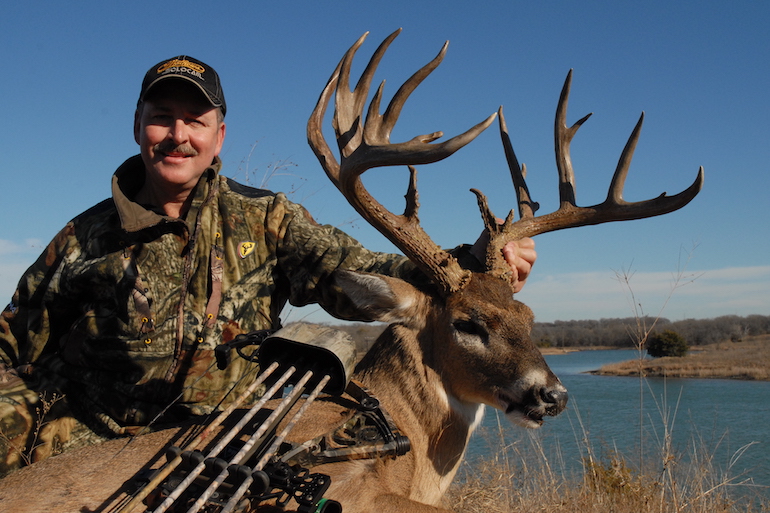
While November deer hunting gets most of the headlines, those hunters who are willing to punch the clock to the late winter buzzer can still take the trophy whitetail of a lifetime. Texas bowhunter Dale Moses did just that a few years ago, preserving through a long season of hunting that eventually culminated with a cold winter day shot that downed a big non-typical whitetail he had dubbed Captain Hook. (Photo by Lynn Burkhead)
Read deer hunting articles each fall, and you’ll see a lot of stories, a lot of photographs, and a lot of chest-thumping about the month of November. Outdoor writers are notorious for their November deer hunting praise and I’m as guilty as the rest of them.
In short, it’s the Whitetail Chamber of Commerce’s best advertising material, the month when the woods are alive with colorful leaves falling to the ground on a freshening north wind and deer-hunting prospects are at their very best.
That’s because November is when estrous does are plentiful. Mr. Big and his antlered buddies are throwing caution to the wind, and every deer trail has the potential of a whitetail love triangle straight out of the latest Yellowstone episode.
But then there’s the month of December, a time when the deer woods are suddenly as barren as Ebenezer Scrooge’s bankrupt soul, a collection of weeks as dead as the proverbial door nail pulled straight from the opening lines of Charles Dicken’s “A Christmas Carol.”
If you find yourself hunting in December with an empty buck tag in your back pocket, well, good luck. Because you’re going to need it, right?
Not necessarily. Play your cards right in the season’s 11th hour—and follow these five buzzer-beating tips—and you just might end the season smiling as big as the redeemed soul of old Ebenezer when he hears Tiny Tim cry out “God bless us everyone!”
Curious as to what you can do to tag a late-season buzzer-beater buck? Follow these five cardinal rules for late-season success.
1. Hunt the Fronts
The first rule is to hunt the passage of strong cold fronts. Especially on the day or two leading up to the frontal passage as the barometer is falling, clouds are gathering, and wildlife are noticing that a storm is brewing.
Like humans do with their pre-winter storm milk and bread run rituals that wipe out the shelves at the local grocery store, wildlife do something similar as they get up, feed heavily and pile on the calories to prepare for the coming blast of Old Man Winter.
Read more: Tag a Whitetail When It’s Hot, Cold, Wet or Windy
That’s what a bowhunting friend of mine named Tarif Alkhatib did a few years ago when he arrowed a gnarly horned, multi-tined non-typical buck in North Texas as the first Arctic blast of the season moved in.
Bundled up in his Under Armour hunting gear as the front barreled through and dropped temps into the lower 30s with light freezing precipitation, Alkhatib downed the buck as it moved quickly by his stand.
Late-season deer are active before and after a cold front. (Photo by Lynn Burkhead)
One good shot from his Mathews bow and the dedicated archer was soon on the ground shaking from both excitement and the cold as he tagged one of several wall-hangers that he’s knocked down in recent seasons.
Keep in mind that the same principle applies to a day or two after a storm, as deer get back on their feet and come out to feed and move around when the sun starts shining, the precipitation ends, and temperatures start to slowly moderate.
2. Hunt the Food
The idea noted above leads to the second rule of late-season success — hunt near high-calorie food sources. In the Midwest, that might be a cut corn field or a snow-covered soybean field. In the Deep South, it could be a green food plot or an oak tree with a few acorns still laying around. And in Texas, where I live, it could be a corn feeder shelling out golden nuggets twice a day.
Even the buck of a lifetime can come calling if the weather is cold and there’s adequate whitetail food around. (Shutterstock image)
Hunting late-season food is exactly what Robert Taylor did at the end of the 2012 season when he arrowed a huge North Texas non-typical whitetail that was chronicled in the pages of North American Whitetail.
The key to Taylor’s hunt — which came on the evening of Dec. 29 as cold weather and the remains of the region’s 2012 White Christmas dotted the landscape — was food.
Read More: Field of Dreams Offer Food for Whitetails, Success for Hunters
That food was the combination of a feeder spitting corn out and a food plot that promised local deer high-caloric intake during the cold snap. That was enough to lure in several does, a good 10-point buck, and the huge bruiser that Taylor ended up shooting. All on a five-acre plot of land, no less.
Unfortunately, the Taylor buck rode a bit of a scoring roller coaster – it received a green score of 249 2/8 inches, then a 60-day entry score of 254 4/8 inches, and finally a revised Pope and Young Club panel score of 219 1/8 inches. While the middle number would have made it a Texas bow buck record, 219 and change is nothing to sneeze at and proof positive that even the buck of a lifetime can come calling if the weather is cold and there’s adequate whitetail food around.
3. Hunt Thick and Nasty Cover
On an outdoor writer’s deer hunt last December in Oklahoma with Kevin Reese and the Sight Mark optics crew, I pushed my hunting luck to the very end. But hunting a box-blind stand in a Sooner State pecan bottom during the final hour of the final day of my hunt at Dakota Stower’s most excellent North Texas Outfitters operation, I was rewarded for nothing more than sheer persistence. And sitting in a post-rut deer stand situated next to some of the area’s thickest and gnarliest cover.
Focus on an area’s thickest cover during the post-rut. (Photo by Lynn Burkhead)
As high cirrus clouds streamed in and muted the last hour’s shooting light that was filtering into the pecan bottom, a good 8-point buck stepped out of the creek bottom’s nasty vegetation where he had holed up and bedded down the entire day. But as he trotted through a brief window of a last-hour shooting opportunity before ducking back into the thick cover, one shot from my rifle put down the only deer I would tag in all of 2019.
A short while later, I was discarding the recipe for “tag soup” I had carried in my back pocket last fall, not to mention looking through my phone contact list for the number of a favored taxidermy shop, all thanks to my own buzzer-beater buck.
4. Hunt the Secondary Rut
A fourth rule in tagging a December bruiser is to remember that November doesn’t always have the market cornered on rutting activity.
That’s because of the secondary rut which occurs when does that weren’t bred in last month’s breeding frenzy actually cycle into estrous again approximately 28 days later.
The key to hunting the secondary rut successfully are to find scrapes that have been reopened, to identify and hunt preferred natural food sources that mature bucks tend to key on, and to be in the woods when late-born fawns come into their first estrous cycle in December. (Photo by Lynn Burkhead)
While some hunters debate the strength of secondary rutting activity and its effects on big buck hunting potential, you won’t find Dallas hunter Sherman Wyman arguing about it. That’s because Wyman capitalized on the secondary rut on Dec. 24, 2005 when he shot a B&C non-typical buck netting 226 4/8 inches on his low-fence ranch near Wichita Falls in the state’s Red River country.
Read more: Second Rut, Last Chance
“I’ve shot a lot of big deer around Christmas time,” said Wyman. “(In North Texas), everyone thinks once Thanksgiving or the first of December has come and gone, you’re done.”
Obviously not.
In Wyman’s mind, the keys to hunting the secondary rut successfully are to find scrapes that have been reopened, to identify and hunt preferred natural food sources that mature bucks tend to key on, and to be in the woods when late-born fawns come into their first estrous cycle in December.
5. Punch the Clock
A final rule to notching a tag on a December buzzer-beater buck is to employ the deer-hunting version of the photographer’s old “F8 and be there” rule.
For photographers of old-school training, that rule means to put your digital camera on manual, set the f-stop to F8 and be there for the shot.
That idea rings true for late season deer hunters too.
A deer hunting physician I once knew practiced this rule near my North Texas home many years ago just before Christmas when he carved time out of his busy holiday and professional schedule, braved some intense cold weather, and got to the nearest deer stand as the season was winding down.
Deer season, as well as the holiday season, that is.
Read more: How to Rally for a Late-Innings Whitetail
Dr. Wade was rewarded for his consistent punching of the clock that December when he arrowed a beautiful 163 5/8 inch net typical, a wide and beautiful racked buck that adorned the good doctor’s Christmas cards that year.
My good friend Dale Moses, a passionate bowhunter and retired Texas Game Warden, has taken numerous big deer over the years with his Mathews bow, a few of those wall-hangers getting tagged in the season’s final days. That includes a late-season buzzer-beater back in 2013, one that he dubbed “Captain Hook.”
Just after Christmas that year, in a frigid stretch of weather that was gripping the North Texas woods Moses had hunted all season, his cat-and-mouse game with this big non-typical finally ended. The whopper non-typical buck placed well in the Texas Big Game Awards Program that year, scoring 184 0/8-inches.
Want to do something similar as the 2020 deer season winds down? Then get out of that easy chair, leave the warmth of the fireplace behind, and get into your deer stand, even if it’s the season’s final hours.
Because when it comes to tagging a buzzer-beater buck, you just never know, right?
“How many guys do you know that were out on a (North Texas) deer stand on Christmas Eve?” asked Sherman Wyman.
The truth is, not very many.
Only the ones whose inner hunting flame still burns hot enough to drive them out the warm comfort of home and into the chill of the late-season whitetail woods.
Which is exactly where they hope to be to beat back Jack Frost’s wintertime chill while tagging a buzzer beater buck just in time for Christmas delivery.
If you feel curious about what is Chaturbate andhow it works, stay with me. You will learn lots of things about Chaturbate.
What exactly is Chaturbate?
Chaturbate is a website that allows users to broadcast themselves and earn money through tips and subscriptions from viewers.
To make money on Chaturbate, you will need to create a performer account and complete the verification process. Once your account is verified, you can start broadcasting yourself and earning money from tips and subscriptions from viewers.
To increase your earnings on Chaturbate, there are several things you can do.
First, you can promote your Chaturbate profile on social media and other platforms to attract more viewers to your broadcasts.
You can also offer special features or services, such as private shows or custom content, which viewers can pay extra for. Additionally, you can participate in Chaturbate’s affiliate program, which allows you to earn a commission for referring other performers to the platform.
It is important to note that making money on Chaturbate, or any other platform, requires hard work and dedication.
Success on Chaturbate, like on any other platform, is not guaranteed and will depend on a variety of factors, such as the quality of your content, your ability to engage with viewers, and your dedication to promoting your profile.
Chaturbate is a website which combines 2 things: Chatting and masturbation, as the name suggests. Currently is the world’s largest adult cam-site with a healthy advantage over its rivals.
The website was launched in February 2011 and has increasingly become a very popular site with members and broadcasters alike.
It is the most followed cam site online with 489,000 followers on Twitter. Currently, it keeps growing on all levels so it still is an excellent choice for anyone willing to watch or broadcast.
Now I’ll explain what are Chaturbate’s best features from a broadcaster point of view and also from a viewers point of view.
Chaturbate is a platform that features hundreds of chat rooms from around the world. You’ll see a live amateur webcam stream in each chat room.
For instance, by clicking here, you can view the current most popular stream on Chaturbate right now. You’ll find a model trying her best to make money in front of thousands of horny viewers.
Chaturbate makes it easy for both, allowing to tip your favorite broadcasters in exchange for a performance. But not everyone has time to see all shows to the end.
Good cams shows can last for hours. If you are in a hurry, you may not want to waste hours waiting for a free show to go down. In that case, I suggest you try one-to-one private shows instead.
How to use Chaturbate?
When you enter a chat room, you’ll find that on the screen video takes centre stage with a sidebar for users to talk with each other directly and exchange messages with the ‘broadcasters.’
Chat rooms are divided into five major categories:
Female Cams
Male cams
Transgender cams
Couples
Featured
All these categories are self-explanatory so I won’t say more about that. The featured category shows homepage cams because those get the most traffic. That’s where you’d want to be in.
With tags, each broadcaster can also classify what’s her/his show is about, making it much easier to find what you are looking for.
There are common tags such as bbw, teens and anal, as well as more unique ones for those exquisite viewers.
You can also filter cams by geographic region, but remember that most broadcasters won’t disclose their real location for privacy reasons.
I am a spectator. How does Chaturbate work?
Registering is fully free and will allow you to view most cams but there are premium shows that may require an extra payment.
Private shows can be paid using tokens, the usual currency on all cam sites.
Broadcasters will encourage viewers to pay tokens in order to see something included in the broadcasters’ tip menu.
Tokens may also be used to purchase pictures and videos from a broadcaster, even when she/he is offline. Many broadcasters also include their personal Amazon wishlists so true fans can know what to buy to their favorite models.
What is Chaturbate Pro?
Chaturbate recently launched a new type of subscription called Chaturbate Pro. For $19.95 a month you get:
Clean Ad-Free Interface
Custom chat font & colour options
Private messaging
Anonymous tipping
Animate room images
200 free tokens ( worth $20.99 )
Is it worth it? Chaturbate Pro is basically like buying a basic 200 token pack, but with some more perks.
If you are an active Chaturbate user that spends around 200-400 tokens per month on the site, I recommend you to try this new subscription, because you get more bang for your buck with it than just buying tokens only.
What’s the real value of Chaturbate’s tokens?
Click here to view in detail how much Chaturbate tokens are worth.
As a model, what should I look out for?
Here’s one of the things you might not know about this site. Chaturbate uses a colour coding scheme.
Site participants are categorized depending on how many tokens they have and how frequently they spend them, as well as more information about their site activities. That means that members names on the right-hand side will appear colour coded.
This is extremely useful for broadcasters as it provides information to recognise which members are likely to tip.
Also, broadcasters are much more likely to respond to a suggestion to perform from someone who frequently gives tips than to accept suggestions from someone without tokens. Categories are as follows:
ColourDescriptionRedThis is the chat room moderator. Usually is a person chosen by the broadcaster to help her keeping beggars and idiots out of the room.OrangeMeans that person is broadcasting in their own room.GreyIt means that this member has no tokensGreenMeans that this member is a fan of that roomDark BlueA member who has spent at least 50 tokens in the las 2 weeks.Light BlueA member who has spent between one and fifty tokens in the last 2 weeks.Light PurpleA member who has spent at least 250 tokens in the last 2 weeks.Dark PurpleA member who has spent at least 1000 tokens within the last two weeks.
So now you know it. As a viewer, you need to have some tokens in your account to be taken seriously.
No broadcaster will fulfil your desires with an empty pocket. They know whether you have tokens in your account or not so don’t be stingy and buy some!
Want to broadcast? Check out these guides
Having success on Chaturbate is something definitely possible but that requires work. Check out how much money you can make on Chaturbate or the latest tips to improve your shows.
Why Chaturbate is so popular
I think Chaturbate is enormously popular because of the relationship that it creates between broadcasters and followers. It was the first cam site that exploited this area and years after it’s easy to see they were right.
As a broadcaster, you can not only get tokens from your fans but gifts too. You just have to create an engaged enough audience willing to buy your whims.
Conclusion. Is Chaturbate worth it?
Absolutely. Chaturbate’s popularity right now is in all-time high and nothing indicates that’s gonna change short term. From my experience broadcasting, it can be a nice experience and it can make you lots of money.
If you combine that with other appearances on sites like OnlyFans you may very well in place to improve your financial position drastically, but to do so, you must first know what viewers want and work hard until you get the hang of it.
It took me a few weeks before making significant money so my final advice is to keep at it, never give up and ask for help if you need to. Here on this site, we are open to help any of you who needs help broadcasting. Send us a message through the contact form or leave a message in the comments section.
*My latest book, All Weather Whitetailsis now available!
Backing Out For Wounded Whitetails
Trust me I have heard them all, including: “It’s going to rain”, “the yotes will find him first” and “snow is coming”. Although some hunters may not admit it, I think you can even add, “I have to get home” and “I have to work tomorrow”, to the list of reasons not to back out. However, the hunters I personally know who experience nearly a 100% success rate for recovering mortally wounded whitetails, all have one thing in common: Patience. If “when in doubt, back out” is the king of whitetail recovery phrases, “Patience” it’s single root word of success.
Exercising patience with anything in life is difficult and the art of tracking a wounded whitetail is absolutely no exception. But, if you want to consistently find a deer that you just shot, you have to apply a whole lot of patience. The decisions that you make within the first few minutes after you shoot a deer, will directly dictate the rollercoaster of emotions that you experience for hours or even days to come. The reliable level of predictable tracking success is based on the behavior patterns of wounded whitetails.
Top Whitetail Blood Tracking Tips
*A mortally wounded deer will lie down within 200-300 yards (or first thick cover) and will expire in the time-frame of the specific hit. Unless pushed, this will be the final resting place for your deer. If pushed from this location, the deer will usually go in excess of mile or more, depending upon cover, with little to no blood trail. Unless you are extremely lucky the odds that you find your whitetail are extremely low, even if you only jump him 1 time.
*If raining or snowing, you dont have much to lose by waiting. If you have a good hit, the deer will only go a short ways, making recovery relatively easy, even with no blood trail! If the deer had a marginal hit, hurrying to track because of an approaching rain or snow will only push the deer and you have a great chance of losing the deer anyways. Do you have lots of coyotes or other predators in the area? Same thing…jumping a bedded deer will only lead to the same results of jumping him in the rain or snow. 1 jump and he is typically gone for good, so taking a chance that a predator finds him is better than the certainty that he will be lost if he is pushed to early.
*Just because you see a double-lung hit, doesnt mean thats what hit it was. Our mind has a way of tricking us into thinking we did a better job than we did (we practiced, aimed hard, took a careful shot-had to be good!). Believe it or not, a deers reaction is quick enough to completely avoid an arrow, even within 10 yards. If a deer reacts just slightly to the sound of the shot, your arrow can be no where near where you aimed. Also, do we always make a perfect shot?I know that I don’t, which is why I thought is was important to relay this informationt to you.
*Unless you see your deer fall, it is always best to wait until morning, or later in the day, even if you think you made a good shot. This practice has resulted in dozens of 100 yard tracking jobs that ended with a deer that had expired hours earlier. But I can also say that this practice has ended with at least 2 deer that were still warm to the touch.
*If you know you made a double-lung shot, with a heavy blood trail and plenty of bubbles, and are also confident you made a perfect shot; wait an hour and go get your deer. The problem with this is that it takes many years of experience and tons of confidence to determine exactly what situation and hit is yours. Each year there are many lost liver shot deer that fell victims to I know I shot a double lung, when in fact it was not. I consider all my deer trophies, and even if I know I shot a great shot, I still give the animal the time and respect it deserves to expire. If you shoot a buck early in the morning, go have breakfast, go shopping, call some friends or even take a nap (if possible!). An evening tracting job is the same-walk straight home, have a sleepless night, and go get your deer in the morning with no harm done.
*A wounded deer may only be 100 yards away when you exit your stand, dying, so it is critical to sneak out of your stand and away from the deer. Walking towards the deer only 10 feet could result in a fleeing deer that often will cover a 1/2 mile or more prior to settling down again. Remember, that deer really doesnt know what happened, he probably feels sick, and is doing his best to feel hidden, safe and comfortable. The moment a whitetail knows a human is after him, he is gone! It only takes a jacket being un-zipped, an arrow hitting a stick, or even an innocent cough or sniffle.
*Always look for the last place you saw the deer and mark with a tissue, tree, or other natural feature. Still follow the blood trail at the place of the hit to more accurately determine the type of hit, but marking the last place of deer sighting is a great reference. Over the years I have had to climb back into a stand after searching a bit becasue I did not mark the location I last spotted the deer I had just shot only hours earlier. Remembering a fallen log, odd tilt to a tree trunk or even an unusual opening in the woods are all great references for when you return to .
[PLEASE NOTE: This article originally appeared in the Jan. 2021 print issue of Firearms News. The ammunition prices mentioned herein are not current.]
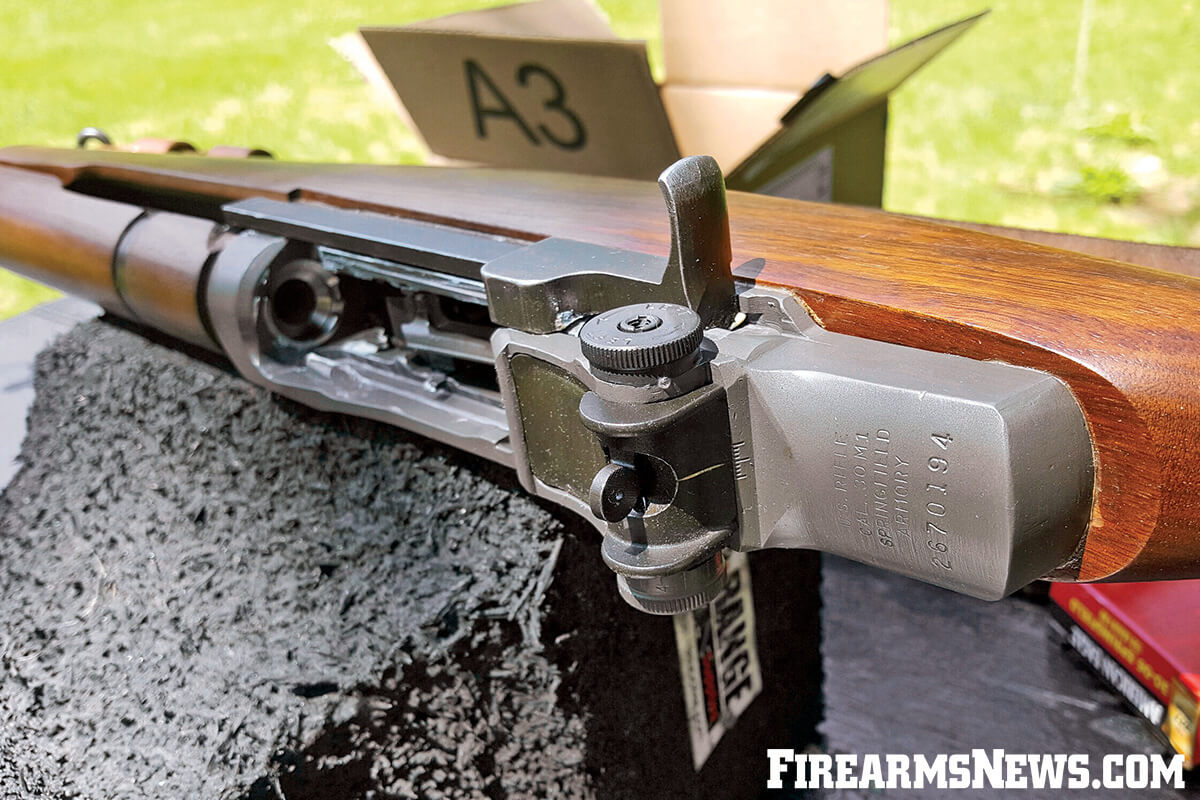
I have been a Garandaholic since I was a teenager in the ‘70s. My interest in this great battle rifle was spurred by my father’s memories of his World War 2 service. Like many vets of World War 2 and Korea he spoke of the M1 with reverence. The only source for G.I. surplus M1s in my youth was the Director of Civilian Marksmanship (DCM), the forerunner of the current Civilian Marksmanship Program (CMP). I recall the DCM selling them for $99 each. The catch was that the buyer had to be an NRA High Power Rifle competitor and I didn’t start shooting in rifle competitions until over a decade later.
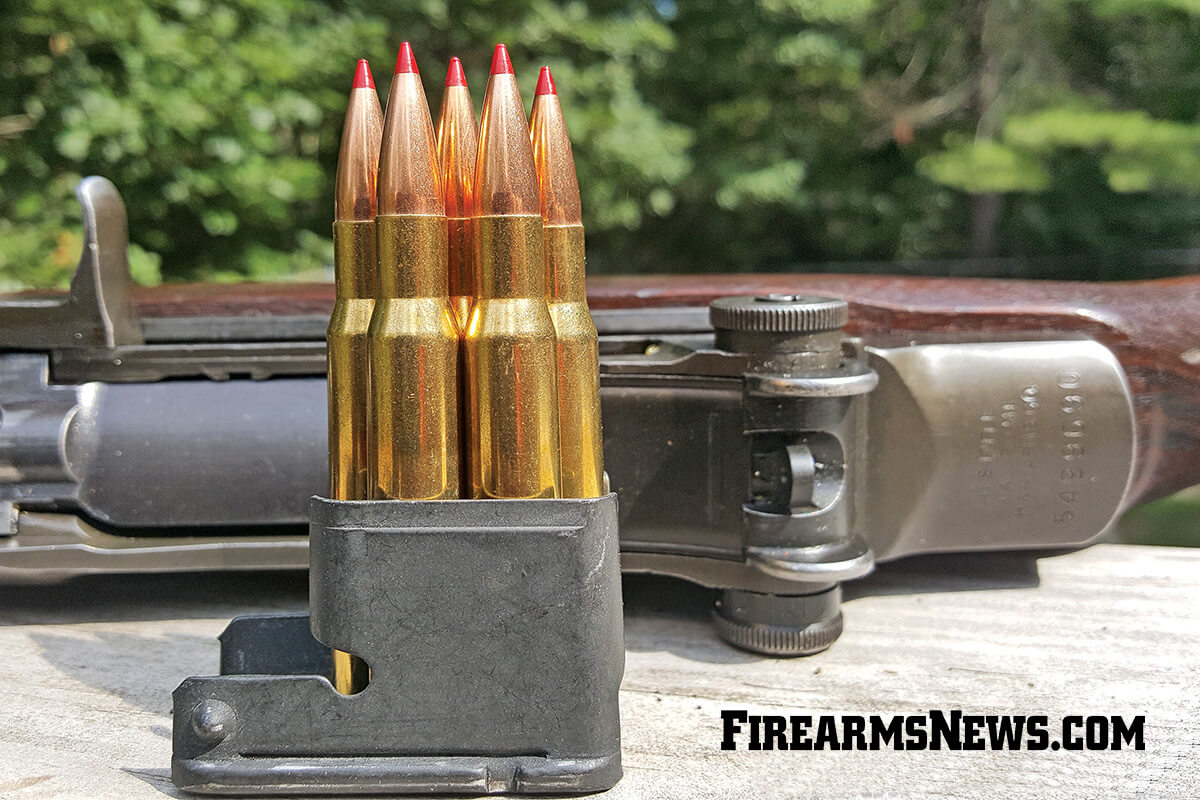
A five-round clip of Black Hills 155 gr. ELDs awaits testing on the shooting bench.
On December 11, 1975 I walked into a local gun shop and found a Garand for sale. It was built on a rewelded receiver and the barrel had been fabricated from a 1903A3 barrel, although I wasn’t aware of those things at the time. My fate was sealed. From that point on I would always have M1s. That first M1 remained in a closet during my tour with Jimmy Carter’s Army and I never really started shooting it until I became interested in High Power Rifle competition toward the end of the ‘80s. I re-barreled it to .308 for logistical reasons. The Maine Army National Guard marksmanship team issued me 7.62 NATO for practice and that beats buying ammo.
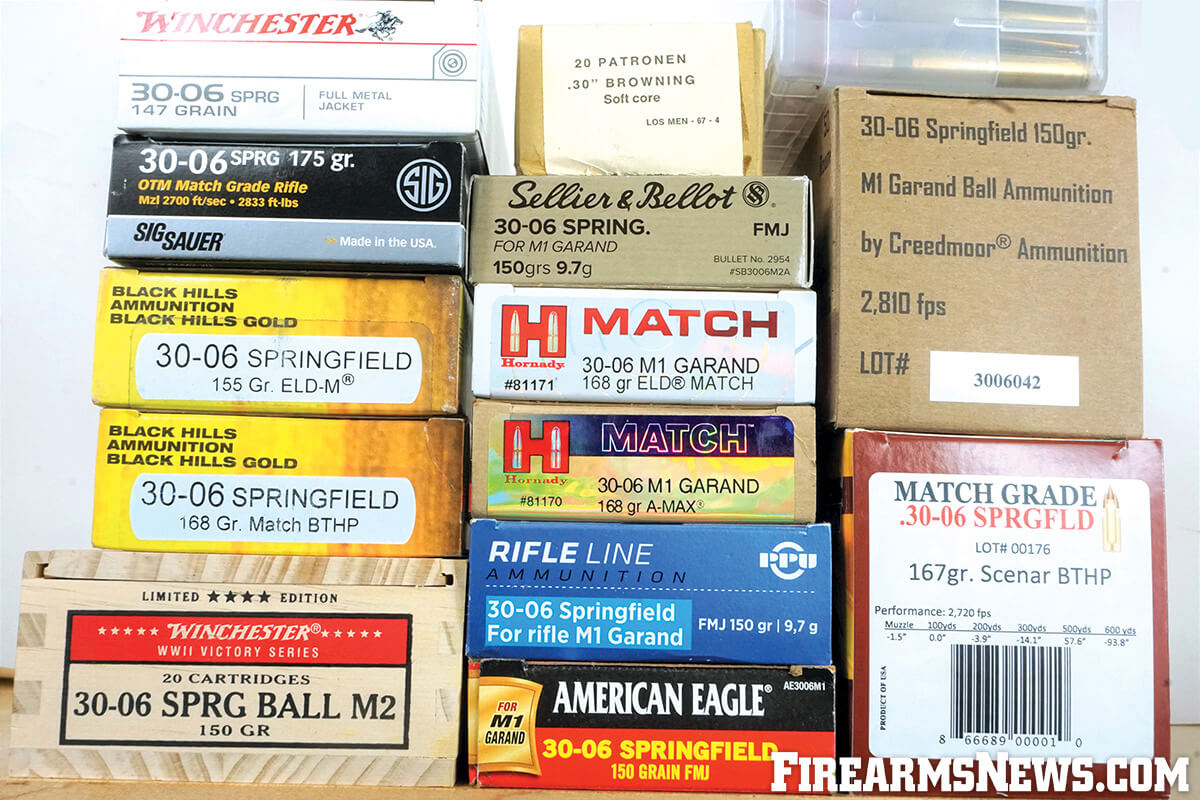
Loads from just about every major manufacturer were tested for this article.
.308 Garands shoot quite well, but most of the rifles out there will still be found in .30-06. This old cartridge has been around for over a hundred years and it is still popular with hunters and military rifle shooters. The Garand, due to its gas-operated action, is easy on the shoulder compared to a bolt-action rifle firing the same round and it comes equipped with the best sights ever issued on a battle rifle. An old-school rifleman who appreciates wood and steel blasters will find the M1 a pleasure to shoot.
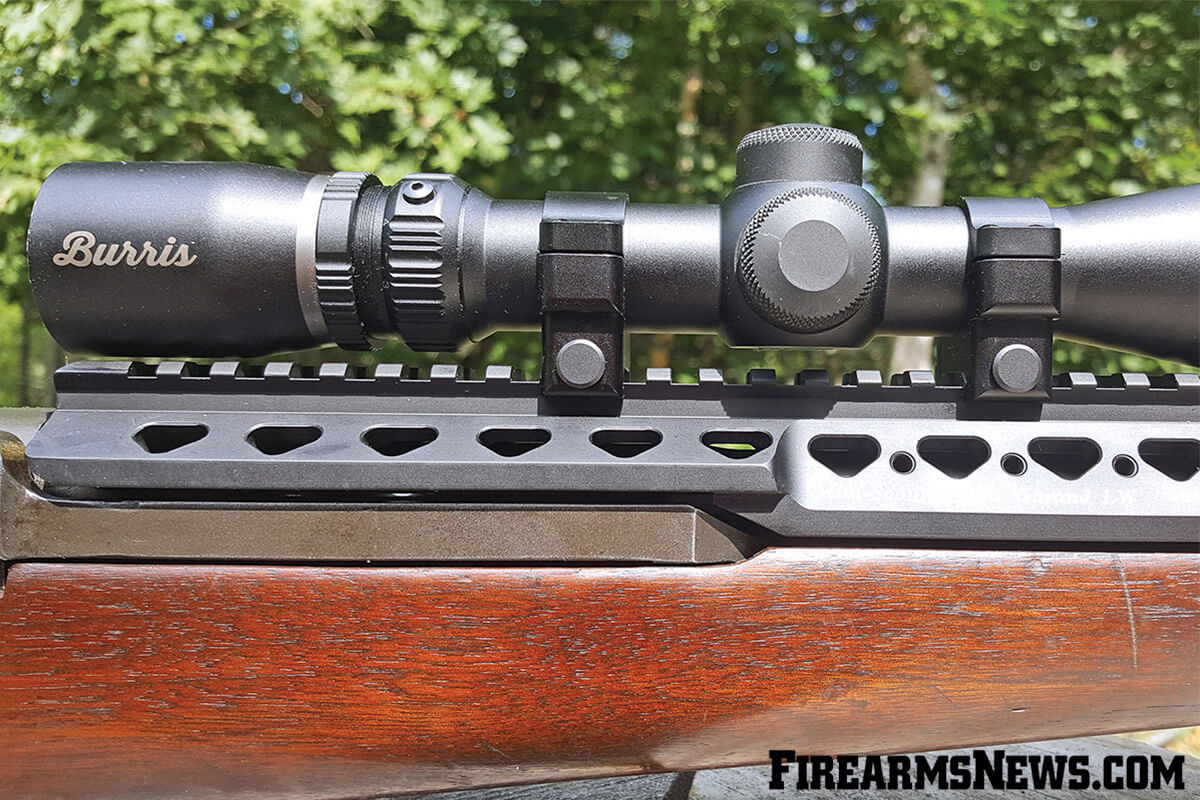
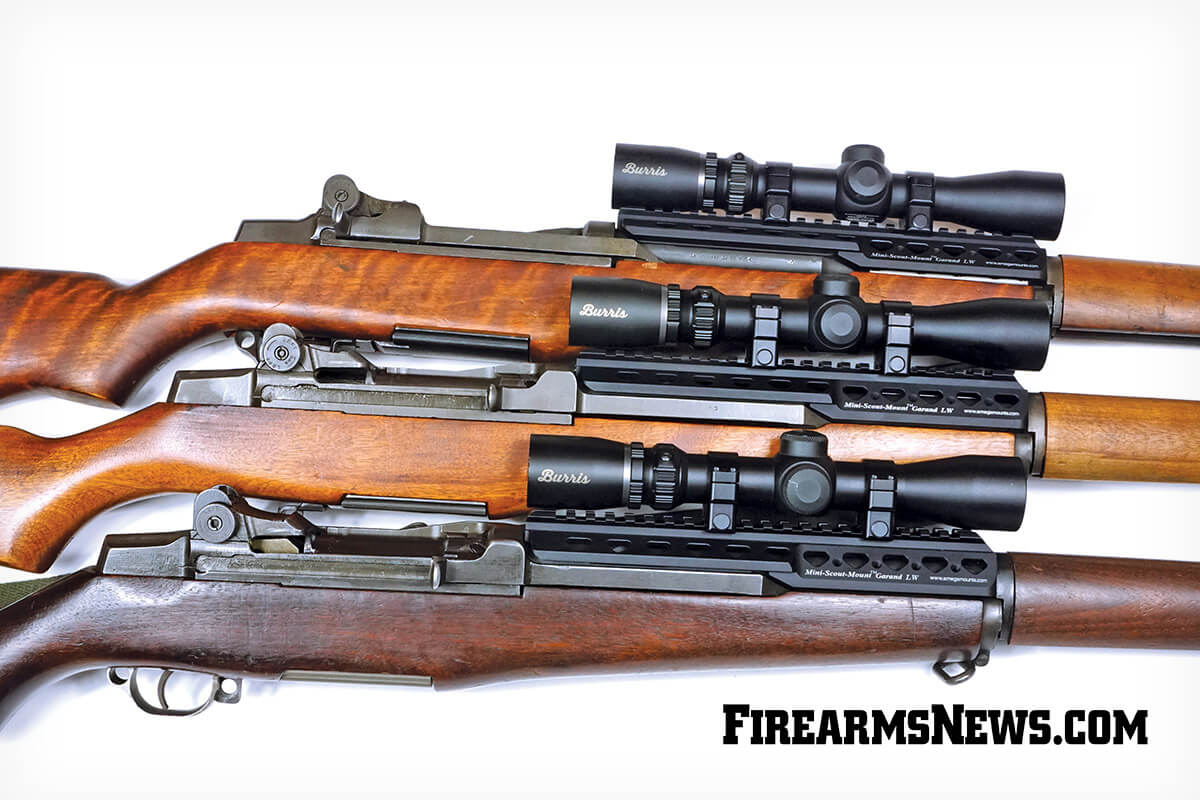
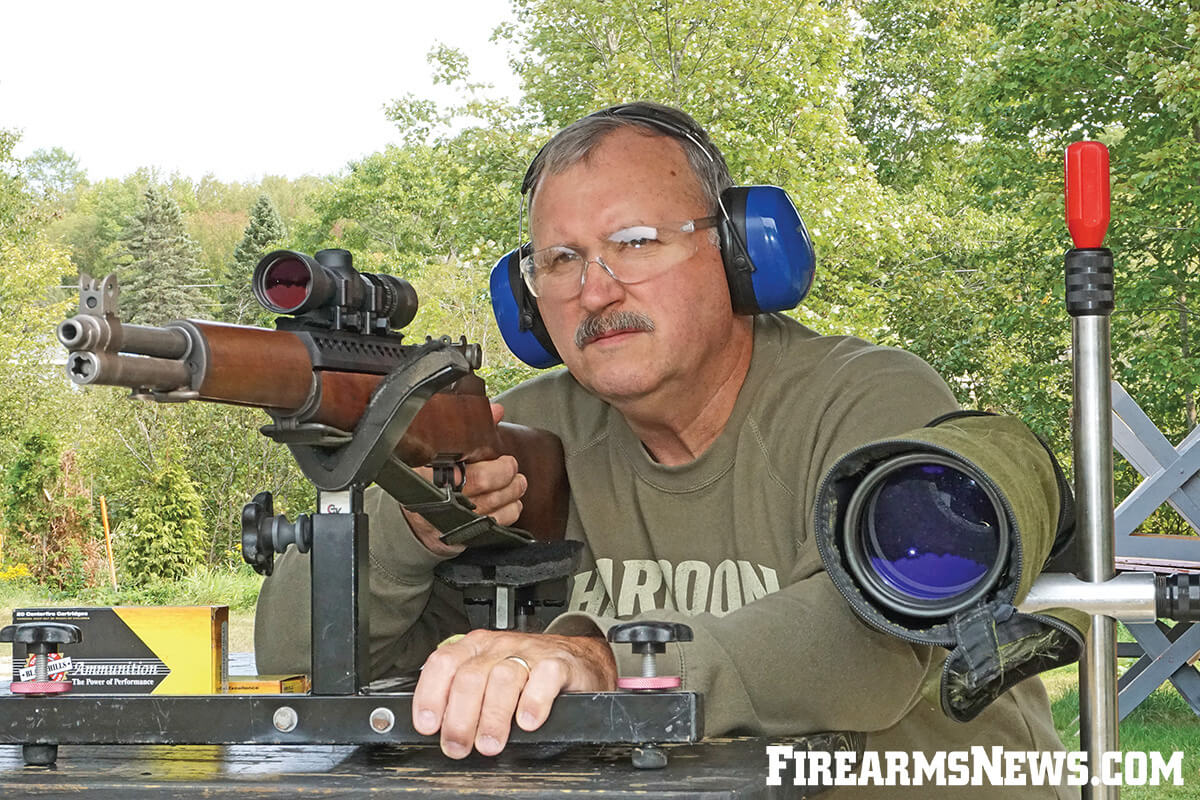
Burris 2-7x scout scopes were fitted to each of the test Garands to reduce human error.
A concern of M1 shooters is finding the correct ammunition. But, you say, .30-06 ammo is everywhere. True, but a lot of the ammo commercially available today is not loaded to the original pre-World War 2 military spec for which the Garand was designed. The gas system was configured to operate efficiently and reliably with the military issue Caliber .30 Ball Cartridge M1 (and later M2). The gas port size and internal dimensions of the gas cylinder were optimized for the military powders of that era resulting in the correct bolt velocity as it travels rearward after unlocking. Excessive bolt speed can damage the weapon and in extreme cases the rear of the receiver may fail. One can only imagine the discomfort experienced by the shooter who is whacked in the face by a high-velocity receiver heel! For decades M1 shooters fired military surplus ammo with no worries but that supply is gone now. Luckily for Garandaholics, several commercial manufacturers have stepped up to the plate and offer specific loads tailored for the Garand gas system. The purpose of this article is to sort through current offerings testing them for accuracy, velocity and function so you can determine what product best fits your needs and budget. If Consumer Reports did ammo tests they would read something like this.
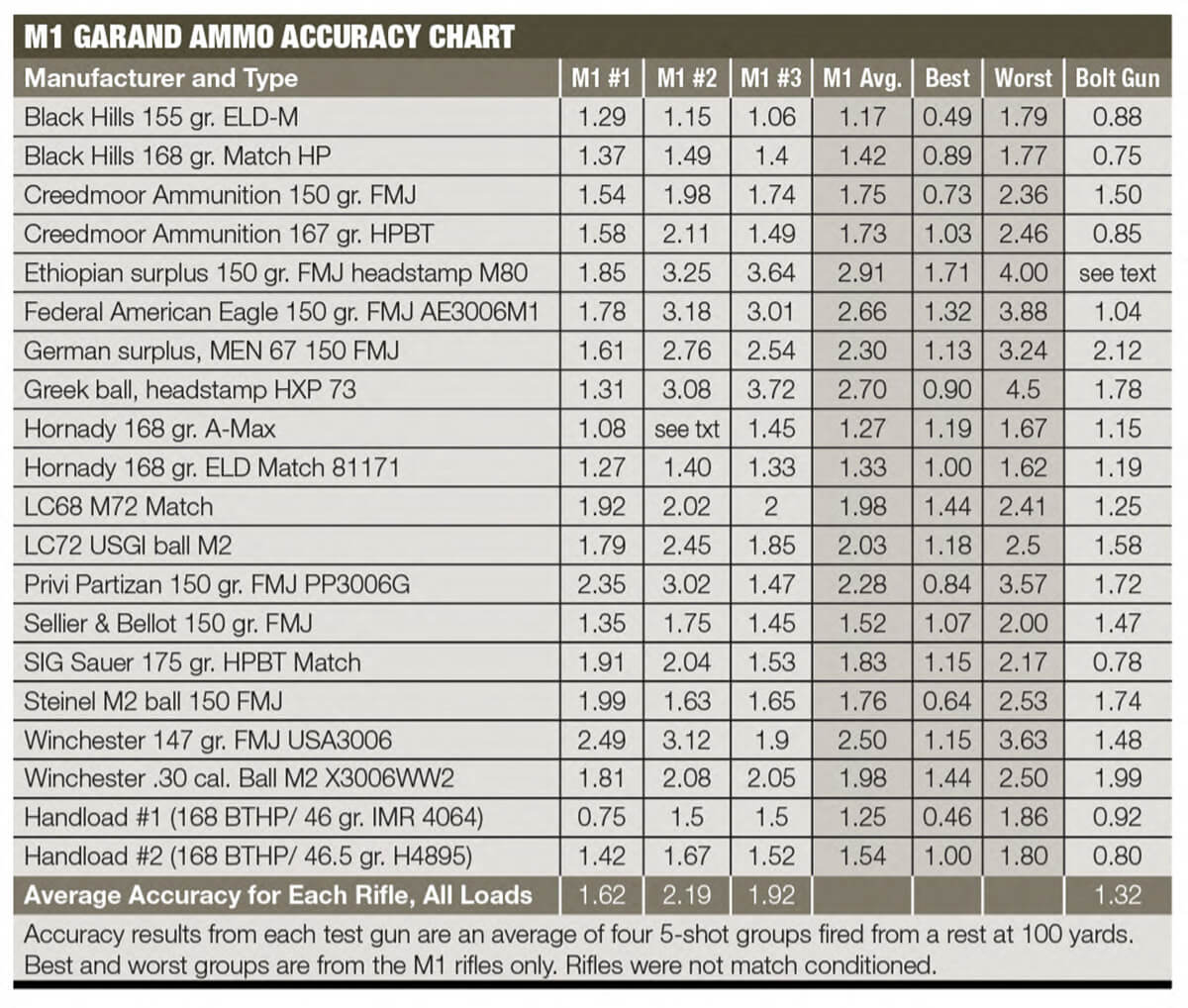
Test standards: All loads were fired for accuracy at 100 yards. Obviously, the heavy bullet loads would shine at longer distances, but my home range is 100 yards and considering the many man-hours spent testing a couple thousand rounds traveling to another range simply wasn’t feasible. Rifles were fired from a bench rest. I used a CTK Ultimate Shooting Rest for the M1s. The Savage bolt gun was fired from a bipod. As much as I would like to think of myself as a human machine rest I am just an old man who likes M1s but this was a pretty solid setup.
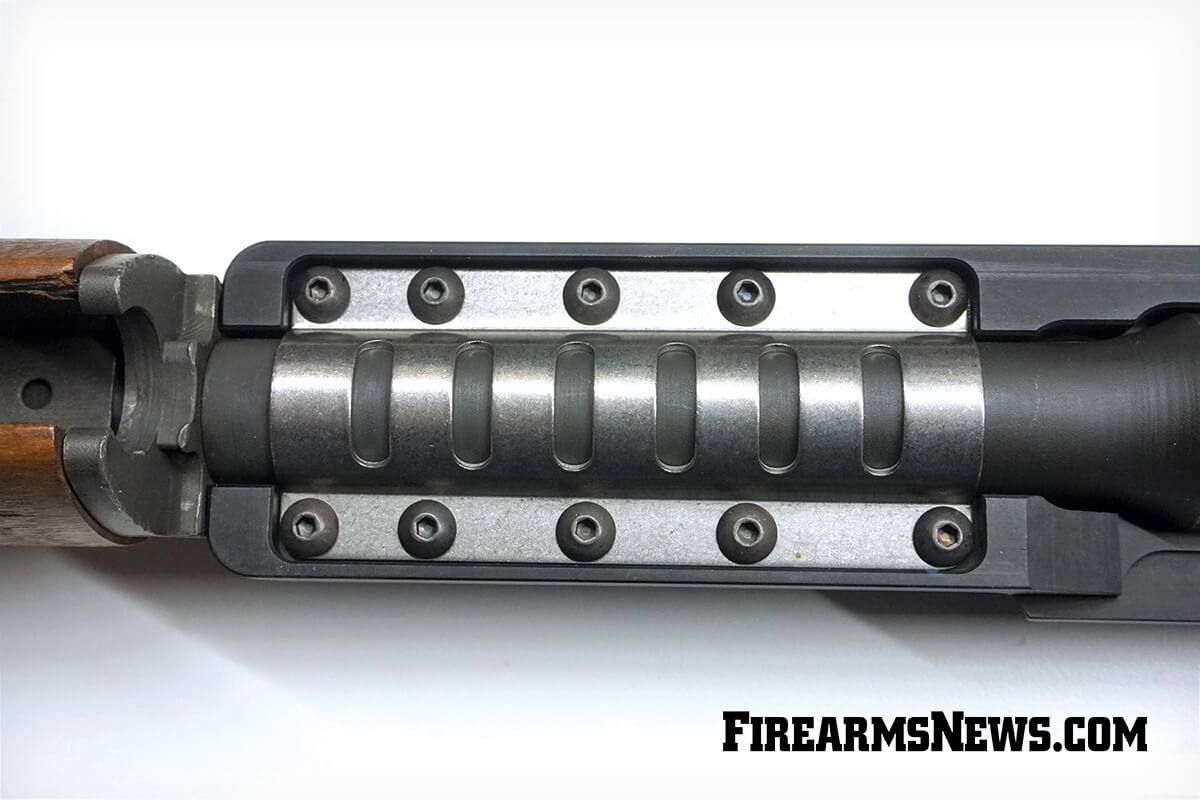
Bottom view of the Amega scope showing the clamping plate and screws.
Targets were the IBS Hunter Rifle target with six bullseyes. I fired six five-shot groups with each type of ammo from each rifle and averaged the four best. Why five-shot clips? Because Firearms News test standards for rifles are based on five-shot groups so if you are comparing Garand accuracy to some other rifle we keep test standards uniform across the board. Five-shot clips are available for Garands (Brownell’s 901-000-004). I feel that averaging the groups of many targets results in a trend that reveals the most accurate loads. Shot groups were measured center to center with a caliper as accurately as possible.
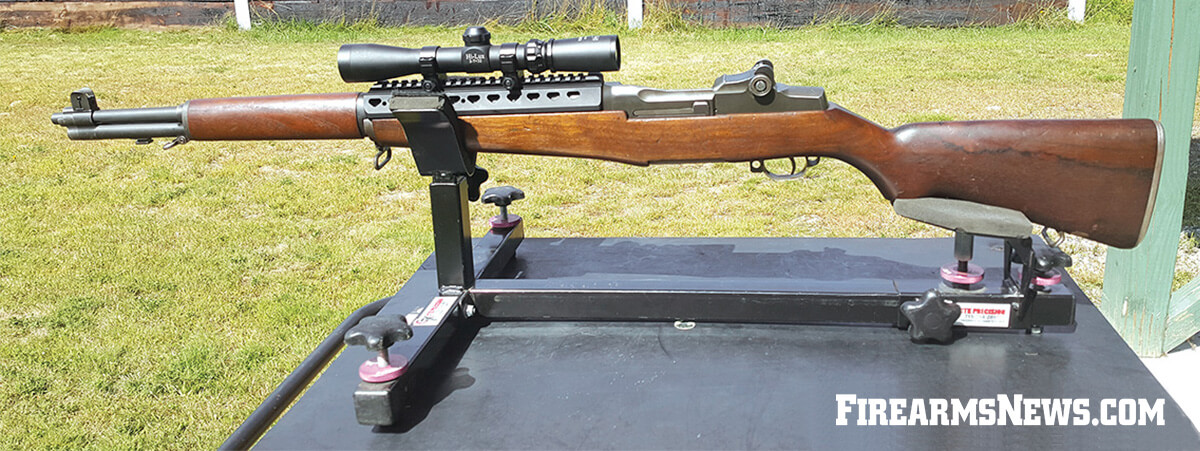
Test rifle #1 shown mounted on the CTK shooting rest employed in accuracy testing.
To reduce human error, I fitted the M1 rifles with scopes. Heresy, you say. I agree, but the point of this test is to rate the accuracy of available ammo, not my marksmanship. Scopes reduce human error. Due to the top-loading design of the rifle, a scope cannot be positioned directly over the receiver. However, a “scout” scope with eye relief of approximately 9-1/2 to 10 inches mounted just forward of the receiver works fine. I used the Mini Scout Mount from Amega Mounts (AmegaMounts.com) which clamps to a standard profile M1 barrel replacing the rear handguard. The mount never loosened during testing.
The Garand test rifles with scopes mounted as tested.
I employed two different scopes: a Hi-Lux 2-7x BDC and a Burris 2-7x 32 Scout. All testing was done at 6x. The Burris was a bit brighter with a finer reticle but also cost over twice as much as the Hi-Lux. The first Hi-Lux I mounted failed after several hundred rounds. The manufacturer replaced it. If you shoot a lot, you know scopes will fail occasionally. If the manufacturer stands behind their product its nothing to worry about.
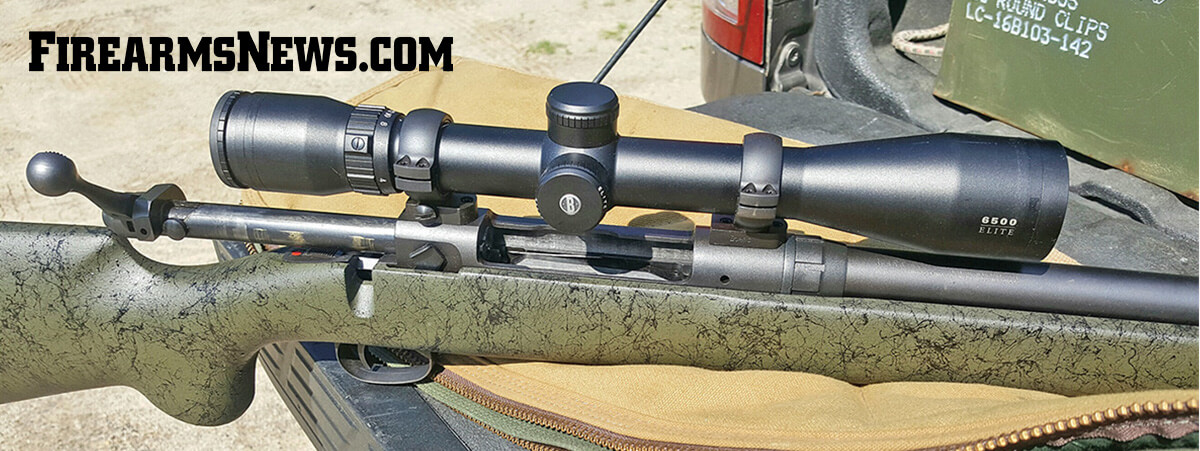
Test rifle #4 was a Savage 110 Police Special from the 1990s that had been restocked.
The rifles: All test rifles were from my personal collection. These are not match-conditioned rifles, but they were inspected for mechanical issues that may cause inaccuracy such as loose gas cylinders, poor op rod fit, little to no stock compression, etc. and corrected as needed. I guess you could say they were “blueprinted.” About halfway through the test, guns #2 and #3 stopped grouping. The actions were loosening in the stocks. To tighten them I inserted a short piece of 1/16″ walnut veneer under the forward end of the receiver rails. These pieces of wood served to lever the barrel upward slightly increasing pressure between the stock ferrule and lower band. Tensioning the barrel through shimming or bedding results in increased accuracy from M1s and M1As. After this simple modification, our test guns started shooting again.
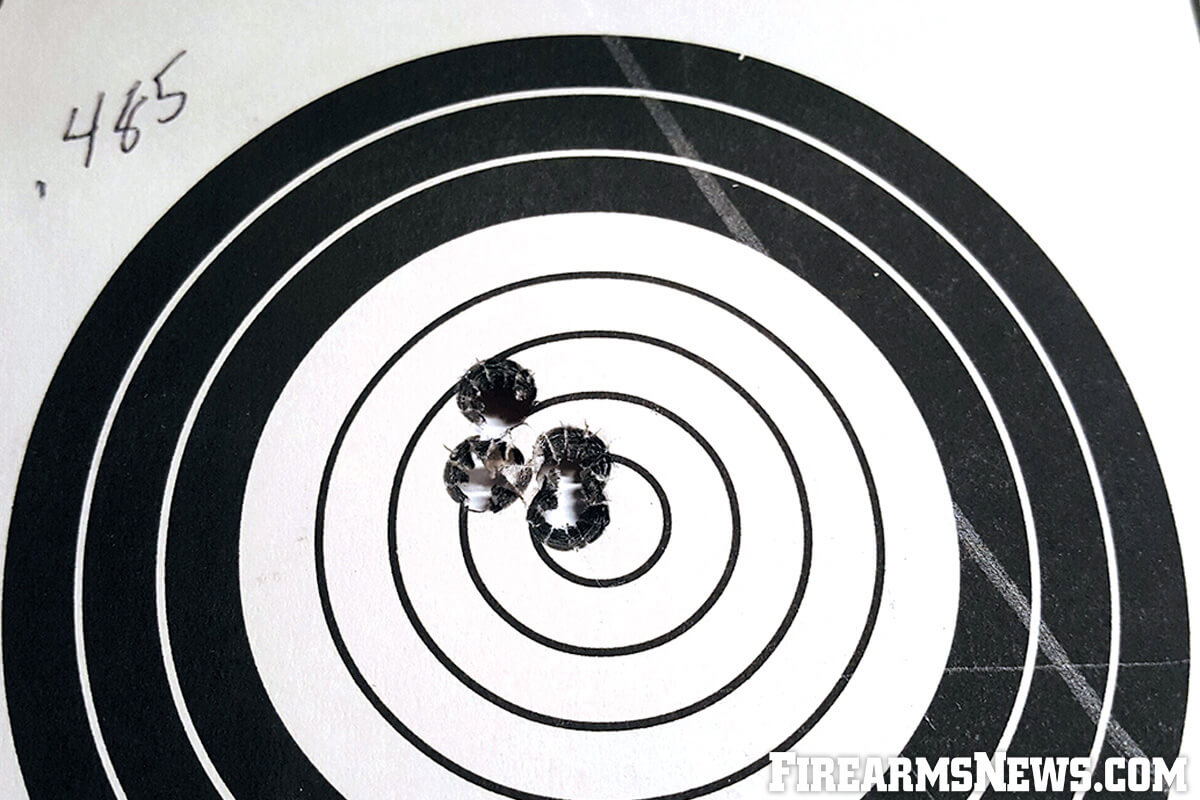
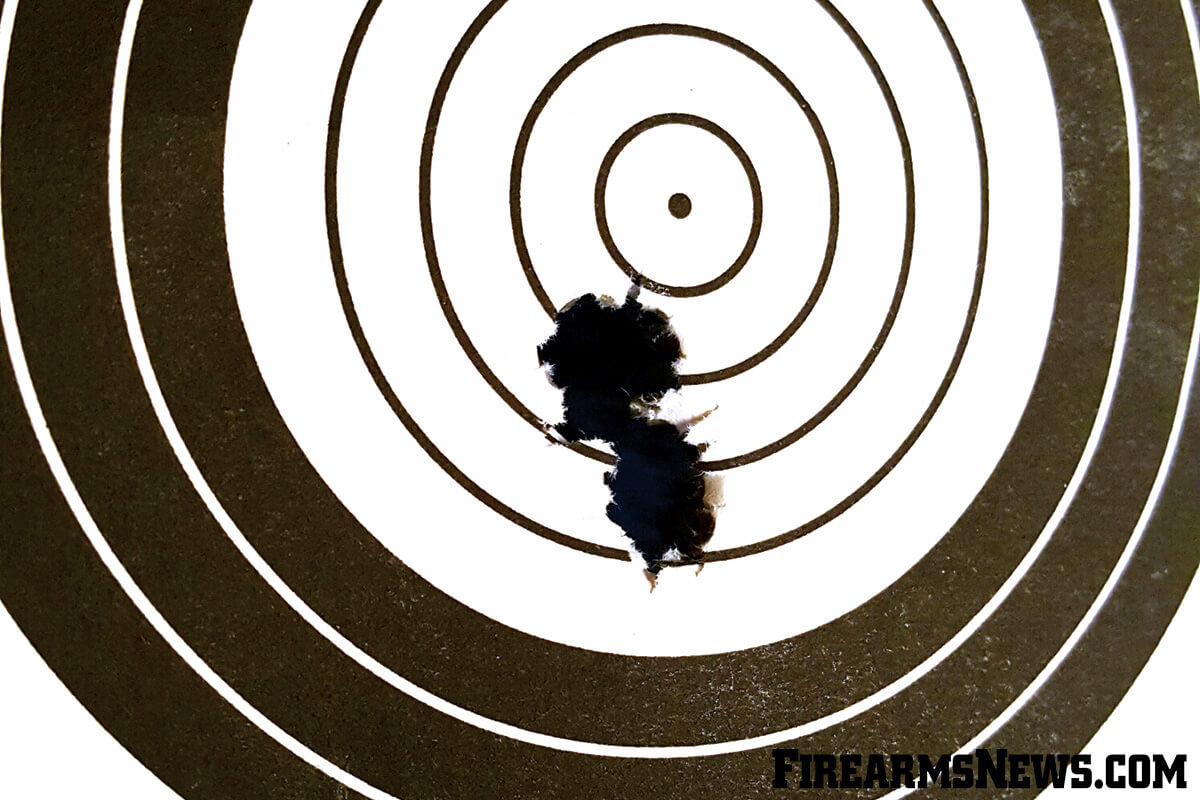
An incredible .485″ 5-shot group fired from Garand #1 (Black Hills 155 ELDs).
Rifle #1 is a Korean War era M1 produced by H&R. I re-barreled it with a Fulton Armory standard weight barrel a dozen years ago. Aside from the commercial barrel it is a standard issue infantry rifle. When fed ammo of the correct spec it will function reliably and shoot accurately all day. The barrel probably had less than 200 rounds through it at the beginning of testing. This is one of my best shooting rifles.
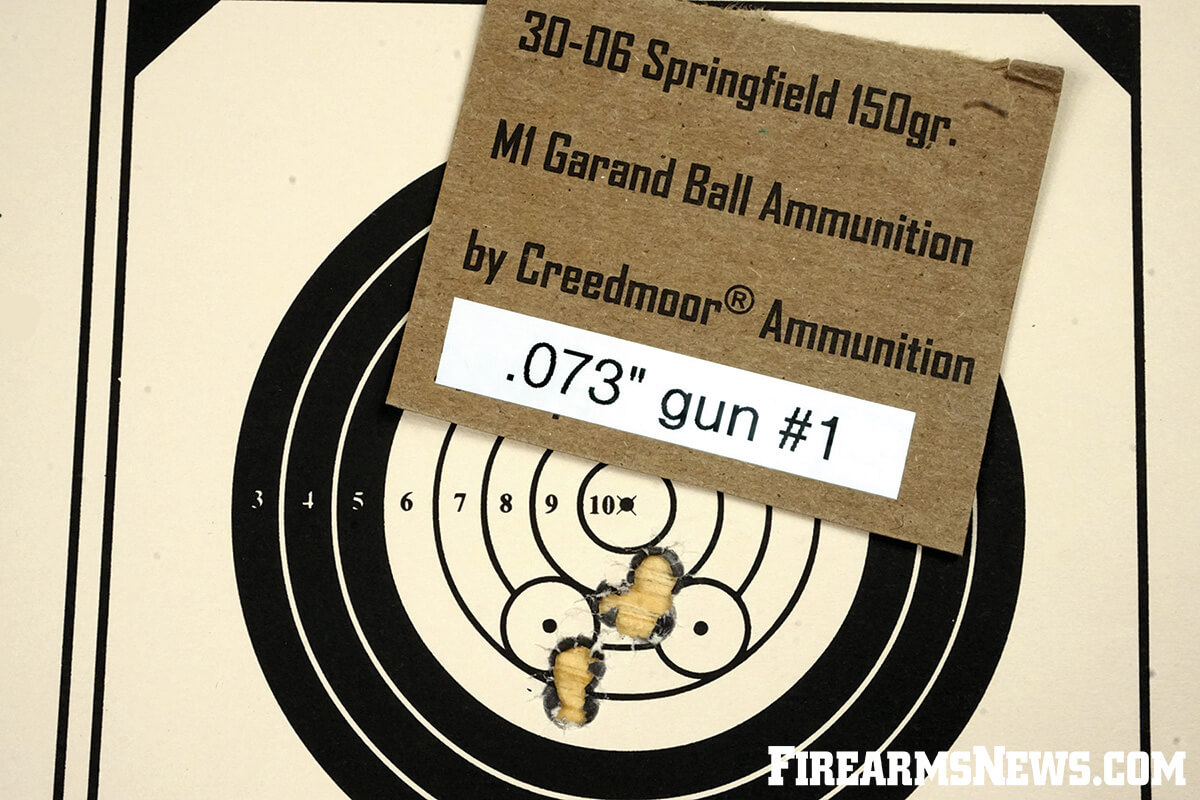
Our best five-shot group with Creedmoor 150 FMJ from the CMP: .073 inch.
Rifle #2 is from Springfield Armory and was produced in 1944. I purchased it from DCM in 1991 for $165 and it was shipped to me registered mail from Anniston Army Depot. It came equipped with a G.I. Springfield Armory barrel dated 10-63 and at the time this test commenced had approximately 2,000 rounds down the tube. It is 100% G.I. in issue condition. This rifle does not shoot as well as rifle #1 but with good ammo it will shoot almost as well. This is a beautiful weapon and I will probably never modify it.
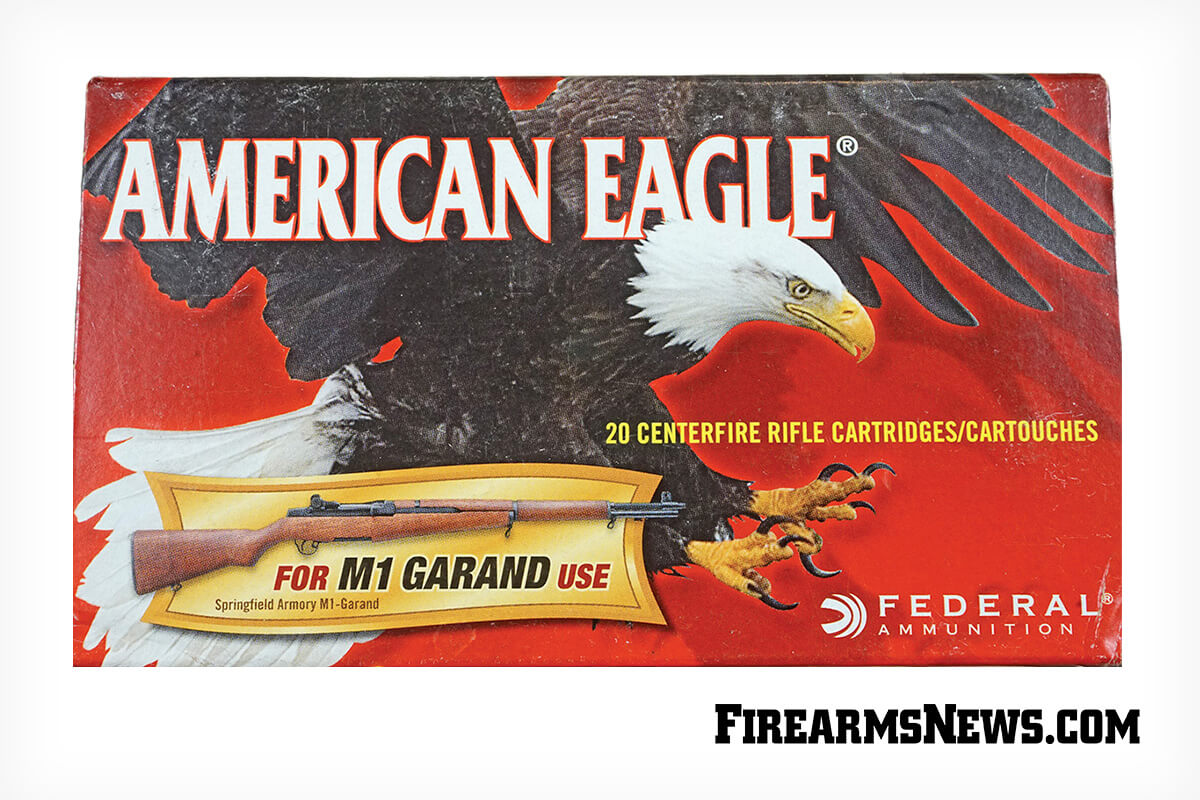
A Garand is prominently displayed on this box of American Eagle indicating its intended use.
Rifle #3 is another beautiful Garand purchased from CMP in 1999 for $400. This one sports a G.I. Springfield Armory barrel dated 12-65 with about the same wear on it as Rifle #2 as indicated by a G.I. throat erosion gage. The rifle went through a rebuild in 1966 at Red River Army Depot and probably didn’t see much use after that. Like the previous two rifles it is unmodified G.I. issue in excellent condition. This rifle was also used to chronograph all loads.
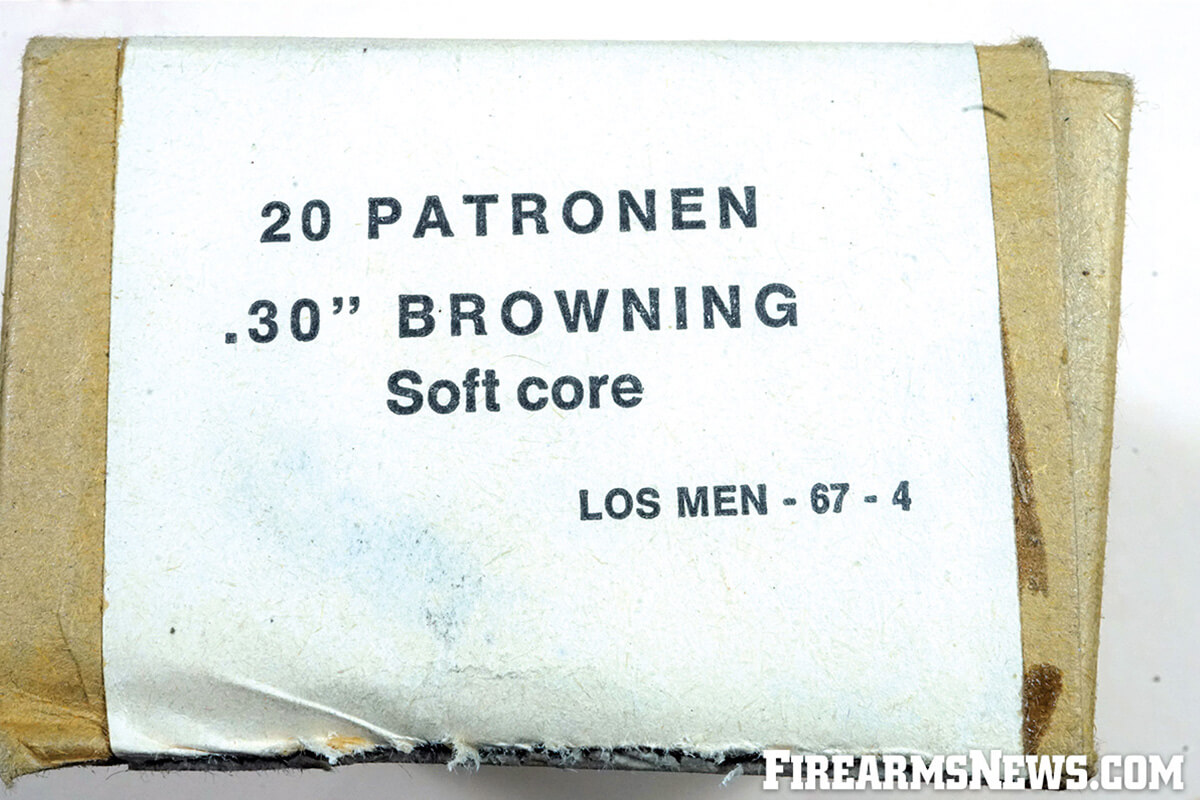
Surplus German MEN ammo in 20-round boxes manufactured in 1967.
Rifle #4 is a Savage 110 Police Tactical rifle produced in the late ‘90s. I bought it used and I have no idea how many rounds it has digested but it is a reliable shooter producing slightly under 3/4 MOA groups with good ammo and I thought it would be interesting to throw a bolt gun into the mix to judge the accuracy of the loads if, for instance, you will be shooting a vintage sniper match with the same ammo. I did not have a 1903A4 available for testing. The Savage was bolted into a Bell & Carlson M40 style stock and equipped with a very nice 2.5-16×42 Bushnell Elite 6500 scope. One thing I noted about the Savage was from the first cold bore shot to the last shot from a smoking hot barrel the point of impact didn’t wander. The action has been blueprinted by Larry Racine, one of the great bolt rifle mechanics of our time.
Over 2,400 rounds were fired during this test. It took months to complete. 60 to 90 rounds were fired during each visit to the range and the rifle bores were patched out in between trips. Obviously, weather conditions varied.
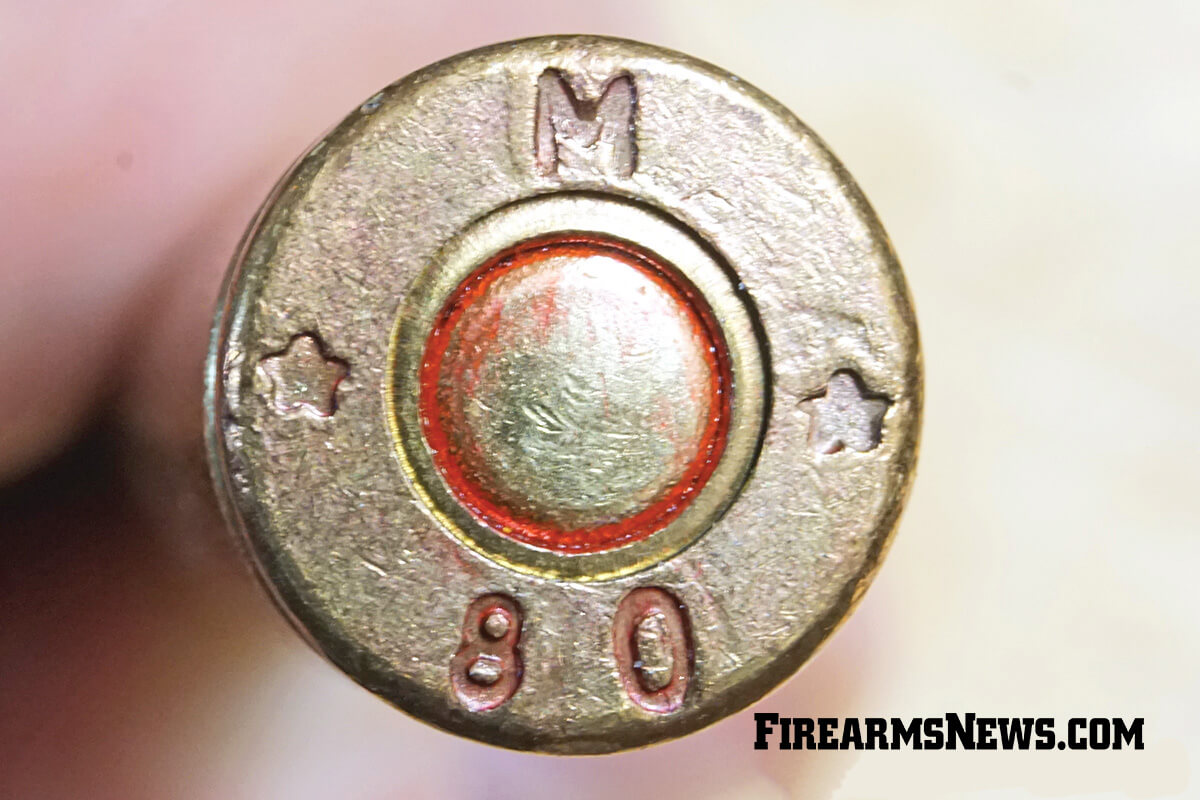
The headstamp on the Ethiopian surplus ball indicated 1980 manufacture.
The Ammo
A few comments are in order about the ammo I tested. Please note that any ammo purchased was pre-Wuhan Virus so ammo prices have increased compared to those I list in the ammo cost chart.
Black Hills
Black Hills has been a manufacturer of premium quality ammunition for many years. I have evaluated some of their offerings in 5.56mm, .308 Winchester and .45ACP but I was unfamiliar with their .30-06 ammo. I didn’t even know if it was compatible with the Garand gas system. I contacted them, and they assured me it was and sent test samples loaded with both 155 and 168-grain Hornady ELD-M projectiles. The accuracy of the Black Hills rounds was stunning. While testing the 155s I shot one five-round group that measured 1/2″ center to center. Amazing. And remember, I’m shooting G.I. issue grade rifles, not match rifles. The only downside to factory ammo this good is cost. At $2/round it simply isn’t practical for most of us to shoot it a lot. That being said, I will keep some Black Hills .30-06 ammo on hand for occasional use to impress my friends who think M1 Garands don’t shoot well. I love to prove them wrong…
A fine group fired with Hornady 168 ELD Match ammo.
Creedmoor
Creedmoor is the house brand ammo for the Civilian Marksmanship Program and is specifically loaded for Garands and vintage sniper rifles. I obtained it directly from CMP. The 150-grain FMJ-BT load consists of Hornady brass and bullets. Averaging less than 2 MOA in all three Garand test rifles and costing less than a buck a round this load would be a good choice for a rifleman who wants decent accuracy without taking out a second mortgage to pay for ammo. The second Creedmoor load I tested was loaded in Lapua brass (!) with Lapua 167-grain Scenar bullets and was a bit more expensive. I had high hopes for this load but at 100 yards it didn’t shoot better on average than the 150-grain load although the bolt gun liked it. The higher ballistic coefficient of the 167-grain bullet would be an advantage at longer ranges. At 100 yards I would stick with the 150 FMJ load for less money.
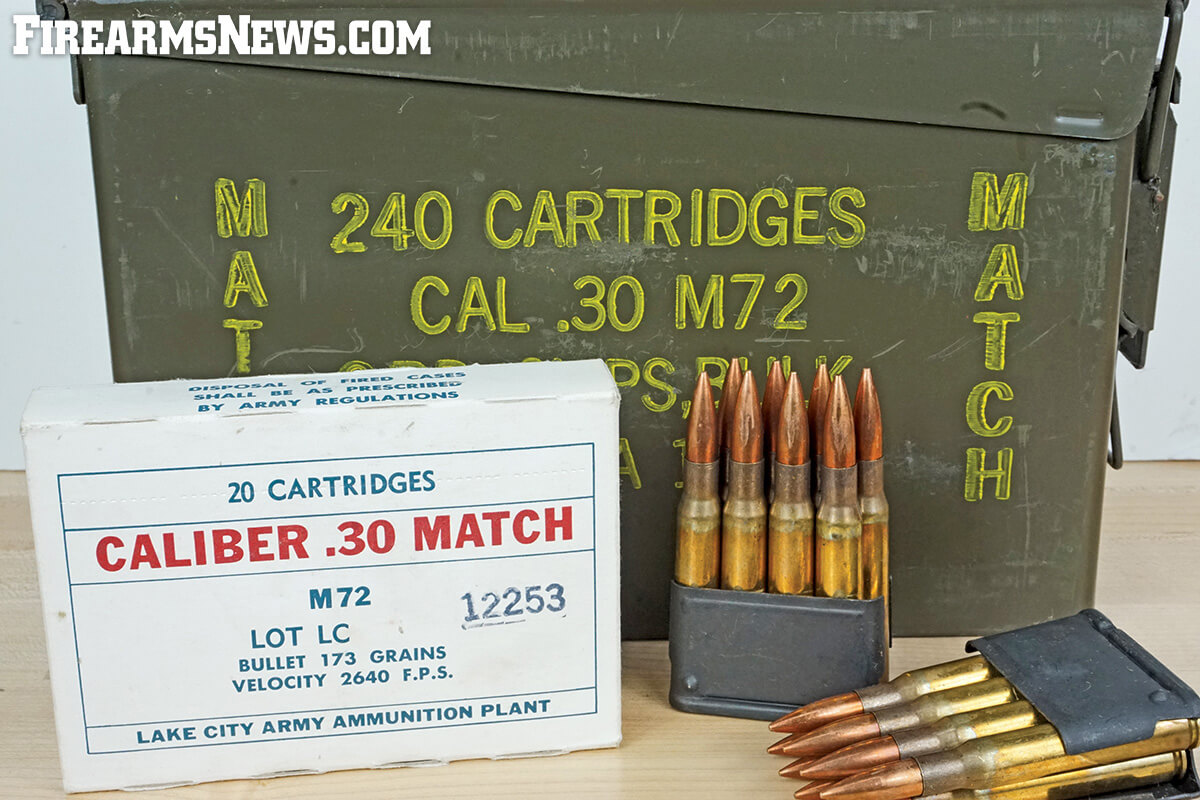
Lake City M72 Match ammo was issued in 20-round boxes or loaded on 8-round clips.
Ethiopian Surplus
I saw this Ethiopian ball for sale at SG Ammo. It was loaded in eight-round clips and packed in bandoliers, obviously loaded for Garands. I was not aware that Ethiopia manufactured their own ammo but the experts of the International Ammunition Association assured me they did in fact produce this stuff. The manufacturer’s code on the clips appeared to be French. The cartridge cases are Berdan primed and the primers are crimped. I experienced a few malfunctions in the Garands with this load and the Savage bolt action rifle would not chamber it. Closer inspection revealed the size of the cases (base to shoulder) was larger than what SAAMI would consider normal. Accuracy was not exceptional. Based on my experience with this load I cannot recommend it.
Prvi Partizan ball ammo is marketed specifically for Garands and the boxes are so marked.
Federal American Eagle
I have shot a ton of Federal American Eagle AE3006M1 ammo in rifles I rebarreled for customers. It shoots quite well in new barrels with short throats but not so well in a G.I. barrel with a couple thousand rounds down the pipe. I believe this situation is caused by the short overall length of the round. For instance, the traditional OAL of the .30-06 cartridge in reloading manuals is 3.34 inches. A sample G.I. (LC72) M2 ball round I pulled out of my pile measured 3.33 inches. The Federal cartridge is 3.1 inches. The base to bullet ogive length was .128 of an inch shorter than the G.I. ammo from Lake City. This means the Federal bullet has to jump 1/8 of an inch farther before it engages the rifling. Looking at the accuracy chart, the Federal load shot great in Garand #1 with a fairly new barrel but really choked in the G.I. guns with throats that were farther forward. I like this round. It functions great in any Garand and the cost isn’t stupid. I just wish the bullet wasn’t stuffed so far down in the case.
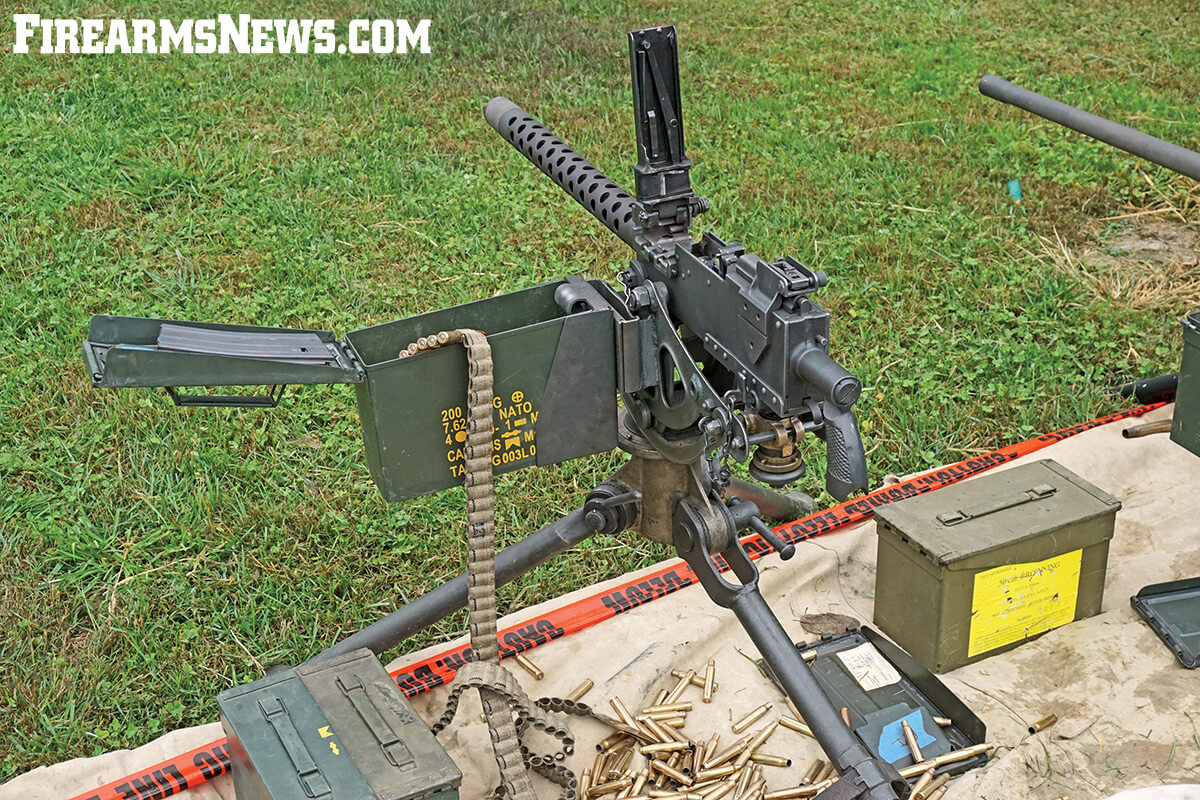
Prvi Partizan ball ammo was successfully test-fired in a vintage M1919A4 machinegun.
German Surplus by MEN
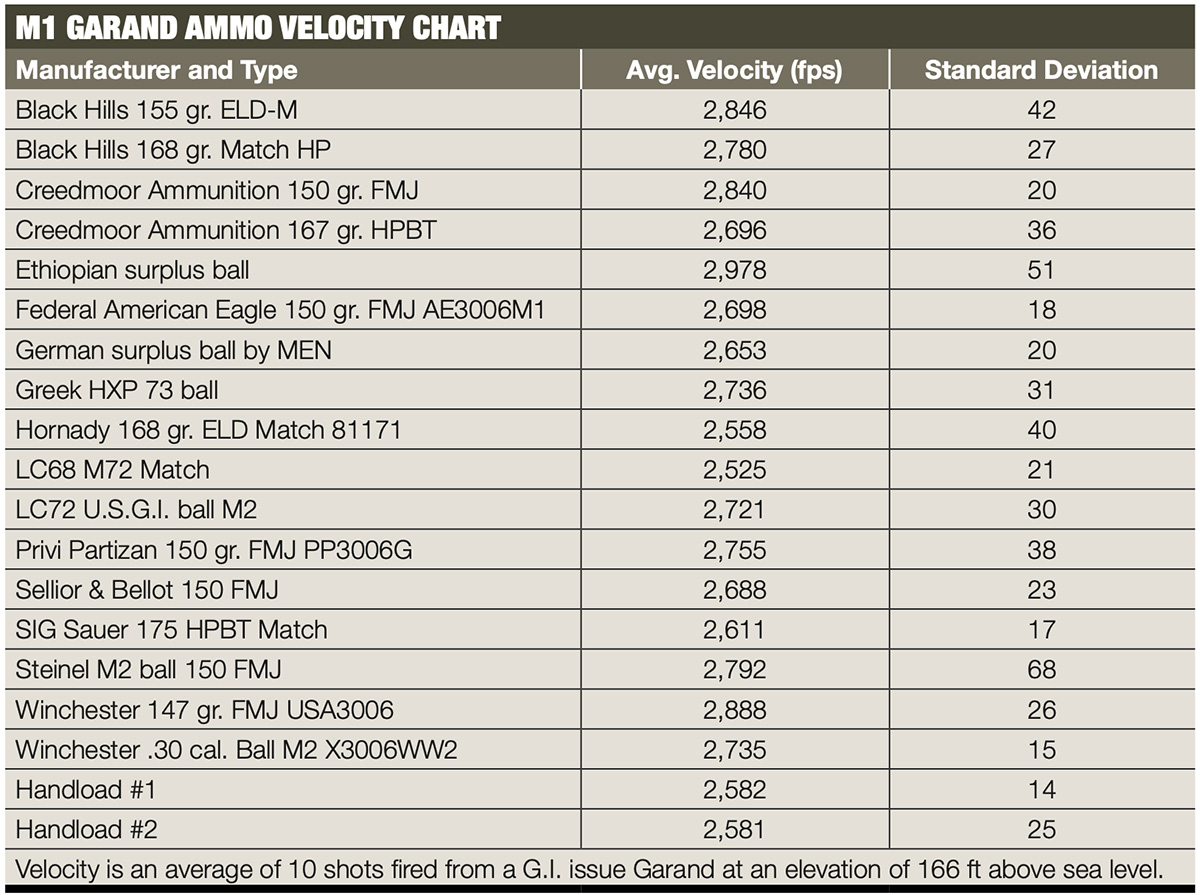
I picked this stuff up on a whim. It was packed in 20-round cardboard boxes marked “.30 Browning.” I have no way of knowing if it is loaded to the correct pressure curve for M1s but if the label refers to the .30 Browning machinegun it should be ok. MEN is Metallwerk Elisenhutte GMBH, Nassau, Lahn, Germany. The number 67 probably refers to the year it was loaded. West Germany did employ M1 Garands after World War 2 to some extent. The brass is Berdan primed and the ammo functioned ok in the M1s. Accuracy was average. The bolt gun did not particularly like it. Cost was equal to the Privi Partizan and Sellier & Bellot offerings, but the brass is not reloadable, so I probably wouldn’t purchase this ammo again. Velocity was the highest of any ammo tested prompting me to worry about excessive bolt velocity in the Garands.
Sellier & Bellot 150 FMJ loaded for the Garand is a best buy of currently available choices.
Greek Surplus Ball
The CMP sold this stuff for years with various headstamp dates packed loosely, on clips or in sealed metal tins. They have since run out of it and there is no source for it in quantity as far as I know. Some lots were better than others. Suitable for the weekend blaster or a highpower shooter practicing offhand, the brass is reloadable. Fifteen years ago, many of the choices we enjoy in commercial ammo loaded for Garands today didn’t exist and Greek was one of the few alternatives to handloading. That being said, I wouldn’t pay a premium for it today. Some of the Greek clips seem to be a bit out of spec in my experience. Like the Federal load, it seemed to do well in a new barrel but not so great in a used G.I. barrel.
The iconic M1 Garand will still draw a crowd at the local range.
Hornady
Hornady 168 grain A-Max is a load that has been discontinued. I had enough on hand to test it in 3 out of 4 rifles. It shot well but on average no better than the new ELD load.
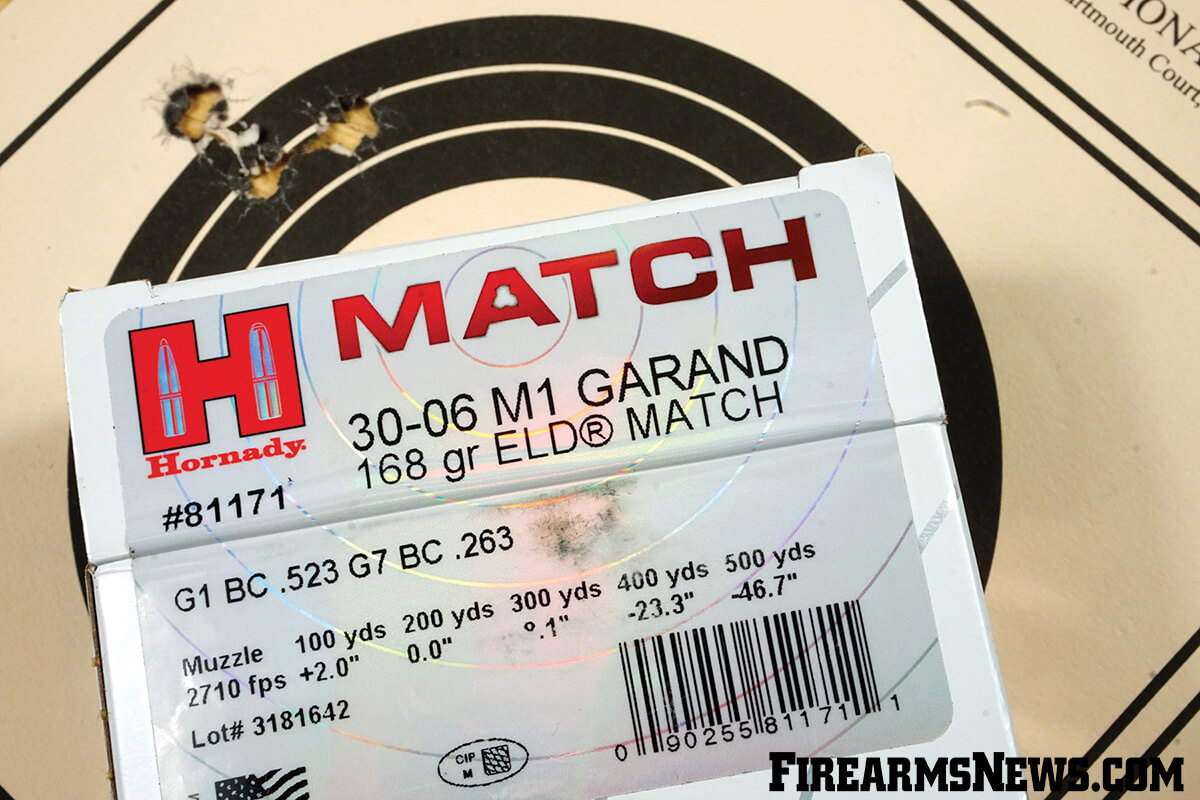
Hornady 168 grain ELD Match was my second load from this manufacturer (Hornady.com). Cost, availability and accuracy considered, this was probably the best ammo of the whole test. Averaging over $.50 per round less than the excellent Black Hills load utilizing the same bullet, it was equal in accuracy. If I were buying match ammo to shoot out to 600 yards this would be the stuff. Hornady introduced this product and an earlier (slightly more expensive) version loading the A-Max bullet specifically for the Garand and vintage sniper rifles. Velocity is similar to the original M72 military match load. More expensive than the common M2 ball clones, but not excessively so, this product is a winner. In all three rack-grade rifles it averaged only 1.33 inches. My handloads aren’t quite that good but I’m working on it.
WW2 commemorative packaging from Winchester for its Garand load.
Lake City
I was fortunate to have stashed a quantity of LC 68 M72 Match which is an original military sniper load from years ago. Originally developed by Frankford Arsenal in the late 1950s, and standardized as Cal. 30 Match M72 in 1958, this load featured a 173-grain boattail full metal jacket bullet. Production appears to have ceased in late 1968, or thereabouts, so this particular lot may have been one of the last loaded by Lake City. Interestingly, it was still available to the Army National Guard into the 1990s. According to the History of Modern U.S. Military Small Arms Ammunition, Vol. 3 by Hackley, Woodin and Scranton (2015), M72 components (casings and bullets) continued to be produced into the 1970s for use by military teams with the last cases headstamped LC 78. In the unlikely event you can acquire a quantity of this ammo for a reasonable price keep in mind it shoots about 2 MOA in rack-grade guns. It may have been considered match grade 50 years ago, but times have changed, and bullets have improved in the interim. Your money will be spent more effectively on modern fodder such as the Hornady ELD load. That being said, the LC .30 cal. Match brass is very nice to reload if you can find some. My sample batch was loaded in 8-round clips, 264 rounds per .30 cal. ammo can.
An eye-popping .457″ 5-shot group fired with hand- load #1.
LC 72 U.S.G.I. issue M2 ball ammo is where it all started. M2 ball ammo was approved as the U.S. issue rifle cartridge in 1940, replacing the previous M1 ball cartridge. Although the M1 rifle (adopted in 1936) was developed for M1 ammo, testing proved the new M2 round actually improved the performance of the Garand and M1 ball was phased out. The main difference between the two cartridges was bullet weight. M1 ball (standardized in 1926) was loaded with a 173-grain boattail bullet while the new M2 sported a 150-grain boattail bullet. Although corrosive priming was standard during wartime M2 production, non-corrosive primers were developed during the war and incorporated into M2 production by the early 1950s. During World War 2, M2 ball was replaced by M2 AP (armor piercing) for combat use in 1943 but the standard ball round remained in production into the early 1970s. The sample lot I tested was, in fact, produced at Lake City in 1972. Primers were crimped, creating an extra step for reloaders.
Another day at the office. There are worse jobs than shooting M1s!
Prvi Partizan
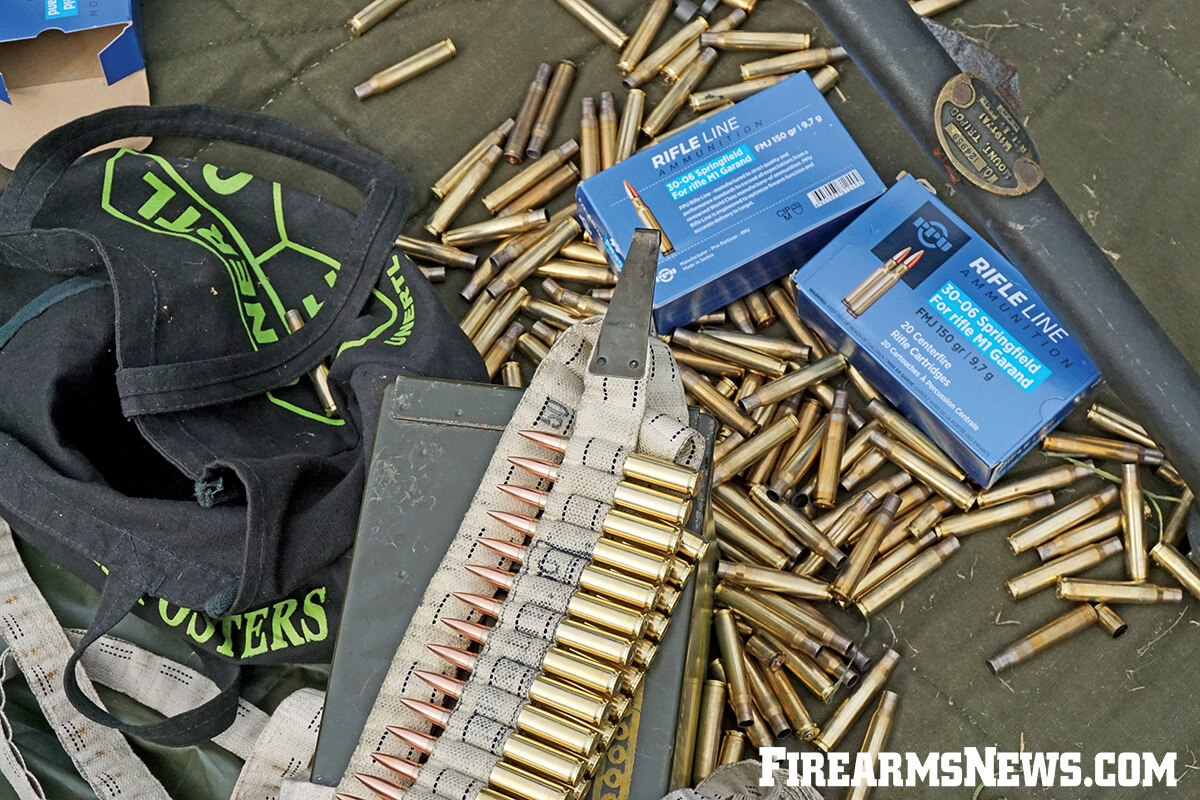
Produced in Serbia, with boxes clearly marked “For Rifle M1 Garand,” Prvi Partizan 150-gr. FMJ is designed to mimic M2 ball (PrviPartizan.com). The brass is boxer primed and the primers are not crimped. Expect accuracy to be in the 2-3 MOA range. The main attraction of this product is its relatively low cost of approximately $.70 per round. For a shooter that wants reliable ammunition with the correct Garand pressure curve for weekend plinking this is a good choice. On a whim, I took some of this ammo to a machinegun shoot and fired it in an original M1919A4 BMG. The BMG and the Garand fired the same ammo, so it should work. We plowed through 100 rounds loaded on a cloth belt without incident. Function was perfect. Some of my handloads tested for this article were loaded using PPU brass.
Sellier & Bellot
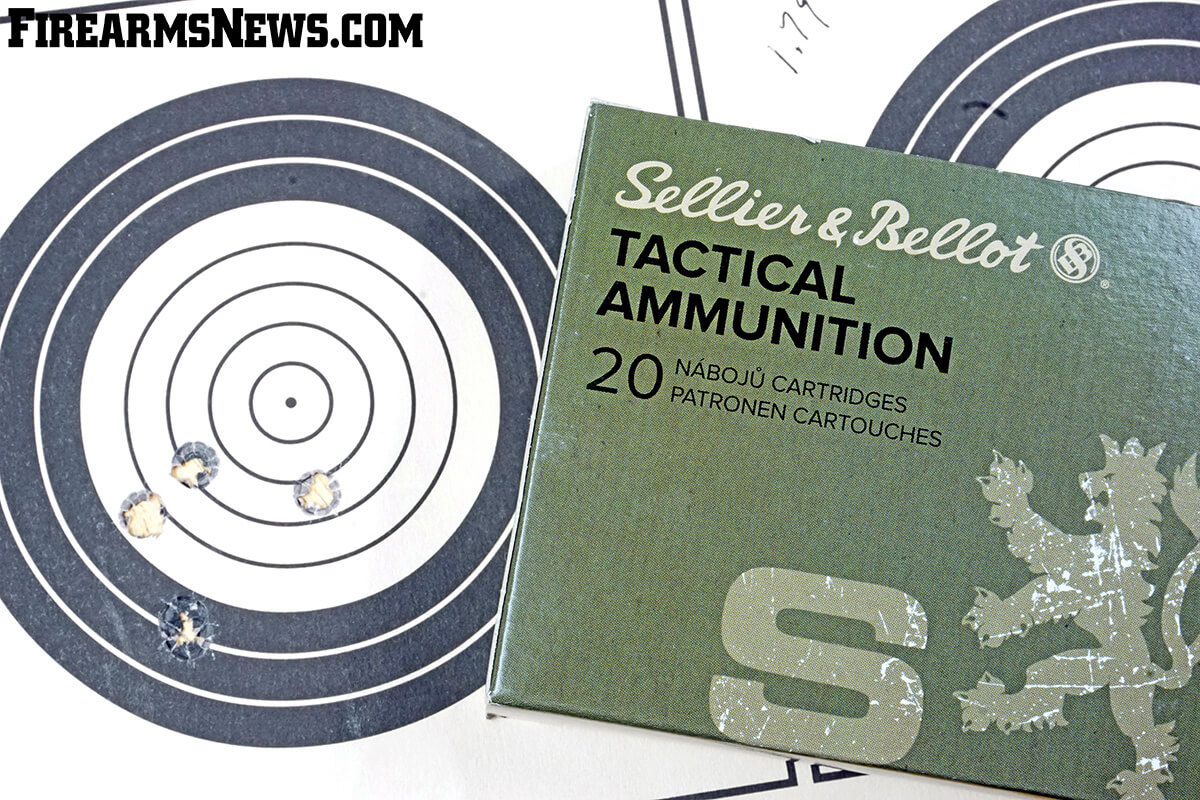
Sellier & Bellot 150-gr. FMJ is made in the Czech Republic and marketed as part of S&B’s Tactical Ammo line (SellierBellot.us). The 20-round boxes are clearly marked “FOR M1 GARAND.” This is good. No confusion as to its intended purpose. The brass is boxer primed and reloadable. The primers are not crimped, and the primer pockets were nice and tight when I reloaded some once fired cases. This ammo outshot some of the expensive “match” loads which is pretty impressive considering it cost $.65/round. I would absolutely recommend it as a best buy. The higher BC loads would beat it at distance, but at 100 or 200 yards S&B is a good choice.
SIG Sauer
I shot some pretty decent groups with SIG Sauer’s 175 gr. HPBT Match (especially with rifle #3). It probably wasn’t optimized for Garands although SIG said the pressure curve was suitable. The Savage bolt gun really liked it and I’m betting this load was developed in and for bolt guns. The only reason I would avoid it for Garands is cost: $.35/rnd more than the Hornady 168 ELD load which shot better.
Steinel
Steinel M2 ball, 150 FMJ is a relatively new product from Steinel Ammunition in Ohio. It is intended for M1s and is part of their Vintage Military Ammunition line which includes some interesting hard-to-find cartridges like 6.5 and 7.7 Arisaka and several flavors of .45/70 ammo with a couple intended for safe use in old Springfield Trapdoors. My samples were loaded in federal brass, but the CEO informed me that by the time you read this they may switch to Starline brass now that it is available. As far as commercial M2 ball goes, this Steinel load ranked behind S&B and Creedmoor in performance but it is still a solid choice. You can buy cheaper imported ammo, but it may not shoot as well as domestic products. I wish this new ammo company luck in the future. Steinel ammo is packed in very nice re-useable slip-top plastic boxes (reloaders take note).
Winchester
Winchester USA 147 gr. FMJ is a low-cost offering in Winchester’s “white box” line, the Garands didn’t like it. I doubt it was ever intended for use in M1s and I wouldn’t recommend it for that purpose when just about every other type of ball ammo shot better. Stick with the next product if you want to shoot Winchester.
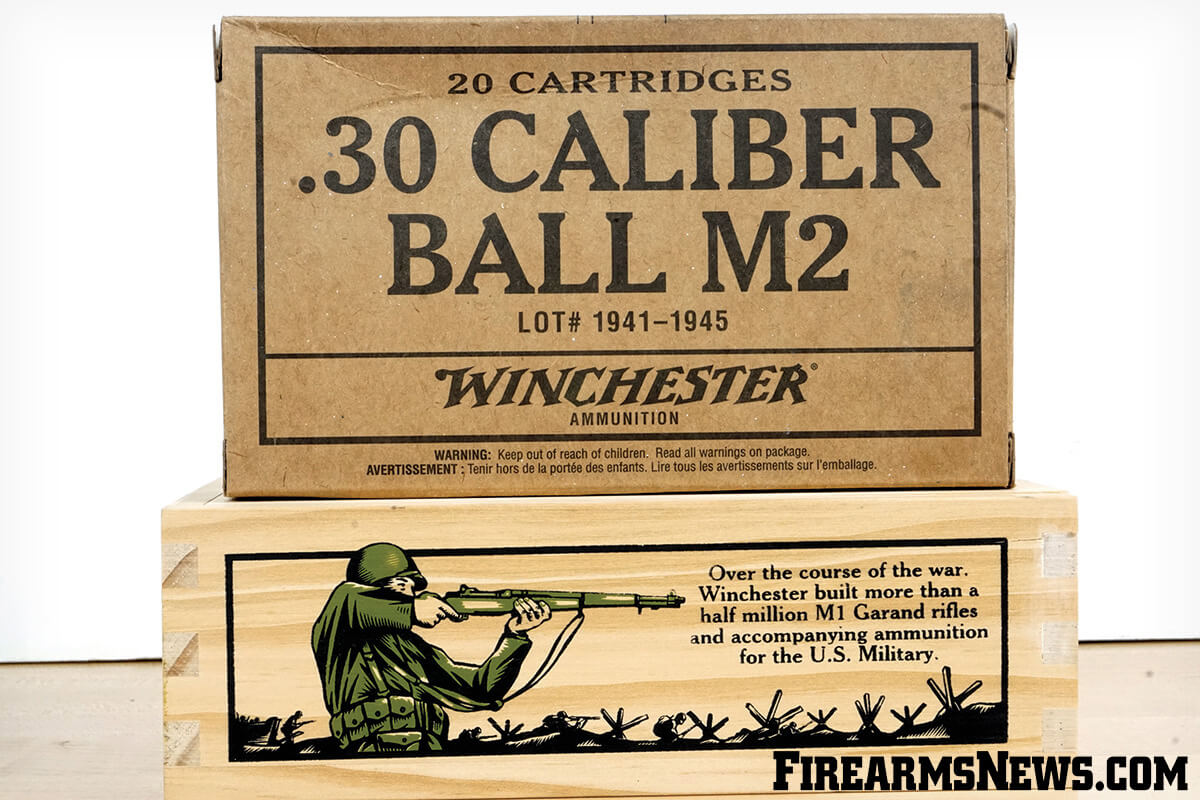
Winchester .30 cal. Ball M2 X3006WW2 is a new offering in World War 2 packaging, even including brown military-type cardboard boxes, this is a decent ball load for M1s. Not the best or the worst, it is under a buck a round and designed for use in Garands. More accurate than some imports, domestic offerings Creedmoor and Steinel were slightly more accurate for a bit more money. Cost and accuracy considered, this would be a solid choice for the Garand owner.
Handload #1
I have a long history with the 168 BTHP match bullets. I have shot literally thousands of them through M1 Garands and M1As. They are solid performers. In recent years this bullet has been eclipsed for long range use by the new generation of low drag, high BC products offered by seemingly every bullet maker. I don’t care about that. I no longer shoot in competition and almost all my ammo is expended at 100 yards. I know this bullet will do the job out to 600 yards and I still have a pile of them, so they are my choice in M1s and M1As. In fact, Lake City loaded the 168 BTHP in their excellent M852 7.62mm match ammo which eventually became the military sniper load after someone in the legal arm of DoD determined the “hollow point” in the bullet was not designed for expansion and therefore didn’t violate Geneva Convention references to “Dum Dums.” Handload #1 was 46 grains of IMR 4064 under the aforementioned bullet in a PPU or S&B case sparked by a Winchester Large Rifle primer. Common components, excellent accuracy.
Handload #2
Same load with different powder. 46.5 grains of Hodgdon H4895. I used H4895 in match loads for years shooting M1As. It meters super smooth in my ancient Pacific powder measure. I don’t think load #2 shoots as well on average as load #1 so in the future I will stick with IMR 4064.
Everyone is looking for a bargain and the hard reality is that good .30-06 ammo will be much more painful to the wallet than bulk 5.56mm (especially these days). Generally speaking, I think any ammo that consistently shoots under 2 MOA in most guns is worthy of consideration. But, as far as surplus ammo goes, forget it. The price isn’t cheap, and the accuracy of G.I.-grade ammo will not impress. The best bang for the buck will be imported ball such as Privi Partizan and S&B. Personally, I prefer not to buy imported ammo during times when American ammo companies are laying people off (call me a hater), so I would lean toward the slightly more expensive Creedmoor 150 FMJ and Steinel M2 ball. If I was looking for the best deal in match ammo I would choose the Hornady 168 gr. ELD load (especially for longer ranges) and possibly the Federal 150 FMJ for testing freshly rebuilt guns with new barrels. I am quite fond of the Black Hills 155 ELD load but with a cost of $2 a round (during normal buying times) and limited availability I won’t shoot a lot of it.
I think most people will be impressed with how well a 60-year-old battle rifle will shoot if fed decent ammo. Bench rest rifle? No, but certainly adequate for most other purposes.
Hunting rabbits is not easy, and you need a few tips and tricks, the most important being where to shoot a rabbit with a.22. A headshot is undeniably the most humane kill shot.
Rabbit hunting is a popular outdoor sport that most hunters grow to love over time. When hunting rabbits with a firearm, a .22lr is among the best to use as it does not damage the rabbit’s flesh.
Even though some people see rabbit hunting as less glamorous than big game hunting like deer, it comes with its fair share of thrill and adventure. Rabbit hunting is both mentally and physically tasking, and it is this challenge that intrigues hunters.
Understanding the Rabbit Anatomy
Rabbit hunting, like other game hunting, needs practice. You must know where to aim at a rabbit to ensure you do not miss your target, especially if it’s a moving target. An ethical shot for rabbit hunters is the headshot, leading to instant and pain-free death. When aiming at a running rabbit, aim ahead so that the bullet catches the rabbits nose.
If the rabbit is motionless, aim your .22 caliber rifle below the rabbit’s ear just behind its eye. The reason is that the rabbit’s brain is small, and a bullet at this point is a guaranteed hit leading to instant pain-free death.
Proper Rabbit Shot Placement
Rabbit hunting is all about giving it a humane death. If you have ever shot a rabbit, then you understand how its death is often dramatic. With kicks flailing through the air, it can be devastating to watch. It is why you should only shoot under these conditions.
When your accuracy is guaranteed, and the risk of a non-lethal shot can be avoided. Take a one-shot kill that leaves no room for recovery of consciousness.
Only take a shot when you can visibly see and recognize a rabbit under your aim. Also, ensure that the rabbit is within range, and the ammunition you are using is fatal.
Never shoot at a rabbit when you cannot guarantee a humane kill. The rule is simple; when you are in doubt, do not take the shot.
The best way to take down a rabbit is by aiming at the head. When you miss the head, you can land at the spinal cord, which destroys the nerve center. Other targets include the lungs, heart, and major blood vessels.
Types of Fatal Rabbit Shots
Frontal Position
Here you aim dead center at the head just between the rabbit’s eyes. It is an instant kill if you hit your target.
Temporal Position (side view)
If you have the rabbit at a side view, the best shot placement is between the base of the ear and the opposite eye.
Chest Shot
Most chest shots are sided views hence offers a broader target than the rabbits head. Aim your firearm horizontally to hit the shoulder. Chest shots are best applied when the animal is stationary, as this gives you an accurate shot placement.
Hunting rabbits when they are out of range with a .22lr is not advisable. It would be best if you estimated the distance before taking any shot to ensure maximum penetration.
Sometimes you can hit the rabbit, but death cannot be instantly verified. To minimize the rabbit’s suffering, you should consider a second shot or rush in with a blow to the head. Target the base of the skull to give a single but fatal sharp blow.
Effective Rabbit Hunting Tips
Snapshot
If you hunt rabbits hidden in heavy cover, you will barely have time to aim and take a good shot. You must ensure that you have one swift motion starting by locating, aiming, then shouldering your rifle before squeezing the trigger.
Because there is no time to pick your spot, speed, and accuracy determine your success.
Walking Up Rabbits
It is among the basic and traditional ways of hunting rabbits that are still effective today. The walk-up-rabbit technique compels a rabbit to abandon its sitting and hiding position, preferring the dash, assuming it has been spotted.
The rabbit cannot stand when you wait it out, and the lack of motion from a hunter makes the rabbit nervous even when it is camouflaged and hidden from the hunter’s purview. The technique is simple.
Once you enter a rabbits hiding spot, walk through slowly. It helps if you count ten paces, then stop for 20-40 seconds and repeat the process. As you approach the rabbit, the sounds may fail to flush it out, but the silence may trigger a dash.
Best .22 Ammo for Rabbit Hunting
There are two reasons for rabbit hunting, either for the fur and meat or for pest control. The reasons determine the kind of ammo you will use. For example, if you want to spare the meat and fur, flat or round nose ammo should suffice. The bullets will cause less damage to the flesh, leaving it edible as there will be no contamination or fragmentation of the bullets.
The pelts will also have a tiny hole meaning that the fur is preserved. The best .22lr ammo is the 40-grain standard CCI mini-mag that is readily available in most gun retail shops. If you prefer a much quieter load, the quiet CCI 40-grain ammo is the preferred choice for sound suppression.
But if you hunt rabbits for pest control, there is no need to preserve the meat or fur. A hollowpoint bullet is a deadly shot that gives the rabbit a humane death. Hollowpoint bullets expand on impact and rarely leave an exit wound. It causes more damage to the flesh, leaving no chances of recovery.
Conclusion
The concept of rabbit hunting borders on making it simple. Rabbit hunting is not as complicated as hunting big game animals. It is also quite affordable to start rabbit hunting if you are a novice hunter. There is no need for unique hunting gear and equipment. You will not be required to build tree stands or have blind spots. Once you find a rabbit habitat with a decent rabbit population, the fun begins.
The ability to hit a fast-moving bird is the most important aspect of teal hunting, but having the right choke in your shotgun when the bird finally commits to the decoys is second. In this guide, we’ll take a look at the three choke tubes that work well for hunting teal and why you should consider them.
The most popular steel shot sizes for teal hunting are #6 and #4. Choosing a choke tube that can deliver uniform patterns at the right distances is critical for early teal season success. Carlson’s Modified choke happens to pattern #6 shot extremely well, producing consistent results at 30 yards.
Blue winged teal
Top 3 Best Choke Tubes for Teal Hunting
These are the three chokes that you should consider for your next teal hunt that can provide dense and consistent patterns downrange with steel shot. As always, patterning your shotgun is extremely important to find out which choke tubes and ammo work best out of it.
1) Carlson’s Modified Choke Tube
Carlson’s is one of the most trusted choke tube brands in the industry and their extended modified choke is perfect for teal hunting. It delivers a dense pattern out to 35 yards with steel #6’s and makes for a versatile all-around choke tube for most teal hunting situations.
Regardless if you’re hunting the rice fields of Texas or the rivers of Arkansas, this choke performs exceptionally well at medium ranges over decoys for teal. #4 and #6 shot happen to be the sweet spot with this choke, and fast flying teal just can’t escape it. This is the TOP pick.
2)Patternmaster Code Black Choke
The Patternmaster Code Black is a top-of-the-line choke tube that provides unmatched performance for long-range teal hunting situations. If you’re thinking of picking up a new choke not just for teal, but to use all season long, this is the choke to consider.
The Patternmaster Code Black is great for field hunts, ponds, lakes, and rivers where the range of shots varies and you’ll be able to handle it all without having to change chokes mid hunt. Patternmaster works with internal studs that halt the wad just before it exits the barrel, resulting in a controlled wad seperation that increases pellet distribution and limits flyer pellets. Expect it to pattern closer to a full choke. This is the TOP pick for MAX range.
3)Carlson’s Cremator Choke Tube
The Carlson’s Cremator choke tube is an excellent choice for teal hunters who need a versatile choke that can perform well with a variety of shotshell loads. This choke tube uses a unique design that consists of multiple tapers, which work together to provide a consistent shot pattern. This makes the Cremator ideal for hunting situations where you need to be able to adjust your shooting style quickly and accurately.
The Cremator is equipped with triple shot technology which gradually compresses the shot column as it exits the barrel to prevent deformation. This is the perfect choke for medium range teal hunting with #4 and #6 shot. Carlson’s Cremator can produce 80% of pellets inside a 30-inch circle at 40 yards with the right ammo. This is the BUDGET pick.
Why a modified choke works best for Teal Hunting
Modified chokes are the middle ground of choke diameters (0.705”) and because of this are versatile in many different hunting situations. Chokes in modified can handle teal decoying close as well as long fast-moving passing shots as they attempt to exit.
Modified choke tubes work especially well with #6 steel shot and it’s not uncommon to pattern this choke and ammo combination and receive 80% coverage in a 30-inch circle at 30 yards. Steel shot also works well with an improved cylinder choke tube like the Carlson’s extended choke mentioned above.
How to hunt Teal
Teal are some of the easiest waterfowl to hunt during the special early season. They typically decoy with reckless abandonment and are suckers for spinning wing decoys. Your choke setup will likely need to be tailored to the types of teal you will be hunting and how they react to decoy spreads.
Teal hunting in tight spaces can limit which chokes are best. If most of your shots are in thick brush or dense vegetation, shots within 20-25 yards where an Improved Cylinder (0.715”) which opens the shot up quicker will be the top choice.
For teal in open terrain like rice fields where birds may pass from further out, the modified (0.705”) or improved modified (0.695”) are the top choices that will keep your pattern together for shots between 30 and 40 yards.
Teal Choke Tubes and Ranges
Improved Cylinder (10-20 yards) – Up close decoying shots
Modified (20-40 yards) – Decoying and medium passing shots
Improved Modified (35-45 yards) – Long range decoying shots
Full Choke (40-60 yards) – High flying birds over 40 yards
Ballistics show that a 1300 fps load of steel #6 shot enters 0.90″ of gel penetration at 30.5 yards, while a 1300 fps load of steel #4 shot enters 0.90″ of gel penetration at 33.4 yards. These are the max ranges for #6 and #4 steel shot while teal hunting.
The chart above shows the recommended choke tube and range in yards for teal hunting. Modified is the best choke for typical teal hunting shots that include close decoying and bird exiting scenarios. Improved cylinder is the best for close flushing shots just as the teal rises. Improved modified (IM) and full chokes are best for longer range shots after the bird is exiting and gained full momentum.
Teal Hunting Field Tips
Get a set of improved cylinder, modified, and improved modified chokes
This will let you switch chokes as conditions change
Steel #6’s and an IC choke tube work well on close birds
Keep shots below 40 yards, know your ammo and choke limitations
A full choke may be needed for those days where birds are skirting the decoys
Windy days, especially those with cross winds, you may need to up your pellet size
Pattern your shotgun to find out what choke and ammo work best
If using a tight choke, allow a bird decoying close to get distance before shooting
Modified choke tubes can take a lot of the guess work out of teal hunting. They usually work well with most ammo and won’t damage the birds at close ranges.
Having a set of choke tubes in your hunting vest or backpack is the best option that works well for changing conditions. You can tailor your setup to how teal are responding while in the field and changing a choke only takes seconds with a good choke wrench.
What to expect
When it comes to choosing the right choke tube for hunting teal, Carlson’s Modified choke stands out from its competitors. The Carlson’s Modified choke is engineered with a unique design that provides consistent and even shot patterns, resulting in better accuracy and a higher precision. Unlike most of its competitors, the Modified choke ensures that the shot is evenly distributed, reducing the chances of having holes or gaps in your pattern. Overall, the Carlson’s Modified choke is a top performer, delivering outstanding results that set it apart from the competition.
Bottom Line
Teal hunting requires a choke size geared toward the situation at hand. #6 and #4 steel shot are popular pellet sizes most teal hunters use. Naturally, finding a choke tube that patterns these loads well is key to success in the field.
A modified choke such as the extended chokes that Carlson’s offers work well for an all-around teal hunting choke tube with small steel shot. The Patternmaster Code Black and Carlson’s Cremator choke are two options for chokes you can use for teal season and also rely on in the general season as well.
Hunting teal and figuring out how the birds are responding will help determine which choke size you may need. Shots on teal in open terrain tend to be longer where a modified or improved modified are best. Teal in dense vegetation and brush may only require an improved cylinder for shots inside 20 yards.
Latest Posts
Best Waterfowl Choke Tubes for Duck Hunting Success
Choke Tube Diameter and Constriction Table
7.5 vs 8 shot: The 3 Key Differences to Know
Last update on 2024-11-08 / Affiliate links / Product Images from Amazon Product Advertising API
Have you just purchased your first bow sight and you need to sight it in?
What are the right sight marks for you?
What is the best way to sight-in your bow?
The only way to find out is to get out there and start somewhere, and we’ll show you where that is.
We’ll discuss common distances used to set your pins as well as our favorite way to sight in your bow.
What Distances to Sight in Pins on Your Bow?
What is the best distance to sight in your bow? You’ll find various answers here and there according to the preferences of the person providing the advice. We’ll lead you straight as the best distances for you will depend on a few things:
Draw weight/bow speed
Type of bow hunting
Personal preference for maximum shooting distances
All these factors will be addressed as we discuss the most commonly used sight marks for many bow shooters.
Top Pin Setting
The most common top pin setting for both timber and the open fields is 20 yards.
These days, most compound bows are fast enough to see very little difference in arrow trajectory between 10-20 yards. When this is the case, the first pin is usually set at 20 yards that also serves as a pin for 10-25 yard distances. You may be a few inches high when using the 20-yard pin for a 10-yard shot, and you may be a few inches low for a 25-yard shot.
To enable accurate and precise shots using your 20-yard pin this way, you’ll have to know how your bow, arrows, and sight setup will perform. Get to shooting off some arrows!
Do you have a 5-inch difference or more? Do you need to start with a 10-yard pin instead? If you’re shooting from a tree stand, you just might. You must also know the positions and kill-zone sizes of your game if you’re a hunter.
Low poundage bows that includes 40lb draw weights will require a top pin that should be set for 10 or 15 yards. It’s about shot placement that includes getting close enough to your target with it in a position to take an ethical shot.
Factors to think about:
How fast is your bow?
Where and what are you shooting?
Become proficient with setup to predict how it performs between 10-25 yards.
See instructions for your bow sight if there is a recommended top pin distance.
5-Yard Distance Increments
You may see some shooters with sight marks in 5-yard increments. An example includes: 15, 20, 25, 30, 35, and 40 and other similar variations. Again, personal preference is the rule here.
Consistent 5-yard increments are usually seen on sights that have 5 to 7 or more pins, and there are both pros and cons to this pin setup.
Advantages include less gap shooting, pin for every reasonable distance, and smaller yardage increments for confident shooting.
However, the disadvantages can outweigh the benefits. When increments are small, and you have a generally fast bow, the pins will be stacked very close together. It’s likely you will choose the wrong pin to shoot with.
Pins too close together can also block out a significant amount of the target. The more pins you have, the more it clutters your field of view.
10-Yard Distance Increments
Even 10-yard distances are the most common and versatile setup for hunters for many types of prey in the field. It may start with a 20-yard pin and continue from there, or it may start with a 15 or 25-yard pin and follow suit.
10-yard increments allow enough space between the pins to adequately see the target and to appropriately shoot the gaps when necessary. However, difficulty in achieving accuracy and precision at ranges further than 50 yards increases especially when you gap shoot. When you extend your pins out to longer distances, arrow drop, user error, and form issues are magnified.
Holding over or holding under isn’t so easy to do when you’re cold, hungry, tired, or you’re pumping with adrenaline due to the 10-point buck that just came into view 30 or so odd yards away. It may now be helpful to split the distance in 5-yard increments for the bottom pins such as 20, 30, 40, 45, and 50 or 20, 30, 35, 40, and 45. Find the variation that works for your bow setup and your shooting style.
Think about:
How many pins should be in your 10-yard increment setup?
What maximum distance are you comfortable and skilled enough at to make an ethical shot?
The more pins you have, the further you can shoot out in practice whether you realistically take shots out this far in the field. Practicing at 60 and 70 yards can make your 20-40 yard groupings tighter and easier to make. However, it does clutter your sight picture and it may encourage you to take shots you shouldn’t in the field.
Where is the Middle Ground?
The middle ground is more about having the right number of pins for your setup. There’s no need to clutter your sight picture with more pins than you realistically use in the field.
A general rule of thumb is 3 pins for many hunting applications, and 5 pins for Western or long shot hunting. Of course, there are hunters that do very well with a single pin bow sight to eliminate the process of gap shooting altogether. Where do you sit in the single vs multi-pin debate?
If you’re one of those hunters who push your bottom pins down as far as they can go to get them out of the way, but you keep them for the “just in case” moment, a fixed pin with a floater bow sight would serve you better.
Many times, the bow sight manufacturer will recommend in the setup and sighting-in instructions what distance the first pin should be set with and the distance increments for the following pins.
While 10-yard increments are certainly the standard and is a versatile setup, the goal is to find what setup works best for you. You won’t know it until you get out there and start practicing.
How to Sight-In a Bow
General Preparation Instructions for Sighting In
Mount your sight to your bow.
Be prepared to spread out sighting-in process over a course of several days due to fatigue that can compromise everything from correct form to accuracy.
Have necessary gear and equipment ready i.e. targets, arrows, appropriate laser rangefinder, etc.
Safety first: ensure you have the appropriate backstops and area clearance to shoot.
Start close to the target: 10 yards to get on paper and to reduce adjustment issues later.
Adjust in small increments at a time.
Have Allen wrenches or required tools to make adjustments to sight.
We like the “one axis at a time” method of sighting in. This process may incorporate use of leveled tape in the shape of a sideways “T”, as a cross, or any target that helps to focus the eye to aim in straight lines.
How to Sight In With a Fixed Pin Bow Sight
Stand approximately 10 yards away from your T target. Starting with the windage axis (left/right), you will want to aim for the vertical part of the target. Let off 3-5 arrows in a line.
Examine the arrows position in relation to the vertical line of the T. Being this close to the target, you want to make sure you’re as dead-on the center of the line as possible. Margins of error will be magnified when you step back to fine-tune your adjustments at longer distances.
To make adjustments, follow the arrow. If your arrows are left of the T, make an adjustment to move the entire sight housing If your arrows are right of the T, make an adjustment to move right.
Repeat this process until your arrows are dead-on center on the vertical line.
Stand approximately 10 yards away from your T target. If necessary, move the top pin high up towards the top of the housing to leave enough adjustment room for the remaining pins on sights with 5-7 pins. Let off 3-5 arrows in a line using your top pin as an aiming point for the horizontal part of the target to begin adjustments for the elevation axis (up/down).
Examine the arrows position in relation to the horizontal line of the T. You don’t have to be so precise with this at 10 yards. If the arrows are further than 6 inches of the line, follow the arrow to make adjustments by moving the entire sight housing. If your arrows are above the line, make an adjustment to move the sight up. If your arrows are below the line, make an adjustment to move the sight down.
Repeat this process until your arrows are within 6 inches of the horizontal line.
Step back to the distance you want to set your first pin for which is likely 20 yards. The top pin is the only pin you can set by moving the entire sight housing at this point in the process. Let off 3-5 arrows aiming with your top pin to hit dead-on the center of the horizontal line as possible. Now is the time to be precise with your adjustments by moving the entire sight housing up or down.
Once you’re hitting dead-on with your 20-yard pin, it’s time to sight-in the remaining pins which will all be adjusted individually. Typically, the next pins will be set for 30, 40, and 50 yards, if applicable. Stand at the distance you want to set your next pin for, let off 3-5 arrows using the appropriate pin to aim with and shoot for the horizontal line of the target.
Examine the arrows in relation to the horizontal line of the T. Be precise in making individual adjustments for the appropriate pin. Again, follow the arrow. When you’re successfully hitting the center of the line, it’s time to move to the next pin until all remaining pins are set for their distance.
Go back to 30 yards and let off 3-5 arrows for the vertical line to fine-tune your windage (left/right) axis with any adjustments if needed. You might notice you may be slightly off at 30 yards since variations in accuracy are magnified at longer distances.
Fine-tune any adjustments by double checking you’re consistently hitting the lines at your set pin distances. If you need to make any fine-tuning adjustments to your 20-yard pin at this point, do it by adjusting the individual pin, not by moving the entire sight housing.
How to Sight In a Bow Sight With 1 Pin
Each manufacturer and model of single-pin sights will have slightly different sighting-in instructions and sight tapes provided. It’s important to follow the setup recommended by the manufacturer to achieve maximum potential and accuracy from your sight.
A well-accepted method is the 20/60 setup which we’ll explain below.
Stand approximately 10 yards away from your T target. Starting with the windage axis (left/right), you will want to aim for the vertical part of the target. Let off 3-5 arrows in a line.
Examine the arrows position in relation to the vertical line of the T. Being this close to the target, you want to make sure you’re as dead-on the center of the line as possible since margins of error will be magnified when you step back to fine-tune your adjustments at longer distances.
To make adjustments, follow the arrow. If your arrows are left of the T, make an adjustment to move the entire sight housing If your arrows are right of the T, make an adjustment to move right.
Repeat this process until your arrows are dead-on center on the vertical line.
If you’re using calibration tape provided by the manufacturer, go ahead and stick it on your wheel or bar now. Turn the wheel or knob all the way to the top until it stops. Stand 20 yards away from your T target. Let off 3-5 arrows in a line using your pin as an aiming point for the horizontal part of the target to begin adjustments.
Follow the arrow. If you’re low, turn the wheel/knob down in small increments at a time. Repeat this process until your arrows are dead-on center on the horizontal line.
If using calibration tape, note the reference number the indicator is lined up with as this is your 20-yard mark. If not, use a pencil or marker to mark where your 20-yard mark is.
Step back in 10 yards at a time to sight-in for 30, 40, and 50 yards. Dial down the wheel/knob each time you move back.
Finally, get sighted-in at 60 yards and make the adjustments necessary by following the arrow. Take note of the reference number the indicator is lined up with or mark this spot as this is your 60-yard mark. Additionally, fine-tune your windage (left/right) axis now to ensure consistent shots.
Match the correct sight tape for your markings or number references provided by the manufacturer and apply it to the wheel or bar. Use the sight-tape to double-check you’re hitting consistently at the matched distances.
Put it to the Test!
Once you’re done sighting-in, it’s time to pull out the 3D and 10-ring targets and put your skills to the test. You may be surprised to find your groups are tighter than ever. But, is this the only way to sight in a bow?
Everyone may use a slightly different sighting-in method, the same way they may use different distances to sight in their pins. Some may adjust for both left/right at the same time as they’re adjusting for up/down shots. It happens to be the mainstream way of adjusting especially when using traditional 10-ring targets.
Use the system you’re most familiar with. Get to know what distances or sight-in method you like best by getting out there and nocking some rounds. Sight in and shoot sharp!
Further Reading
How to Measure Scope Ring Height (With Pics & Calculations)
How to Adjust a Rifle Scope: 6 Scope Adjustments Explained!
How to Level a Scope on a Rifle [Step-by-Step With Pics]
What is a Rifle Scope Ruler (Mildot Master) & How to Use It?
"Debate over whether a 22 air rifle can effectively take down a deer has sparked curiosity among hunting enthusiasts. With its lower muzzle velocity...