Home Blog Page 118

Foraging Wild Ramps (Wild Leeks): Identification and Look-alikes

0

Wild ramps are a type of onion that are delicious, popular, elusive, and sought after. Also called wild leeks, it is very important to properly identify and sustainably forage ramp plants. Once harvested, wild ramps make a delicious and flavorful addition to many meals!

Fresh wild ramp leaves on a wood cutting board.

What are Ramps?

Ramps (Allium tricoccum) are a perennial species of wild onion with a strong onion or garlic flavor. The ramp plant is wild growing in some areas and is also called wild leek, wild garlic, or ramsons.

Wild ramps are native to eastern North America and grow widespread in the eastern United States and Canada. Although I had heard much about them when I lived in the west, I had never seen them before I moved to Vermont!

Allium ursinum, also called wild garlic, is a related species that grows in Europe and Asia and can be used the same as wild leeks.

Ramps grow from March to June depending on your location. They are one of the earliest plants to forage in the spring, which is a happy sight for those of us who have long winters.

Related: What to Forage in Spring: 20 Edible and Medicinal Plants and Fungi

Where Can I Find Wild Ramps?

Wild ramps grow in eastern Canadian provinces, and in much of the northeastern United States, as far west as Minnesota and south as Georgia. It is common to find ramp plants in New England and the Appalachian mountains.

Ramps do not grow wild in the western US but can be planted and grown in a home garden. This is a wonderful way to have access to ramps and their tasty flavor without harming the population.

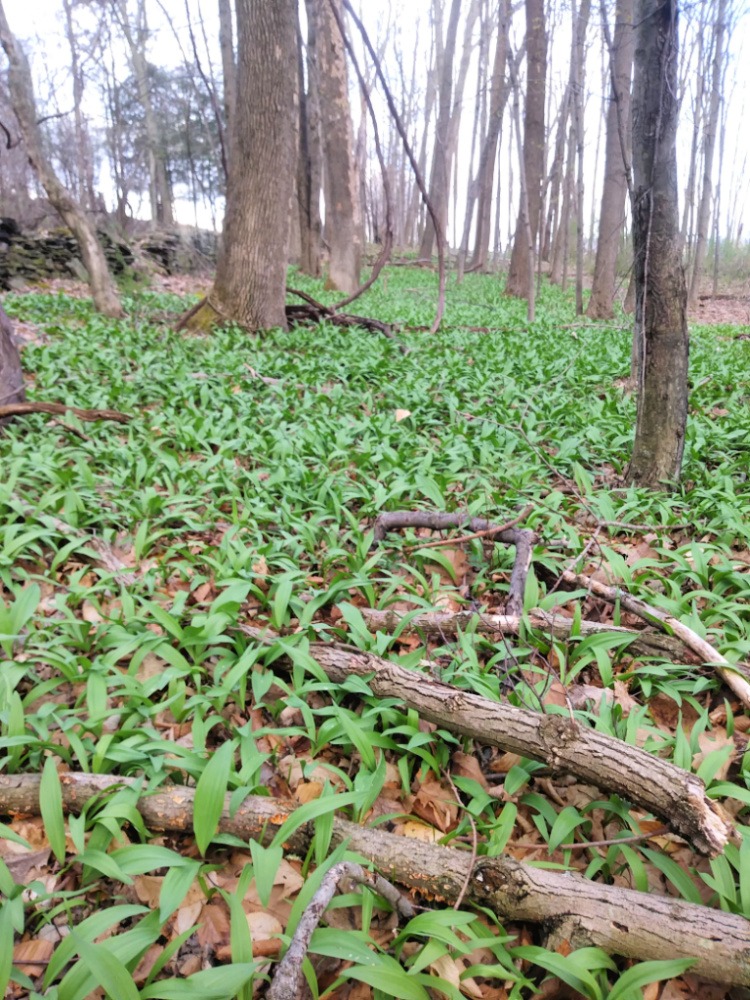
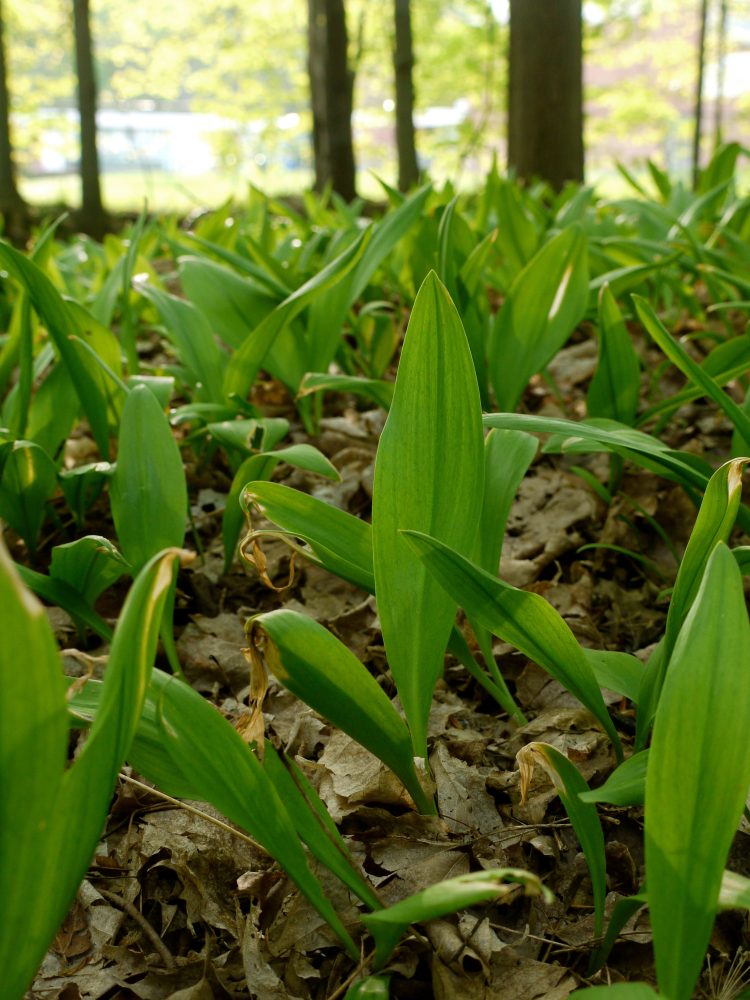
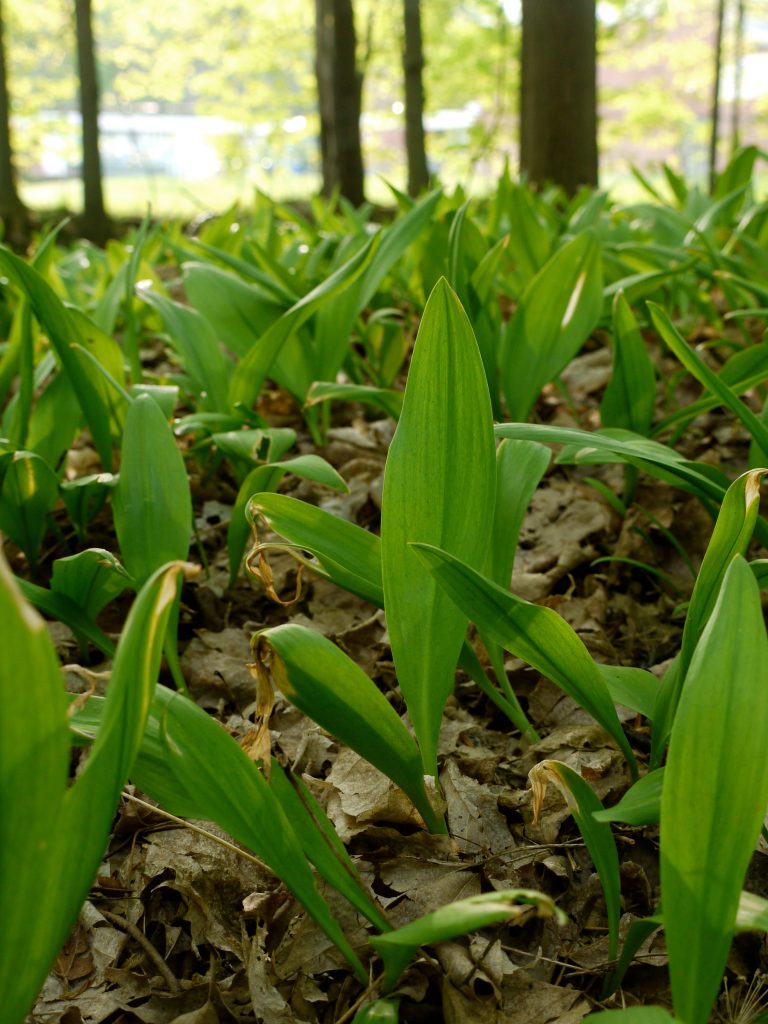
Wild leeks are found growing in clusters on the forest floor, often popping up through fallen leaves of deciduous hardwood forests. They tend to like damp areas but can be found in many types of rich soil.

Is Wild Leek Invasive?

Sometimes ramp plants grow in huge patches or colonies, so to the naked eye, it might appear that they are invasive. However, they take over 7 years to grow so are not considered invasive.

Wild leeks are actually protected due to overharvesting in many areas.

A close up of wild ramps showing green leaves and a red-purple stem.

How to Identify Wild Ramps

To identify wild ramps for while foraging, look for plants that are low growing, about 4-12 inches high. They have 1-3 broad leaves per plant and either white or reddish-purple stems (there are 2 varieties).

Ramp plants have flowers that bloom in the summer after the leaves have died back. The flowers look similar to cultivated onion flowers and produce black seeds.

A key identifying factor is that they smell like onion or garlic. This is a very important identification characteristic as toxic look-alikes won’t have this smell.

If it doesn’t unmistakably smell like an onion, it’s not a ramp!

A cluster of ramps growing in a wooded area.

Do Ramps Have Poisonous Look-Alikes?

Wild ramps have two extremely dangerous and deadly toxic look-alikes. It’s just as important to identify these properly as it is to identify the ramp plant.

Both of these toxic plants have wide leaves that come up in spring, and neither of them will have an onion or garlic smell.

False Hellebore (Veratrum viride) leaves can look similar to the wild ramp plant in that they are both pleated. This toxic plant can be identified by its ribbed leaves and lack of onion scent. They grow in swamps and marshes, whereas ramps grow in wooded areas.

False hellebore growing.
False Hellebore – a toxic wild ramp look-alike

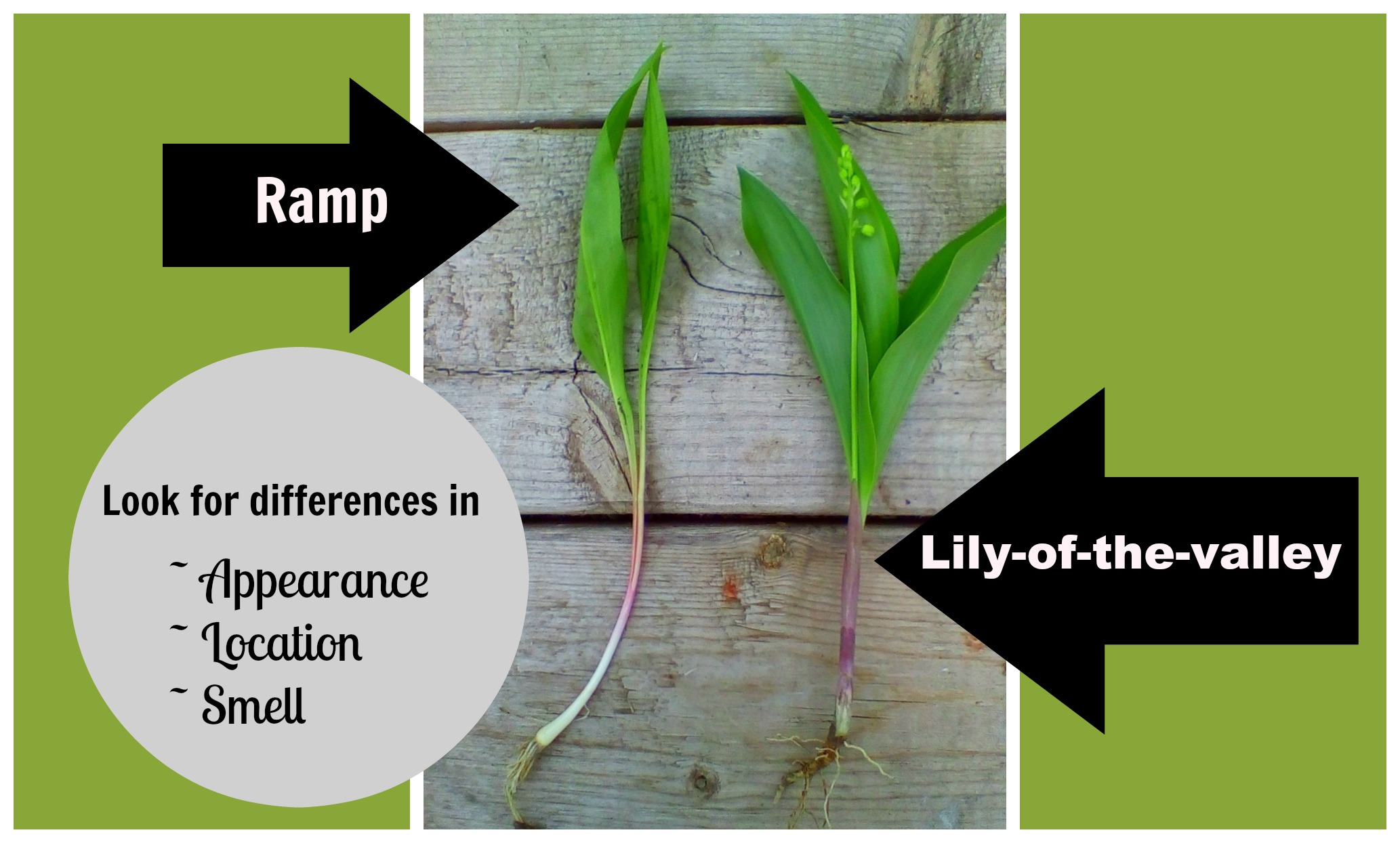
Lily of the Valley (Convallaria majalis) do not have bulbs at the roots like ramps, instead, they have longer roots and rootlets along the length. They produce many bell-shaped flowers in contrast to the small daisy-like clusters that grow on ramp plants. They do not smell like onion or garlic.

Lily of the valley leaves growing.
Lily of the valley with bell-shaped flowers is a toxic plant

How to Forage Ramps Sustainably

In some areas, wild ramps are protected due to overharvesting so it is important to forage sustainably.

Ramps are a threatened species in many regions, and in some locations, there are regulations on harvesting them. Be sure to check your local laws before foraging them.

Ramps are slow growing, taking 7 years or more to fully mature. Completely pulling up the bulb will kill the plant, so be sure you know how to harvest them correctly before heading out to gather.

A wild ramp patch, with a natural cloth and foraged ramp leaves resting on it.

How to Collect Wild Leeks

It is best to only take one leaf per plant without pulling up the bulb. If the bulb or rhizome (the base of the bulb) is left in the ground it will continue to grow year after year.

If you find a patch where it is clear that other foragers have already taken leaves from the plants, move on to a different patch. Overharvesting the leaves is detrimental to the plant.

A patch of wild ramps growing in the forest.

Harvesting leaves is much easier and cleaner than pulling up bulbs. The good news about only harvesting the leaves is that the leaves have tons of flavor, so pulling up the bulbs is not necessary!

If you live in a region where ramps grow prolifically as they do in some areas of Vermont, it can be helpful in large and very dense colonies to selectively pull up some bulbs.

The bulbs or rhizomes can be replanted either elsewhere in the forest or on your property, ultimately helping the population of ramp plants.

Before pulling up and replanting any wild leek bulbs, research to determine if it is permitted in your region.

Take seeds after the plant flowers in the summer and spread them to other areas of the forest or bring them home to plant in your garden.

A cluster of ramps growing in a wooded area.

How to Grow Ramps

Since the population of wild ramps is protected and in a state of decline, grow them in your yard for a great way to have access to their delicious flavors without threatening the wild population.

Grow ramps from seeds, bulbs, starts, or by transplanting wild plants or rhizomes. Read this guide on how to grow ramps in your backyard for all of the best methods.

They have a long germination period if growing from seed, and once sprouted the plants take 7 years or more to fully mature. Patience is key!

These tasty plants need shade and moisture. They tend to do best under hardwood trees, just like when finding them growing wildly.

A good way to keep this threatened plant around is by growing your own!

How to Use Ramps

Just like their smell, wild ramps have a distinct onion or garlicky taste. The taste will mellow out when cooked but are still very flavorful.

For a stronger flavor, know that wild ramps are safe to eat raw! Try them in this delicious ramp pesto recipe.

A dish of ramp pesto on a wooden cutting board surrounded by ramp leaves and a block of parmesan and a cheese grater.
Ramp pesto

To preserve ramp leaves and enjoy them all year, make ramp butter and freeze it, or make pickled ramps.

Another great way to preserve wild leeks is to ferment them, of course! Try this ramp kraut recipe.

Add ramps to a delicious dinner and saute them in this ramp pasta, with a side of ramp focaccia bread or buttermilk ramp biscuits, yum!

However you choose to use your sustainably foraged wild ramps, they’ll be a delicious and appreciated part of your meal!

More Spring Foraging Finds:

  • Foraging for Morel Mushrooms
  • Chickweed Foraging
  • Foraging for Purple Dead Nettle
  • Dandelion Foraging
  • Foraging for Wild Violets

10 Orange Mushroom Species

0

Did you find unknown orange mushrooms in your yard, in the wood, or growing on tree trunks? We made a list of 10 species of orange mushrooms to help you recognize them.

The diversity of mushrooms is impressive. Not only do they look different from species to species, but they also impress with their color variety. We can find species ranging from white to red shades to even green and blue.

In this article, we will talk mainly about several species of fungi that develop predominantly orange fruiting bodies.

Keep in mind that it’s not a good idea to try identifying mushrooms based solely on their colors. Some species may have variable colors depending on the different stages of their lives. Some may be white initially, then turn yellowish, later orange, and even reddish close to the end of their life cycle. Therefore, we recommend you pay great attention when classifying them.

IMPORTANT: The toxicity of each species of mushroom included in this article was obtained from several sources. This data and display photos may or may NOT be entirely accurate. The purpose of this article is NOT to advise whether these species of mushrooms are edible or not, but it’s intended to present fascinating facts about the numerous types of orange fungi.

Never consume any wild mushrooms unless you are 100% sure they are edible! Just because a mushroom species is labeled as “Non-Toxic” or “Non-Poisonous” in this article doesn’t necessarily mean it is edible and safe for consumption.

1. Orange Mycena (Mycena Leaiana)

Scientific NameCommon NameFamilyToxicity

Mycena leaiana is a species of mushrooms with origins in North America, but there is a related variety (Mycena leaiana var. australis) that can be seen in the woodlands of New Zealand and Australia. Other common names for mycena leaiana include the orange mycena or Lea’s mycena.

This mushroom species is usually easily distinguished by its bright orange cap with a smooth and sticky surface. Its cap is no greater than 1.5 inches (4 cm) in diameter, has a bright orange color, but this may fade as the mushroom matures. Initially, it has a bell shape but becomes convex with age and frequently forms a depression in the center.

On the underside of the cap, it has crowded orange gills with reddish-orange margins. These are almost free from the stem.

The cap is supported by long and thin stipes, also orange and covered in fine hairs.

Mycena leaiana is a saprobic species. It feeds on dead and rotting wood, leaves, and other organic matter found in the forests. Another particularity of these mushrooms is the fact that they usually grow in dense clusters on deciduous logs.

Although it is oftentimes labeled as non-poisonous, the edibility of Mycena leaiana is unknown. In the absence of any convincing studies concerning these species of mushrooms, it is not recommended their consumption.

2. Orange Peel Fungus (Aleuria Aurantia)

Scientific NameCommon NameFamilyToxicity

Aleuria aurantia is a species of fungus seen throughout Europe, South and North America, parts of Asia, Australia, and New Zealand.

This fungus develops an orange, thin fruiting body similar to a cup, or a husk, hence its popular name, “the orange peel.” When maturing, it can take on a flat or irregular shape and can reach sizes up to 4 inches (10 cm) in diameter under favorable conditions. The underside of the cap may be fuzzy, lighter in color than the top, or even whitish when the mushroom is young.

It doesn’t have a stem. It attaches directly to the ground through a thickening in the center of the cap.

Aleuria aurantia usually appears in late summer to autumn (or even in winter in warmer climates) and grows in clusters on the soil’s surface. It is frequently spotted in urban landscaped areas with disturbed soils, clays, roadside, or covered with wood chip mulches.

Aleuria aurantia is generally considered a non-toxic species and edible if cooked. However, it does not excel in flavor, and many say that it is almost tasteless. It is also quite difficult to pick because it is fragile and breaks into small fragments when touched.

Also keep in mind that there are several poisonous European species that look similar to these mushrooms, such as Caloscypha fulgens or Sarcoscypha coccinea.

3. Jack-O-Lantern (Omphalotus Illudens)

Scientific NameCommon NameFamilyToxicity

Omphalotus Illudens is a species of orange mushrooms distributed mainly in eastern North America and parts of Europe. These mushrooms are largely known as “jack-o’lantern mushrooms” due to their pumpkin-orange color and bioluminescent properties (thought to glow in the dark due to a chemical reaction, but some say that this is just a myth).

Although luminescence is not very common among mushrooms, according to PlantSnap, there are over 80 species of bioluminescent mushrooms. Through the weak light emitted in the dark, these species of fungi attract certain insects that spread their spores, hence, helping their multiplication.

Omphalotus Illudens is a saprobic fungus that feeds with dead organic matter from the forests, such as decaying stumps or dry fallen branches. It usually grows in clusters and is frequently spotted at the base of hardwood trees.

These fungi can reach fairly large sizes, especially at the group level. They are distinguished by a yellow-to-orange cap that initially has an umbrella shape which later flattens. The underside holds true non-forking gills, the same color as the cap, that run down the stem. The cap’s margins are initially curled inward but later can turn upward.

The stalk is long, has a smooth surface with a bright yellowish-orange color, darkening towards the base.

The Jack-O-Lantern mushrooms are toxic and should never be consumed raw or cooked. Unhappily, they are easily confused with edible species such as the golden chanterelle.

4. Goblet Waxcap (Hygrocybe Cantharellus)

Scientific NameCommon NameFamilyToxicity

Hygrocybe cantharellus is a species of small mushrooms found largely in the grasslands and woodlands of eastern North America, Europe, and parts of Australia. It belongs to the genus Hygrocybe (waxcaps), the family Hygrophoraceae and it’s popularly known as the Goblet Waxcap.

It has a small-size cap with a dry surface whose color can vary from light orange to reddish-orange. It does not usually exceed a few centimeters in width, initially has a convex shape, then flattens out and forms a slight depression in the center.

The cap’s edges are usually twisted inwards, slightly lighter in color, and become scalloped when aging. On the underside, it features sharp-edged pale yellow gills that run down the stem.

The stem is thin but relatively long compared to the mushroom’s size, orange in color, but pales toward the bottom.

Goblet Waxcap is considered by many to be a saprobic fungus because it sometimes grows on wood or decaying roots of plants but also thrives in areas covered with moss. It can grow both in small groups and alone.

Depending on the climate, they usually appear from late summer to late autumn.

Hygrocybe cantharellus is generally considered a non-toxic mushroom, but there is limited data on the edibility of this species to be considered entirely safe for consumption. Its reduced size can also be a downside.

5. Lobster Mushroom (Hypomyces Lactifluorum)

Scientific NameCommon NameFamilyToxicity

Hypomyces Lactifluorum, or the Lobster mushroom as it’s commonly known, is a species of parasitic fungus that develops on top of several species of mushrooms. Although it is believed to be distributed mainly in North America, there are numerous records of the existence of this fungus on several other continents.

It is popularly called the “lobster mushroom” because it has the appearance of the outer shell of a cooked lobster and a reddish-orange color.

At maturity, hypomyces lactifluorum contains its host entirely, making the original species impossible to identify visually. Studies also point that this fungus not only changes the look of its host but can also alter its chemical composition.

Among the species of mushrooms that Hypomyces Lactifluorum prefers are those of the genus Russula, Lactifluus, and Lactarius.

This fungus is usually found in hardwood and coniferous forests, places where the host mushrooms mentioned above are regularly found.

It doesn’t have always the same shape. While at times mimics the form of the mushroom species it attacks, other times, it can exercise a pretty irregular shape. The orange color and the lobster shell look covered with tiny pimples may be the best indicators to recognize the lobster mushrooms.

Lobster mushrooms are non-toxic and also edible. They are even sold in certain markets. Still, many argue that there may be situations when these parasitic fungi might become inedible.

Although they are known to only parasite particular non-poisonous species, some say that might be always a slim chance for them to infect a poisonous variety. In this case, it raises the possibility to carry on the host’s toxins.

Unfortunately, I was not able to find any solid study to confirm or disprove this fact, nor any reports of poisonings linked to hypomyces lactifluorum consumption. Therefore, I would recommend you to be cautious, and only consume these when you know the host species.

6. Woolly Chanterelle (Turbinellus Floccosus)

Scientific NameCommon NameFamilyToxicity

Turbinellus floccosus is a species of fungi growing especially in coniferous woodlands across Asia and North America. It has several popular names such as the woolly chanterelle, scaly vase, scaly chanterelle, shaggy chanterelle, and more.

Although the popular name of turbinellus floccosus often includes the term “chanterelle,” and even has some similarities in shape with mushrooms in the genus Cantharellus, they are not related.

Turbinellus floccosus appears especially in late summer and autumn and prefers humid regions with heavy rains. They can grow both individually and in small groups.

These mushrooms are mainly distinguishable through their trumpet or vase-like shape and a central depression that gets deeper when aging. The cap’s top color usually alternates depending on humidity and age and can vary from yellowish orange to a dark reddish-orange.

Instead of gills, turbinellus floccosus possess irregular pale yellow-to-cream wrinkled ridges that go down the whole stem. There is no clear separation between the cap and the stem. Sometimes, multiple fruit bodies may grow from one stipe.

Turbinellus floccosus is generally considered inedible as it is known to cause gastrointestinal problems such as nausea, vomiting, or diarrhea. However, some sources assert that the geographical region in which these mushrooms grow may determine whether or not they are edible. Apparently, those growing in the Pacific Northwest and British Columbia are toxic, while the ones from central Mexico and India are considered edible.

7. Jackson’s Slender Amanita (Amanita Jacksonii)

Scientific NameCommon NameFamilyToxicity

Amanita jacksonii is a species of mushrooms native to North America. It belongs to the family Amanitaceae, which is famous for including some of the most poisonous mushrooms, but also varieties appreciated for their flavor.

The appearance of this mushroom and its color vary depending on its maturity stage. At first, it looks like a white oval egg that rises above the ground. Later, it opens up, forming an orange or reddish-orange hemispherical cap that becomes convex and eventually flat, usually with a small cavity in the middle.

Its pigment concentrates in a central orange or reddish ring at maturity, fading to yellow toward the margins, with orange streaks on the edges.

The underneath has moderately crowded to crowded yellow to yellow-orange gills, free from the stem or slightly attached. It also presents subtruncate to truncate short gills.

A long and slim yellow stem supports the cap, often sprinkled with orange spots at the surface. At the base, you can often see white remnants of the original coating.

Amanita jacksonii is non-toxic and even labeled as edible by various sources. However, there are several deadly Amanita species similar to them. Hence, there is a significant risk of misidentifying this mushroom and ending up consuming a poisonous one.

8. Eyelash Cup (Scutellinia Scutellata)

Scientific NameCommon NameFamilyToxicity

Scutellinia scutellata is a saprobic fungus species found in many regions of the world. It is, in fact, one of the most widespread fungi in the world.

Besides the scientific name, it is also known as the Eyelash cup, Molly eye-winker, or the Common eyelash fungus.

It produces a small fruiting body which is generally seen growing in small groups on rotting wood or on soggy soil. It thrives in swampy environments where there is humidity constantly.

Scutellinia scutellata is easily recognizable due to its oily wet look, bright orange or reddish color, cup shape or flattened, and margins covered with stiff hairs, similar to an eyelash.

Depending on the climate, it can be noticed from late spring to late fall, and sometimes even in winter or spring.

We did not find data regarding the toxicity of Scutellinia scutellata, but most sources seem to indicate that it is not edible.

9. The Orange Bonnet (Mycena Acicula)

Scientific NameCommon NameFamilyToxicity

Mycena acicula, ordinarily known as the coral spring Mycena or orange bonnet, is a species of miniature mushrooms found throughout Asia, Europe, North America, and the Caribbean.

This species of fungus is mainly identified by the small size of its fruiting body, along with several particularities.

The orange bonnet has the classic mushroom look, with an orange-red cap that presents gills underneath and which is supported by a leg. Even at maturity, the cap rarely grows more than 0.4 inches (1cm).

Initially, the cap is hemispherical, later gets a bell shape, and eventually becomes convex. Its surface becomes smooth with the age and shows streaks leading to the edges.

The stem is relatively long compared to the overall size and does not usually exceed 2-2.5 inches (5-6 cm) in length.

These tiny mushrooms grow solitary in wet environments. Are often found on hardwood and conifer twigs or buried under the top layer of the leaf litter. They usually make their presence from late autumn to mid-winter and usually in spring in mountainous regions.

It is not known exactly if these mushrooms contain any toxic chemicals, but they are considered inedible due to their small size.

10. The Golden Trumpet (Xeromphalina Campanella)

Scientific NameCommon NameFamilyToxicity

Xeromphalina campanella is a saprobic species of mushrooms native to North America. It is known by several names such as the golden trumpet, Omphalina bell, or fuzzy foot.

The mushroom is observed in coniferous forests, usually growing in dense clusters on rotting logs and stumps. It is a small mushroom, but it cannot easily go unnoticed due to the fact that it almost always grows in large groups.

The cap of xeromphalina campanella has an umbrella shape when young, then its margins widen and rise, forming a central depression. Its color ranges from brownish yellow to orange. On the underside, it has well-spaced gills that run down the stem. These range in color from pale yellow to orange.

The stalk is thin, light orange near the cap, and brownish to yellow towards the base, which is covered with fine yellow or brown hairs, hence its common name “fuzzy foot.”

Although it is generally considered non-toxic, most sources label Xeromphalina campanella as inedible.

Final Word

This is just a tiny selection of the orange mushrooms that you can observe throughout various regions of the world. Because of their orange color, they are often easily observable in the green grass, growing on trees’ trunks, on decaying wood stumps, on the forest floor, or even in your yard or garden.

We hope you found this list helpful and assist you in identifying mushrooms with this particularity.

Several other species of fungi that produce orange fruiting bodies are:

  • Cantharellus cinnabarinus
  • Cystodermella cinnabarina
  • Entoloma quadratum
  • Gliophorus perplexus
  • Gymnopilus sapineus
  • Gymnosporangium juniperi-virginianae
  • Pycnoporellus fulgens
  • Pycnoporus cinnabarinus
  • Tylopilus balloui
  • Laetiporus cincinnatus

Since you have reached the end of the article, you may also be interested in our selection of 10 yellow mushroom species or 10 red mushroom species.

Please do not eat any species of mushrooms based only on the information presented in this article! Always consult a specialist before determining whether a mushroom is safe for consumption or not.

8.6 Creedmoor or 8.6 BLK or 8.6 Blackout?

0

What is a 8.6 Creedmoor?

First off, it is now officially called the 8.6 BLK or 8.6 Blackout, dubbed such by the very creator Kevin Brittingham. Kevin, owner of Q and inventor of the .300 Blackout cartridge first came up the with idea of a .338 caliber cartridge like the .338 Federal, but better because it has a shorter 6.5 Creedmoor based case, so it could accommodate larger and longer bullets than the .338 Federal in normal magazines, which would mean it could provide for a cartridge that could be effective at both subsonic and supersonic muzzle velocities. Not only does this owe for interesting low-noise subsonic rifles, but also for short barrel, high-punch rifles and even a cartridge being able to feed in a semi-auto configuration.

Back in 2018 when Kevin initially developed the cartridge and worked with the idea, trying to get Hornady to start manufacturing the cartridge, he intended to call it the 8.6 Creedmoor, but in June 2021 when Q made the official announcement of the cartridge on their Instagram account, they dubbed it the more appropriate 8.6 BLK or 8.6 Blackout, owing to their own unique .300 Blackout, but necked up to accommodate the 8.6 caliber bullet, and also uniquely identifying it as separate from the Creedmoor sports developed cartridges like the 6.5mm Creedmoor and the 6mm Creedmoor.

The reason why Q and Hornady are only now officially bringing it to market in 2021, is mainly because of the ammo crisis that hit since early 2019, which meant that they could not even keep up with demand of current cartridge ammo, let alone start manufacturing or marketing a new cartridge.

Brass

Why a New Cartridge

Yes, it feels like every week someone is just necking some other cartridge up or down and “bringing out a whole new cartridge”, but this time, it is really a game-changer. The 8.6 BLK is not just an improvement on previous designs or a wildcat, it changes what was thought best for hunting cartridges and tactical military cartridges all together. It shows that large long bullets can work out of small cases, and even better, high energy effective hunt kills can be made out of short barrels, even at what would be considered long range distances for hunting.

Create Your Own

There aren’t really any large scale manufacturers making a 8.6 BLK Factory Rifle yet, however, if you jump on the waiting list now, you may be able to snag one of the early ones when they become available soon from Q and Faxon firearms, or you can even just buy a barrel conversion from them if you already have a Fix by Q.

The other manufacturers should jump on the band wagon offering 8.6 BLK chambered barrel pretty soon after Hornady starts making the brass available, and you can even have your own build on a .308 bolt face, standard-length action, by chambering a .338 / 8.6mm barrel in it once reamers become available (just remember the tight twist rate needed to make the most of this cartridge).

8.6 BLK Twist Rate

Very fast twist rates like 1:4 and even 1:3 are used for the 8.6 BLK, as this provides greater energy at supersonic velocities, and greater accuracy at subsonic velocities, thus enabling the use and stabilization of such long and large bullets out of such short barrels. The fast twist rate, also ensures good bullet expansion even at slower velocities.

8.6 BLK Ballistics

When loaded with a 210gr Barnes TTSX bullet at a conservative 2000fps from the short 16″ barrel, you still have over a 1000 ft/lb energy on target at 375 yards, although this round is not really made for such long distances. The designers also claim that the normal energy on target figure is not applicable as the incredible rotational energy of the projectile spun at such a high speed because of the 1:3″ twist rate, multiplies the energy on target, see this video to show that.

EDIT: Ballistic figures, chart and graph was updated in June 2022 to get closer to actual achieved muzzle velocity figures now that the round has been tested more, and showing that the initial muzzle velocity figures claimed by Q were a little overstated.

8.6 BLK for Hunting

Although very practical as a new do-all military cartridge, hunting is where the 8.6 BLK really shines. It redefines the general purpose hunting and utility rifle genre. Even during testing and R&D hunts, Kevin Brittingham and the guys from Q have been making waves online with their small Fix 8.6 BLK taking down everything from smaller CXP1 sized animals like a Black Backed Jackal, CXP2 sized game like deer, CXP3 sized animals like a large Kudu bull, all the way through to the very large and thick-skinned CXP4 sized African Cape Buffalo. Proving the versatility of the cartridge and rifle platform for a single, compact, do-it-all hunting rifle.

8.6 BLK Barrel Length

8.6 BLK vs .338 Federal

Most people that first read or heard about the 8.6 BLK, quickly asked why, given the similarity or superiority (as they thought) of the already available .338 Federal cartridge. Well, the 8.6 BLK is the quieter and more efficient version of a .338 Federal, basically with a trimmed back case and improved shoulder so you can get longer heavier subsonic bullets than you can with the .338 Federal. Overall it’s a more efficient and versatile design than the .338 Federal.

Whilst the case length of the .338 Federal is 2.015”, the 8.6 BLK case is 1.685” in length, allowing the ability to run heavy subsonic loads, 280 to 360 grains or more, whilst the longer 338 Federal case will put the ogive of those long projectiles back inside the case, which will perform badly.

Although having a smaller case capacity, the 8.6 BLK offers more consistent ignition of the powder thanks to more case fill, which gives you more consistent performance, especially with those heavy subsonic loads. Another big upside due to the shorter case and cartridge length, the 8.6 BLK will feed out of .308 Winchester length magazines, allowing greater compatibility. Even the fact that the 8.6 BLK uses the same bolt face as the .308 Win, means you can change your barrel on your Fix or other current rifle and have your own 8.6 BLK.

Lastly, when looking a long bullets like the Berger 300gr Hybrid with a nose length of 0.955 inches, but the case to OAL length of the .338 Federal is only 0.785 inches, meaning that those bullets or similar cannot be reliably fed from a magazine, whereas it can in the 8.6 BLK.

Mugolio: Pine Cone Syrup

0

Mugolio, a dark, aromatic syrup imbued with the flavor of pine cones, is the poster child for the kind of crazy cool, Illuminati-esque foodstuff foragers have access to, all for the price of a hike, or even less, depending on how close you are to some pine trees.

The syrup came on my radar when my friend Dan Farmer gave me a little jar of some he made to try. I remember it being good, but I forgot about it until I opened the Salt Cellar, and started making my own from spruce tips, which is excellent, but not quite the same as pine cone syrup (for the record both are great).

Mugolio is now still a bit of a chef secret, and available through elite specialty distributors, but the price is staggeringly high, exorbitant even, when you consider you can make nearly the exact same thing at home, for less than it costs to make a cake.

A chef secret that takes months to make

The cost of mugolio is not found in ingredients, but is paid in time. How much time is certainly up for debate, and you’ll notice my recipe turns around a lot quicker than burying a jar of pine cones and sugar in the yard and digging it up the next year (an actual recipe from Romania). You’ll want to wait at least a month for a good pine syrup, although aging it longer can be fun.

Mugolio: more than just pine cones

Real quick, some reality. I use the word mugolio interchangeably for syrups made from numerous tree parts, if you look around you’ll see mugolio usually refers to a syrup made from the young cones of mugo pine (Pinus mugo), harvested at a specific time of year, under the strictest of conditions, blah, blah, blah.

I’ve made all kinds of similar sugar based products from all kinds of conifer parts, and it isn’t some difficult, arcane thing you can only do in the light of a full moon— just the opposite.

Making mugolio is easy, and there’s a very forgiving time window for harvesting cones, or other things products like cedar cones, wintergreen, juniper, or spruce tips. All of the aforementioned making excellent syrups in their own right.

There’s something special about the pine cone syrup though. Pine cones hold more water than any other thing I’ve used, and they also ferment during the maceration process, vigorously.

The day after you combine the pine cones and sugar, there will look as if there was a rush and release of water—what was once a solid packed jar of pine cones and sugar is not 75 % full and liquid.

Species of unripe pine cones I’ve used to make syrup

Balsam fir cones for making pine cone syrup
Spruce cones for making pine cone syrup
Norway spruce cones for mugolio
Green black pine cones or Pinus nigra for pine cone syrup
Jack pine cones for making pine cone syrup
Unripe red pine cones for pine cone syrup

Variation in flavor between species

One of the most fascinating things about mugolio is that every species of tree you harvest unripe cones from will impart a noticeably different flavor unique to the finished product.

Once I started to notice the different flavors, I made a point out of trying to “mugolio” as many different species of unripe coniferous cone I can, and I found some fascinating things. Here’s a quick breakdown of the differences between flavors I taste.

Pinus/Pines

Mugolio made from pinus cones have a resinous, assertive taste.

Picea/Spruces

Spruces lack the aggressive resinous flavor of pines and are the most subtle of all I’ve tasted. Instead of the resinous taste, spruce cones, just like spruce tips, have a citrusy note to them, and so will syrups made from their cones.

Thuja and likely others/Cedars

The only cedar I’ve made mugolio with is the green cones Thuja occidentalis, since they’re easy to find in landscaping. It has a taste exactly like the aroma of fresh green cedar, a bit in between spruce and pine mugolios.

Abies/Firs

Of all the syrups here, and all the different flavors, the syrups I’ve made from balsam fir are the most delicious.

Firs have a resinous punch like pine mugolios, but it’s slightly less aggressive, and most noticeably, comes with strong notes of warm spices like cloves, allspice, and cinnamon.

Unfortunately, mature balsam fir trees, at least around me, seem to only want to grow cones at the very top of the tree, which can make getting enough for a batch of syrup tricky.

Using other conifer products

Other tree products like spruce tips, pine tips and cedar cones I’ve worked with are more dry, and may not ferment during the maceration process, but they can still make a fine syrup.

The point is: you can make syrups like this out of all kinds of things, and everyone I’ve had has been good. If you have spruce trees near you, take a look at the basic spruce tip syrup too, which is nearly the same, sans the fermentation. Here’s a few things I’ve used:

  • Unripe eastern white cedar cones (Thuja occidentalis. This could can be an abortifacient in high doses)
  • Juniper berries (Juniperis virginiana)
  • Spruce tips (many species)

The best part is figuring out how to use it. Somethings take some experimentation, mugolio not so much.

You can literally put it on just about anything where maple syrup would be good, and you’ll be glad you did. The syrup has the essence of pine, but with none of the strong tannins you’d expect If you took a bite out of a pine cone—just pure piney goodness.

Harvest young pine cones in spring or early summer

Most importantly, you are looking for unripe pine cones in the spring and early summer, not the fall, not the winter. Opened cones are not to be used.

This is up for debate, but my favorite comes from green cones as they contain more water. Purists might say that you need to harvest pine cones when they’re the size of a pinky nail, or some other arbitrary size.

I can tell you after making this for years now, that any of the pine cones pictured in the image above will make a fine syrup, but smaller cones will make a syrup with a much stronger flavor, strong enough that some people may not like it.

Another good rule of thumb I’ve found is that whatever cone you’re picking will probably be sticky and exuding resinous, sticky liquid at a prime stage for making pine cone syrup.

Making fermented foraged pine cone syrup or mugolio

Green cone=higher water content

Larger green cones hold more water in them which makes syrup making much easier, and also allows for some fermentation in the process, which adds fun flavors.

As long as the cones are meristematic and tender, and can be cut through with a knife, even if it’s into pieces with long cones like white spruce or balsam fir, they will make a good mugolio. The only cones that won’t work, are mature, tough, barky cones, like those you’d see on the ground.

Using very young pine cones

You can use young pine cones, but they’re smaller and don’t hold as much water as cones that are green, so they’re not ideal here.

If you really want to try with very young pine cones, try chopping them up medium to make it so more cones can be fit in a jar, which means more water, meaning an easier syrup. You can also add a splash of water to help it on it’s way.

Is it safe?

Yes, this is absolutely, positively safe, and there’s no need to worry about botulism. I can’t speak to the exact science of spruce tip and cedar cones syrups, (also safe) but pine cone syrup is especially safe as it ferments as it macerates, due to the higher water content of the cones if harvested at the green stage.

The extended fermentation lowers the pH, making it shelf stable. Remember that sugar is a preservative, and conifer products are all naturally acidic, which is a preservative in itself.

Consider using gloves

The most prime pine and spruce cones for making syrup will be plump, but still unripe. At this stage, most of them will be very sticky and oozing a sappy resinous substance that will quickly coat your hands and will stay for hours. Consider wearing gloves to avoid sticky hand syndrome.

Choosing the right sugar

Some recipes might call for white sugar, and while it will work and give you a flavored syrup, white sugar is more dry, and I find the clear color far less attractive than the caramel color that organic, unrefined turbinado-style sugar or even light brown sugar or a similar substitute will give.

I try to avoid using plain white sugar when I can, and I highly doubt that original mugolio recipes used such highly refined products when the first adventurous people crafted them.

Use a good sugar that you can feel good about eating, and drizzling over everything, because you’ll want to drizzle it, on, well, everything. Here’s a list of sugars that will work

Turbinado

Turbinado is slightly more dry than commercial brown sugars, but it has an excellent flavor.

Light, golden, or dark brown sugar

These are some of the most versatile and affordable, but I suggest using a high quality organic brand. The varying molasses content of the different colors of sugar is negligible in regards to the flavor of the finished syrup.

Maple sugar

Maple sugar is the most expensive you could use, and in my opinion is not the most ideal as it’s prone to crystallization from my experience. It is delicious though. If you’d like to harness the flavor of maple with your pine cones, you can just toss pine cones into maple syrup at a ratio of 1 cup of pine cones to 1 lb (2 cups) of maple syrup.

Zirbenshnaps

This stuff is unique enough that it needs a special mention. Zirbenschnaps is a liquor made with pine cones.

I’m not an expert on distillation by any means, but I’ve been working with a distillery to make similar products, and one thing we’ve been toying around with is making a rendition of it by simply using it as the sweetener in a macerated liquor.

The traditional zirbenshnaps has a red tone to its color, which makes me think they’re using a syrup made from fresh pine cones cooked immediately—not aged.

I know there’s also birch schnaps, and that’s made with reduced birch syrup, so I think using mugolio would be fine. Currently I know zirbenshnaps is only sold at ultra high-end restaurants in my area.

Whatever you make with it, it’s one of the most fascinating and delicious condiments made from wild ingredients I know of.

Making Large Batches

I occasionally make very large batches of syrup, 2 or 3 gallons at a time. Here’s a few tips on doing that if it’s something you’re interested in, especially as this is such a fun (also cheap) and interesting thing to give as gifts. The tips below are intended for those people making 1 gallon batches and up at a time.

Skimming the foam

Similar to maple syrup, when you cook large quantities of the syrup, it will begin to froth and foam at the top and will double in size quickly.

Some cones seem to create more foam than others, especially Norway Spruce. When you notice foam during the cooking process, do your best to skim it off with a spoon and discard.

After you bring the syrup to a simmer and strain, put it back in the pot and bring it to a simmer again, let it rest for a minute or two so the syrup can settle and return to it’s original volume. If you don’t do this, you run the risk of having jars that are half full after settling.

Canning for long-term storage

Pour the piping hot syrup into large jars, or, for smaller ones, pour the syrup into a pitcher with a spout, and pour directly into canning jars (4 oz mason jars make a great gift). Fill the jars nearly to the brim, leaving about ⅛ inch headspace, then, working quickly, screw on the lids tight and turn the jars upside down.

You don’t have to water bath-process this as it’s basically the same sugar concentration as maple syrup, just make sure your jars are clean. The jars will seal naturally but should be refrigerated after opening.

Here’s a few ideas for using it, and a few things yet on my list to try.

Ideas for using

  • Drizzled on pancakes, crepes waffles and other things primed for syrup.
  • Use it to flavor whipped cream
  • Excellent drizzled over soft cheese like mascarpone, labneh, chevre, etc.
  • Drizzled over fresh fruit
  • Using in place of honey, I love drizzling it over bowls of warm buttered wild rice with nuts, fruit, and yogurt for breakfast.
  • It’s good in desserts, added in small amounts like you would use honey. Dairy based desserts like ice cream, panna cotta and custards of all kinds can just be seasoned to taste with it.
  • Try adding small drizzles to salads, or whisking into vinaigrettes.
  • Mixing it with a splash of vinegar just to loosen it a bit makes a good brush on or glaze for hams, etc.
  • One of my friends adds it to whiskey

Rifle Barrel life – What you should know from 3 Top rifle smiths

0

barrel throat erosion 300 norma mag

Rifle barrel life – How fast will your barrel reach retirement age?

In this age of increasing retirement age, it seems we’re expecting our rifle barrels to follow suit! In the world of high-performance rifle cartridges, barrel life maybe a short season. This month we look into rifle barrel life with 3 top gunsmiths on both sides of the Atlantic to get a shot at this highly energized topic amongst competitors, hunters and ELR shooters alike.

We spoke to three top gunsmiths in the game to find out how it effects competition shooters, ELR shooters and hunters, all after the ultimate performance for their intended game.

barrel burning article

Left to right: Mik Maksimovic presenting a new rifle to a customer, Ryan Pierce out hunting and Harry Drescher from Solid Solution Designs

416 rigby muzzle

Rigby: Barrel life with traditional rifles like this Rigby in 375H&H is almost infinite. You will probably never wear out this traditional hunting rifle’s barrel.

Rifle barrel life is a topic I come across often when discussing some of the long-range cartridges both online and in gun shops. A few have also asked me about the barrel wear on the 300 Norma Mag cartridge so I thought I will put out a few thoughts about it as well as reeling in the thoughts of some top gun smiths in the process. What do they have to say?

For this we have reached out to Mik Maksimovic at Dolphin Gun company in the UK that has built more F-Class rifles than he cares to forget about.

We also spoke to Harry Drescher in the Netherlands from Solid Solution Designs that builds many large bore rifles for long range and ELR (exlrs.com) as well US based gunsmith Ryan Pierce, who has probably built more 300 Norma hunting rifles than anyone else and is a well-respected knowledge source on the respective 300Norma Facebook group. Among other things, Ryan builds 300 Normas that are meant to hunt with. This means that weight is usually on a premium and the overall balance of the gun important.

In this way we shall get 3 expert views on the important topic.

Why do barrels burn out?

Barrel wear or rather barrel burning comes from the immense heat that is generated whenever a cartridge is fired and you’re effectively channeling all that energy through a small hole hence coining the term for some cartridges as ‘over-bore’ cartridges. This creates immense heat and friction inside a small bore, pushing a bullet along the lands of the rifle barrel. The more powder you burn through a small hole, the more your barrels burns out. Shoot a few rounds fast, any you will feel that barrel steaming! All this in the name of Long Range Performance. Check out the video below of the high performance 338LM at 1 mile that we shot in Sicily.

Rifle barrel life in perspective

A 308win cartridge will burn circa 42grains of powder for a 30 caliber bullet. A 300 Norma is burning 90 grains of powder for the same 30 cal. bullet.

A 338 Lapua burns circa 90grains of powder under a larger .338 bullet. David Tubb’s 33XC is burning close to 125grain of powder, that’s 38% more than the 338Lapua for the same bullet diameter. Those big numbers you see on your chrono have an effect on your shoulder as well as your barrel life :_)

Does short barrel life hold you back from that shiny new cartridge you’ve been craving for?

voere 338 Lapua

Voere X3 rifle topped with leading Steiner tactical optics on offer

If you’re reading this, it probably concerns you. Rifle barrel life puts many prospective shooters off a high-performance cartridge. But should you really be concerned with barrel life? Here’s one way of seeing it. If burning barrels concerns you more than the performance you can achieve, than that level of performance is probably not for you or you don’t need it. High performance cartridges are created for specific tasks. If I’m using a 37XC cartridge to take out a high value target, the cost of my round is virtually negligible. If I take a 300Norma on my next Ibex hunt, the cost of the barrel wear and the lifetime of that barrel is virtually negligible too compared to the cost of my hunt. In the same way, if I’m a prospective F-class competitor and absolutely want the top cartridge I can manage to shoot that could help me achieve a marginal advantage to WIN, then 500 rounds of barrel life maybe just the ticket to achieve that. Are you still with me? If yes, keep reading.

300 Norma cartridge

rifle barrel life 300 norma mag loads

Let’s take a hunting rifle chambered in 300Norma such as those built by Ryan Pierce. Let’s say we get 1000 rounds of tip top accuracy, 1/3 MOA accuracy shooting a 215gr at 3100ft/s without pushing it. We’re going to get impressive performance that will put meat in the freezer for years to come. It requires less than half the windage of my 308win seen below making my shots more forgiving in the same wind condition. If you take it out for practice once a month and fire 30 controlled rounds each time, that’s 360 rounds of practice in a year. That’s 3 years of practice with enough life in the barrel to bag tons of meat. Being a more wind forgiving round, it allows you make the same shot with half with difficulty. If you’re doing an Ibex hunt and absolutely must connect at any feasible distance you may be shooting, you can’t go wrong with a 300 Norma. You’re spending a few thousands on that trophy Ibex, barrel life in comparison is nothing, you guessed it! If you want to read more about the 300Norma, we prepared this in detail write up.

I’ve also noticed that the users after specific cartridges often are trying to achieve very specific goals and understand this principle better than others who just go to the range to plink and have fun burning a few rounds of ammo. Typically these rifle cartridge users build rifles around the bullet and cartridge they want to use or otherwise rechamber an existing rifle for a specific rifle which entails a new barrel and set of dies in most scenarios (as is the case with 338LM users shooting a 33XC) Typically these shooters are more involved with their goals and objectives and want to achieve specific goals.

How much barrel life are you happy with?

surgeon rifles 591 action

Above: A 308Win round is often thought of having some of the best barrel life available. 10k rounds is not unheard of in service rifles. Burning barrels is not an issue with such volume to bore ratio as found in the 308win. Get the March Scope 2.5-25×56 with upto 100MOA of elevation

View your barrel with a borescope as we did here https://www.instagram.com/p/CEGVveyJi9U/

If like us you enjoy Ultra long range, the 300 Norma Mag is a fantastic contender for 1-mile shooting as you can see here and even a few hundred yards further in the right conditions. Mine is doing 3250ft/s with a 215berger, it’s no slouch. My shooting buddy Robert is running 230s at 3050ft/s from a 29inch barrel.

high speed bullet low barrel life
Above: At these velocities, a rifle barrel may only last a few hundred rounds.

Above: Pushing the limits during ladder testing of the 300Norma Mag before taking it for the King of 1 mile competition in France.

If you shoot 3 rounds and let it cool, you’re looking at 900-1200 rounds of barrel life maybe more.

“The other question I ask shooters that write to us at rifletalks.com is, do you want a 1-mile rifle or a rifle that can potentially shoot 1 mile?”

What’s the difference some ask me?

A 300win mag can shoot 1 mile as will your 30-06 and your 284Win as I saw at the king of 1 mile with the excellent shooting of Cap Beng from France. The guy is a phenomenal army shot but under gunned with a 284win at 1 mile. Had he been running a 300Norma, the outcome could have been very different.

A one mile rifle cartridge like the 300 Norma and similar cartridges have what it takes to connect at 1 mile. They are still supersonic at the distance, their windage correction will be relatively low say 6-8MOA of wind in 10mph full value which makes it easier to connect in changing winds.

If you want to shoot 1 mile in Europe, join this facebook group, Trapani one mile shoot with more info about the next one mile shooting weekend in Sicily, Italy coming March 2021.

300 norma magnum

Considerations around rifle barrel life

Below are some questions you may want to ask yourself when deciding about a new high performance cartridge.

  1. String of shots – how many rounds are you expecting to shoot in a string?
  2. What are your objectives with this cartridge?
  3. Are you in for competition or a high-performance hunting cartridge?
  4. What is the cost of your barrel wear?
  5. What is the cost of ammo before you wear out the barrel?
  6. How can you extend the lifetime of your barrel?
  7. Are the achievements worthwhile for you?

How can I see what’s going on in the barrel?

I suggest you get yourself this borescope, for $129 it will give you a good idea what’s happening inside your barrel as you shoot your way through its lifetime as well as seeing what’s going on after you actually clean your barrel. Take the guess work out of the equation.

Above: a bartlein 308 barrel just before engaging the rifling forward of the lead, it’s brand new, only fired a proofing round through it.

borescoping rifle barrel wear

Above, a 308barrel with about 200 rounds of 300 Norma Mag through it at 3250ft/s. Surprised?

How much does your rifle barrel wear cost?

Often, shooters take this to be the rifle barrel cost. If you’re in Europe you’re looking at £900-£1300 per barrel depending on configuration, length, fluting, finish, muzzle break etc.

When you consider a high-performance cartridge doing 1000 rounds of peak performance before it drops off, you’re looking at about £1 per shot in barrel wear plus whatever it costs you to assemble your ammo. I can see some of you raising their eyebrows. If you consider the cost of 1000 high performance rounds, you’re looking somewhere at £2-3 a pop if you handload and £6-8 if you shoot factory for the big magnums and ELR rounds. That’s £2-3000 in ammo consumed before replacing the barrel…. Still interested? Ok once we’re over the financials, let’s speak to the experts.

Chat with Mik Maksimovic

What does Mik Maksimovic have to say about rifle barrel life and burning barrels? (Dolphin Gun Company UK)

mik maksimovic shooting

Producing some of the largest volume of F-Class rifles in Europe, Mik knows barrel life as the palm of his rifled hands 🙂

Rod: What kills rifle barrels fast when shooting strings?

Mik: Hey Rod, firstly, rifle barrels don’t wear out they BURN out. Heat from repeated firing burns barrels out slightly quicker

Rod: How many rounds do you expect your F-open gun to go?

Mik: I expect 2000 rounds from my 300 WSM and 1200 to 1500 from my 7-270 WSM

rod shooting Fclass Europeans 2019
Me at the 2019 Fclass European Championships shooting a custom 284Win built by Dolphin Gun Company in a Fox Barrel Block Chassis

Rod: Do you see any big changes in Fopen calibers?

Mik: F-Open is always evolving calibre wise, we have gone from 6.5-284 to 7mm to 30 Cal, but it’s restricted to 8mm and no one has gone down that route yet, no really good bullets in 8mm avail yet. (editor: similar challenges lie with the .408 round, not enough high performance bullets to choose from restricting the popularity of the cartridges)

Rod: What can help shooters in getting the most out of their barrels?

Mik: Using single based powders and cleaning correctly and regularly will give you the best barrel life, double based or high energy powders will burn a barrel out quicker

Rod: How far off is an FTR 308win barrel in terms of barrel wear from an open gun by today’s performance standards?

Mik: FTR 308Win barrel burns out the same as an F-open barrel, they use 20% or so less powder so they get longer barrel life, the barrel life is dependent on the calibre, and amount/type of powder burnt down the barrel.

You can email Mik [email protected] if you need more info referring to this article

284Win rifle
Your’s truly running my 284Win F-open at Bisley Ranges, UK

Ryan Pierce on High Performance hunting rifles

Next: Ryan Pierce from Piercision rifles, USA

ryan pierce on rifletalks

Above: Ryan doing what he enjoys best with his own high performance hunting rifles

Rod: What kills a barrel fast when shooting strings?

Ryan: There’s quite a few variables that come into play for killing a barrel. How hot you get the barrel. Are you shooting at a pace similar to F-class? (editor: 1 round every 80 seconds or so) That will cut barrel life in half easily if you get the barrel really hot all the time. I keep my barrels cool whenever possible. During load development I’ll wait a couple minutes between shots and use a chamber cooler during that time. The type of powder used will have an effect on barrel life also. I generally don’t let the barrels on my big magnums get really dirty. Extreme spread and accuracy opens up when that happens, due to carbon build up etc.

Rod: How many rounds do you expect your high performing 300Norma/ 28Nosler hunting rifles to go?

kentucky Windage hold

Above: High performance rounds can help you half your windage hold offs.

Ryan: Round count is pretty subjective. Accuracy requirements play a big role in that as well, along with the above-mentioned variables.

For instance, if a guy shoots a bunch of rounds through his 28 Nosler all the time and gets the barrel smoking hot while doing so he could shoot a barrel out in 3-400 rounds pretty easily. However, if you keep it cool and clean you can get 600 or more rounds down it. That’s pushing a 195gr at 3100+ fps. The Norma and Norma improved I am telling guys to expect 1000 rounds or more of good accuracy if the barrel is taken care of. I have a barrel with 800 rounds through it that still hammers. A customer sent me some groups from his awhile back that were still 1/8 moa at that round count. It all comes down to how the barrel is treated.

Rod: Do you see any big changes in high performing hunting calibers or barrels used for them?

Ryan: I did hear about Bartlein’s new steel they’re offering. Sounds like a good deal. Time will tell on the new steel.

As far as new cartridges go there’s always going to be the “latest and greatest”. “I’ve obviously built quite a few 300 Norma and Norma improved. The fact that Lapua makes the brass is a huge bonus for it. I have 28 WARM firings on a single piece of brass and the primer pocket is still tight. Feels almost brand new. Its a great round. Extremely accurate and wide nodes. Capable of sending a 230 berger over 3000 fps in a 26″ barrel and still fit in magazines while throated for heavy bullets.”

I’m currently messing with reloader 50 in my heavy 30″ barrel setup and have a node at 3150 fps with a 230 berger and no pressure signs. Its offering much better case fill than N570 also. Another one of the popular cartridges I’ve chambering for guys is the 30-28 Nosler which is simply a 28 Nosler necked up to 30 cal. It has more case capacity than the 30 Nosler. My personal rifle in it has a 26″ proof carbon and is pushing a 230 Berger at a little over 2950 fps with h1000. It’s mind blowing accurate as well. The last two groups I shot at 580 yds had .6″ vertical. I also shot a cold bore 3 shot group over 3 days at 580 yds. One shot per day. Each day had 10 mph winds from different directions. The 3 shot group was 1.7″ tall x 6″ wide. I misjudged a fishtail wind and opened the group up to 6″. The first two days the group was under 2″ and perfectly centered. It also shoots the 215 Bergers lights out at a little under 3100 fps with h1000. I’m guessing optimal barrel life for it will be 1200-1500 rounds.

200 meter shot mouflon in pyrenees

Above: Nowhere is the game more life and death than when hunting in the mountains. High performance cartridges may just be your ticket to success!

Rod: How far off are these cartridges in terms of barrel wear from traditional cartridges like 300win mag by today’s performance standards and materials?

Ryan: Both those 30 cal magnums mentioned are quite a bit faster than the 300 win mag. 300 win mag is gonna get 1500+ rounds of good barrel life if its taken care of.

Another somewhat new and great option is the 131 gr Blackjack bullet with its sky-high BC. Its been out over a year now. I’ve done a few for guys and they’ve hammered. I’m finishing up a 25 SST for myself in the next week or two and will be using that bullet with it on deer/antelope size game. Not sure how long the barrel will last but seeing as its predominantly a hunting rifle it will last a long time.

That’s the same with my bigger magnums. Remember 600-1000 rounds of barrel life in a hunting rifle is a really long time. That’s a lot of meat in the freezer, haha. If the new steel ends up offering 50% or more-barrel life in big magnums, then the 33XC might start picking up popularity in hunting rifles. My current setup has quite a bit of throat erosion at 190 rounds. My buddy said it looked like his 6XC at 2000 rounds LOL.

The funny thing is the 33XC barrel is consistently holding 2-3″ vertical at 1000 right now. How much longer it will do that I have no idea but I’m guessing the barrel will give up peak accuracy around 400 rounds or maybe a hair less. I’m going to try a different powder in my next barrel and see if that helps with throat erosion etc. Currently using N570 and pushing a 300 gr berger at 3225 fps in a 30″ proof carbon barrel. That combo definitely isn’t going to be easy on barrels!

Rod: What can help shooters in getting the most out of their barrels?

Ryan: My advice to new shooters on allowing the barrels to last as long as possible is to keep them cool. Don’t shoot 5-10 round strings. Let it cool between each shot to maximize barrel life.

Ryan is extremely knowledgeable and helpful, you may contact him here [email protected]

Remember, keep load development short when testing hi performance rifle cartridges. Learn how to load develop in < 50 rounds here.

Dutch Rifle smith on ELR rounds

FOR SALE MARCH GENESIS

FOR SALE MARCH GENESIS 6-60×56

Read about the March Genesis ELR scope.

Next from the Netherlands, is Harry Drescher (Solid Solution Designs)

harry drescher on rifletalks

Rod: What kills a barrel fast during shooting strings?

Harry: In order to answer this question, we should think about how the barrel is built and how it is constructed, that is a free-floating match barrel in a MTU style profile. Let’s take stainless steel barrels, Single point cut rifling. The critical part of the barrel is the first 10 inches from the chamber into the barrel. This is exposed to a lot of pressure, heat, carbon and coppering. It is the area where the bullet spins for the first time in the lands and grooves of the barrel. If you shoot a fast string,and repeat this, the internal surface wears fast and the heat stress will cause deformities also known as heat cracks or snake skin. In time when these deformities grow, the accuracy can drop off.

Rod: How many rounds do you expect your high performing ELR rifles like 33XC and 375chey to go?

Harry: If the customer chooses the type of barrel and the type of rifling as mentioned in option 1 we can expect loss off accuracy after as much as 1200 rounds in high performance mode. This means monolthic bullets, with speeds over 960m/s

Rod: Do you see any big changes in high performing calibers or barrels used for them?

Harry: Recently we have seen a massive increase of sales of replacement barrels in 33xc, and 37xc as well as 416 Barret. The main brand chosen is in our view Bartlein, Krieger, and Proof research. Runner up is Benchmark and Rangemaster Precision Arms barrels being both top notch supplier of button rifled barrels.

Rod: What can help shooters in getting the most out of their barrels?

Harry: Choose a matching finished length and twist rate that really helps you achieve your ULR goals. Lower twist rates can really make the difference in the subsonic phase.

First accuracy, then speed we always say. Off course it’s a relative thing.

When your barrel is freshly cut, and you start using it, it will wear out. The first few hundred rounds will be the best that you get. A good tip might be to focus your cleaning more on carbon removal and less on copper removal. In this way you maintain the performance level even better.

And for projectiles, please choose a good High BC bullet like WTC, Berger solid, Cutting Edge, SSD Holland.

Rod: How far off are these ELR cartridges from introductory cartridges like 338Lapua when it comes to burning barrels?

338 Lapua barrel burning
Above: Courtest of PGM Precision Rifles showing a 338LM barrel’s throat after 4000rounds of CIP factory ammo in military use with about 5mm of erosion.

Harry: The true ELR cartridges are reducing rifle barrel life fast. That is absolutely true. We have seen that already with the good old 300rum back in the days.

33XC by David Tubb
33XC by David Tubb: A true high performance round with heaps of potential having conquered 2020 King of 1 Mile in France competition! Rifle barrel life is not very important when you only need 20 rounds to conquer the European title!

Where a 338lapua magnum can do easily 3000 rounds without loss off accuracy, Formula 1 cartridges like 375CT, 33xc, and the others mentioned will engage your barrel rapidly. I have even had a customer who did 600 rounds laser-style in his 416Barret, ending the rifling for a good 45 percent…….. I must admit that he used a brass solid over a copper solid, but still. Yeah!

You may reach Harry Drescher here: [email protected]

Over and Out,

Rod

Enjoyed it? Share it with your friends!

Rage Hypodermic Crossbow Broadhead Review | Mechanical vs. Fixed Blade

0

The Rage Hypodermic Crossbow Broadhead is one of the greatest innovations in modern archery hunting in several areas. That said, it may not be perfect for everyone, but I’ve found it to be my favorite tool in my broadhead toolbox thus far. I just finished my fourth deer hunting season exclusively using these broadheads, and I have alot of insights to share.

I’ve seen plenty of reviews where people talk hypothetically and scientifically about these broadheads, quoting all the marketing materials or synthesizing other online reviews and it’s obvious they have never touched let alone shot one of these broadheads.

That isn’t going to be this review. I have four sets of antlers that these broadheads have brought home for me, not to mention some does the Rage’s have put in my freezer as well. And I have bought every single broadhead with my own money. This review is packed with information and insight that the cookie cutter reviews can’t provide.

How They Work

The rage hypodermics are a mechanical broadhead, which means they fold up neatly for storage and shooting. But upon impact, the cutting blades expand outward to drastically increase the cutting diameter. One some models the blades are held in place by a collar, other models have no collar, more on that later.

These broadheads are simple to work with, safe to handle, and thus far in my experience, 100% reliable. The goal of mechanical broadheads is to provide a larger cutting diameter than is feasible with fixed blade broadheads while being more aerodynamic and accurate. Do they achieve this goal? In short, yes.

Specs

  • 2-Blade Crossbow Broadhead
  • 100 Grain or 125 Grain
  • Hybrid Hypodermic Tip
  • Stainless Steel Hypodermic Ferrule
  • .035″ Blade Thickness
  • 2 ” Cutting Diameter
  • High Energy SHOCK COLLAR™ or No Collar Blade Lock
  • 3 per Package
  • Replacement Blades Available

If you are new to crossbow hunting, here is a podcast episode I did on How To Pick Your First Crossbow For Deer Hunting.

Massive Effectiveness – Hype or Truth?

Rage boasts a lot of big colorful words to describe how impressively effective these crossbow broadheads are, along with the non-crossbow versions. Do they live up to that hype though? Are they really that devastating on deer? My experience with archery hunting is that if you hit a deer in an ideal location, that deer is going to die. And if you hit it in a bad location, it may or may not die, and you may or may not recover it. Shot placement is everything to achieve a quick humane kill.

These hypodermic crossbow broadheads are no exception to that simple truth. I have botched a shot and lost a deer. But if the hunter can do their part and place the shot in a good spot, these things are amazing. The stories below illustrate that quite well.

Cast Studies Of How They Really Work

The first shot I took with a Rage Hypodermic Crossbow Broadhead dropped the deer to the ground, in place, at 30 yards. The deer couldn’t go five feet. The wound was so impressive, and deer bled out so much and so quickly that it was a little bit nauseating to me. I kid you not. The deer was unconscious within seconds, it dropped right to the ground and couldn’t get back up. I was immediately sold on these broadheads. They were unbelievably effective.

The second deer I shot was a nice buck walking at 23 yards. I watched it run less than 50 yards and pile up right in front of me. This shot was not as gruesome as the first, but it was impressively effective. The deer was not conscious for more than a few seconds.

The next buck I shot ran 75 yards or so but left such a large blood trail that I could not believe there was any blood left in the deer by the time I found it. Far more blood than with any rifle kill I’ve had on a deer. Again, a very fast and humane kill.

I could go on and on, but the bottom line is this. Every deer where I was even close to a vital area was on the ground within seconds and didn’t go more than that one at 75 yards. The blood trails were always easy to follow when I didn’t watch the deer go down. Sometimes the blood trails were excessive and other times they were average. But each time the deer went down fast, humanely, with minimal suffering and was easily recovered.

How Well Do They Penetrate?

When it comes to arrows, everyone wants a pass-through shot, myself included. A pass-through double lung shot will quickly kill a deer 100% of the time and provide the most trackable blood with the largest margin of error. Plus, a pass through arrow is most easily recovered and reused. These Rage broadheads have not always given me a clean passthrough shot though.

I would say 60% of the time the arrow has gone through the deer and cleanly come out the other side. The other 40% of the time the arrow has poked through the other side of the deer to some degree but remained lodged in the deer. I hate this, because almost every single time the arrow has been broken, usually sheared off when the deer runs next to a tree.

However, the effectiveness of the broadhead has not diminished at all in these situations. The deer do not run any further or bleed any less. The broadhead does its damage, its game over every single time. What keeps the arrow from cleanly leaving the deer? I cannot tell. These things tend to go right through rib bone like nothing. I am wondering if the bow I’ve been using needs the string replaced and is losing some velocity. But the bottom line is a 100% fast kill rate on all deer shot anywhere close to a vital area.

Do They Always Work?

Yes, so far. I have not had one fail to deploy, deploy improperly, or malfunction in any way. I shoot, the broadhead opens, and the deer quickly expires. I have full confidence that these are going to work every time. I’ve shot deer as far as 40 yards and have never had an issue with the broadheads. They just work. As they should.

Can They Pass Through Bone?

I hate this question, because it is not often asked responsibly. No archery hunter should ever fire into the shoulder or at any bone other than a rib. It is irresponsible and unethical. No broadhead, no matter what it’s made of, fixed, mechanical, titanium, or weighing 600 grains can reliability pass through the thickest part of the shoulder of a gull grown deer, let alone with enough power to humanely kill the deer. Often the arrow will deflect, sometimes it will bounce off, if it goes through its trajectory can be greatly altered. It is a not a shot hunters should take or try to find special equipment for. Stop it.

Stop chasing this foolhardy idea, it is wounding too many deer. Never aim for hard bone and don’t try to build a heavy arrow setup that gives you a better change of taking the deer if you do. You will focus on the wrong things and botch more shots because of it. These broadheads and all broadheads will do what they are designed to do, go through both lungs and kill a deer quickly. If you want to shoot through the shoulder, then use a rifle. For more, check out my podcast episode Heavy Arrows Vs. Fast Arrows For Deer Hunting.

Can You Shoot Through Mesh In Ground Blinds?

This is a hotly contested subject! Shooting through the mesh of a ground blind with any broadhead, let alone a mechanical broadhead like the Rage Hypodermic is greatly debated. Rather than quoting arguments and articles, I’ll just tell you the truth. It works, its fine, and it works great. 80% of the deer I’ve shot with these have been from ground blinds and through the mesh. I have not noticed any difference whatsoever of shots going through the mesh vs. those not through the message. It’s a non-issue.

I believe the benefits of the mesh to conceal the hunter outweigh any theoretical cons about shooting through mesh. It does not seem to impact the velocity, range, accuracy, or penetration of the broadheads. And no, they do not deploy when shooting through the mesh. This debate is waged largely by people who have no experience. I can tell you first-hand, the mesh hasn’t hurt me one bit.

Collar vs. No Collar

Rage makes a version of the Hypodermic crossbow broadheads with a collar and without a collar. If you are unfamiliar, the collar is just a little plastic ring that holds the blades in place. When the broadheads hit the deer, the collar snaps off and the blades open. The no collar version uses a newer mechanical mechanism to replace the collar.

There is alot of debate about broadheads that use a collar being inferior because the collar requires “alot of energy” to break and that energy is not able to go into the deer. I talked to Rage about this very point at length, and according to them, the people who make the broadheads, this is completely untrue. The amount of energy required to break a collar is inconsequential.

People accidently snap collars when brush touches the broadhead in a quiver, which is one of the main reasons they created the no collar version. The collar and the no collar broadheads perform almost identically.

Keep in mind, it is in their best interest to push the no collar models because they cost more. So, to say the cheaper and older collared models have the same performance is just plain honesty. I personally prefer the collar version because it is cheaper than the no-collar.

The Best Part – They Fly Like Field Tips

Hands down, the best feature of the Rage Hypodermic Crossbow Broadhead is that they fly just like a field tip. I can practice with field tips as much as I want, and then put on a broadhead and will have the same accuracy at every range that the field tip has. This means I only need to practice with one set of ranges. I am able to hit what and where I am aiming much more easily.

Because shot placement matters more than anything else and everything else when it comes to deer hunting. And these broadheads help me place my shots better. That is the number one reason I like them. The better the hit, the cleaner the kill, the faster you can recover the deer and the better quality the meat. Here is a short video I did about how long to wait to recover a wounded deer from two different perspectives. 

Can You Re-Use Them?

People sometimes also say the no collar version of the broadheads is better than the collar version because you won’t run out of collars. Well, neither of these broadheads are very re-usable. They are essentially a one-shot tool. The arrows you can easily re-use, the broadheads rarely are. Rage does make replacement blades you can swap out, so if you do that and sharpen the point of the arrow and nothing is bent, you could re-use them.

But for the trouble and cost, I just throw on a new broadhead every time so I can have peace of mind than I am at 100% for the next deer. I do save my used broadheads that are still in good shape for small game or even turkey hunting. I asked Rage directly if the broadheads were typically single use items and they agreed that they are.

Mechanical vs. Fixed Blade Broadheads

I will not go into the same level of detail describing any specific fixed blade broadheads, but I want to mention the general pros and cons of them. The biggest three benefits that fixed blade broadheads have are less complexity, better able to break through bone, and are more easily re-usable. The cons are that they often drop faster or fly different than field tips, may have less range, and do less damage to the deer.

For me, and only me, I value the mechanical broadheads much higher than fixed blade versions. I prize the ability to accurately hit the deer above everything else, and the Rage’s excel in this area. I have not seen any reliability issue with the Rage’s despite their greater complexity, and I would not likely take the time to straighten and re-sharpen fixed blade broadheads after use anyway, so they would still be single use items for me. In terms of ability to “smash through bone”, you shouldn’t be doing anyway, as I noted previously.

So, for me, it is no contest. Accuracy trumps everything and being able to more speedily dispatch a well hit deer trumps any theoretical potential to break through bones I shouldn’t be aiming at. You may have different priorities and ways to rate the value of these tools for your use. Always use what fits YOU best.

The Cheapest Way To Get Them

I have found the most cost effective way to buy the Rage Hypodermic Crossbow Broadheads with a collar and without a collar is from Amazon. The prices fluctuate throughout the year but when they are low, especially for the version with a collar they can be very inexpensive. Always be on the lookout for good deals though. You never know where you might find a great price. I will buy them anytime during the year to keep my stock up to an acceptable level.

Conclusion & Recommendations

Are the Rage Hypodermic Crossbow Broadheads the best option on the market? I can’t say that. There are lots of other options I have yet to test. But of everything I have put my hands on, these are thus far the best tool I’ve come across. Why? I can hit what I’m aiming at better than anything else, they work every time, and they do all that a broadhead can do to bring down a deer fast and humanely. So I give them top marks.

Be sure to listen to The New Hunters Guide Podcast and check us out on YouTube.

Till next time. God bless you, and go get em in the woods!

George Konetes Ph.D. – Founder and Host of the New Hunters Guide.

The New Hunters Guide is simply what George wishes he would have had when learning how to hunt; a single place to get practical hands on knowledge about different kinds of hunting, gear, strategy, and tips that can improve your comfort and fun factor in the woods.

Ravin R29 Review – Powerful, Accurate, High-Quality Crossbow

0

Ravin released the Ravin R29 back in early 2019. After months of waiting for this crossbow to arrive, I finally received it last week and today I can finally publish my review! It’s a very compact, lightweight, accurate and also very expensive crossbow.

Ravin is one of the leading brands in the crossbow industry together with TenPoint, Excalibur and Barnett. They always produce high-quality, highly accurate and powerful crossbows.

One of my first ever reviews I published was about the Ravin R29X and I was immensely impressed with that crossbow. Later in this review I’ll compare both crossbows as well, click here to skip to the comparison.

Ravin ships the Ravin R29 Predator Fully Assembled & Pre-Tuned. Included with this package are a 100 Yard Illuminated Scope, 6x Ravin .003 Arrows & Field Tips (400 Grain Total), 3-Arrow Quiver & Mounting Bracket, Removable Draw Handle, and an owner’s manual.

Ravin R29 Crossbow Features

First Impressions / Size and Weight

Like with any Ravin crossbow we’ve bought and tested so far, the Ravin R29 Predator Crossbow Package comes fully assembled and pre-tuned. Which means you can instantly take it out to the range for some target practice.

Pulling the Ravin R29 out of the box, you’ll instantly notice how compact and lightweight this crossbow is. It feels very comfortable to hold and the ergonomic foregrip is really well made as well. These Ravin foregrips are rubberized and one of the better ones out there.

The Ravin R29 crossbow has a total weight of only 6.75 pounds, length of 29 inches and a width of 10 inches uncocked and 6 inches cocked! Ravin rated the R26 to be the most compact crossbow on the market, but the R29 is only 3 inches longer and 0.25 inches wider. But the R29 shoots 30 feet per second faster at 430 FPS.

All Ravin crossbows come with HeliCoil technology, the Ravin R29 Predator Crossbow is no exception to that. This crossbow also comes with a built-in cocking mechanism and a removable crank.

This crossbow looks a lot like the Ravin R29X, but there’s some small differences. Click here to skip to the comparison section.

Arrows and Speed

The Ravin R29 is rated at 430 feet per second with a 400-grain Ravin arrow. With a power stroke of only 12.5 inches, the Ravin R29 still has a kinetic energy of 164.

Ravin includes 6 Ravin .003 Arrows & Field Tips with this package. These arrows have a total weight of 400 grains, the shaft weighs 300 grains and the field trips 100 grains.

These arrows use special nocks that are required to properly cock and load the Ravin R29. If you do not use Ravin nocks, your warranty will void!

Also included with this package is a 3-arrow quiver. This quiver does the job and it’s very easy to install or remove. The mounting bracket that the quiver attaches to is also used for the detachable draw handle for the cocking mechanism.

Optics

Ravin always makes sure to include a proper scope with their crossbows. Mounted on the Ravin R29 sits a 100-Yard Illuminated Scope. This scope is one of the best scopes that comes with a crossbow.

This 9-dot, red or green illuminated scope comes pre-tuned for 20 to 100 yards and features a variable speed and arrow drop compensation setting.

Of course, this scope is fog-, weather-, shock- and recoil proof for optimal durability.

If you’d like to extend the range of the Ravin R29 out to 200 yards, you can order a Jack Plate Elevation Scope Mount on Amazon!

Cocking

The only way to cock the Ravin R29 is with the Built-In Versa-Draw Cocking Mechanism. This built in cocking mechanism reduces the draw weight to only 12-pounds! Ravin also upgrade the cocking mechanism to be fully silent! No more sounds or clicking when you cock your crossbow. Because of the Trac-Trigger System it’s not possible to rope cock or cock this crossbow by hand.

The Trac-Trigger System slides along the rail to latch onto the center of the bowstring. Attach the removable draw handle to use the versa-draw cocking mechanism to cock the Ravin R29. Once you’ve fully cocked the crossbow, the trigger will automatically engage.

You can mount the removable crank next to quiver.

Trigger and Safety Features

Ravin installed a trigger that works together with the Trac-Trigger system. It breaks at around 3 pounds and has some creep. For a crossbow at this price level, I really hope this will go away once I’ve shot it a couple more times.

After cocking the Ravin R29, the trigger will automatically engage. The Anti-Dry Fire and safety switch will also automatically engage. The anti-dry fire mechanism will only disengage once you’ve loaded a .003 Ravin arrow. It takes about 10 pounds of force to get it loaded correctly, you’ll hear a click once it’s correctly loaded.

Assembly and Sighting-In

Ravin ships the Ravin R29 fully assembled and pre-tuned. Due the shipping of the crossbow, Ravin removed the scope from the stock. If the package gets knocked during shipping, the scope can get damaged or is not sighted in properly anymore.

Mount the scope, quiver bracket and quiver on the stock of the Ravin R29 and you’re ready to take it out to the range or a hunting trip! I made sure to use some levels to make sure the scope and stock are completely level.

Sighting in the scope wasn’t needed, Ravin already pre-tuned the scope correctly!

Range Test

Because of the compact and lightweight design of the Ravin R29, it’s a really comfortable crossbow to hold. This crossbow is great for hunting in tight spaces, hunting blinds or tree stands.

Cocking this crossbow is really easy to do. It’s also finally fully silent. Unfortunately, you’re not able to let go mid-draw unlike TenPoint’s ACUslide. Ravin’s Versa-Draw reduces the effort to cock this crossbow to only 12 pounds of force.

Load the Ravin .003 arrow with the white vane point down. It takes quite a bit of force to actually load the arrow properly, once you’ve loaded it correctly, you’ll hear a click. It’s now ready to shoot!

Note: It’s impossible to put the safety to fire with your trigger-hand. It’s placed a bit weird at the end of the stock.

Sighting in the scope was not needed and I was getting really tight groups at 50-yards. Shooting the Ravin R29 at closer distances will greatly increase the chances of splitting arrows. Its accuracy is just ridiculous.

Ravin is always spot on with their speed ratings, so I expect this crossbow to also hit the advertised speeds of 430 feet per second. I managed to see speeds of 429, 427 and 429 FPS on our chronograph. Ravin really builds high-quality crossbows.

I decided to move the target to 100 yards to see how tight my groupings were. I shot 3 arrows and managed to get a 2-inch group. The arrows were still pretty deep inside the target as well. This means that you should be able to take out animals at 100 yards easily!

You’ll definitely feel the power that the Ravin R29 has to offer. It has some recoil, not enough to hurt to hurt anyone though.

This crossbow comes without any string or limb dampeners or other silencing features pre-installed. Without these features the R29 is already a pretty silent crossbow. But, if you’re already spending this much cash on a crossbow though, you’ll definitely want to get some limb dampers. This will greatly reduce the vibrations that goes through the limbs and reduce the noise even more.

Ravin R29 vs Ravin R29X

The R29X is the newer and faster brother of the R29. Below is a quick specification comparison of both crossbows.

[table “109” not found /]

As you can see there’s not much difference. The R29X shoots arrows at 20 feet per second faster and has a different scope mounted. This tactical scope with elevation mount extends the range of the crossbow out to 200 yards!

You can buy the elevation mount for the R29 as well, but the R29 might lack some power to actually get consistent accurate shots for 200-yard distances.

Recommended Accessories

Arrows & Broadheads

Ravin features a big warning in the owner’s manual; “Use of arrows, nocks, strings or cables other than genuine Ravin components.” You’re only allowed to use Ravin branded arrows and nocks with the R29 crossbow. Ravin also states: “Use of fixed-blade broadheads with a maximum diameter greater than 1 5/8” with the model R29.”

Because of that I can only recommend to use Ravin arrows, there’s an exclusion to broadheads though. You can’t pick any broadhead that has a cutting diameter greater than 1 5/8”. I recommend to use the HME fixed blade broadheads in combination with the Ravin arrows for hunting.

Storage

To protect your crossbow during travel, transportation and storage, it’s best to store it in a case. I highly recommend to get the Ravin soft crossbow case. This crossbow case fits the R29 the best and has plenty of room for your arrows, field points, broadheads and other accessories you might want to bring with you.

Sling

Ravin offers 2 different slings for this crossbow. The first one is a padded shoulder sling and the second is a backpack sling. Both have different uses. I highly recommend to just get the shoulder sling and use the soft crossbow case for transportation.

Final Rating of the Ravin R29

Forget Walleye Speed by Capt. Mike Schoonveld

0

“It’s a number’s game.” Lance said. “It’s not the way most guys do it. It’s not the way I used to do it. But if you just do the math, it makes sense and when you look in my livewell at the end of the day, the numbers in there show fishing with the odds in your favor wins out most of the time.”

That’s what walleye pro, turned walleye educator, turned walleye guide—just call him a walleye entrepreneur—Lance Valentine told me last July.

I fished Saginaw Bay with Lance to experience big water fishing on a pontoon boat. Valentine fishes Sag Bay on a Angler Qwest 824 Pro Troll.

As eye opening as the pontoon boat experience was, his “numbers game” fishing was equally revealing. It involves finding the part of the water column where the lures being trolled are getting the most hits, putting the maximum number of lures in that zone, then upping those odds by speeding up the troll to make sure those lures swim by more walleyes.

walleye trolling speed fishing plugs

Valentine puts all the lures on one side of his boat at the same depth.

Key number one, lure speed.

Everyone knows (or assumes or has been taught) walleyes will only bite a “lazy” lure. How many times have you heard the importance of having a boat which will slow down to walleye speed—walleye speed normally being something under two miles per hour and often half that.

How about twice that? “I troll a couple tenths of a mile per hour either side of four miles per hour.” Valentine explained.

“It’s easy math,” he continued. “Here on Saginaw Bay, most places on Lake Erie or at other lakes where walleyes suspend over vast reaches of open lake with little if any structure, fishermen use trolling tactics primarily to just cover a lot of water.

However you prefer to visualize it, whether it’s so many walleye per mile or so many walleye per acre of water, it doesn’t matter. When I’m going twice as fast, I’m covering twice as many miles or cutting a swath through twice as many acres of water than the guy trolling at half my speed—at what is considered to be a normal trolling speed. When I show my lures to twice as many active walleyes, it makes sense I catch more of them.”

walleye speed trolling fishing fish

How fast is your walleye speed? If it’s not close to or over 4 mph you are missing out.

Will they bite a lure going that fast? Of course they will. Anyone who has ever trolled much with planer boards has undoubtedly caught fish when the boat is turning and the outside lures are pulling through the water much faster than when trolling straight ahead.

How much faster?

The exact speed doesn’t matter or if it does, you do the math.

I’m sure there’s a complicated mathematical formula involving pi and other numbers you can use to calculate the MPH of those lures. What does matter is a common rule of thumb trollers often follow. If bites are coming when the boat is turning either speed up or slow down when going back to a straight course. Boost the trolling speed if the bites are coming on the outside lines, slow down if the bites are coming on the inside lines.

Realistically, the difference isn’t so much attributable to speed as it is lure action and depth. The fish aren’t swimming around looking for a meal going 1.8 mph to the point they will shun anything swimming at 2.2. They are just looking for something that looks good to eat and they can catch.

Don’t worry about them being able to catch it. Walleyes aren’t speedsters, but neither are 260 pound line backers on a football team. The big guys, given an angle, regularly bowl over 170 pound halfbacks in the open field. Walleyes can catch your fast moving lure if they think it looks good to eat.

I’m sure one of the reasons the term “walleye speed” was coined had to do with lure action rather than walleye preference. Many of the baits and plenty of lures that look good-to-eat at slow speeds don’t look (or sound) like walleye fodder when trolled above a certain speed.

Valentine’s go to lure for trolling that fast is Flicker Shads. He used a variety of colors the day I fished with him, but all the same #7 size (size may vary with the time of year). “Flicker Shads are great lures,” Valentine said. “And they troll perfectly straight at four miles per hour. Sure, there are other lures that will work at fast speeds and most lures can be tuned to run that fast. That’s not why I use all the same baits. All I’m doing is simplifying.”

fishing walleye boat speed rod great lakes

The author’s wife Peg is the beneficiary of Valentines speed walleye tactics.

Fishermen tend to over think what’s going on under the waves and there are dozens of variables, big and small, to consider. Does it make a difference if the fishing line is monofilament or fluorocarbon? Is a 2 1/2-inch lure better than a 2 3/4-incher? Should the leader behind a Jet Diver or Dipsey Diver be 40 inches or 50? Does the color of the diver make a difference? Should the lure color be matched to the diver color? Does the lure color even matter? Is the color of the underwear I’m wearing make a difference?

The answer to all these questions (except for the underwear thing) is “sometimes.” More to the point, “sometimes” is a continuum going from almost never to quite frequently.

Many anglers head out trying to find the perfect lure, the perfect depth, the perfect speed and the perfect color or pattern to make the fish bite—all at the same time. I’ll admit to fishing that way, at times.

I try to cover as many of the variables as possible by positioning lures high, medium and low in the water column by mixing ‘riggers, divers, weighted line, lead core and copper wire at times. I may have spoons, flies and plugs out. It’s called covering the bases or the shotgun approach.

When a shotgunner catches a fish, which of the variables was it that coaxed the fish on the line?

Was it the particular lure?

Was it the speed?

Was is the color or depth?

If that fire-tiger lure that caught the fish was swimming 12 feet deep, would that fish have mistaken it for an edible baitfish if the lure had been swimming at 18 feet? Would it have even seen the lure? If a the first fish came on a spoon on a downrigger, should you put spoons on the divers? It’s trial and error and besides being confusing, it’s time consuming.

Will the trip be over before you figure it out?

Not Valentine. Lance further simplifies his already simplified lure selection process. Besides years of experience telling him likely areas and depths to fish, Valentine watches his sonar to make sure there are fish in the area he’s fishing. He’s much more interested in the marks showing suspended fish in the water column than the ones belly to bottom.

“Those suspended walleye are active fish, they are the ones most likely to bite trolled lures. And though a walleye will swim up to bite a lure passing overhead six or eight feet, undoubtedly more; I know I’ll get more bites by putting my lures in the narrow, three or four foot zone where the most active fish are suspended and feeding.”

walleye trolling fishing suspended crankbaits jerkbaits great lakes

“Covering the bases” anglers agree and will stagger the depths they are presenting their lures at the beginning of the day to let the fish “tell them” the perfect depth. So they use one lure that will troll 8 feet deep, another that will go 15 and use other tactics to put lures at other likely depths.

How long does it take to learn the 15 foot level is best? If there’s only one lure in the spread or on each side of the boat running at 15 feet it may take a long time. A walleye will certainly swim horizontally one way or another to chase a lure, but how far? If it will swim six feet but the lure is 10 feet away, you won’t catch it, you’ll never know the lure is at the perfect depth.

So what Valentine does on Sag Bay is match his sonar readings with experience and select the two most likely productive depths to sample first. This is more the “rifle” approach, than the shotgun. He puts all the lures trolling on one side of his boat at the one distinct depth and all the lures on the other side at different depth. He does this by using line counter reels and letting out specific amounts of monofilament before attaching his in-line planer to the line.

His simplified lure selection method described earlier makes this easy. Sure, he could consult tables and run lure X which will troll at 12 feet deep on 50 feet of line and deploy lure Y which the tables show will troll at 12 feet with 65 feet of line and so on.

“That introduces another whole level of complexity in setting the lures and then, when a fish does bite, was it the depth or was it the lure?” Valentine said. “By using identical lures, except color, I can zero in on the best depth and be certain the results aren’t being confused by other factors.”

crankbait walleye trolling speed jerkbait fishing fish troll leadcore downrigger

Valentine varies the color of his lures, but uses all the same model and size to help keep things simple.

By putting all the lures on one side of the boat at the same depth, if that’s the “active-fish” zone, Valentine will know quickly.

No bites? Adjust them all higher or lower.

There’s a far greater chance of a fish spotting and striking three or four or five lures covering a wide swath of water than the chance of fish spotting just a single lure. If, in a short period, Valentine gets more bites on the lures trolling on lines set 40 feet behind the planers on one side than on the ones set 60 feet behind the boards on the other, he will adjust the lead-length on all of the lures on the less active side.

Once he gets all the lures in the active layer of water, he can then, need be, zero in on specific colors. “Most of the time, once I get all the lures into the strike zone, I’m getting enough action on all or most of them, I don’t even have to worry about switching from golds, to silvers, to painted,” he said.

That’s a good thing.

– written by Capt. Mike Schoonveld

SPEED TUNING

If you find your normal hard bodied baits won’t tolerate zipping through the water at “Valentine-speeds” and you don’t want to buy to lures that will troll fast and faster, just tune up your existing lures. Here’s how.

First, speed the boat up to the speed you want to troll, tie on the lure and let out five or six feet of line. Troll the lure along side the boat, out of any wake or turbulence, and watch the action. If the lure tries to swim on its side or even rolls over you will need to adjust the eye of the lure where the line, split ring or snap connects.

tuning plug tool fishing crankbait offshore tackle

The rule to remember is: Bend the eye ring towards the bottom of the lake. If the lure swims or rolls starboard side up, bend the eye to the port side. Usually, just a tiny, often just a millimeter tweak or two, will put it right.

Some precharged pneumatic basics explained

0

by B.B. Pelletier

Before we start, I have another plug about the Friday Facebook event from 10 to 11 a.m., Eastern. I’ll be answering airgun questions on Facebook on this Pyramyd AIR Facebook page. To see the discussion, you must have a free Facebook account. You do not have to be a recognized Friend of Pyramyd AIR to ask a question.

If you want to set up a Facebook account, register on the link provided above. Once you have an account, sign in and then click on the link above once more to go to the page. Please join me on Friday, if you’re able!

Today, I want to explore some of the basic facts about precharged pneumatic operations, because I sense the time is right. Let me begin with the term precharged pneumatic.

What is a precharged pneumatic airgun?A precharged pneumatic (PCP) is an airgun that is filled with air and then shot many times before refilling. Compare that to a multi-pump pneumatic that is pumped many times by a built-in pump and then fired just once. To take another shot, the multi-pump has to be pumped up all over again.

Big boresHow many shots each precharged pneumatic gets on a single fill of air depends on just one thing: How much of the stored air is used for each shot? Big bore airguns use incredible amounts of air and, therefore, get very few shots per fill. A Quackenbush .457 Long Action rifle gets two good shots per fill; on mine, the max fill pressure is 3,500 psi. After the second shot, the gun is down to 2,200 pounds per square inch (psi). My rifle gets about 560 foot-pounds of muzzle energy on the first shot and 490 foot-pounds on shot two.

A .50-caliber Career Dragon Slayer can get 5 good shots on a 3,000 psi fill. That rifle generates just under 200 foot-pounds on the first shot and drops off to about 120 foot-pounds by the final shot. And, once again, the pressure in the reservoir will be down to somewhere around 2,000 psi when you’re finished. Exactly where it will be depends on how many shots have been fired.

That should answer another question that’s often asked: Should you get a scuba tank or a hand pump to fill a big bore? The answer is “neither.” To fill a big bore airgun, you really need a carbon fiber tank. I will explain all of this, but right now I need to back up, because this is report is supposed to be basic.

What is a hand pump?A modern high-pressure hand pump is a mechanical pump that enables a shooter to fill a pressure vessel with air compressed to a very high level by muscle power, alone. Being mechanical, the pump requires effort; and, as the pressure increases, the pumping effort increases with it. From zero up to somewhere above 1,500 psi, the effort is relatively easy and most able adults will have no difficulty pumping. Above about 1,500 psi is where the effort starts to become noticeable. When I say that, I shudder because people come in all shapes and sizes and there is no such thing as a standard person. So, perhaps I should say that above 1,500 psi is where I begin to notice an increase in effort. I once watched an adult woman struggle to pump over 1,600 psi, so please take what I say in that light.

Also, hand pumps fill guns slowly. Think of this. At the tire store the hydraulic lift hoists your car rapidly and with great ease. Now, you try to do the same thing at home with a hydraulic hand pump bought at the hardware store. It goes a little slower, wouldn’t you say? That is the difference between filling an airgun from a tank and filling it from a hand pump. If all you need to do is change one flat tire, a hydraulic hand pump is a great little tool. But if you’re running a tire store, you want to have five or six bays, each with its own hydraulic lift. If you’re going to be a serious PCP shooter, you will need serious air.

It can take 100 to 150 pump strokes of a hand pump to fill a big bore air rifle reservoir. It all depends on the size of the rifle’s reservoir.

A big bore gets two to five shots from a fill and drops down to 2,200 psi in the reservoir, then it has to be filled up to between 3,000 and 3,500 psi to shoot again. That happens to be the hardest place for a hand pump to operate; and if it takes 100-150 pumps to refill the gun, what do YOU think about using a hand pump on a big bore? Maybe, only if it’s your absolute last alternative? And, yes, I have done it a couple times.

Refilling a smallbore PCPA smallbore air rifle comes in any of four calibers: .177, .20. .22 or .25. While there are still a great differences among these guns in the amount of air they use per shot, none of them uses anywhere near the amount used by a big bore. So, a smallbore gets many more shots per fill than a big bore. The most powerful guns of the bunch get the fewest number of shots because they use the most air. The AirForce Condor is one of the most powerful factory-made smallbores and has a special valve to extract the maximum number of powerful shots per fill. It also has one of the largest air reservoirs on the market. A Condor can get about 20 shots on a single fill when the power is set to its maximum.

Stepping down in power to an Air Arms S410, you may get up to about 35 or even 45 shots on full power. The actual number depends on the distance at which you’re shooting and the velocity variation you can tolerate. Given that many shots, a hand pump may be a viable option for the shooter who is in shape, doesn’t mind a little work and takes a while to shoot all those shots.

But in 2008, Benjamin brought out the Discovery rifle. It’s a low-cost PCP that operates on just 2,000 psi. It’s much easier to fill from a hand pump than most of the guns on the market. The Discovery gets about 25 shots from its fill. Not only is the work easier, but there are also a decent number of shots when you’re done. The Discovery is a PCP that’s designed to be filled by a hand pump. But if you use a scuba tank to fill one, you’ll still be able to fill your Discovery all the way after other PCPs have drained the tank to the point that it needs to be refilled. That’s another bonus.

A scuba tankWe talk about scuba tanks as though they are all the same, and they aren’t. They come in different sizes and have different fill pressures, all of which affects the amount of air they contain. One very common scuba tank is an aluminum 80-cubic-foot tank. That means that the tank holds 80 cubic feet of air, not that the tank has an internal volume of 80 cubic feet. Since air compresses, what they are talking about is the number of cubic feet of air at sea-level pressure that is being filled into the tank. Since this particular scuba tank is rated to 3,000 psi, it can hold 80 cubic feet of sea-level air, when that air is compressed to 3,000 pounds per square inch (psi).

The pressure of air at sea level is about 14.56 psi. That number divides into 3,000 just about 206 times, so each cubic foot of air is being compressed about 206 times to get 80 of them into this scuba tank. By the way, that’s where the pressure unit bar comes from. So, 206 bar equal 3,000 psi.

There are other types of scuba tanks. I have a couple little ones that hold only 6 cubic feet of air at 3,000 psi. They’re used just to top off a gun during a match or when hunting. There are 120 cubic-foot, 3,500 psi steel tanks that aren’t much larger than an 80 cubic-foot aluminum tank. Because they’re steel, they hold higher pressure safely, so the same volume holds half again as much air (120 cubic-feet compared to 80 cubic-feet). I used to own a scuba tank that held air pressurized to only 2,200 psi. It was useless for filling most PCPs, with the exception of the Benjamin Discovery. So, don’t think that all scuba tanks are the same.

Carbon fiber tanksA carbon fiber tank is a breathing tank that is not for underwater. They’re used mostly by rescue workers such as firefighters. Like scuba tanks, they also come in sizes, although their fill pressures tend to not vary as much. An 88 cubic-foot, 4,500 psi carbon fiber tank holds only 8 cubic-feet more air than an 80 cubic-foot scuba tank, but it does so with a very important difference. Since the carbon fiber tank is pressurized to a higher level than a scuba tank, it has more high-pressure air available. Consequently, there are a great many more full fills for any given gun in one of these carbon fiber tanks than in a scuba tank. You might be able to fill a PCP to 3,000 psi two times from a 3,000 psi scuba tank, and after that the next fill might end at 2,975 psi. After that you’ll stop at 2,925 psi, then 2,850 psi and so on.

But, a carbon fiber tank that’s pressurized to 4,500 psi will continue to fill a PCP to 3,000 psi many times. Perhaps, as many as 18-20 times, depending on the gun. So, we say the carbon fiber tank has about nine times more full fills in it than in a typical scuba tank. That’s why the carbon fiber tank is so valuable.

Carbon fiber tanks have an aluminum bladder inside the carbon-fiber winding. Since the carbon fiber strengthens the bladder so much, the aluminum can be thinner and yet withstand even greater pressure. Therefore, an 88 cubic-foot carbon fiber tank weighs only about half as much as a scuba tank. That’s a lot more full fills for your guns at half the weight. What’s not to like? Well, there’s the additional cost of the more expensive carbon fiber tank; but if you can get past that, there are very few reasons not to get one.

Why higher air pressure doesn’t make your PCP shoot any fasterThink of a PCP gun as a car. Put in the correct fill, let’s say 3,000 psi, and the gun shoots fine. As the pressure drops it still shoots fine because that is how it is engineered to operate. Fill a car with gas and it will go far and fast. But, try though you might, you cannot put in five more gallons of gas than the tank is designed to hold. Even if you could, the car would still go the same speed. It’s not designed to go any faster.

Put a longer barrel on a PCP and it probably will shoot faster, just as taller tires will make a car go faster. But there are limits. Too long a barrel is ungainly, just as too-tall tires handle poorly.

How many shots can I get?This question commonly comes from someone who is looking at their first purchase of a PCP with the same enthusiasm as an insurance underwriter looks at smokers’ lives. Do you want the baritone to sing a moving song or are you just interested in how much of the alphabet he can burp?

What I mean by that is this. Shooting accurate shots is a goal. Hunting with clean kills is a goal. Shooting a PCP for as long as it will still poop out a pellet is a college prank. There’s no useful purpose to that number, but a nickel-sized 75-yard group is appreciated by everybody. Find out what the gun you want will really do by asking those who really do it on a regular basis. Forget the online wizards with their tin-can technology and witches-brew lubricants that promise you Nirvana for $89, plus shipping.

Now, it’s time for all of you readers who are prospective first-time buyers of precharged airguns to do your part. I really want to hear your questions about PCP guns, Don’t worry about embarrassing yourselves because you don’t know everything. Around here, we wait until you’re an old hand and comfortable with us before we start embarrassing you.

Crabbing: 10 Trot-Lining Tips

0

Crabbing is a great way to spend time on the water, and trot-lining is a very effective and fairly easy way to fill the bushel basket. Crabbing in my family started when I was very young, when I would go out with my dad and have a fun morning—and then an even better afternoon as we got to feast on the succulent crustaceans. Then I started my own business crabbing commercially for the past two summers. Here are 10 things I learned while trot-lining on the bay.

running a trot line for crabs
You want to catch a bushel of prime jimmies? Trot lining is the way to make it happen.

1. Don’t be afraid to pick up and move your line. Crabs are very depth- and bottom-oriented. If you’re not in the right area, you simply won’t catch crabs. Although moving the line may seem like a waste of time when you’re out on the water, if you’re only catching a crab or two that are keepers every run, it’s worth it to try a different depth. The type of bottom you’re over also plays a big role. If you notice that your trot line is flinging mud off your baits and you’re not catching crabs, go try a spot where you know there’s a shell bottom.

2. Use a heavy enough anchor. I highly recommend using mushroom anchors. Mushrooms are very easy to handle, can be dragged if necessary, and work on all bottoms. When buying your mushroom anchor, it’s crucial to choose an anchor heavy enough to stick on the bottom when you pick up the line to start running it. If your anchor is too light, you’ll drag it as the boat moves forward. This process will create lots of slack in your line, and will ruin that run—while also creating a problem (all that slack) that you need to fix. An anchor anywhere from seven to 10 pounds should do the trick. Although heavier anchors are harder to move around the boat, it is more important that you can run your trotline effectively.

3. Tighten or tie baits as tightly as possible to your line and snoods. Crabs are very tricky carnivorous devils. Whatever bait you are using, you should tie or tighten your snood as tightly as possible. On a good day of crabbing, especially if you are using chicken necks, after a couple of hours your baits will start to go missing. If you don’t tighten down the baits to your line to the full potential, even more will be missing. Crabs are able to dislodge baits from the line and they will scuttle away with it whenever possible, freeloaders taking that bait you paid for and painstakingly put on the line.

4. Use clips or carabineers at the ends of your main line. It’s great to use metal clips or carabineers for attachment points. They allow you to connect your anchor and float lines to your main line in a timely fashion. This will make setting out your line much easier, because all you must do is put a loop (at the end of your main line) in the clip and then you can keep feeding your line overboard. Also, this allows for easy storage of your anchors and floats because when pulling in the line you can simply unclip it and leave the rest of the rig on the boat until next time. When using a 1200 foot line it can be advantageous to have clips in the middle of your line, too. If you’re uncertain where crabs are going to be, you can split your trot line into two half-lines and lay them in different areas, to test where the crabs are.

5. At each end of mainline, use a short length of galvanized chain. This will ensure that the line is resting on the bottom, so crabs are able to locate the baits and hang on until the scooper is ready to attack. When using a long trot line, some people like to add another short length of chain in the middle.

blue crabs
This is the kind of bushel basket we like to see – one full of blue crabs!!

6. Keep enough slack in the line. Although too much slack can ruin your run and impede on the operations, it’s crucial to make sure that your line is not too tight, either. In most cases it’s obvious when your line is too tight; it will be stretched out so you see baits a mile away, and in turn, you will watch as crabs drop the baits because they see what’s headed for them. If this is happening to you, it’s actually very easy to fix. Go to the end and grab the anchor line, pull it until you feel the anchor lift off the bottom, and then simply drop it back down. This will add a bit of slack into your line and after you run it a few times, the line should level out and run more effectively.

7. Work with the tide and wind, not against it. When it is a bit choppy or windy it can be very hard to crab. Try your best to set the line in a calmer area that’s sheltered from the wind. If you know where the crabs are but your spot is troubled by wind, it is crucial that you run your line with the wind at your back. By doing this you will avoid many troubles; going too slow while the wind pushes against your bow, not being able to control where your boat is going, and your bow crashing against the waves and scaring off crabs. Don’t worry too much about how this affects your speed, because as long as you remain at idle it’s rare to go fast enough to cause crabs to drop off, even with a strong wind at your back.

8. Judge soak-time by trot line length. How long you wait before you begin scooping crabs again, after finishing a run, depends on how long your line is. When using a 600 foot trot line, it’s important to let your baits sit for 10 minutes (give or take) before running it again. This is because with a shorter line you will run it faster, and there will be less time for the baits to rest on the bottom. If you’re using a 1200 foot trotline, however, by the time you finish your run the first baits you scooped on have already been resting on the bottom for a while so you can go back to the start and run it right away. If crabbing is really hot, even with a shorter line you should start a new run quickly—in some cases the crabs will just eat off your baits, if you give them any extra time.

9. Use a wire-mesh net. Using a nylon or cotton mesh net is a very common mistake for beginner crabbers. Making an investment into a nice wire-mesh net is very important and will lead to a lot less frustration down the road. When using a nylon or cotton net, the crabs will get stuck in the mesh much easier or the mesh will tangle in the line. You have a lot less control with the mesh, and in turn will miss more crabs.

10. Try your best not to cast a shadow over your trot line. When running the line on a bright day, it’s important that you run the trot line in a direction so that your shadow doesn’t cast over top your line. If the sun is to your back and a shadow appears over your line, the crabs will see it and let go of the baits before you have time to scoop them. It may mean changing the direction you run the line in or even how you have your trot line laid out, but either way, eliminating that shadow will mean catching more crabs.

The more you go and do it, the more crabs you will catch. Every boat and every trot line is a little bit different, and it may take a season or two to get the trot-lining process down with confidence. But scooping crabs as you watch the sunrise is very relaxing—and eating crabs as you watch the sunset may even be better.

– by Max Rudow

Want to learn how to go trot lining from a kayak? Check out this video:

Best Air Rifle Deals

Popular Posts

Master Small Game Hunting with an Air Rifle: Tips and Techniques

0
"Experience the thrill of small game hunting with an air rifle! Embark on a captivating journey as you test your accuracy and precision in...

How Far Can a .22 Air Rifle Pellet Travel?

0
"Unveiling the Power: Exploring the Distance Capabilities of a 22 Air Rifle Pellet. Discover the fascinating journey of a 22 air rifle pellet as...
5 Types of Air Guns You Need to Know Before Buying

0
Have you ever wondered how many types of air rifles are out there? Is your head spinning around with various powerplants and you don’t know...