Whitetail deer hunting is a foundational American pastime and a thriving passion among today’s hunters. Good deer hunting can be found across nearly the entire country, so hunters have plenty of places to choose from. But which are the best states for deer hunting?
With so many states that offer legitimate deer hunting opportunities, we’re forced to wonder what criteria makes a state “good” or “bad” destinations during whitetail season. There are certainly many factors to take into consideration, such as total harvest numbers, hunter success rates, measurable hunting pressure, the average age of harvested bucks, and even prevailing weather conditions. Many hunters have strong feelings on the matter, citing personal experiences as the strongest evidence to support an area having a strong, healthy whitetail deer population.
There is plenty of accessible data—from sources such as the National Deer Association, Boone & Crockett Club, and state wildlife agencies—that points to a handful of states having an edge, as well as the timeless word of mouth method of communication that has sustained hunting traditions since its origins. In the end, it’s up to you to decide—but we’re here to help. Here is our list for the 10 best states for deer hunting in the U.S., all of which deserve serious consideration by anyone looking to travel for future whitetail pursuits.
10. Georgia
While its placement on this list may come as a surprise to many, the quality of whitetail hunting in Georgia has increased greatly over the years. You’re certainly less likely to tag a Booner here than in other states on this list, but the overall harvest numbers are simply eye-popping, as Georgia ranked No. 1 in antlerless harvests in 2011 and has stayed consistent, still ranking third in 2020 with 74 per 100 hunters. Meanwhile, it also boasts a high buck density, plenty of public hunting land (over 3 percent of the state), and high hunter satisfaction rates, with over 90 percent of hunters rating their season as satisfactory, good, or excellent. Incorporate a 55-percent hunter success rate and you have a state that is a must-have on a list such as this.
9. South Carolina
South Carolina slides into the back end of this list for many of the same reasons as Georgia, but there are a few exceptions. The Palmetto State Boasted a hunter success rate of nearly 70 percent in 2020, as well as 9.3 deer harvested per square mile—one of the highest rates in the country. However, it also moved up to second place with 65 antlered deer harvested per 100 hunters. While your chances of bagging a monster might not be quite as high as they would be in some of the other states on this list, having a good chance to shoot any buck always makes for a good time!
8. Texas
Everything is bigger in Texas, and that includes whitetail hunting. Hunters in the Lone Star State kill more bucks than in any other by a huge margin—449,933 in 2020 alone—and 71 percent of those were at least 3 1/2 years old, which means the mature bucks are most definitely there. Only further reinforcing its case for elite whitetail hunting, Texas also ranks first in total antlerless harvest numbers, with 402,515 in 2020, ranked 10th from 2005 to 2010 for most Boone & Crockett entries with 132. Combine these factors with the almost 1.6 million acres of public hunting land available, and it seems as if Texas hunters have a good thing going.
When the time comes to book a Texas hunt, try Ox Ranch, home to some of the best whitetail deer hunting you can find not only in the state, but in the entire country.
7. Mississippi
If any state is a poster child for effective QDM practices, Mississippi takes the cake. Ranking first in the nation for percentage of bucks older than 3.5 years in the harvest at 74 percent, fourth in lowest number of yearling bucks harvested at 9 percent, and first in number of bucks harvested per 100 hunters at 74 percent, the Magnolia State and its hunters are seemingly doing everything right. You might not think of Mississippi, or anywhere in the Deep South as a destination for a successful whitetail deer hunt, but you simply can’t get the same odds of harvesting a quality buck anywhere else in the country.
6. Iowa
For many Midwestern whitetail hunters, the idea of Iowa not finding a place within the top three rankings of any deer hunting list is just ludicrous. However, while it does have a legitimate reputation for being a trophy whitetail hotspot, as only two states had more B&C entries between 2005 and 2010, there are quite a few statistics that knock the state down a few spots.
Unfortunately, though, Iowa presents a little bit of a boom-or-bust hunting opportunity. While it ranks third nationally in 1,330 B&C entries, owning three of the top 20 counties for the most records produced, it doesn’t rank in the top five for any of the NDA’s antlered deer harvest, antlerless deer harvest, or age structure for either. Its lighter harvest numbers could be a product of a number of factors, including painful out-of-state license fees (for a license that restricts nonresidents to certain parts of the state, and the fact only 0.7 percent of the state’s land is open to public hunting (only Hawaii has less). However, with designated Deer Management Zones, you’re pretty much guaranteed to fill a tag, even without the roughly 100,000 bucks harvested each season.
5. Kansas
Kansas is a state that has grown accustomed to being near the top of any “best whitetail destinations” list, and for good reason. Ranking eighth in total Boone & Crockett entries with 867, the Sunflower State offer the third best chances of any state to kill such a buck.
However, hunters run into the same obstacles in Kansas that exist in Iowa. Sure, monster bucks are there, but getting them is no easy feat. Only 420,000 acres—about 0.8 percent of its total area—are open to public hunting (Michigan, for example, has over 7.3 million acres of public hunting land). Also, while the state’s lottery system for deer tags seems to offer a better chance at being drawn than Iowa, the cost of a guided or private land hunt can be out of this world!
While Kansas may be a top destination if your goal is to kill a record-book whitetail, prepare to fork over some serious coin.
4. Illinois
Illinois is a state that isn’t in the top 10 in any of our categories—except trophy production. Ranking second in total B&C entries with 1,445, Illinois is a powerhouse among deer hunting states. Featuring the 10th, 11th, and 12th hottest counties for trophy entries—Pike, Fulton, and Adams— it offers an array of legitimate opportunities to harvest a big-time buck.
While some states on our list scored highly in one or two categories, Illinois did fairly well in several. The anterless harvest is large (well over 87,337 in 2020), the pressure is high but no more so than many other states. And, there’s a lot of public land to hunt, which bodes well for traveling hunters.
3. Missouri
Missouri stands as an up-and-coming star in the outdoor world. Several online and television hunting shows have sprung up from Missouri in the last several years, putting this great state on the radar for many of us. It has the chops to back its newfound popularity, too. The trophy potential is huge, there’s an amazing amount of public land available, the pressure is reasonable, nonresident permits are affordable, and with 29 percent of the buck harvest being 3 1/2 years old or older, the state’s deer heard appears to have a healthy age structure. If you’re planning on hunting the Midwest this year, don’t overlook Missouri.
2. Wisconsin
When you have a state that ranks first in B&C entries by a margin as wide as 377 with a total of 1,882, you have to put it near the top of the list. Wisconsin also ranked fourth in the 2020 antlered buck harvest with a 158,236, behind only Texas, Michigan, and Pennsylvania. It ranked fourth in its antlerless harvest, too, with 181,665, and fifth in antlerless deer harvested per square mile with 3.4. Additionally, Wisconsin has 572,000 acres of public hunting land, a diverse range of habitats, and an affordable nonresident permit
1. Kentucky
For years, Kentucky has been one of the best-kept secrets of the hunting world, but many of the Commonwealth’s hunters fear the secret is out.
The Bluegrass state seems to have it all: long seasons with friendly regulations, reasonable pressure, a large, healthy, and well-balanced herd (in some portions of the state hunters can harvest as many does as they are wiling to buy tags for), and lots of public land with trophy potential. In fact, the deer pictured above scored 246 3/8 inches, and was killed on public hunting land. Kentucky ranks second only to Indiana in likelihood of harvesting a Booner (0.082 percent), and all of these factors combined are enough to earn Kentucky the number one spot on our list of top 10 places to hunt whitetail in the U.S.
READ MORE: Axis Deer: How to Hunt the Invasive Big Game
The vast majority of Eastern bowhunters hunt from trees, but rarely do they practice from them. Before you ascend, it’s important to understand the ins and outs of treestand trajectory.
The force of gravity upon a traveling object is strongest when parallel to the Earth. Therefore, if your sights are zeroed at ground level, your arrow will impact slightly higher when shooting at both upward and downward angles. Here’s how to maximize accuracy and become more deadly from above.
Prevent Form Breakdown
Many golfers are PGA-caliber players from the friendly mats of the driving range, but out on the course, the fairways are uneven and footing is shaky. Form breaks down. This is the same with treestands.
Travis “T-Bone” Turner of Bone Collector fame first gained notoriety as a tournament archer. He competed professionally from 1989 to 2002 and won the world championship in 1991. He’s also a hunter who’s taken hundreds of deer from treestands.
“Some people drop their bow arm when shooting down, but that changes the geometry of their form and causes missed shots,” Turner said. “It’s important to bend at the waist.”
To do this correctly, draw and aim as if the target is at your height level, and while holding that form, bend at the waist until your pin is on target.
T-Bone also suggests adding a kisser button to your bow. He says it’s particularly valuable when shooting from a stand, as it forces you to align not only your eye, but also your arms, head, and body properly. It’s a blatant fact that poor and inconsistent form will lead to bigger groups and more wounded deer.
Consider a Specialized Sight
While they have faded in popularity, pendulum-style sights work wonderfully when shooting from treestands at modest distances. They work on a trigonometric function based on the fact that your bow, the target, and the ground form a triangle whose unknown variable (the distance to the target) can be deduced. In layman’s terms, the sight uses gravity to automatically adjust to the correct range.
Once dialed-in for your bow, the sight stays on-target from about 5 to 35 yards or farther, depending on your arrow speed and your height above the ground. The higher you go, the more room the sight has to work before it “bottoms out,” thereby establishing the sight’s maximum distance. For hunters who always shoot from treestands and keep shots under 35 yards or so, pendulums are deadly.
TruGlo’s Pendulum One-Pin adjustable model works amazingly well, plus it can be dialed for ground shooting. That said, any sight you use will work just fine as long as you understand the effect of elevation and master your technique.
Consider Stand Placement and Angles
Of course, you must weigh the height at which you place your stand against the wind and how important it is to get up high to avoid being detected. As a general rule, the higher you go, the tougher the shot. While a deer and its vitals are three dimensional, the backbone can shield arrows. So the greater the angle, the smaller the margin for error in making a double lung hit.
Combine that with the fact that there is often more foliage from the tree canopy to contend with and that it’s rarely practiced, shooting at a downward angle is harder than shooting from the ground. Many bowhunters prefer climbing 20 to 30 feet, but I prefer 12 to 20 feet in typical good-wind situations.
That being said, you must also consider extreme angles. Plenty of deer have been taken while walking directly under bowhunters’ stands, and some actually like the “straight down through the shoulder blades” shot. A matador kills the bull at the end of the faena by threading a sword just by the spine, down through the shoulder blades between the neck and the back, to reach the heart. When done perfectly, it’s poetry. But when missed by a fraction, it’s appalling. It’s the same for bowhunters.
If you miss the heart, you’ll hit one lung. A deer can go a long way on only one lung. If you center the spine perfectly, you’ll paralyze the deer and have him, but if you don’t, it can glance. If there is little chance of the deer entering cover in the next few yards, it’s probably best to wait until the angle becomes less extreme.
Practice From Above
No matter where you set your zero, or what sight you choose, the key to accurate shooting from a treestand is to practice from a treestand – while wearing your hunting gear. All of it.
Get a feel for where your arrows strike in relation to your sights at various heights and distances. Certainly it takes more effort going up and down the tree, but it’ll make you a more efficient bowhunter. Bribe a helper to pull arrows and send them up.
If you hunt more from treestands, consider zeroing your pins from an elevated position. It’s better to be slightly off on the practice range than slightly off while actually hunting.
Figure 1
Tech Tricks
To truly comprehend treestand trajectory, let’s take it back to the beginning. Before rangefinders existed, most hunters would take a length of rope and stretch it from the base of the tree from which they were hunting to various distance markers – trees, bushes, or whatever was available. If the length of rope stretched for 15 yards to the base of a tree inside your shooting lane, you set your pins and shot accordingly. There was just one problem: Picture trying to climb 15 feet to set your stand while holding that rope. Eventually that rope will run out of real estate, hence the difference in true horizontal and linear distance.
Comprehending that equation is, quite simply, a critical part of under-standing arrow flight.
Nowadays, though, any bowhunter with a rangefinder in hand can instantly solve said equation. Bushnell’s Angle Range Compensation (ARC) system is just one example of this technological application. All Bushnell units equipped with ARC will calculate the angle at which you are shooting, then determine how much that angle affects the true horizontal distance to the target. In a blink, the rangefinder displays the actual linear distance, so you can adjust your point of aim. (See Figure 1, above)
(Figure 2) Bushnell’s ClearShot will show you the highest point of your arrow’s trajectory compared to straight line of sight.
But technology doesn’t stop there. Bushnell’s newest innovation for treestand hunters might change the game. The company’s ClearShot system, given proper calibration using two different pin distances, will show you the highest point of your arrow’s trajectory compared to straight line of sight. (See the small line above the crosshairs in Figure 2.) This illustrates that not only is the horizontal distance different from the linear distance in a treestand, but also the angle is not always true. Your arrow flight has an arc. Knowing that arc will allow you to thread the needle between branches and other obstacles when shooting from above interesting.
Have you heard of Australia’s Emu War? The Great Emu War is exactly what it sounds like: a war against emus. But what even are emus, and why did Australia wage war on them? How long was the Emu War? And what does this mean for the U.S.? Keep reading to find out.
See more: Deny It All You Like, Birds Aren’t Real
The Great Emu War of 1932
The Great Emu War is not a joke; it actually happened. Australia is filled with strange wildlife, and emus are just a part of the mix. But with the Emu War, Australia was up against a particularly unique enemy. Let’s dive into this strange war.
What Are Emus?
To put it simply, emus are really ugly, stupid birds that are native to Australia. Related to the ostrich (another ugly, stupid bird), emus are the second tallest living bird. Like the ostrich, they are flightless and have long legs and long necks. Despite being flightless, emus can move terrifyingly fast – up to 30mph. This makes them a formidable foe on the battlefield.
The Purpose of the Australian Emu War
So, when was the Emu War? The Emu War was only a month long, from November 4, 1932, to December 10, 1932. The Australia Emu War was an attempt to control the emu population that had gotten out of hand.
After WWI, several Australian WWI Veterans were given land to farm in Western Australia. The Australian government encouraged the farmers to plant wheat crops, promising them assistance in the form of subsidies. However, as the Australian government refused to provide the subsidies, Australian farmers were met with an increased amount of wheat products that they refused to deliver due to the lack of subsidies.
Around the same time that this was happening, around 20,000 emus began arriving to the farmlands. Emus traditionally migrate after their breeding season from inland to coastal regions. The farming land and the additional water supply being directed to this area made the farmlands an ideal location for the emus. The migrated emus would feast on the farmers’ crops and would often destroy the farmers’ fences.
The farmers, many of them war Veterans, complained to the government, asking for some sort of solution to their emu problem. The government agreed to send out military personnel to help control the emu problem as long as the farmers provided food and housing for the soldiers and paid for the ammunition.
Emu War Outcome
Two significant attempts were made to murder the emus. Several ambush attempts were made, and a good handful of the birds were shot, but eventually, the emus got smart. An account from the emu war states, “each pack seems to have its own leader now—a big black-plumed bird which stands fully six feet high and keeps watch while his mates carry out their work of destruction and warns them of our approach.”
The Australian government decided that the Emu War wasn’t successful enough, and a lot of negative media surrounded it. By early November, the military left the farmlands.
However, as the Australian summer began to get hotter and drier, emus began flocking to farms by the thousands. The farmers asked for assistance from the military again, and they returned by November 13. This second attempt was more successful than the first. Toward the end of the “war,” around 100 emus were being killed per week.
Emu War Casualties
How many emus died in the Emu War? The Emu War’s casualties aren’t definitive. There are no solid numbers about how many emus died, but it’s estimated that at least 986 were killed and around 2,500 were injured.
And, if you want to know who won the Great Emu War, it was definitely the emus. A lot of great Emu War meme content has come out of this. Thank you, Australia, for the memes!
Invasive Species in the United States
Though emus are not technically an invasive species to Australia, they’re still just as annoying as an invasive species would be. Some of the worst invasive species in America are the spotted lantern fly and the Asian carp. So, why are these invasive species the worst, and will the U.S. follow in Australia’s footsteps and start a war against them? Spotted Lantern Fly and Asian Carp Invasive Species
Spotted lantern flies and Asian carp are both really annoying. The spotted lantern fly, though beautiful, is a threat to crops and trees. Mostly located in Pennsylvania, it secretes a substance called “honeydew.” The “honeydew” it secretes leads to mold and plant damage.
The Asian carp has been making the U.S. its home since the 1970s. Their purpose was to help clean up wastewater treatment plants and aquaculture ponds throughout the U.S. However, the Asian carp are a dominant species. They can grow to be up to 31 pounds and tend to eat all the food around them that other fish need, like snails, plants, etc.
These invasive species are a huge nuisance to the U.S., just like how emus were to Australia, so will the U.S. wage war against them? Probably not, but they are encouraging people to be mindful of their interactions with these species.
The spotted lantern fly doesn’t fly very far, but their eggs are commonly accidentally picked up. People who travel through areas with a high population of spotted lantern flies are asked to check their clothing and belongings to make sure they are egg-free. Fishermen are encouraged to report their sightings of Asian carp; if they catch one, the protocol is to either eat it or use it as bait.
The Great Emu War is a “war” that will go down in history as probably the most ridiculous war ever. Hopefully, the U.S. won’t need to declare war on the spotted lantern fly or the Asian carp, but you never know!
Did you know that bears have some of the strongest bites in the animal kingdom? While they don’t exactly rank at the top in terms of overall strength, their jaws can pack a serious punch.
So, which subspecies top the bear bite force scale? Who’s managed to sink their teeth into the title of the most powerful jaw? Let’s take a closer look at the six main contenders to find out.
Strongest Bear Bite Force
Before we get into details, you need to understand the basic measurement used to determine an animal’s bite force. It’s usually expressed in PSI, or pounds per square inch. This refers to the amount of pressure that the animal can exert with their teeth.
To give you some perspective, the human jaw can generate about 200 PSI of pressure. But when it comes to bears, the numbers are a whole lot more impressive.
Next, we’ll list six subspecies with a strongest bite force.
Polar Bear Bite Force
The polar bear’s claim to fame is its massive size. And when you’re that big, it’s no surprise that you’ve got an equally a powerful bite. These apex predators can weigh up to 1600 pounds and measure over ten feet in length—perfectly matching a bite force of 1200 PSI.
They store fat in their bodies to help them withstand the cold weather and survive for extended periods without food. And this extra weight gives them added strength, allowing them to take down prey that is much larger than they are. When they’re not chomping down on seal meat, polar bears also enjoy munching on berries, roots, and seaweed.
Despite their imposing strength, polar bears are actually quite gentle creatures. They’re known to playfully wrestle with each other and even interact with humans on occasion. But don’t be fooled by their friendly demeanor—if you get on their bad side, they won’t hesitate to show you just how dominant they really are.
Grizzly Bear Bite Force
The grizzly bear is the next contender on the list. These massive animals are found across North America and can weigh up to 1500 pounds. And while they’re not quite as large as polar bears, they more than make up for it with their ferocious appetite. The bite force of a grizzly bear rounds out to 1160 PSI, making it one of the strongest in the animal kingdom.
These bears have a diet that consists mostly of meat, but they’re also known to eat nuts and roots. Their jaw is designed for crushing bones and flesh, which comes in handy when they’re taking down their prey. And while they might look slow and sluggish, they can actually run at the speed of up to 35 miles per hour—making them one of the fastest land animals on the continent.
Unlike polar bears, grizzlies are not known for their friendly demeanor. In fact, they’re one of the most feared animals in North America. And with good reason—when they’re angry or provoked, they can be absolutely ferocious and take no prisoners. In fact, they’re the most aggressive bear species out there and they’re responsible for the majority of bear-related human fatalities.
Brown Bear Bite Force
This is the type of bear you’re probably most familiar with—they’re often featured in children’s stories and movies. But while they might look cute and cuddly, brown bears are actually quite dangerous. They weigh between 600 and 1500 pounds and have a bite force of 975 PSI.
Brown bears are found throughout North America, Europe, and Asia. Their widespread habitat is due to their ability to adapt to a variety of climates and ecosystems. Their fur helps keep them warm in cold weather and their long claws are perfect for digging up food. Their diet mainly consists of vegetation, but they will also eat fish, small mammals, and carrion.
While brown bears are typically introverted and elusive creatures, they are fiercely protective of their cubs. If they feel like their young are in danger, they will attack—even if that means taking on a human. After all, a mother’s love knows no bounds. And that’s something we can all admire, even if we don’t want to get too close to these giant animals.
American Black Bear Bite Force
The American black bear is the smallest of the three main types of bears found in North America. But don’t let their size fool you—they can still pack a powerful bite. These bears typically weigh between 250 and 600 pounds and have a bite force of 970 PSI.
While they’re not quite as large as grizzlies or polar bears, they more than make up for it with their agility. They can climb trees, swim swiftly, and run up to 30 miles per hour. They’re mostly herbivores, but they will also eat meat on occasion. And their diet consists of a variety of items, including fruits, nuts, roots, and insects.
American black bears are generally shy and timid creatures, which means they rarely interact with humans. But if they’re startled or feel threatened, they can be aggressive and even dangerous. Unless you’re a trained professional, it’s best to stay away from these bears and admire them from a distance.
Asiatic Black Bear Bite Force
The Asiatic black bear is found throughout Asia and is the smallest of the three main types of bears. Their bodies are smaller and more compact than their American and grizzly cousins, with slightly longer claws. And while they might be small, they still have a powerful bite—their jaws boast a force of 650 PSI.
For the most part, Asiatic black bears are herbivores. They’ll munch on fruits, nuts, and leaves, with their sturdy jaws crushing through even the toughest of vegetation. They will also eat meat if they’re starving, but it’s not their preferred food. These bears are also excellent swimmers and climbers, which helps them escape predators and find food in hard-to-reach places.
In general, Asiatic black bears withdraw from human contact and avoid confrontation. Interactions with other animals are also rare, as these bears tend to be solitary creatures. They are, however, close to their own families—mothers will stay with their cubs for up to three years to ensure they’re safe and well-fed.
Giant Panda Bite Force
Next up is the bite force of a bear that’s more likely to make you smile than scream—the giant panda. These adorable creatures are found in the mountains of central China, in mostly forested and bamboo-covered terrain. And while their diet consists mainly of bamboo, they’re still capable of delivering a powerful bite. Their jaws boast a force of 212 PSI.
Their fur is thick and woolly, which helps protect them from the cold. Their bodies are stout and compact, with short legs that make them look quite clumsy. But don’t let their appearance fool you—giant pandas are excellent climbers and can even swim fairly well.
These bears are generally gentle giants. They don’t feel the need to be aggressive and are content to live a peaceful life in the bamboo forests of China. However, they are still wild animals and should be treated with caution. After all, a giant panda’s bite may not be as strong as some of the other bears on this list, but it’s still powerful enough to cause some serious damage.
Key Takeaways
All in all, the specifics regarding the bear bite force depend on the type of bear in question. One thing is for sure though—you definitely wouldn’t want to get on the wrong side of any of these animals, whether they’re the cuddly giant panda or the dangerous grizzly bear.
One of the biggest benefits of a multi-pump air rifle is that it gives you more control over the power of your shot.
The more you pump, the higher the velocity and power.
The less you pump, the lower the power and feet per second (FPS).
Therefore, the M4-177 can adapt to short and long-range shooting and indoor and outdoor shooting.
In general, a multi-pump air gun will be lightweight, compact, and recoilless, and this model is no exception.
Additionally, they are self-contained so there is no need for expensive CO2 cartridges
Or scuba tanks that some of the other pneumatic require.
The only downside of a pump air gun is the considerable amount of time and effort required for cocking before each shot.
When hunting, this timing can be detrimental and your target might scurry off while you are still trying to cock the rifle.
This gun has an internal diameter of 0.177 (or 4.5 millimeters).
As the name suggests, it uses 0.177 pellets which are known for having a very high velocity, good knockdown power, and flat trajectory (higher accuracy).
The 0.177 pellet is also very cheap so it’s awesome for shooters who shoot a lot for practice or in hunting.
Unlike some automatic air rifles, the Crosman M4-177 is a single-shot air rifle, which means that the gun must be cocked before each firing .
In this way, a single-shot air gun forces shooters to slow down and be better marksmen.
With a single shot, there is a greater chance that your shooting skill and precision will increase.
What makes the Crosman M4-177 stand apart from other airguns is its feel: this gun looks and feels like a real M4- assault rifle.
To start, the barrel is rifled, which means that it has spiral grooves inside to make the bullet spin around its long axis.
Spinning the bullet stabilizes it in its trajectory, improves accuracy, and enhances the shooting range.
Not only is the gun styled to look like an M4, but Crosman also incorporated non-functional features
That reflects features on a real carbine, such as a flat suppressor, hammer pin, trigger pin, magazine release button, takedown pin, and charging handle.
Since it looks just like an M4, you may want to apply some high-visibility tape on the end of the barrel
So that it can be distinguished from a real firearm.
Stock
The Crosman M4-177 features a black synthetic and elongated textured polymer forearm.
The synthetic stock of Crosman M4-177 is made of ABS plastic,
Which stands for acrylonitrile butadiene styrene, and the chemical formula is (C8H8)x(C4H6)y(C3H3N)z.
It is a common material used to make air rifles and is lightweight, rigid, temperature-resistant, and impact resistant.
The black synthetic stock is lighter than wood and is more resilient to atmospheric changes.
For example, if you live in a hot, humid place, a wood stock might expand and contract due to the changes in weather conditions.
These types of minor fluctuations might affect your shot accuracy, which can be crucial when hunting small games.
The M4-177 would therefore be ideal for those who shoot in various weather conditions such as extreme heat, humidity, snow, and rain.
The stock length can be adjusted to five different positions so as to fit your arm’s length.
For ease of carrying, there are two loop slots to hold the sling.
The stock is also ambidextrous so you can train both shooting arms or switch off with an opposite-arm shooter in practice.
A thin plastic pad at the bottom end can allow the gun to be stood up for added convenience.
There is also a fake magazine included in this rifle, which can be easily removed or used to store BBs, pellet clips, and sight adjustment tools.
Ammo
The Crosman M4-177 uses both BBs and 0.177 pellets as its ammo so you can shoot whatever ammo you’ve got lying around.
It also includes a five-shot pellet clip, and the BB reservoir can hold up to 350 BBs at a time.
Therefore, you can practice target shooting for long hours without worrying about running out of ammo.
Cocking and Loading
Before cocking, be sure to first push the cross-bolt safety in the trigger guard to the “ON SAFE” mode.
Then you will hold the stock with one arm, fully grasping the foregrip with your other arm, and extend the stock all the way until it stops.
After that, swing it back into its original position.
This gun will require at least three pumps to prevent pellet jamming, but don’t pump more than 10 pumps since that can damage the gun.
You can easily load both pellets and BBs, so you have a lot of options when shooting.
Remember that you cannot shoot both BBs and pellets at the same time.
To avoid loading ammo into the wrong port, BBs are loaded on one side and pellets on the other.
The loading action of BBs and pellets may seem complicated at first but when you get used to it, it will become second nature.
To load BBs, locate the BB loading port by moving the loading port cover toward the rear of the gun.
You can pour up to 350 BBs into it.
Close the port cover, push the BB retainer button forward, tilt the rifle down, shake the gun, and then let gravity feed BBs into the magazine.
After that, you pull the retainer button back to lock them in.
Now, you position the pellet clip so the BBs can be fed through one of the pellet’s chambers.
With the barrel tilted downward, the magnetic bolt will pick up the BBs when you cock the bolt (pull it back and push it all the way forward).
And voila, you are ready to shoot with BB ammo.
If you’d like to load pellets, first load pellets into the pellet clip with the pellet’s nose lying forward.
Next, pull the bolt back, put the pellet clip into the gun, and make sure that the pellet’s chamber is aligned with the barrel.
Push the bolt all the way forward and you are ready to fire with pellets.
Velocity and accuracy
We can see that the velocity is consistent between different pellets. Each provides a medium shooting speed.
The Crosman M4-177 has a maximum velocity of 660 FPS with steel BB and 625 FPS with a pellet.
With 5.23 grains Crosman Copperhead BBs, Daisy zinc-plated BBs, and steel BBs, its velocity is 576 FPS, 579 FPS, and 650 FPS, respectively.
With Crosman premier super match pellets, 8.18 grains pellets, and 7.9 grains Crosman Premier pellet,
Its velocity is 529 FPS, 559 FPS, and 625 FPS, respectively.
Ammo
Velocity (FPS)
Steel BB (manufacturer)
660
Pellett
625
5.23 grain Crosman Copperhead BB
576
Daisy zinc-plated BBs
579
Steel BB (tested)
650
Different shooters have performed accuracy tests.
The shot distance is good, with some shooters being able to shoot a metal drum at 100 yards.
However, this gun is very accurate for 40 yards or less.
The common shooting groups are:
0.25 inches at 25 yards,
5/8 inches at 12.5 yards,
1 inches at 15 yards,
2 inches at 40 yards,
0.25 inches at 25 feet,
quarter size at 40 yards,
2 inches at 35 feet,
4 inches at 100 feet,
0.25 inches at 30 yards,
1.4 inches at 20 yards.
Sight
The Crosman M4-177 comes with an open sight, which consists of a post front sight and dual aperture rear sight.
If you’re not familiar with these types of sights, then you might be in for a treat!
The use of these two sight types allows for better clarity in focusing as well as more adjustments based on terrain.
Additionally, both the front sight and rear sight are removable and can be replaced with a scope if you like.
Aperture sights, also known as peep sights, are similar to standard open sights except it has a cut in the middle of the rear sight for target alignment.
With aperture sights, the “ghost ring” of the aperture blurs the surrounding areas,
So your eyes are only drawn to two points (the front sight and the target) as opposed to the three points in traditional open sights (the target, the front sight, and the rear sight).
This type of sight can easily improve accuracy and is far superior to traditional open sight.
The aperture rear sight of the Crosman M4-177 is also a dual sight, which means that it has two rings with different purposes.
The ring with the bigger aperture permits you to zero in on the target more quickly
While the ring with the smaller hole provides you with more precision for aiming.
Moreover, the rear sight can be adjusted from left to right to account for windage,
While the front sight can be adjusted up and down for elevation.
The accessory rail is a Picatinny style rail, which is almost identical to the weaver rail, except it has a series of ridges located at precise intervals along the rail.
The Picatinny rail provides more mounting options so you can easily swap scopes and mount the scope rings at any distance along the shaft.
This gun comes with four optic rails (two in the barrel, one in the upper receiver, and one in the handguard),
But I recommend that you only use the rail on top of the receiver and on top of the muzzle to mount your accessories.
If you install accessories along the other two rails, then they may get in the way of the pumping.
This video below will explain in detail how to install and adjust the sight for this air rifle:
Noise
This gun is very quiet. None of the customer reviews on Amazon, Walmart, Pyramid Air, and Cabelas complain about the noise.
Shooting range and intended use
The effective shooting range of this air fun is less than 40 yards.
The maximum shooting range can be up to 100 yards.
This gun can be used for both indoor and outdoor shooting.
The manufacturer recommends it for plinking and target shooting
Accessories
This gun only has the front sight and rear sight as included accessories.
If you want to utilize the built-in features, you can buy other gear such as a sling, scope, red dot, laser, flashlight, and more.
Maintenance
This air gun requires little to no maintenance.
It only requires a few drops of Crosman 0241 Pellgunoil in the barrel and the pivot pin after 250 shots.
With this simple maintenance, this gun will last for a long time.
Specification
Caliber: 0.177
Power plant: multi-pump pneumatic
Cocking effort: 3-10 pumps
Maximum Velocity: 660 FPS with steel BB, 625 FPS with pellet
Ammo: BBs and pellets
Weight: 3.75 pounds
Barrel Length: 17.25 inches
Overall Length: 33.75 inches
Capacity: single shot
Barrel: steel rifled
Front sight: removable, adjustable for elevation
Rear sight: removable, dual aperture, adjustable for windage
Trigger safety: manual
Accessory rail: Picatinny Style
Buttpad: plastic
Material: metal / ABS plastic
Warranty
At the moment, Crosman offers a one-year limited warranty from the date of purchase.
Customer Reviews
The many customer reviews online are very positive.
Most people love its cool style and find it very fun to shoot with.
They also like its quietness, easy-to-use open sight, adequate velocity, sufficient power and modern design.
Nothing arises as a serious issue.
Price
The Crosman M4-177 is only about $60 USD, which is very affordable for a gun of this caliber.
Pros
Look and feel like real M4-AR
Lightweight
Medium velocity and decent power
Quiet
Very accurate
Useful synthetic and adjustable stock
Control over power of the gun with pumping action
Can shoot both BBs and pellets
Picatinny optic rail
Effective dual aperture sight
Cons
Pumping action takes time to learn and can be tedious
The Crosman M4-177 is an impressive multi-pump pneumatic air gun that comes with a lot of great features.
While you may have to get used to the pump-action, I would still highly recommend this gun for more playful settings and to shoot with your kids, family, and friends.
When learning about firearms, it’s important to be precise. There’s a wealth of terminology and an even greater number of products on the market.
So when wondering about ammo, simply asking “what bullets do the most damage?” is a vague question.
You must qualify it for it to make sense. For example, a shotgun slug will do far more damage to a barn door than a .22 will do to a pig, yet the .22 caliber has been used in more killings than the shotgun slug.
OK, then what are we talking about here? There are only a few reasons why this conversation would be taking place.
The first is sheer curiosity. Some bullets look pretty gnarly, and naturally you would think they would do severe damage to anything they encounter.
You might wonder why all bullets aren’t made that way. Another reason this discussion might come up is to cause debate amongst friends or in political circles.
The final reason — and the one being addressed here — is if someone is trying to make an informed decision about which rounds best suit home defense or everyday carry needs.
All Bullets Can Be Lethal
Let’s start off with a little cold, hard truth that many people simply don’t like. All bullets are inherently lethal.
Even so-called “non-lethal” or “less-than-lethal” rounds have accidentally killed people.
All bullets are dangerous — in fact, even the use of blank-firing cartridges has led to deaths in some extremely rare cases.
This brings us to the next point: Despite what gun legislation opponents will tell you, no bullet is “designed for the battlefield” and inherently more dangerous than others.
Almost every caliber round has been used somewhere in a theater of war.
While there are some obscure rounds that were never used in battle, there’s honestly no round that is somehow safer than another because the military isn’t currently using it.
This brings up another point worth mentioning: Hollow points and full metal jacket rounds are inherently no different from each other at their most basic level.
They are both projectiles designed to be fired from a gun and can both kill. In fact, for those that think hollow points are somehow more deadly, the U.S. military doesn’t use hollow point ammunition in infantry units.
It uses FMJ. Again, that doesn’t mean they are more deadly. It just means that a bullet is a bullet.
The point here is that there are many misconceptions about different ammunition and the reality is that most of them are conjecture at best and outright lies at worst.
What Constitutes Damage?
When it comes to the measurement of ammunition capabilities, damage is measured in a couple of ways.
First, most rounds are measured by ballistic coefficient. Next, rounds are often judged by penetration ability.
Lastly, damage can be measured by the size of the overall hole left on the object the bullet struck.
Ballistic Coefficient
What exactly is a ballistic coefficient? In the simplest terms, a ballistic coefficient is the ability of the bullet to overcome air resistance in flight.
The better a bullet is able to overcome air resistance as it flies, the more energy it retains through flight.
The more energy the bullet retains over the course of flight, the more energy it has to deliver into the target.
While this isn’t the only thing you should be looking at in terms of judging your potential rounds for the damage they can do, it’s a good indicator that you’re on the right track.
There are other factors involved here too, like the mass of the bullet, but that is a part of the calculation for the ballistic coefficient.
So, as a general rule, the higher the ballistic coefficient number, the more damage the bullet is capable of inflicting.
It doesn’t mean it will — just that it could.
Penetration
This is also a factor that can be misleading. Like the ballistic coefficient, the penetration capability of the round deals with the potential of the round to deliver damage.
Rounds with the ability to penetrate well into the target are more capable of delivering energy into the target.
In older times, to ensure something that was shot was truly shot, manufacturers would try to load as much powder as possible into loads.
This was because some rounds that were made for handguns but that could be fired from rifles — such as the .44 Long Colt — might not actually enter into the target far enough to accomplish the intended goal.
Plus, thick layers of clothing or degrees of distance could cause some rounds to fail at truly damaging an intended target.
This is where a round’s penetration ability became important.
The powder loads were adjusted over time, along with bullet designs and materials used, to ensure a more stable flight path for the round.
This has allowed modern loads to use only enough powder to deliver the round while ensuring it’s able to penetrate the target on arrival.
Now, rather than running the risk of over or under penetration, the rounds are more consistent throughout their journey.
As far as damage is concerned, this penetration ability can translate to larger cavities as the round travels farther into and even through the intended target.
But, as with the other measurements, this factor alone is not a solid judgement of what makes a round do more damage.
The .223/5.56, for example, is known for penetration ability, but there is a ton of evidence of people being shot and having rounds go right through them without them even knowing.
Penetration alone is not enough of a barometer.
Exit Wound/Wound Cavity
Another factor for measuring damage is the size of the wound cavity a round makes and the exit hole it leaves.
Some rounds deliver their energy in such a way that the force pushes through, causing a cavity to form around the bullet.
Most rounds create a cavity much larger than the round itself, so the size of the round is not a factor. What can be important is a combination of the size and other factors as well as the composition of the target.
In addition, when this occurs, it leaves an exit wound with a much larger hole than that of the entry wound.
Again, this one factor alone is not enough to judge which rounds do the most damage.
It’s a combination of all factors, plus the type of gun being used and the conditions at the time of fire.
Rounds are designed to very specific standards and tolerances, and any number of factors can throw them off.
Everything from the weather to the way you hold the gun can negatively impact the ability of the round to perform optimally.
Most Damaging Rounds
So, what does the most damage then?
Which rounds have the best combination of those factors aside from the person pulling the trigger?
However, the answer is simple: It isn’t about what’s best, but rather what’s best for you.
It’s going to depend on what gun you’re using and your purpose for that gun.
Someone going to war has different needs than someone carrying for self-defense. But that said, the most popular calibers of bullets are popular for a reason.
For handguns, you can’t go wrong with a 9mm, a .40 or a .45 caliber. Based on ballistic tests, all these rounds are capable of doing more than enough damage to suit your needs.
Similarly, for rifles, the .223/5.56 rounds, .308, 7.62 x 39mm and even .300 Blackout are all equally damage-inducing depending on application.
The reality of the situation is that for modern uses, there is no one round that does more damage in all situations for all shooters.
They all do fantastic jobs depending on why you’re buying them. Like everything else, it’s situationally driven.
So get out there and find what works best for you; the exploration is the fun part.
There are a vast array tree stands and other hunting options on the market today (ground blinds, elevated box blinds, etc.). Just as varying are the heights of ladder stands and recommended tree stand height. So the question is, how high does your tree stands actually need to be?
This can be a complicated topic simply because there is no right answer for every scenario. However, there are several things to consider that will help you make the best choice for your hunting location.
First of all, the type of tree you intend to hunt out of plays a big role. If you’re in a grove of pines or cedar trees with low hanging branches, it will likely provide a fair amount of natural cover and you can get away with hanging your tree stand lower. All you have to worry about is making sure there are adequate shooting lanes where you anticipate the deer to be moving.
In a bigger hard woods with trees that might not have many low hanging branches for cover, the higher you can place your tree stand the better. Often times 20 feet is the benchmark. This will get you up high enough to be out of direct line of sight for any deer in the area and is not so high that a hunter feels uncomfortable climbing to and getting into the stand safely.
If you’re using a climber, you are limited based on the shape of the tree. Obviously you cannot climb above any branches with a climbing tree stand, but you also want to take any large knots or other abnormalities of the trunk of the tree into account. They can be obstacles as well.
Personally, the higher the better. I have been in open trees without a low level canopy to provide any sort of concealment and on any given day, a deer might bust you or they might not take notice at all. A lot of this depends on the amount of movement you’re making. That is why I prefer to be up around 25 or 30 feet if at all possible. The further I am from a deer’s line of sight, the better off I am in case I do need to move or make other adjustments. At these heights you will definitely want to consider how you’ll need to compensate for shot angle when shooting, however. A little extra practice from an elevated position will go a long way to help.
Something that I ALWAYS use to ensure my safety is a safety harness system. There are several brands that make products like these and they are all equally sufficient to keep you safe while you’re hanging the stand, climbing into and out of, as well as hunting from it. What you need to know is that a lineman’s belt that can strap to your harness and around the tree will make hanging tree stands incredibly easy and far safer for you.
Once the stand is in place make sure there is a safety strap in the tree that you can secure your harness to while you’re hunting. The final piece to this safety system is a life line. You can purchase these ropes or you can make your own lifelines. Several companies make these rope kits you can purchase that are around 30 feet in length. It is a rope system with a prussic knot that you can slide up and down the rope as you climb. The knot is designed to slide when it supports no weight but catch when weight or force is applied to it, as in the event of a fall. This way you are connected to the tree by some means at all times during your climbs, ensuring the most effective safety measures possible.
Hopefully these tips will help your tree stands be more effective and safe this fall. For more tips and helpful articles like this one, sign up to receive our newsletter. Best of luck to all you hunters. Shoot straight!
Many people use the flat shooting 6.5 PRC for hunting deer, elk, and many other species of big game with excellent results. Here are a few great brands of 6.5 PRC ammo that will probably serve you well next time you’re afield.
Released in 2018, the 6.5 Precision Rifle Cartridge (sometimes known as the 6.5 Hornady PRC or just 6.5 PRC) has taken the hunting world by storm. Designed to use the same high BC bullets as the 6.5 Creedmoor, the 6.5 PRC has a larger case capacity and can shoot those bullets 200-300fps faster.
When compared to the 6.5 mm Creedmoor cartridge, the 6.5 PRC has a flatter trajectory with less bullet drop, more resistance to wind drift, and more retained energy at long distances. Additionally, with an overall length of just 2.955″, the 6.5 PRC will also still function in many short-action rifles.
The end result is that the 6.5 PRC is a flat shooting, hard hitting, and moderately recoiling cartridge capable of the highest levels of accuracy that still functions in a short action rifle. These factors have made the 6.5 PRC a very popular centerfire rifle cartridge among hunters in recent years.
Indeed, the 6.5 PRC compares favorably to many other 6.5 mm cartridges (like the 6.5 Creedmoor, 6.5 Grendel, 6.5-284 Norma, etc.) as well as bigger cartridges like the 300 Win Mag and 7mm Rem Mag in certain areas.
While it is definitely gaining in popularity, not all manufacturers produce ammunition for it as it is still a specialized and relatively new cartridge. However, famous brands like Federal Premium, Nosler, and Winchester have all recently joined Hornady in producing factory 6.5 PRC ammunition for hunting elk, deer, moose, black bears, and many other big game animals in North America and elsewhere.
While the 6.5 PRC absolutely excels on deer sized game, it is also powerful enough for use hunting bigger game like black bear and elk when using heavy for caliber, premium ammunition loaded with controlled expansion bullets.
It’s important to realize that different hunting situations necessitate the use of different kinds of 6.5 PRC ammo for best results and using the wrong ammunition can lead to disastrous performance.
For instance, a load using a rapidly expanding bullet that’s ideal for use on whitetail deer would be a terrible choice for use on really big game like moose or elk.
Make no mistake, while it’s a little on the light side for extremely large game, the 6.5 PRC can be an extremely effective cartridge for hunting elk, but you do need to use proper bullets if you plan on using the 6.5 PRC for elk.
Fortunately, hunters now have access to a great selection of controlled expansion bullets that perform very well on really big game like elk and moose.
Keep all of this in mind when you select 6.5 PRC ammo for an upcoming hunt.
Additionally, while they can be very accurate and are certainly capable of killing big game animals, I don’t recommend using bullets designed for target shooting or marketed as match ammo like the Sierra MatchKing or Hornady ELD Match for hunting.
This is because target or match bullets usually aren’t designed for optimum terminal performance on big game animals and you may run into issues with poor penetration.
Instead, it’s best to stick with 6.5 PRC ammo specifically designed for hunting that uses soft point, jacketed hollow point, or similar hunting bullets.
Fortunately, there is a large (and growing) selection of 6.5 PRC factory loads specifically designed for just almost any big game hunting situation in the United States or elsewhere in the world. So, regardless of whether you’re using a bolt action Browning X-Bolt, a Christensen Arms Ridgeline, a Tikka T3, or some other hunting rifle, there is pretty much guaranteed to be something for everyone on the list below of the best 6.5 PRC ammunition for hunting.
In this article, I’m going to provide recommendations for the best 6.5 PRC ammo for hunting elk, deer, feral hogs, pronghorn, black bear, and all sorts of other big game. I’ll also go over the strengths and weaknesses of each individual load and so you can select the right ammunition for your specific needs.
Note: some of the links below are affiliate links. This means I will earn a small commission (at no extra cost to you) if you make a purchase of rifle, handgun, rimfire, or shotgun ammunition through those links. This helps support the blog and allows me to continue to create free content that’s useful to hunters like yourself. Thanks for your support.
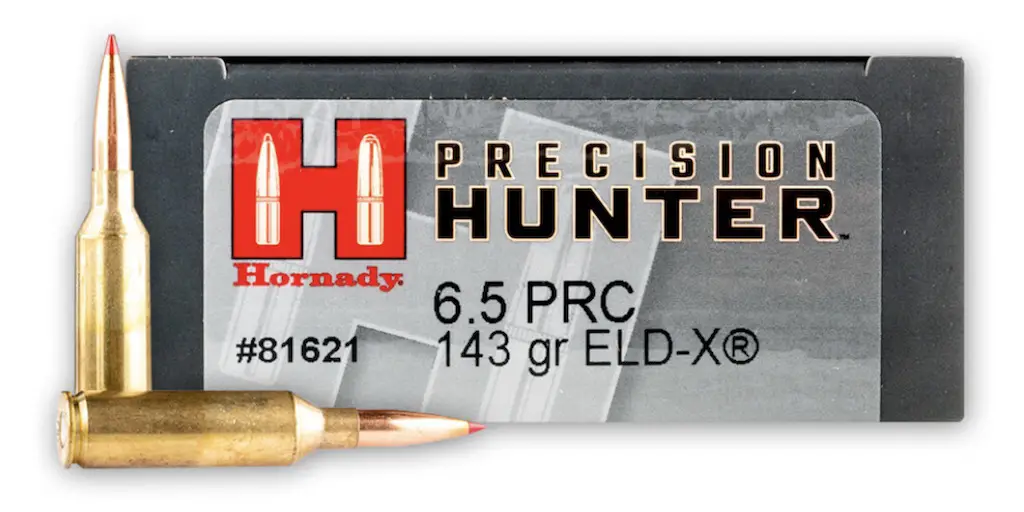
Hornady Precision Hunter
The 6.5 PRC absolutely excels at long distance where the almost laser flat trajectory and wind bucking characteristics of the cartridge become extremely important. It should come as no surprise then that Hornady includes the 6.5 PRC in their Precision Hunter line of factory ammo. As a matter of fact, this was the very first factory hunting ammo option for the cartridge and it’s still a good choice today.
Loaded with the extremely aerodynamic Extremely Low Drag eXpanding (ELD-X) bullet, this ammo line is designed for western hunters going after game like mule deer or pronghorn antelope who need the very best ammo for a long range hunting situation. Using a 143 grain ELD-X bullet, that load is a very good 6.5 PRC ammo option for hunters wanting to maximize the extended range performance of the cartridge.
Hornady advertises that the ELD-X bullet has the best-in-class ballistic coefficients over their entire trajectory and that their Precision Hunter ammunition also offers match grade accuracy (usually sub-MOA).
Though the ELD-X does not have a bonded core like the Hornady InterBond, the ELD-X does feature a thicker jacket and the Hornady InterLock ring to help increase weight retention, control expansion, and minimize the chances of core-jacket separation. For this reason, the ELD-X is still devastating on deer and pronghorn sized game, but it’s also a much better choice than their SST bullet for use on larger game.
That said, the ELD-X is still a little too fragile for my tastes. Many hunters use this exact ammunition on elk each year with a lot of success. Personally, I prefer a tougher bullet for elk sized game (like the Barnes LRX, Nosler AccuBond Long Range, Hornady CX, or Federal Terminal Ascent also on this list). I think the ELD-X is perfect for deer sized game though.
All things considered, this 6.5 PRC ammunition is capable of delivering great terminal performance on many species of big game for shots at 400+ yards without dealing with the price or recoil of the big magnum cartridges.
Bullet Type: Hornady Extremely Low Drag eXpanding
Bullet Weight: 143 grains
Ballistic Coefficient (G1): .625
Muzzle Velocity: 2,960 feet per second (2,782 ft-lbs of muzzle energy)
GET PRECISION HUNTER 6.5 PRC AMMO HERE
Also Available at: Cabela’s, Lucky Gunner, Natchez Shooters Supplies, Palmetto State Armory, and Sportsman’s Warehouse
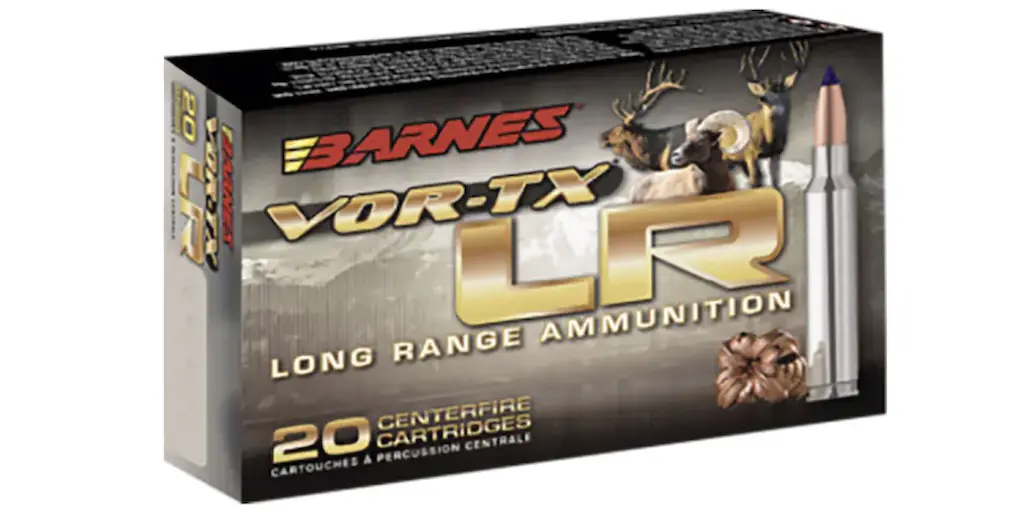
Barnes VOR-TX Long Range
Barnes recently added a 6.5 PRC ammo option to their VOR-TX Long Range line. Featuring their legendary copper Long Range Expanding (LRX) bullets, Barnes ammunition is designed for rapid expansion, high weight retention, and deep penetration.
Available using 127gr 6.5mm bullets, Barnes now offers another outstanding choice for hunters looking for a tough 6.5 PRC ammo option suitable for bigger game like elk hunting. This particular loading uses a 127gr LRX bullet. Designed for use at extended range, these bullets have a higher ballistic coefficient and are built to expand well at lower velocities when compared to the regular Barnes TTSX bullets.
Fortunately, even the LRX bullet is still very tough and will deliver great weight retention and deep penetration. You can also depend on it to perform well at close range. Not every hunter will need the extended range performance of the LRX, but it’s an excellent offering for those who want it.
This load is also 100% copper, which makes it an ideal choice of 6.5 PRC hunting ammunition for use in states like California that that don’t permit the use of lead bullets.
I’m a big fan of the Barnes VOR-TX line and the LRX bullets in general. I’ve used this ammunition with a lot of success on both deer and pronghorn over the past few years. This ammo is also a favorite among many North America, New Zealand, and Africa hunting outfitters.
Bullet Type: Long Range Expanding (LRX)
Bullet Weight: 127 grains
Ballistic Coefficient (G1): .468
Muzzle Velocity: 3,010 feet per second (2,554 ft-lbs of muzzle energy)
GET BARNES 6.5 PRC AMMO HERE
Also Available at: Cabela’s, Lucky Gunner, Optics Planet, Palmetto State Armory, & Sportsman’s Warehouse
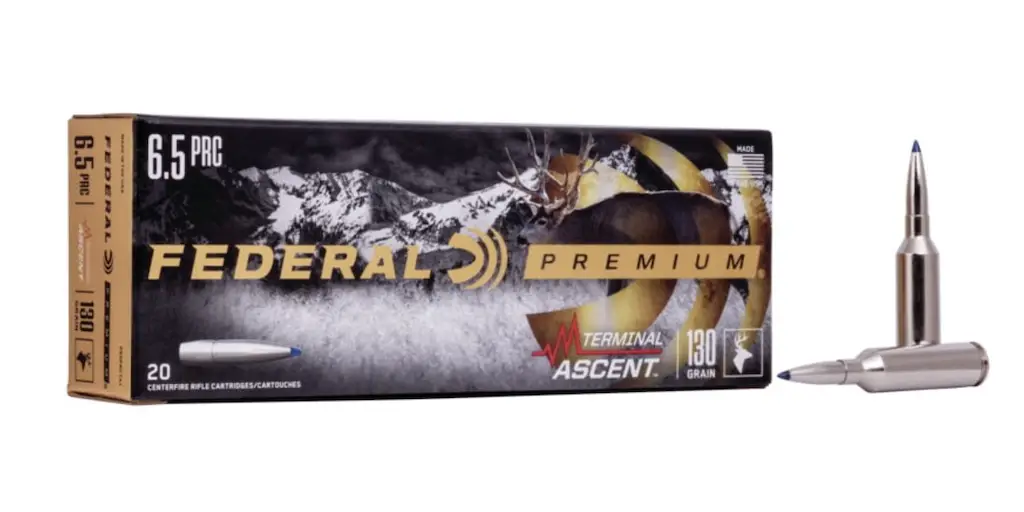
Federal Premium Terminal Ascent
Federal’s Terminal Ascent line is another good option of 6.5 PRC hunting ammo for hunters looking for really good extended range performance. This ammunition uses the new Terminal Ascent Bullet, which is also extremely aerodynamic and accurate. It’s not quite as aerodynamic as the Hornady ELD-X, but it still has a relatively high BC and is also much more robustly constructed.
With those things in mind, I personally tend to lean more towards the Terminal Ascent over the ELD-X for hunting bigger game like elk with the 6.5 PRC. This ammo is another great option for hunters going after game out west like mule deer or pronghorn who need excellent 6.5 PRC ammo for a long range hunting situation.
If this ammunition shoots accurately in your rifle, this is another good option (with the 127gr Barnes LRX and 130gr Hornady CX, and 142gr Nosler AccuBond Long Range) for hunters who need good 6.5 PRC ammo for elk hunting. While the Barnes LRX is a slightly tougher bullet, the Terminal Ascent has a little bit higher BC though. Both are excellent options though and will work great on an upcoming elk hunt if they function reliably and shoot accurately in your rifle.
Bullet Type: Terminal Ascent
Bullet Weight: 130 grains
Ballistic Coefficient (G1): .532
Muzzle Velocity: 3,000 feet per second (2,598 ft-lbs of muzzle energy)
GET TERMINAL ASCENT 6.5 PRC AMMO HERE
Also Available at: Brownell’s, Cabela’s, Natchez Shooters Supplies, Optics Planet, & Sportsman’s Warehouse
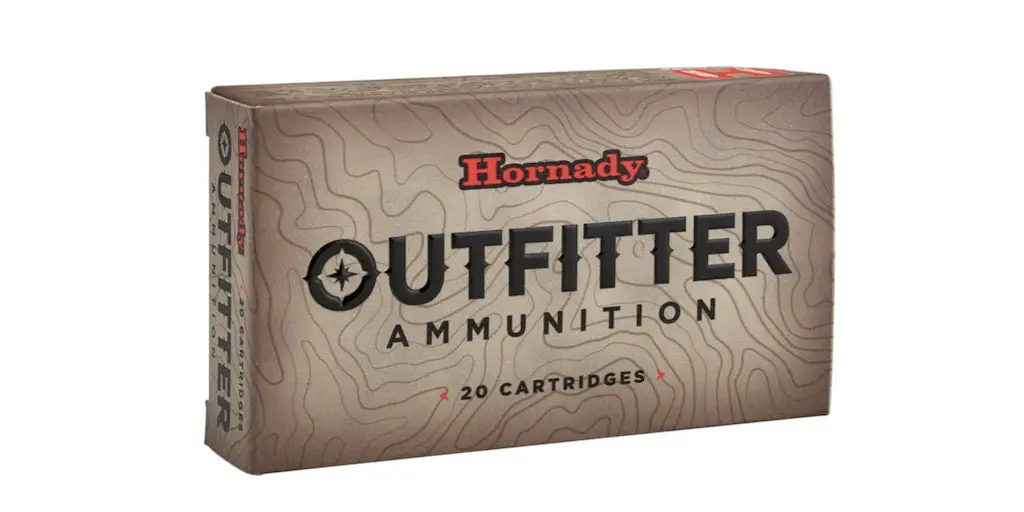
Hornady Outfitter
Hornady introduced their new Outfitter line of ammunition a few years ago and just added the 6.5 PRC cartridge to that lineup. Though it will also work quite well on a whitetail deer hunt in the back 40, the company markets this 6.5 PRC ammo specifically for use on guided hunts in really tough environments like a caribou or moose hunt in Alaska or a kudu hunt in South Africa.
This ammunition is loaded with an extremely tough 130 grain CX bullet that’s designed for controlled expansion, high weight retention, and deep penetration on large, heavy boned animals like elk and moose. This is high-quality ammunition that also uses nickel-plated case for reliable feeding and corrosion resistance under the most demanding conditions. The primers and case necks are also sealed.
With all those things in mind, it’s easy to see why Hornady advertises their Outfitter 6.5 PRC ammo for use on a big hunt that’s the culmination of years of saving and planning. After all, when the chips are down on the hunt of a lifetime, the absolute last thing you need is for your ammo to fail at the moment of truth.
Look really hard at the 127gr Barnes LRX, the 130gr Terminal Ascent, the 142gr Nosler AccuBond Long Range, or the 130gr CX for the best 6.5 PRC ammo for elk. All will offer similar terminal performance and similar ballistics. Choose the one you’re able to obtain that shoots best in your rifle.
The CX bullet used in Hornady Outfitter ammunition is lead free, which makes this ammo another good choice for use in states like California. Note: the CX bullet replaced the older GMX bullet from Hornady and is a tiny bit more aerodynamic, but retains the great terminal performance of the GMX.
Bullet Type: CX
Bullet Weight: 130 grains
Ballistic Coefficient (G1): .489
Muzzle Velocity: 2,975 feet per second (2,555 ft-lbs of muzzle energy)
GET HORNADY OUTFITTER 6.5 PRC AMMO HERE
Also Available at: Brownell’s, Cabela’s, MidwayUSA, and Sportsman’s Warehouse
Nosler Trophy Grade Long Range
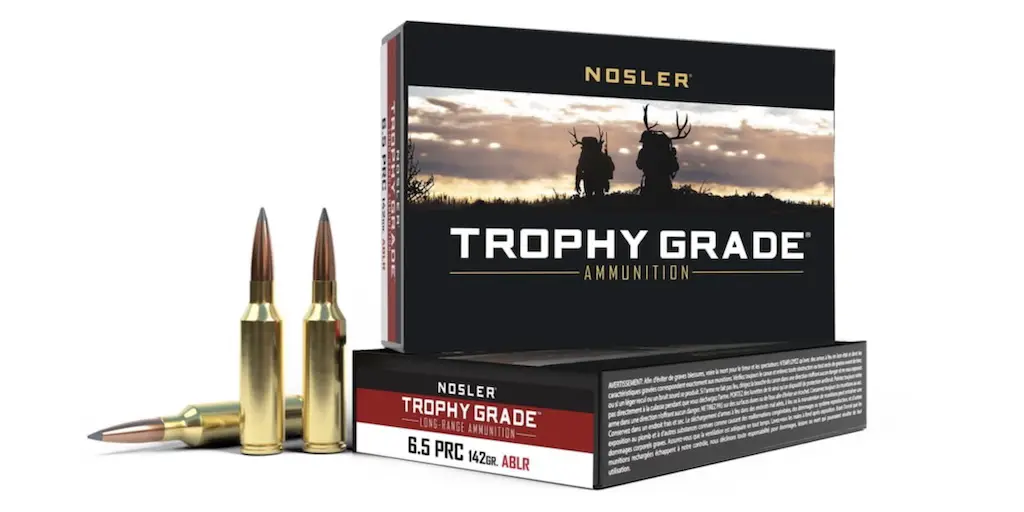
Nosler produces 6.5 PRC ammo as part of their Trophy Grade Long Range line loaded with their AccuBond Long Range Bullets. The 142 grain AccuBond Long Range bullets used in this loading have a bonded core and have both the highest BC and use the heaviest bullets available in a factory load for the cartridge.
That heavy for caliber, extremely aerodynamic bullet maximizes the strengths of the high velocity 6.5 PRC cartridge and delivers heavy hitting, flat shooting, and wind bucking performance out to extended range. This bullet also works great with the 1:8″ twist barrels that are common with 6.5 PRC rifles.
Indeed, this 6.5 PRC loading is capable of shooting a much tougher bullet with the same BC as the 143gr ELD-X used in Hornady’s Precision Hunter line. For this reason, the two loads will have virtually the same trajectory, but the tougher 142gr ABLR will work better on bigger game than the 143gr ELD-X.
With all that in mind, this is the best choice of a factory load for a hunter looking to maximize the all-around performance of the 6.5 PRC. That bullet is soft enough to deliver devastating terminal performance on game like deer and pronghorn, but is also tough enough to reach the vitals on bigger and tougher game like elk and moose from typical shooting angles.
By the same token, this bullet has a very high ballistic coefficient and, thanks in part to the combination of using Nosler brass with Nosler bullets, is also capable of outstanding accuracy.
All of those factors combine to facilitate use on big game at extended range.
All things considered, I think this is the best 6.5 PRC ammo for use on all manner of game and under the widest possible variety of hunting situations.
Bullet Type: Nosler AccuBond Long Range
Bullet Weight: 142 grains
Ballistic Coefficient (G1): .625
Muzzle Velocity: 2,900 feet per second (2,651 ft-lbs of muzzle energy)
GET NOSLER TROPHY GRADE LONG RANGE 6.5 PRC AMMO HERE
Also Available at: Cabela’s, Natchez Shooter Supplies, and Sportsman’s Warehouse
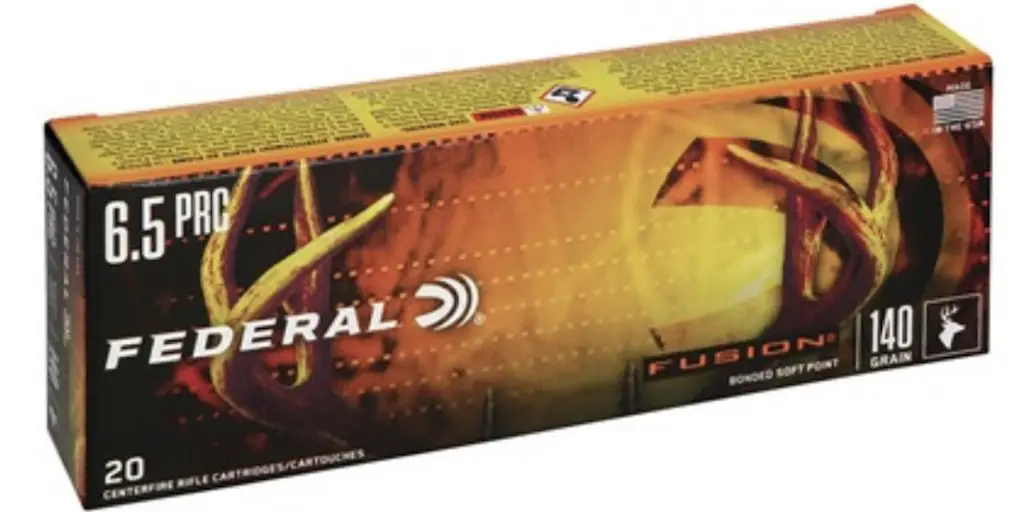
Federal Fusion
It’s not new, fancy, or sexy, but Federal Fusion ammunition with a 140gr bullet is outstanding 6.5 PRC ammo for deer hunting. In addition to being very effective, this ammunition is also somewhat reasonably priced and has been one of the easier to find 6.5 PRC ammo options during the past few years.
Fusion bullets have a bonded lead core to help with weight retention. Combined with a skived tip to help initiate expansion, Federal Fusion 6.5 PRC ammo delivers a really good balance of controlled expansion, high weight retention, and deep penetration. While it’s not the latest and greatest stuff, Federal Fusion ammunition also has a really good reputation for accuracy.
This is ideal ammo for feral hog and deer hunting. You could also include game like pronghorn and even black bear in there as well.
It will definitely work on bigger game if you don’t have anything better, but I do not recommend using Federal Fusion 6.5 PRC caliber ammo for hunting game like elk or moose unless that’s all you have. Instead, I think other loads I recommend later in this article are a better choice like the Barnes LRX, Hornady CX, Nosler AccuBond, or Federal Terminal Ascent.
All things considered, this is outstanding on deer sized game and you can’t go wrong with Federal Fusion 6.5 PRC ammo for deer hunting.
Bullet Type: Fusion Soft Point
Bullet Weight: 140 grains
Ballistic Coefficient (G1): .439
Muzzle Velocity: 2,925 feet per second (2,659 foot-pounds of energy)
GET FEDERAL FUSION 6.5 PRC AMMO HERE
Also Available at: Cabela’s and Natchez Shooter Supplies
Nosler Trophy Grade
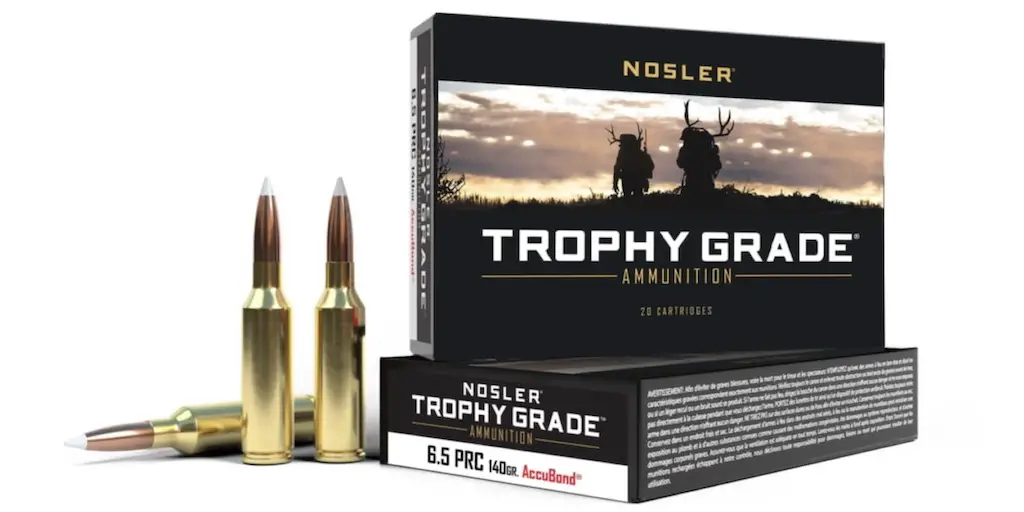
Nosler manufacturers a loading that uses a 140 grain AccuBond bullet as part of their Trophy Grade line. This is perfect for those in need of some quality and extremely versatile 6.5 PRC ammo for deer, bear, or elk hunting.
Just like the name says, the AccuBond is a bonded bullet where the lead core is chemically bonded to the jacket, so you don’t have to worry about the bullet “grenading” or expanding too rapidly upon impact. It’s not quite as tough as the Nosler Partition, but the AccuBond is still a very robustly constructed bullet and these features make the AccuBond a much better choice for an elk hunt than typical cup and core bullets.
AccuBond bullets are also pretty darn aerodynamic (much more aerodynamic than Partition bullets of the same caliber and weight) and will reliably expand at lower impact velocities. All things considered, this ammunition is tough enough for close range shots on big game while at the same time providing very good extended range performance.
Some of the more specialized 6.5 PRC loads (which I’ll also cover in this article) offer better performance in specific circumstances. However, this 140 gr AccuBond load is an excellent all around choice for hunters who want a flexible, yet still extremely capable 6.5 PRC hunting load regardless of whether you’re hunting deer in Idaho or elk in Colorado. Place one of these bullets in the right place and you’ll be happy with the results.
Bullet Type: Nosler AccuBond
Bullet Weight: 140 grains
Ballistic Coefficient (G1): .509
Muzzle Velocity: 2,900 feet per second (2,614 ft-lbs of muzzle energy)
GET TROPHY GRADE 6.5 PRC AMMO HERE
Also Available at: Cabela’s, Natchez Shooter Supplies, and Sportsman’s Warehouse.
Winchester Expedition Big Game Long Range
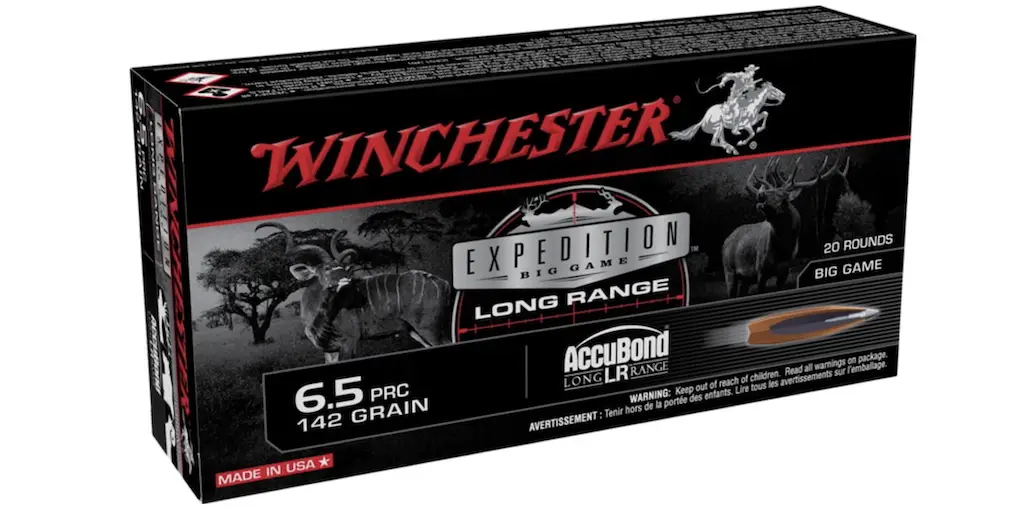
Winchester’s Expedition Big Game Long Range factory load is a collaboration between Winchester Ammunition and Nosler Inc. that’s loaded with a 142 grain Nosler AccuBond Long Range (ABLR) bullet. This ammunition offers great long range performance, but also uses a bullet that’s tough enough use with a short range shot on a big animal (like an elk).
The AccuBond Long Range is a great bullet that’s very aerodynamic and will still reliably expand at lower impact velocities. Nosler advertises that this bullet will still reliably open at velocities as low as 1,300fps (compared to 1,800fps for many other bullets). At the same time, this is a bonded bullet that’s designed to offer a mix of deep penetration, high weight retention, and controlled expansion.
With over 2,800 ft-lbs of muzzle energy shooting very tough, low-drag bullets, this load will also work great at almost any reasonable range from point blank out to several hundred yards on all manner of game ranging from thin-skinned animals like whitetail and mule deer or pronghorn all the way up to bigger and tougher game like black bear, elk, and even moose.
For those reasons, this Winchester ammo with a 142-grain Nosler AccuBond Long Range is also great 6.5 PRC ammo for elk, bear, pronghorn, and deer hunting.
Bullet Type: Nosler AccuBond Long Range
Bullet Weight: 142 grains
Ballistic Coefficient: .625
Muzzle Velocity: 3,020 feet per second (2,875 ft-lbs of muzzle energy)
GET WINCHESTER EXPEDITION BIG GAME 6.5 PRC AMMO HERE
Also Available at: Brownells, Cabela’s, and Natchez Shooters Supplies
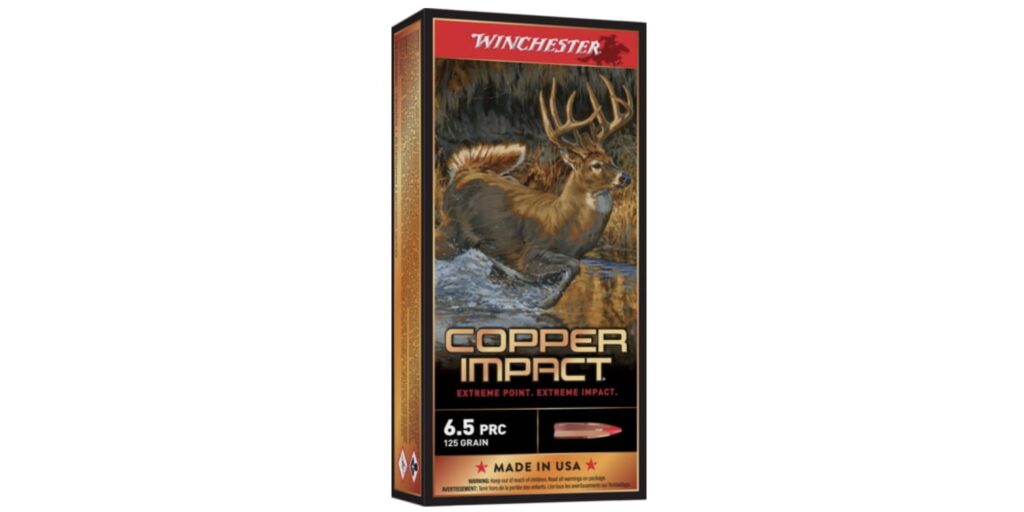
Winchester Copper Impact
Winchester originally developed their Copper Impact line of ammunition in parallel with their Deer Season XP line to provide some lead free ammo options for deer hunters. Those two ammo lines were well received by the hunting community. This eventually led to the expansion of the line to include lead free 6.5 PRC ammo as well.
Just like the other loadings in that line, Winchester Copper Impact 6.5 PRC ammunition uses a solid copper bullet design with a large diameter polymer tip that’s specifically designed to produce a gigantic wound channel along with massive impact trauma.
Additionally, this bullet will retain weight and penetrate extremely well since it is a monolithic design.
The end result is a bullet that expands rapidly, transfers a lot of energy to the animal for devastating terminal performance, and will still penetrate through thick hide, heavy muscles, and solid bone to reach the vitals of very large game from most reasonable shot angles.
The 6.5 PRC loading also has decent G1 BC of .428, which is pretty good for a lead free bullet. Using moderate powder charges, it does not quite have ballistics on par with some of the other 6.5 PRC ammo options on this list, but it still performs extremely well and offers excellent performance at short range as well as for longer range shooting.
While this loading will indeed work great on deer-sized game, it’s not limited to just deer either and should work great for bigger and tougher game like feral hogs, black bear, and even potentially elk. For this reason, Winchester re-branded this ammo to drop the “Deer Season” moniker and just go with “Copper Impact” instead.
Finally, this ammo is a great choice for use in states like California and is another California legal 6.5 PRC factory ammo option.
Bullet Type: Winchester Copper Extreme Point
Bullet Weight: 125 grains
Ballistic Coefficient (G1): .428
Muzzle Velocity: 2,875 feet per second
GET COPPER IMPACT 6.5 PRC AMMO HERE
Also Available at: Brownells
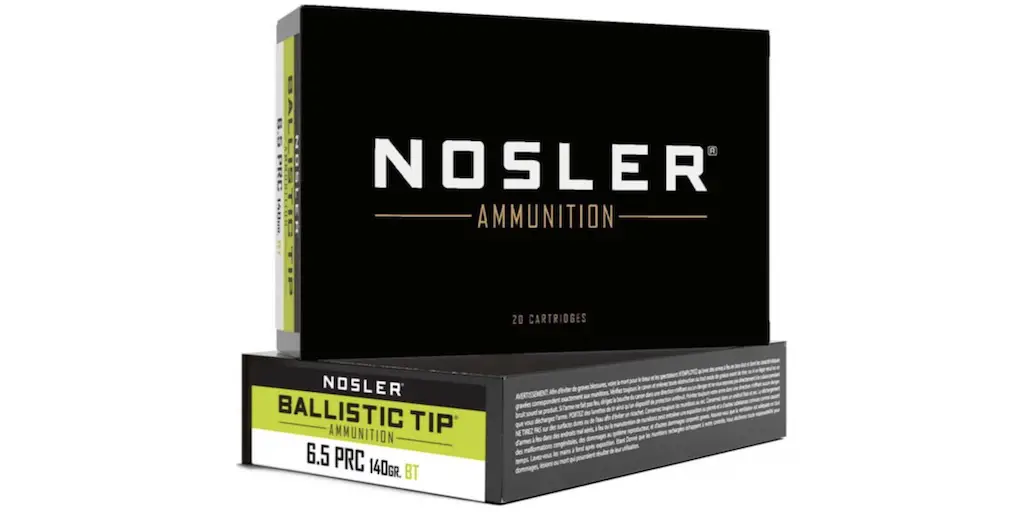
Nosler Ballistic Tip
Nosler also offers a 6.5 PRC loading using a 140 grain Ballistic Tip bullet. This bullet is also an outstanding choice for hunting thin-skinned game like deer and pronghorn.
Ballistic Tip bullets are designed to deliver devastating terminal effects to game upon impact. Nothing is guaranteed, but these bullets often deliver instant, knock down results on deer sized game.
All things considered, Nosler Ballistic Tip 6.5 PRC ammo is an ideal choice for use on deer sized game like feral hogs, pronghorn, mule deer, and whitetail deer at close range as well as extended range. They also tend to shoot very accurately in most 6.5 PRC rifles.
As the saying goes, there’s no such thing as a free lunch.
Those bullets expand rapidly and deliver incredible shock upon impact, but they don’t penetrate very well. This isn’t usually an issue with deer-sized game, but I do NOT recommend using Nosler Ballistic Tip ammo for bigger game like elk or moose.
Instead, stick to game like whitetail deer, mule deer, and pronghorn with the 140 grain Ballistic Tip. You’ll probably be very happy with the results if you do that.
Bullet Type: Nosler Ballistic Tip
Bullet Weight: 140 grains
Ballistic Coefficient (G1): .509
Muzzle Velocity: 2,900 feet per second (2,614 foot-pounds of energy)
GET BALLISTIC TIP 6.5 PRC AMMO HERE
Also Available at: Cabela’s and Sportsman’s Warehouse
Enjoy this article about the best 6.5 PRC ammo for hunting? Please share it with your friends on Facebook and Twitter. Good luck!
Make sure you follow The Big Game Hunting Blog on Facebook, Instagram, Twitter, and YouTube.
NEXT: BEST 6.5 GRENDEL AMMO FOR HUNTING ELK, DEER, & OTHER BIG GAME
NEXT: 101 BEST GIFTS FOR HUNTERS
NEXT: BEST 300 WINCHESTER MAGNUM AMMO FOR HUNTING ELK, DEER, MOOSE AND OTHER BIG GAME
NEXT: BEST 7 mm REM MAG AMMO FOR HUNTING ELK, DEER, MOOSE AND OTHER BIG GAME
Surviving isn’t camping. When you are camping, you are generally having fun even when you are working hard, you’ve probably prepared with ready-made meal options, or even a proper menu for the journey, and you can always tuck tail and go home when things get too bad.
But when you are surviving, pretty much everything else is going to be dictated for you. When and where you can sleep, what you’ll be doing, and of course what you’ll be eating.
In any short or long-term survival situation that lasts a while, what food you do have access to is going to run out and then you have to start sourcing your own food from the wild.
This means you’re going to be eating various animals that you wouldn’t normally consider eating.
How about buffalo fish? Can you eat buffalo fish in a survival situation?
Yes, you can safely eat buffalo fish. They are delicious, nutritious, and usually quite sizable making them a great catch in any survival situation assuming you can get them.
Compared to other, typical freshwater fish found in North America, buffalo fish don’t have the best reputation as game fish, but they have an excellent reputation as table fish (assuming you can get your hands on them).
Easier said than done, though, because they can be very tricky to catch with a rod and reel.
You need to get creative and improvise if you want to bag these big fish in the middle of a survival situation. Keep reading and we will tell you everything you need to know.
Where Can Buffalo Fish Be Found?
Buffalo fish, proper name Ictiobus, are a genus of fish comprising five species native to North America from Mexico all the way up through the United States and into Canada, and also found in Guatemala.
The distribution of the species varies, with big-mouth buffalo being found throughout the Red River in the United States and Canada, and throughout the entirety of the Mississippi River system all the way down to Texas in the Southwest and throughout Alabama.
The smallmouth Buffalo is found throughout the Mississippi River System in the United States and all the way up into Idaho.
Clear, moving freshwater is their typical habitat, and they are tolerant of both fast-moving bodies of water and water with high mineral content.
These fish typically depend on dense vegetation for shelter and to find food, filtering food from the water itself or else sucking up algae off of rocks along with a few inclusions of choice insects and crustaceans.
Generally speaking, you have a good chance of finding these fish if you know where to look and how to find them so long as you are in their habitat.
Buffalo Fish Nutrition Info
Fish are usually pretty healthy eating, and buffalo fish are especially so.
High in protein, very low in saturated fats, and packed with high-quality micronutrients including omega-3 fatty acids, these fish also tend to be sizable and very densely muscled, making them a great meal.
The most notable nutrients found in buffalo fish aside from their high protein content are vitamins B12, D, A, and folic acid along with plenty of selenium.
However, caution should be taken when eating wild-caught buffalo fish because they have a tendency to absorb mercury into their body which will then be consumed by you if you eat them.
Yes, this is a potential problem when eating all wild-caught fish but buffalo fish are more prone than most species to absorb this toxic heavy metal.
Also, because the type of food buffalo fish eats is not really used (or even usable) as bait on a lure when fishing, buffalo fish are most often taken with a bow and arrow.
Do Buffalo Fish Taste Good?
Yes! Buffalo fish, though not commonly advertised or sought for human consumption, nonetheless make for a terrific meal whether or not you are in the middle of a survival situation or just looking for a great fish dinner on a weeknight.
These fish are juicy, firm yet soft, and remarkably clean tasting, lacking the typical fishy oiliness that is present in most species.
The fish also lend themselves remarkably well to many different kinds of preparation, and they can be grilled, steamed, fried, baked, or used directly in a soup or stew with equal ease.
No matter how you are going to cook it and no matter what ingredients you have on hand, you will have a nourishing and wholesome meal from a buffalo fish.
Is it Safe to Eat Buffalo Fish Raw?
No. Eating raw fish, though normalized thanks to the widespread acceptance of sushi, is a bad, bad idea, especially in the case of wild-caught freshwater fish like the buffalo fish here.
The simple fact of the matter is that eating any raw animal protein, including fish, dramatically increases your chances of contracting food poisoning from one of several germs, or else becoming infested with harmful and potentially deadly parasites.
Buffalo fish can play host to all of them, bacteria and viruses to parasites like various species of worms and flukes.
Consider that even contracting something as simple and normally innocuous as food poisoning could prove to be fatal under the circumstances.
You aren’t going to be able to dash down to the ER or to the local clinic for assistance with squashing the bug and getting something for your symptoms…
You’ll be facing crushing nausea, cramping, vicious diarrhea and possibly vomiting in the bargain. That’s just going to dehydrate you and further sap your energy reserves.
That could be enough to finish you off if you are already in a bad way, and it’s going to make taking care of all the other things you need to do to survive difficult or impossible.
To avoid this, always make sure you thoroughly cook the meat from a buffalo fish until it is well done.
An internal temperature of 165° F is sufficient to kill virtually all known pathogens that it could harbor.
Are Buffalo Fish Scales Safe to Eat?
Yes, if they are cooked, but they should generally be discarded.
The scales of the buffalo fish are large and tough, and even when thoroughly cooked they make for pretty difficult eating and offer very little in the way of nutrition.
Feel free to scale the fish when you are cleaning it to prepare it for cooking: you won’t be wasting any calories.
Are Buffalo Fish Eggs Safe to Eat?
Yes, and the eggs of the buffalo fish are fairly sizable compared to most other caviar meaning they can be a great supplemental source of food if you can track them down or are lucky enough to catch a fish that is carrying eggs.
As always, make sure you thoroughly but gently cook the eggs prior to eating if you want to avoid the risks of foodborne illness.
Can You Safely Eat Buffalo Fish Bones?
No. Buffalo fish bones are generally stout and of a pretty good size, making them a significant hazard to try and eat as they are.
People are not supposed to eat fish bones, anyway, unlike some other carnivorous animals, as they pose a significant risk of choking or else they can cause internal injuries including becoming stuck in our intestines.
That’s the last thing you need to deal with under the circumstances!
However, bones can still offer you valuable nutrition in a survival scenario, including the bones from the buffalo fish.
This nutrition comes from the marrow, which can be extracted from the bones easily by simmering or boiling them in water to make a nutritious stock or broth, or else cracking or splitting the bones open before scraping out the marrow and cooking it.
Bone marrow has long been a coveted resource by those who are in a survival situation thanks to its overall nutritional density, so don’t discard the bones unless you have been blessed with an abundance of fish!
Can You Eat Buffalo Fish Organs?
Fish organs are rarely thought of as edible in any situation, but it turns out that you can in fact eat them so long as you take the time to properly prepare and cook them.
They can make for especially nutritious food when taking from a larger fish like buffalo fish.
The heart and the liver are generally the tastiest, and also packed with nutrients, while being easy to prepare.
The intestines of the fish are also edible, but you must use exacting care to expel the waste material from them before giving them a very thorough rinse and then cooking them.
The doe bleat call (or doe grunt) can be a very effective tool in a hunter’s arsenal. Using a doe call during the pre-rut/ rut period can bring in dominant bucks that may ignore a buck grunt. After all, they are looking for does to breed, the fights are secondary. These types of calls can also be especially effective during the later or repeat rut periods when does who “missed” come back into estrus. Just remember, having a buck hear your bleat is one thing; it is another to successfully get him into range for a bow or crossbow.
Doe vocalizations during hunting should be used sparingly. Perhaps make a few doe bleats/ grunts every 30 minutes. Don’t overdue it. When was the last time you heard does making all kinds of noise in the woods? Too much calling is an unnatural presentation. To perfect your calling, look online for videos of both people demonstrating and of the deer vocalizing themselves. You will be a pro in no time.
Once you have the calling down, are you good to go? Not really because you can do better. Generally speaking, when bucks hear another deer vocalize, they don’t come straight in. Instead they tend to circle down wind and investigate the scene with their noses. That is where a good synthetic scent comes in. If you want that smart old buck to believe the doe is there, let him smell her when he is checking it out. A great scent for this early in the season would be Lucky 7 Nanny Doe, one of our Confidence Scents. Now the buck will not only believe he heard a doe make a bleat or grunt, we will smell an older doe, a breeding age doe. He will relax, believe it is real and hopefully pass right by your stand on his way in. If it is the rut, a scent Like Lucky 7 Synthescent Doe In Heat PLUS can be extremely effective. If the rut is in full swing, one of our doe estrus/ buck scent combinations can really rile those big boys up.
Often time, hunters use decoys while calling. Why not add an enticing sight picture with a doe decoy? If you do, removing the odor from it is important and then you’d want to make it smell right. Lucky 7 Decoy Dope is just the scent to accomplish that. If your decoy smells like “nothing”, bucks get very suspicious. If they see her, they want to smell her.
If you haven’t used doe vocalizations before, perhaps it is time to pick up this terrific tactic. It can be very enjoyable to “talk” to the animals you hunt and adds a satisfying new dimension to deer hunting. Nelson Creek Outdoors also carries a couple effective yet affordable deer calls. It is convenient to pick one up at the same time as you order your scents for the year. One of my fondest memories is using one of our grunt calls to bring in a 170 class 10 point buck and then watch as a larger bodied 8 point charged in and kicked his tail. I didn’t get either deer as it happened fast and just out of bow range, but it is still among my most exciting deer hunt memories.
When it comes to shooting sports and hunting, having a reliable and accurate scope is essential. However, there are different types of scopes available...